
On this page
Start here
Quick answer
A shallow dent in one garage-door section may be cosmetic, but a crack, crease, buckle, separation, sharp edge, or damage near hinges, tracks, cables, or the bottom section can affect the door's weight and movement. Photograph the closed door, inspect only from a safe position, and identify the exact door model and damaged section. Keep the door out of service and call a trained garage-door technician if it binds, is off track, has damaged hardware, or cannot be safely identified; do not remove a panel or work on springs and cables yourself.
Before you begin
Safety first
- Limit homeowner checks to floor-level photographs, accessible visual inspection, and records made with the door stationary. Do not remove panels, adjust springs or cables, straighten tracks, loosen brackets, climb, force a jammed door, or walk under a partially open door.
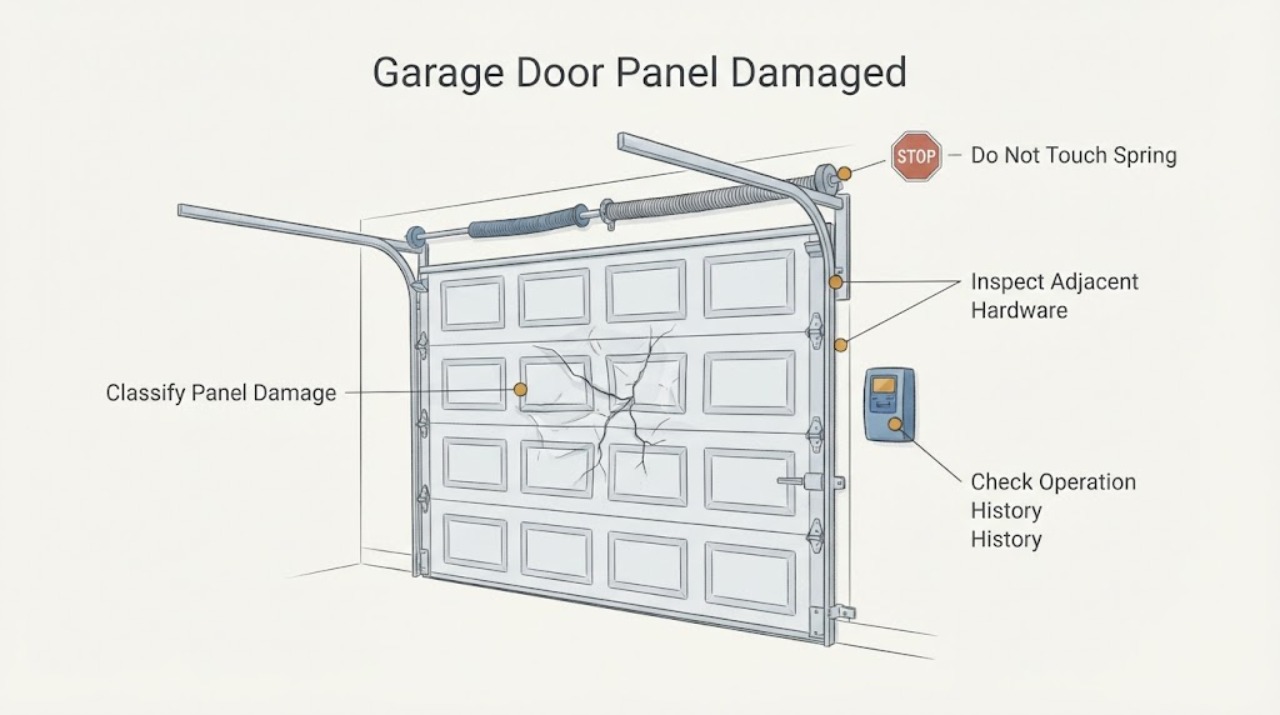
Work through in order
Diagnostic checks
Use only checks that match the exact appliance or system and its official guide.
-
Check 1
With the garage door closed and from a stable floor-level position, photograph the entire door and the affected section. Record whether the damage is a shallow dent, a sharp crease, a crack or split, a puncture, corrosion, a bowed edge, or a section that is separating from its neighbor.
Expected result: The damage is limited to the flat face of one section, or it crosses a seam, edge, hinge area, window opening, or the full width of the section.
Next step: Keep the door closed and continue with the hardware and alignment checks. Do not fill, hammer, pull, or heat the damaged panel before its effect on the door system is known.
Why this matters
Why: A shallow isolated dent is more likely to be a cosmetic repair candidate. A crack, crease, split, bow, or separation can weaken the section or change its geometry and needs a professional repair-versus-replacement assessment.
-
Check 2
Without touching or adjusting the door, inspect the visible hinges, roller brackets, track edges, cables, bottom corners, and weather seal from outside the moving path. Look for bent or missing hardware, a cable that is loose or off its drum, a track that has shifted, a gap between sections, or a bottom section that no longer sits squarely.
Expected result: Adjacent hardware and tracks look aligned and intact, or a hinge, roller, cable, track, corner bracket, or seal is visibly displaced or damaged.
Next step: If any hardware or track is displaced, leave the door closed and arrange a trained technician. Do not straighten tracks, tighten brackets, reconnect cables, or adjust spring hardware as a homeowner check.
Why this matters
Why: Intact surrounding hardware supports a limited panel assessment but does not prove the door is safe. Displaced or damaged hardware means the impact or crack may have affected the counterbalance, alignment, or load path.
-
Check 3
From the closed-door position, record whether the door was last able to open and close evenly, whether it jammed or stopped, and whether the opener made a new noise or the door rubbed the tracks. Do not cycle the door merely to reproduce the symptom when a panel, track, cable, or spring appears damaged.
Expected result: The door was operating normally before the isolated damage, or it now binds, hangs unevenly, stops, makes a new noise, or cannot remain safely closed.
Next step: Keep people and vehicles away from the opening and call a trained door-system technician for any operational change. Do not walk under a stopped or partially open door.
Why this matters
Why: A normal prior cycle does not clear hidden damage, but binding, uneven travel, new noise, or loss of closure indicates that the damage affects operation and should not be treated as cosmetic.
-
Check 4
Read the accessible manufacturer label or serial information without climbing or removing covers, and record the door width, section position, visible material and finish, window layout, and any prior repair. Take straight-on and inside-facing photos only from safe positions.
Expected result: The manufacturer, model, section position, and dimensions are identifiable, or the panel identity is uncertain or the door has been modified.
Next step: Give the photos and identification details to the manufacturer, authorized dealer, or trained technician and ask whether one panel, related hardware, or the full door is the appropriate scope.
Why this matters
Why: A replacement section must match the installed door system and neighboring sections; an appearance-only match can leave the door misaligned or incompatible. An unknown or discontinued identity makes a professional measurement and full-door comparison more important.
Use your observations
Decision map
Find the observation that best matches what you see, then follow the next safe action.
-
PATH 01Next step
What you see
One section has a shallow face dent, no crack or sharp edge is visible, neighboring sections and hardware remain aligned, and there has been no change in safe operation.
Do this next
Request a professional assessment for cosmetic repair or a single-section replacement instead of assuming that the whole door must be replaced.
Why this path and its safety boundary
Why it matters: The evidence is consistent with localized panel damage, but the heavy moving assembly still needs a compatibility and safety check before repair.
-
PATH 02Next step
What you see
The panel is cracked, split, deeply creased, bowed, separating at a seam, or rubbing an adjacent part of the opening.
Do this next
Take the door out of normal use and arrange a trained garage-door inspection.
Why this path and its safety boundary
Why it matters: A deformed or cracked section can change the door geometry and place abnormal load on hinges, rollers, tracks, or the opener even if the damage appears localized.
-
PATH 03Next step
What you see
A cable, spring-related part, bottom corner bracket, track, hinge, roller bracket, or other support is displaced or damaged, or the door is stuck or uneven.
Do this next
Stop operating the door and call a trained door-system technician for the complete mechanism.
Why this path and its safety boundary
Why it matters: Counterbalance and moving hardware can hold substantial stored force; a panel repair alone cannot establish that the system is balanced or safely supported.
-
PATH 04Next step
What you see
Several sections are damaged, the frame or tracks are also damaged, the exact replacement section is unavailable, or the door has widespread corrosion or outdated components.
Do this next
Ask for both a compatible section-repair estimate and a complete-door replacement assessment.
Why this path and its safety boundary
Why it matters: One new section may not restore appearance, fit, or system reliability when damage or compatibility concerns extend beyond one panel.
Helpful context
Understand the symptom
A garage door panel is one section of a heavy, counterbalanced moving system. The useful distinction is not simply how unattractive the dent looks: check whether the section is cracked or bent, whether adjacent sections still line up, and whether the damage reaches hinges, rollers, tracks, cables, or the door seal.
A single shallow face dent with intact paint, seams, and hardware may lead to a panel-repair or single-section replacement assessment. A creased or cracked section, a panel that rubs the track, or a door that no longer closes evenly can indicate a system problem. The correct scope may be one section, associated hardware, or the complete door after inspection.
Do not use a damaged door as a test platform. Keep people and vehicles clear of the opening, do not force a stuck door, and never adjust or remove springs, cables, bottom brackets, or other counterbalance hardware.
Only after diagnosis
Potential parts
- replacement garage door section
Consider only after a qualified assessment confirms that the damage is limited to a replaceable section and the rest of the door system is suitable to retain.
Confirm the exact manufacturer, model, section position, dimensions, material, insulation, finish, window pattern, and hardware requirements before ordering. - garage door hinge or roller hardware
Consider only when inspection confirms that impact or panel deformation separately damaged the hinge or roller hardware; hardware does not make a cracked panel safe by itself.
Match the installed door system and manufacturer instructions; do not substitute generic hardware or adjust spring-connected parts without trained service.
When checks do not resolve it
Need a professional?
Call a trained garage-door technician or the manufacturer or authorized dealer when a panel is cracked, creased, bowed, separating, off track, or affecting safe travel; when a cable, spring, hinge, roller, bracket, or track is damaged; or when the correct replacement section cannot be identified.
Safety scope: Limit homeowner checks to floor-level photographs, accessible visual inspection, and records made with the door stationary. Do not remove panels, adjust springs or cables, straighten tracks, loosen brackets, climb, force a jammed door, or walk under a partially open door.
Have this ready
- Provide full-door and close-up photos, the damage location and type, whether the door was closed, the last known operating behavior, manufacturer or serial information, section position and size, prior repairs, and any visible hardware or track damage.
Common questions
FAQ
Can a dented garage door panel be repaired instead of replaced?
A shallow isolated dent may be a cosmetic repair candidate when the section, seams, hardware, and operation are otherwise sound. A crack, deep crease, bow, separation, or damage near supporting hardware needs a professional panel or full-door assessment.
Can I replace one garage door panel?
Often a single section can be evaluated for replacement, but the exact model, section dimensions, finish, neighboring panels, tracks, hinges, and counterbalance system must be checked. Panel replacement is heavy work with spring-tension hazards and is best handled by a trained technician.
Should I open the garage door to see whether the damaged panel still works?
Do not cycle it merely as a test when the panel, track, cable, spring-related hardware, or alignment appears damaged. A door that binds, hangs unevenly, or is partially open should remain out of service until inspected.
When does a damaged panel mean I need a whole new garage door?
A complete replacement becomes more relevant when several sections, the frame or tracks, or multiple safety-critical components are damaged, when a compatible section is unavailable, or when the remaining door is broadly deteriorated. Get both scopes in writing before deciding.
Read the exact guide
Official sources
- Can I Replace My Garage Door Panels?Clopay Corporation · Residential sectional garage doors with dented, rusted, faded, or damaged panels
- Doors (Garage) 3U.S. Consumer Product Safety Commission · Residential automatic garage-door operators and the doors they control
- Amarr Warranty GuidanceAmarr · Garage-door owners reporting accidental, intentional, or operational damage
- Traditional Steel Collection Homeowner's Garage Door ManualOverhead Door Corporation · Residential sectional steel garage doors and associated counterbalance and track hardware; follow the installed door's own manual where different
Community feedback
Share a repair observation
Share a plain-text repair observation. Accepted observations are published automatically; this page may take a moment to update.