
On this page
Start here
Quick answer
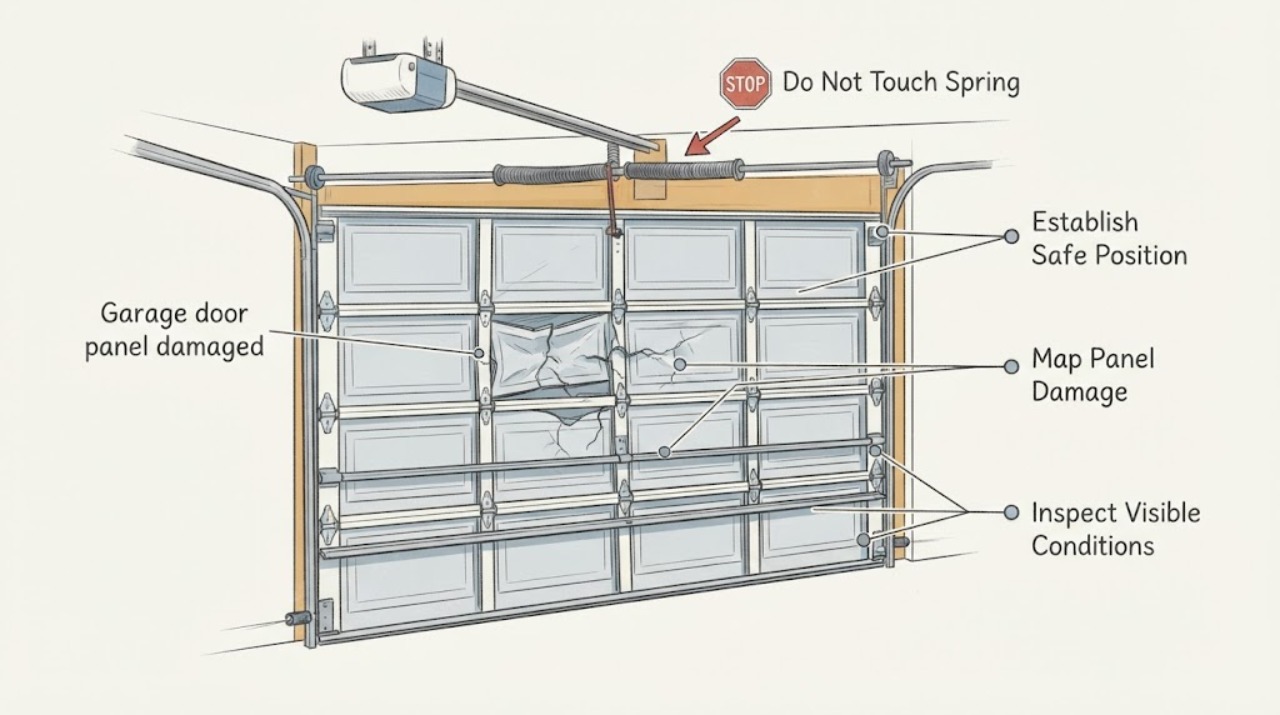
Treat a damaged garage door panel as a safety and system-assessment issue before treating it as a cosmetic repair. Keep the door in its current position if it is binding, sagging, displaced, cracked through, or otherwise visibly unsafe, and keep people, vehicles, and objects away from its path. From a safe distance with the door closed, photograph the whole door and close views of the damage, note whether sections remain aligned, and identify any visible damage to glass, hinges, rollers, cables, brackets, or the opener connection without touching them. Do not lift the door, remove a panel, adjust travel, work on springs, cables, brackets, tracks, hinges, or struts, or test operation when the door appears unsafe. A small surface blemish may have a material-specific care path, but a damaged section, impact that affects closing, separation at a joint, or any uncertainty should be evaluated by a qualified garage-door dealer or technician.
Work through in order
Diagnostic checks
Use only checks that match the exact appliance or system and its official guide.
-
Check 1
From outside the opening or another safe standing position, observe the door without touching it and record whether it is fully closed, partly open, visibly leaning, or stopped in an unusual position.
Expected result: Note whether the sections appear seated and aligned, whether the door is sagging or separated, and whether anything is under or near the door. Do not operate the opener or pull the release to change its position.
Next step: Keep people, vehicles, and loose objects clear, photograph the position, and move to a distance-based damage map only if the door remains stable. If it is visibly unsafe or moving, stop and arrange service.
Stop if: Stop immediately if the door shifts, falls, binds, has a section out of the opening, or would require lifting, lowering, pulling, or operating the opener to inspect it.
Why this matters
Why: A closed and stable door allows a limited visual record. A partly open, leaning, separated, or obstructed door can be unstable, so its position should be preserved for a professional rather than tested.
-
Check 2
Photograph the entire door and then each damaged panel from a safe distance, keeping the door closed and using no tools or pressure on the surface.
Expected result: Classify the visible condition as a shallow dent or paint mark, a crack or puncture, a bent or folded section, an opened joint, broken or displaced glass, rust or rot, or an uncertain pattern. Note whether the edges remain flush and whether the damage crosses a section joint.
Next step: Save wide and close photographs, note approximate location and impact history, and provide them to a qualified dealer or technician. Keep the damaged area unloaded and do not attempt to flatten, glue, fill, or remove the panel.
Stop if: Stop if an edge is sharp, glass is broken, insulation or metal is exposed, the panel is loose, or inspecting the inside would require opening or disassembling the door.
Why this matters
Why: A surface mark may be cosmetic, while a crack through a section, opened joint, broken glass, or bent panel can affect door alignment and the connected hardware. A cross-joint or displaced condition is a service assessment, not a filler decision.
-
Check 3
With the door still closed and from a safe distance, visually compare the damaged area with the rest of the door and note any visible hinge, roller, track, cable, bracket, strut, weather-seal, or opener-attachment damage without touching those parts.
Expected result: Record a straight versus bowed section line, a gap at a joint, a roller that appears out of the track, a loose-looking bracket, a frayed or displaced cable, a damaged strut, a bent track, or a seal gap. If the hardware is hidden or unclear, record it as unknown rather than reaching around the door.
Next step: Take photographs from the same safe position and tell the service provider which system effects were visible or unknown. Do not tighten, straighten, lubricate, disconnect, or adjust any hardware.
Stop if: Stop for any frayed or displaced cable, loose or bent bracket, out-of-track roller, bent track, loose opener connection, or any need to touch high-tension or load-bearing hardware.
Why this matters
Why: Panel impact can be accompanied by alignment or hardware damage. A visible cable, bracket, track, or opener-attachment concern raises the risk and makes a panel-only repair assumption unsafe; an unknown condition still needs professional confirmation.
-
Check 4
Write down what happened and when, including vehicle or object impact, weather exposure, attempted operation, recent installation, or a gradually worsening crack; do not recreate the event or run the door to compare it.
Expected result: Classify the history as a single impact, weather or corrosion exposure, gradual deterioration, post-installation concern, or unknown. Note whether the door was open or closed when damage was noticed and whether the opener, trim, glass, or nearby wall was also affected.
Next step: Provide the timeline and photographs to the original installer, manufacturer dealer, or qualified garage-door technician. Keep the door position unchanged if any binding, displacement, or hardware concern is visible.
Stop if: Stop if the history suggests the door is under load, the opening is obstructed, the opener was forced, or the door was struck while moving. Do not repeat the event or test travel.
Why this matters
Why: The history helps a technician distinguish a localized panel issue from a collision, installation, moisture, or system-load problem. Unknown history is not a reason to test the door; it increases the value of a complete inspection.
-
Check 5
Decide whether the damage is clearly cosmetic and isolated, with the door closed, stable, aligned, and free of visible glass, hardware, or path concerns.
Expected result: Answer yes only when the mark is superficial, no section is bent or displaced, no joint is open, no glass or load-bearing hardware is damaged, and no unsafe movement or access would be required. Answer no for any crack through a panel, impact deformation, separation, broken glass, misalignment, binding, or unknown condition.
Next step: For yes, provide photographs and the door make or model if known for confirmation. For no, leave the door undisturbed, keep the opening clear, and request a dealer or technician evaluation with the recorded observations.
Stop if: Do not operate, lift, remove, adjust, reinforce, or replace anything when the answer is no or any required fact is unknown.
Why this matters
Why: Yes supports asking the manufacturer or dealer about a material-specific surface-care option. No means a qualified garage-door assessment is needed before operation, panel ordering, or any repair; a visually similar panel may not be compatible with the door system.
Use your observations
Decision map
Find the observation that best matches what you see, then follow the next safe action.
-
PATH 01Safety boundary
What you see
The mark is superficial and localized, the door is closed and stable, sections and joints remain aligned, and no glass or hardware damage is visible.
Do this next
Ask the manufacturer or dealer for the approved material-specific cleaning or touch-up guidance and confirm that the finish can be treated without changing the door balance or panel surface.
Why this path and its safety boundary
Safety stop: Stop if the mark is deeper than it first appeared, the finish or material is unknown, or the proposed method involves sanding, cutting, heat, or panel removal.
-
PATH 02Safety boundary
What you see
A panel is bent, cracked through, punctured, separated at a joint, or no longer flush with adjacent sections.
Do this next
Leave the door in its current safe position and contact a qualified garage-door dealer or technician for a panel, alignment, and hardware assessment. Provide wide and close photographs and the impact history.
Why this path and its safety boundary
Safety stop: Do not flatten, glue, fill, drill, remove the panel, operate the opener, or adjust travel, springs, cables, brackets, tracks, hinges, or struts.
-
PATH 03Safety boundary
What you see
Glass is broken or displaced, a cable or bracket appears damaged, a roller is out of track, a strut or opener connection is loose, or hardware cannot be safely assessed.
Do this next
Keep people and vehicles clear, do not touch the damaged hardware or glass, and request prompt professional service. Tell the provider exactly which parts were visible or unknown.
Why this path and its safety boundary
Safety stop: Do not reach between sections, touch cables or brackets, remove glass, release the opener, or attempt to move the door.
-
PATH 04Safety boundary
What you see
The door is binding, leaning, partly open and unstable, obstructed, visibly out of the opening, or changes position without a normal command.
Do this next
Do not operate or manually move it. Keep the area isolated and arrange a qualified garage-door technician to make the system safe and assess the damage.
Why this path and its safety boundary
Safety stop: Stop all inspection that requires approaching the door, lifting it, pulling the release, changing travel, or working near springs, cables, tracks, brackets, or hinges.
Helpful context
Understand the symptom
Secure the situation before inspecting
A sectional door is a connected, heavy moving system. If a panel is bent, a section is out of line, or the door binds, leave the door where it is and keep the opening clear. Observation from a closed, stable position is enough to prepare a service call; it is not necessary to prove the cause by moving the door.
Panel damage can affect more than appearance
A dent or crack may be limited to a skin, or it may change the alignment of sections and the load carried by hinges, rollers, struts, or the opener connection. Manufacturer guidance distinguishes minor cosmetic care from major damage that needs a professional evaluation. A replacement panel also has to match the door system, not just the visible color.
Keep high-tension hardware out of a homeowner repair
Garage-door springs, cables, bottom brackets, and related hardware can carry dangerous loads. Do not remove or adjust them, and do not take the door apart to reach a damaged panel. Give the technician clear photographs and the door position, impact history, and safe observations instead.
Only after diagnosis
Potential parts
- garage door panel hardware
Consider this category only after a qualified inspection confirms the panel system and identifies hardware that must be matched or replaced with the section.
Confirm manufacturer, series, section profile, height, width, insulation, window layout, color, and hinge or strut arrangement; visual similarity alone is not fitment confirmation. - garage door hinge
Consider this category only when a technician identifies a bent or damaged hinge as part of the panel damage and specifies the correct service path.
Hinge position, gauge, section design, fasteners, and load conditions are system-specific; do not order or install from appearance alone. - garage door strut
Consider this category only when a qualified professional confirms that a strut is required for the specific door design and damaged section.
Confirm door weight, section construction, span, existing reinforcement, and the manufacturer's or technician's specification; adding reinforcement can change system loads.
When checks do not resolve it
Need a professional?
Call a qualified garage-door dealer or technician for any cracked-through, bent, punctured, separated, displaced, or impact-damaged panel; broken glass; binding or misalignment; visible cable, bracket, track, hinge, roller, strut, or opener-attachment concern; or any condition that cannot be assessed safely with the door closed.
Have this ready
- Provide the door position, wide and close photographs, manufacturer or model information if known, panel location, impact or weather history, whether sections remain aligned, visible glass or hardware damage, and a clear statement that no lifting, removal, operation, or high-tension adjustment was attempted.
Common questions
FAQ
Can I still use a garage door with a damaged panel?
Do not operate it when the door is binding, leaning, displaced, cracked through, separated, has broken glass, or shows hardware damage. Keep it in its current position and ask a qualified technician to assess the panel and the connected system.
Is a dented garage door panel only cosmetic?
Sometimes a shallow surface mark is cosmetic, but a dent can also change section alignment or affect hinges, rollers, struts, or the opener connection. Photograph the whole door and close damage without pressing on it, then have uncertain or deformed sections evaluated.
Should I order a replacement panel from a photo?
No. A replacement must match the door series, section dimensions, construction, insulation, window layout, finish, and hardware arrangement. Give the manufacturer or technician the model information and photographs and wait for fitment confirmation.
What should I do after a vehicle hits the garage door?
Keep people and vehicles clear, leave the door in its current position if it is damaged or binding, photograph the exterior and visible interior condition, and contact a qualified garage-door professional. Do not repeat the impact or test the opener.
Read the exact guide
Official sources
- Maintaining Your Garage DoorOverhead Door · Applies to Overhead Door systems; the article uses the page to identify visible system effects while excluding homeowner work near high-tension or load-bearing components.
- Amarr Warranty GuidanceAmarr · Applies to Amarr garage doors and is used here for the general safety boundary and service handoff; other manufacturers and door systems may differ.
- Garage Door SafetyAmarr · General Amarr safety guidance; the article uses it to define observation limits and does not prescribe adjustments to a particular door.
Community feedback
Share a repair observation
Share a plain-text repair observation. Accepted observations are published automatically; this page may take a moment to update.