
On this page
Start here
Quick answer
Treat heavy rain as the event that reveals the problem, not proof that the gutter is clogged. After the storm has passed and from stable ground, record exactly where water overflowed, whether it came from one short section or a long run, and whether the downspout outlet discharged. A localized overflow with visible debris supports a clog path; a clear gutter with spillover near a roof valley, addition, low spot, or undersized downspout points to routing, slope, or capacity. Do not inspect during active downpours, climb, use a ladder or roof, send a hose or pressure into the system, probe debris, or reach into the gutter. Have a gutter professional assess high-rain overflow when the cause or access is uncertain.
Before you begin
Safety first
- This page is limited to dry-weather, ground-level observation and photographs. A qualified gutter professional should climb, clean, flush, probe, disconnect, repair supports or seams, inspect hidden routes, and evaluate capacity or roof-valley routing.
Work through in order
Diagnostic checks
Use only checks that match the exact appliance or system and its official guide.
-
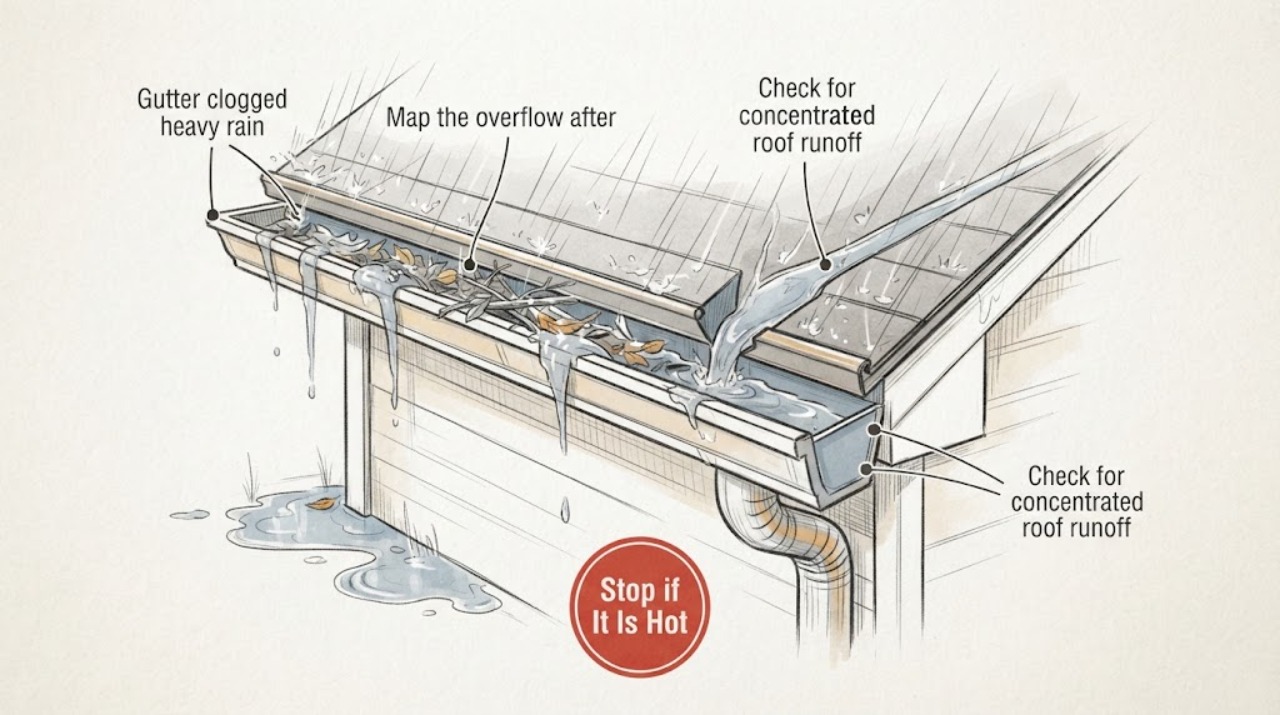
Map the overflow after the storm
When the heavy rain and wind have stopped, stand on stable ground and photograph the exact gutter section where water escaped, using an existing safe view. Record whether overflow came from one point, an end, a corner, a valley-fed section, or most of the run, and whether the observation was during one storm or repeated storms.
Expected result: Overflow was localized, spread along a long run, concentrated at a corner or valley-fed section, or could not be observed safely.
Next step: Mark the location on a photo or simple exterior sketch and provide the storm timing and roof section to the gutter professional.
Stop if: Do not observe during active downpour or wind, stand under falling water, climb, use a ladder, or move close to unstable ground or electrical equipment.
Why this matters
Why: A short repeatable location keeps a local obstruction, joint, or low spot in the branch. Long-run or valley-adjacent overflow during heavy rain raises capacity or roof-runoff concentration questions; an unsafe or missing observation requires professional assessment rather than a guess.
-
Compare the gutter channel with the downspout outlet
After the storm, from ground level, inspect only what is visible at the gutter edge, downspout joints, lower outlet, and extension. Note a visible debris or leaf line, a dry or disconnected outlet, water staining at a joint, and whether the discharge path is open and directed away from the building. Do not put a hand, probe, hose, or pressure nozzle into the gutter or downspout.
Expected result: Debris is visible at one section, the downspout outlet did not discharge, a joint leaks or is disconnected, or the visible channel and outlet appear clear.
Next step: Send close and wide photos of the visible channel, downspout, joints, outlet, extension, and nearby foundation area; leave cleaning and clearing to the provider if access is not safely ground-level.
Stop if: Stop if the outlet is buried, the downspout is unstable, water is near electricity, or further checking would require hose flushing, pressure, probing, disassembly, or elevation.
Why this matters
Why: A localized debris line supports a clog-cleaning assessment. A non-discharging outlet or leaking joint shifts attention to the downspout route. A clear visible system with overflow during heavy rain does not rule out a hidden blockage, but makes slope, capacity, valley concentration, or underground drainage more important to assess.
-
Check for concentrated roof runoff and capacity clues
From the ground, trace the visible roof edge and gutter route without climbing or measuring. Note a roof valley, recent roof addition, large roof plane feeding one short run, a corner with one downspout, or overflow that occurs only in heavy rain. Compare with another similar gutter run only if it is already visible and safe.
Expected result: Heavy-rain overflow is adjacent to a valley or addition, affects one long catchment, occurs only at a capacity bottleneck, or has no visible roof-routing clue.
Next step: Ask the provider to compare catchment area, gutter size, slope, downspout placement, and route instead of replacing a part by appearance.
Stop if: Do not climb to follow a valley, measure from the roof, move guards, open the gutter, or alter downspouts or extensions.
Why this matters
Why: Valleys, additions, and large catchments can concentrate runoff beyond a local section's ability to carry it; that is a capacity or routing review, not proof of a clog. If the same pattern occurs in light rain or at one short debris-marked point, clog, slope, or local damage remains more likely.
-
Document sagging, erosion, and foundation impact
On dry, stable ground after the event, photograph visible low spots or sagging along the gutter line, streaks below seams, erosion under the discharge path, pooling near the foundation, wet basement or crawl-space access areas, and the direction of the extension or splash area. Do not touch wet material or enter a flooded or unstable area.
Expected result: The line looks level and intact, one low spot or seam is wet, discharge has eroded soil or pools near the foundation, or the effects cannot be assessed safely.
Next step: Give the provider the before-and-after photos and state whether the effect followed this storm or existed earlier; request a drainage and gutter assessment.
Stop if: Stop near standing water, electrical equipment, unstable soil, damaged siding or fascia, or any location that would require a ladder, roof access, or handling wet debris.
Why this matters
Why: A low spot or open seam can mimic a clog at one location. Erosion or foundation-side pooling makes discharge routing and prompt service important even if the gutter is clear. A long, clean, structurally sound run that overflows only in heavy rain keeps capacity in the lead.
-
Choose cleaning, downspout, or capacity review
Use the evidence collected after the storm to choose the service question: localized debris and normal catchment suggests a cleaning assessment; a non-discharging or disconnected outlet suggests downspout assessment; repeated long-run or valley-fed overflow with a clear channel suggests capacity or routing review. If the evidence conflicts, request a full gutter assessment.
Expected result: The finding is localized debris, an outlet or joint problem, long-run or valley concentration, foundation impact, or still uncertain.
Next step: Send the provider the location map, visible debris or outlet evidence, roof-routing clue, property effects, storm timing, and all safety limitations.
Stop if: Do not perform a cleaning, hose flush, pressure flush, probing, ladder work, roof work, or permanent gutter or downspout alteration yourself.
Why this matters
Why: Heavy rain changes the decision by exposing peak-flow behavior. It does not authorize a user to clear, flush, probe, climb, or redesign the system, and normal flow in one storm cannot rule out a hidden restriction.
Use your observations
Decision map
Find the observation that best matches what you see, then follow the next safe action.
-
PATH 01Safety boundary
What you see
After heavy rain, one short gutter section repeatedly overflows and a visible debris line or local obstruction is present, with no roof or ladder access used.
Do this next
Request a gutter cleaning assessment and have the provider check the nearby outlet, elbow, and joint before declaring the whole system undersized.
Why this path and its safety boundary
Safety stop: Do not reach into the gutter, probe debris, flush with a hose or pressure, climb, or use a ladder.
-
PATH 02Safety boundary
What you see
The channel is not obviously full, but the visible downspout outlet does not discharge, a joint leaks or is disconnected, or water backs up at the lower route.
Do this next
Request downspout and discharge-route assessment, including the visible elbow, extension, underground connection if present, and safe discharge away from the foundation.
Why this path and its safety boundary
Safety stop: Do not disconnect buried or elevated sections, force a joint, hose-flush the route, or excavate to find a blockage.
-
PATH 03Safety boundary
What you see
A clear-looking gutter overflows along a long run or near a roof valley or addition only during heavy rain, without a single debris-marked point.
Do this next
Request a capacity and routing review covering catchment, gutter size, slope, valley concentration, downspout placement, and any roof addition.
Why this path and its safety boundary
Safety stop: Do not add a downspout, enlarge an outlet, move flashing, or alter the gutter from a ground observation alone.
-
PATH 04Safety boundary
What you see
One low or sagging gutter area, seam, erosion path, or foundation-side pooling pattern matches the overflow location.
Do this next
Request gutter slope, support, seam, and discharge assessment and provide the property-impact photos; treat water near the foundation as a prompt service concern.
Why this path and its safety boundary
Safety stop: Do not climb, lift the gutter, reseal from a ladder, enter flooding, or disturb wet or unstable material.
-
PATH 05Safety boundary
What you see
The overflow was seen only during a dangerous storm, the visible system looks clear, or the location and cause cannot be established from the ground afterward.
Do this next
Arrange a professional assessment and report the storm intensity, timing, locations, and limits of what could be safely observed.
Why this path and its safety boundary
Safety stop: Do not recreate the event with a hose, pressure, probing, roof access, or repeated exposure to severe weather.
Helpful context
Understand the symptom
Let the heavy-rain event provide evidence
Heavy rain can expose a blocked channel, a blocked or disconnected downspout, a low or sagging gutter, concentrated flow from a roof valley, or a system that cannot carry the event's runoff. Observe only after the rain and wind have passed, from the ground or another already safe viewpoint. Do not stand below active overflow or try to watch it from a ladder.
Separate a clog from capacity and routing
One short overflow point with a visible debris line is different from water spilling along a long run. If the channel looks clear but the same section overflows during heavy rain, the downspout count, outlet route, roof valley concentration, added roof area, slope, or gutter size may be the limiting factor. A downspout that does not discharge, backs up at its lower end, or leaks at a joint creates a separate branch from a full gutter channel.
Record what the water did to the property
From the ground, photograph watermarks, wet siding, erosion below the gutter, pooling by the foundation, stained fascia, and the downspout outlet or extension. These effects help the provider distinguish a localized obstruction from a routing or capacity problem and show whether the overflow is causing damage beyond the gutter itself.
Plan service outside the storm
The Fairfax County drainage guide notes that clean gutters that still spill over during rain may indicate an undersized system, while gutter and downspout debris can also cause overflow. The Building America Solution Center likewise calls for gutter and rain-leader capacity suited to heavy rain and roof area. Use those observations to request cleaning, downspout assessment, or capacity review; do not order a tool or redesign from the weather event alone.
Safety boundary
Stop conditions
- Do not inspect during active heavy rain or wind, climb onto the roof, use a ladder, or stand under falling water or unstable material.
- Do not use a hose or pressure nozzle, probe debris, reach into a gutter or downspout, disconnect sections, or flush a hidden route.
- Stop and keep people clear for water near electrical equipment, structural or fascia damage, unstable soil, flooding, falling material, or foundation-side water entry.
- A repeated long-run overflow, valley or roof-addition concentration, non-discharging downspout, or uncertain cause requires a gutter professional to assess clog, routing, slope, and capacity before alteration.
Only after diagnosis
Potential parts
- gutter-cleaning-tool
Consider only if a qualified provider identifies a reachable, compatible cleaning method; this page does not authorize user cleaning or elevated access.
Confirm gutter profile, access method, guard or screen arrangement, and the provider's safe-work plan; a cleaning tool will not correct capacity, valley concentration, slope, or hidden-route problems. - gutter-scoop
Consider only after the provider confirms that localized debris is the cause and selects a safe, compatible service method.
Match the gutter profile and debris condition, and keep the work within the provider's access and safety plan; do not reach or climb to use it. - downspout-cleaning-tool
Consider only after a professional confirms a downspout restriction and the route, joints, outlet, and discharge can be serviced safely.
Match downspout shape, joints, underground connection, and discharge route; a tool cannot substitute for capacity or routing redesign and must not be used with improvised pressure.
When checks do not resolve it
Need a professional?
Request high-priority gutter service when overflow repeats after heavy rain, water reaches the foundation or electrical equipment, the downspout does not discharge, the gutter is sagging or damaged, access is elevated, or a clear system may be undersized for its roof catchment.
Safety scope: This page is limited to dry-weather, ground-level observation and photographs. A qualified gutter professional should climb, clean, flush, probe, disconnect, repair supports or seams, inspect hidden routes, and evaluate capacity or roof-valley routing.
Common questions
FAQ
Does heavy rain prove that my gutter is clogged?
No. Heavy rain can reveal a localized clog, a blocked or disconnected downspout, a low spot, concentrated flow from a roof valley or addition, or insufficient gutter capacity. Map where the overflow occurred after the storm and have the provider compare those possibilities.
How can I distinguish a clog from an undersized gutter?
A short repeatable overflow with visible debris supports a local clog assessment. A clear-looking gutter that spills along a long run or near a valley only during heavy rain points more toward catchment, slope, downspout placement, or capacity. Ground evidence cannot rule out a hidden blockage.
Can I flush the gutter with a hose after heavy rain?
Not for this page. Do not use a hose or pressure, probe debris, reach into the gutter, climb, or access the roof. Photograph the channel, outlet, joints, and property effects after conditions are dry and ask a gutter professional to perform the service.
What should I tell the gutter professional?
Provide the storm timing, exact overflow locations, whether the pattern was local or long-run, roof valley or addition clues, visible debris, downspout discharge, low spots, erosion, foundation pooling, and photos. State which checks were not performed because of weather, height, hose, pressure, or probing restrictions.
Read the exact guide
Official sources
- Gutters and Downspouts: Wetness or Erosion ProblemsNorthern Virginia Soil and Water Conservation District, Fairfax County · Supports distinguishing debris-related overflow from a clean gutter that spills because the system may be undersized, and recording erosion or foundation-side wetness. It does not authorize ladder, roof, hose, pressure, or probing work.
- Gutters and DownspoutsU.S. Department of Energy Building America Solution Center, Pacific Northwest National Laboratory · Supports treating heavy rain and roof catchment as capacity and routing evidence, including the need for appropriately sized gutters and downspouts and discharge away from foundations. It is design guidance, not a homeowner cleaning or roof-access procedure.
Community feedback
Share a repair observation
Share a plain-text repair observation. Accepted observations are published automatically; this page may take a moment to update.