
On this page
Start here
Quick answer
Treat a gutter downspout that does not discharge as a drainage and fall-risk issue, not a reason to climb onto the roof or lean a ladder against the gutter. From the ground or another stable, safe viewpoint, observe the outlet during natural rain, photograph overflow and the downspout route, and check for pooling or erosion near the foundation. If the outlet is inaccessible, the gutter is high, the overflow is active, or the source cannot be distinguished from a damaged or buried connection, stop and arrange qualified gutter service. Do not climb, reach from a ladder, force a tool into the downspout, or disconnect buried or joined drainage.
Before you begin
Safety first
- Ask the professional to inspect the gutter and downspout route, identify the restriction or damage, verify the runoff destination, and correct drainage without creating a fall or property-damage hazard.
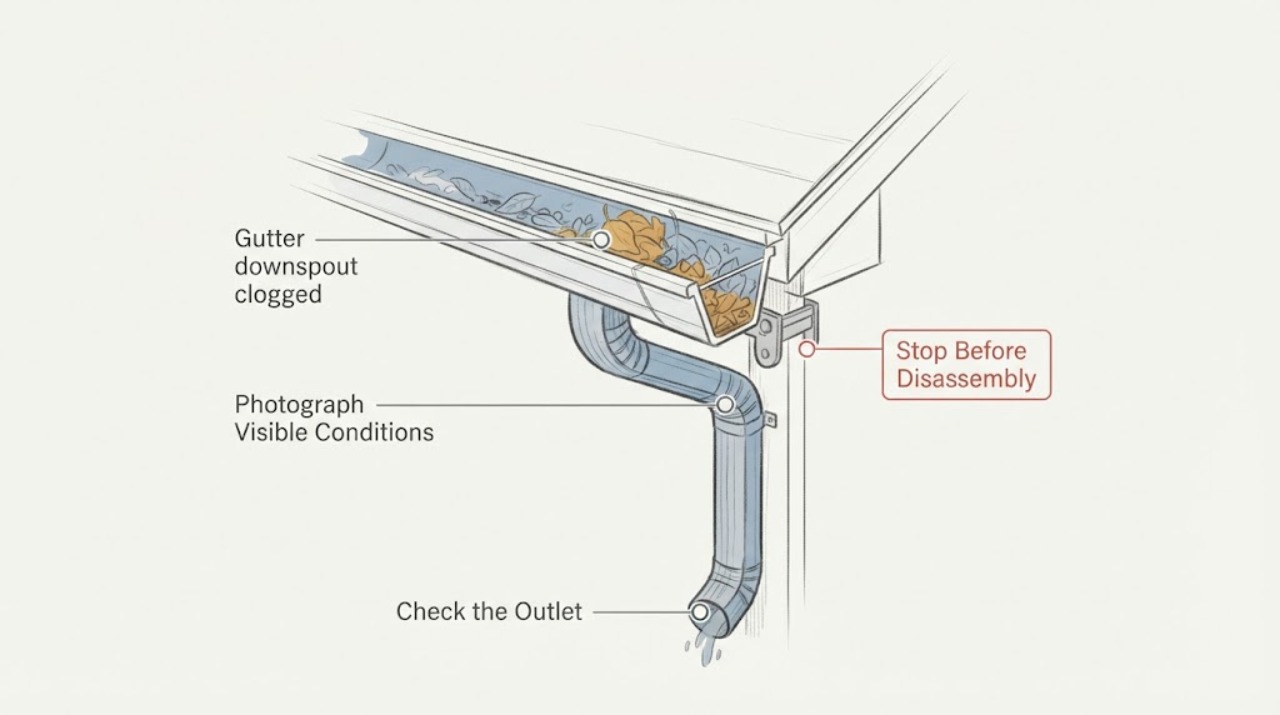
Work through in order
Diagnostic checks
Use only checks that match the exact appliance or system and its official guide.
-
Check 1
From ground level or another stable location that does not require climbing, observe the downspout outlet during natural rainfall and photograph the discharge point without placing hands or tools into the opening.
Expected result: Record whether water exits freely, trickles, backs up, exits around a joint, or does not appear at the outlet while rain is reaching the roof and gutter.
Next step: Save the photo and timing, then arrange gutter service if the flow remains abnormal or the outlet is not safely accessible; do not attempt to push a rod or hose into the downspout.
Stop if: Stop if observing the outlet would require a ladder, roof access, stepping on a wall or railing, entering traffic, or standing on slippery or flooded ground.
Why this matters
Why: Little or no outlet flow together with gutter overflow is consistent with a restriction, crushed section, or hidden connection problem, but no flow during light rain is not proof of a clog. Water escaping at a joint indicates a leak or separation that may be as important as a blockage.
-
Check 2
From the ground, follow the visible exterior downspout and inspect its seams, elbows, straps, lower extension, and outlet for bulges, dents, separation, leaves, standing water, or discharge against the wall.
Expected result: Note whether the pipe is continuous and supported, whether a section is crushed or disconnected, and whether water exits at a joint instead of the intended outlet.
Next step: Photograph the exact joint or damaged section and give it to a gutter professional; do not reconnect, detach, or pull on a section that could shift overhead or expose a buried drain.
Stop if: Stop before touching the downspout, moving a strap, lifting an extension, or inspecting a section that is high, unstable, buried, or adjacent to electrical equipment.
Why this matters
Why: A damaged or separated section can mimic a clog and can direct runoff into siding, soil, or a wall. A sound visible section does not clear a buried or inaccessible continuation.
-
Check 3
Look from a safe, ground-level viewpoint at the gutter line and fascia/eave area for water spilling over one location, dark staining, sagging, a detached edge, or runoff that starts before reaching the downspout.
Expected result: Record whether overflow is concentrated near the downspout, near a corner or seam, along a long section, or not visible; note the weather and whether leaves or roof debris are visible without reaching for them.
Next step: Send the location and photos to a gutter professional for a safe elevated inspection; keep clear of falling debris and do not climb to confirm the suspected point.
Stop if: Stop if the viewpoint is not stable, if the roof edge or gutter cannot be seen without climbing, or if wind, rain, ice, or falling debris makes observation unsafe.
Why this matters
Why: Overflow near the downspout supports a downstream restriction, while overflow at a seam or along a sagging section may indicate a leak, slope, or capacity problem rather than a blocked downspout. Roof-edge observations do not establish the condition inside the gutter.
-
Check 4
After or during rain, inspect the ground around the downspout outlet and the nearest foundation from a safe path; photograph pooling, rills, washed soil, damp walls, staining, or vegetation that stays unusually wet.
Expected result: Record whether water moves away from the building, pools at the foundation, disappears into a buried connection, or cannot be traced because the outlet is blocked or hidden.
Next step: Keep people away from unstable or flooded ground and arrange gutter or drainage service if water reaches the foundation, enters a wall or basement, or cannot be traced to a safe outlet.
Stop if: Stop if water may be contaminated, the ground is undermined, the area is flooded, or inspecting it requires entering a crawl space, excavation, or a restricted drainage structure.
Why this matters
Why: Pooling or erosion shows that runoff is not being managed at the property even if the downspout appears to discharge. A hidden endpoint prevents a reliable homeowner diagnosis and may require a professional drainage inspection.
-
Check 5
Decide whether the downspout and gutter can be safely observed and whether the outlet, visible route, and runoff destination are all identifiable without ladder work, roof access, or disassembly.
Expected result: Yes means the observations above can be documented from a stable position and no unsafe access or hidden connection is involved. No means any portion is high, unstable, buried, inaccessible, damaged, or unsafe to approach.
Next step: For yes, schedule service if flow is abnormal, overflow recurs, or damage is visible. For no, keep clear of the area and call a qualified gutter or drainage professional with the photos and exact inaccessible section.
Stop if: Do not climb, place a ladder against a gutter, work from a roof, reach overhead with tools, or force a cleaning device into the downspout.
Why this matters
Why: A yes result supports sharing the documented flow pattern with a gutter professional for targeted service. A no result is an immediate stop condition; a visible clog is not worth a fall or an uncontrolled release of water.
Use your observations
Decision map
Find the observation that best matches what you see, then follow the next safe action.
-
PATH 01Safety boundary
What you see
The downspout outlet has little or no flow during meaningful rainfall and the gutter is visibly overflowing near that downspout.
Do this next
Treat the pattern as a likely downstream restriction or damaged connection, keep clear of the discharge area, and arrange qualified gutter service for an inspection and safe clearing.
Why this path and its safety boundary
Safety stop: Do not insert a rod, hose, wire, or cleaning tool and do not climb to reach the gutter.
-
PATH 02Safety boundary
What you see
Water exits the downspout but pools against the foundation, erodes soil, or ends at a damaged or too-short visible extension.
Do this next
Arrange gutter or drainage service to assess the discharge route and redirect water away from the building in a manner suitable for the site.
Why this path and its safety boundary
Safety stop: Do not excavate, disconnect buried piping, or redirect water into a neighboring property, walkway, or unsafe low area without professional/site assessment.
-
PATH 03Safety boundary
What you see
Overflow is concentrated at a gutter seam, corner, sagging section, or long run even though the outlet appears to discharge.
Do this next
Request a safe elevated inspection of gutter debris, slope, seam condition, hangers, and downspout capacity; provide the exact overflow location and rainfall timing.
Why this path and its safety boundary
Safety stop: Do not climb or attempt to reseal, rehang, or scrape the gutter from a ladder.
-
PATH 04Safety boundary
What you see
The gutter or downspout is high, inaccessible, detached, crushed, near electrical equipment, or connected to a hidden/buried route.
Do this next
Stop the inspection and call a qualified gutter or drainage professional; provide photographs from the safe viewpoint and identify the inaccessible section.
Why this path and its safety boundary
Safety stop: Do not use roof access, improvised platforms, ladders, excavation, or forced-entry methods to reach the obstruction.
Helpful context
Understand the symptom
What a clogged downspout changes
A gutter collects roof runoff and a downspout carries that water away from the eave. When leaves, sediment, a crushed section, an obstructed outlet, or a buried connection restricts flow, water can back up and spill over the gutter. Overflow may wet fascia and siding, erode soil, or send water toward the foundation. A dry outlet by itself does not prove a clog because no water may currently be entering the gutter, and water that disappears underground may still be backing up out of sight.
Use ground-level observations
The useful record is a short rain-event timeline: whether water reaches the gutter, where it overflows, whether anything exits the downspout, and where runoff ends. Photograph the outlet, seams, visible bends, extensions, splash area, and any foundation pooling from a safe position. Do not climb to inspect the roof edge or put hands and tools into the gutter or downspout.
When service is the right next step
A professional should handle any high or roof-level inspection, unsafe access, persistent overflow, crushed or detached sections, or connection that disappears below grade. EPA guidance emphasizes keeping gutters and downspouts free of debris and leaks and directing downspout water away from the house, but the correct repair depends on the installed route, outlet, grade, and local conditions.
Safety boundary
Stop conditions
- Do not climb onto the roof, stand on a ladder, lean a ladder against the gutter, use an improvised platform, or reach overhead from an unstable position.
- Do not place hands, rods, wires, hoses, compressed air, or powered tools into an unknown downspout; do not detach buried or joined drainage.
- Stop for rain, ice, wind, slippery or undermined ground, falling debris, overhead electrical equipment, contaminated water, or any inaccessible/high section.
- Call a qualified gutter or drainage professional for persistent overflow, foundation pooling, damaged or hidden routing, unsafe access, or any need to clean or repair at height.
Only after diagnosis
Potential parts
- gutter-cleaning-tool
Consider this category only if a qualified professional confirms that the gutter can be serviced safely from the ground with a suitable tool; it is not a substitute for ladder or roof work.
Confirm reach, gutter profile, material, and safe operating limits for the installed system before ordering; do not use it near power lines or unstable ground. - gutter-scoop
Consider this category only for accessible, ground-level debris observation or professional service after the gutter condition and safe access have been confirmed.
Match the tool to the gutter shape and material; do not reach over an edge, use it from an unsecured ladder, or treat removal of visible debris as proof that the downspout is clear. - downspout-cleaning-tool
Consider this category only when a qualified service provider confirms the visible downspout route and a safe, non-damaging clearing method; buried, crushed, or disconnected sections need diagnosis first.
Verify downspout dimensions, bends, outlet configuration, and material before selecting a tool; do not force tools into an unknown or unstable run.
When checks do not resolve it
Need a professional?
Call a qualified gutter or drainage professional promptly when the downspout outlet is inaccessible or abnormal during rain, overflow recurs, water reaches the foundation, a section is detached or crushed, the route is buried, or any inspection would require a ladder, roof access, excavation, or work near electrical equipment.
Safety scope: Ask the professional to inspect the gutter and downspout route, identify the restriction or damage, verify the runoff destination, and correct drainage without creating a fall or property-damage hazard.
Have this ready
- Dated photos and the timing of rainfall or overflow
- Whether water exited the downspout, leaked at a seam, or disappeared into a hidden route
- Visible dents, bulges, detached joints, extensions, debris, and the exact inaccessible section
- Pooling, erosion, damp walls, staining, or runoff directed toward the foundation
Common questions
FAQ
How can I tell if a downspout is clogged without climbing?
Observe the outlet during natural rainfall from the ground or another stable viewpoint and compare discharge with gutter overflow. Photograph the route and runoff destination. No outlet flow is not proof of a clog unless rain is reaching the gutter, and a hidden or buried route needs professional inspection.
Can I put a ladder against the gutter to clear it?
No. A gutter is not a safe ladder support, and wet ground, roof edges, overhead obstructions, and unstable equipment add risk. Arrange qualified gutter service for elevated or inaccessible work.
Why is water pooling near the foundation even though the downspout flows?
The outlet or extension may direct water toward the house, the ground may not carry runoff away, or a buried connection may be restricted. Photograph the flow and pooling and arrange gutter or drainage assessment instead of excavating or disconnecting the route yourself.
Should I push a rod or hose into the downspout?
Not as an observation step. An unknown bend, crushed section, buried connection, or detached joint can be damaged or forced apart. A professional can choose a clearing method after confirming the route and condition.
What should I tell a gutter professional?
Provide the address area description, rain timing, where overflow appeared, whether the outlet discharged, photos of visible seams and extensions, pooling or erosion near the foundation, and any section that was inaccessible or unsafe to approach.
Read the exact guide
Official sources
- Moisture Control Guidance for Building Design, Construction and MaintenanceU.S. Environmental Protection Agency · Use for observing roof drain leaders, pooled rainwater, seepage, damp materials, odors, and swollen or warped wood around a foundation; it is not permission for excavation or roof work.
- Soak Up the Rain: Disconnect / Redirect DownspoutsU.S. Environmental Protection Agency · Use for observing downspout destinations and recognizing that redirection must avoid property damage or unsafe conditions.
- Adapting Buildings for Indoor Air Quality in a Changing ClimateU.S. Environmental Protection Agency · Use for ground-level observation of gutter/downspout debris, leaks, outlet direction, foundation pooling, and rainwater impact.
- 1926.1053 - LaddersU.S. Occupational Safety and Health Administration · Use to support the stop path for ladder, roof-edge, slippery-ground, unstable-equipment, and electrical-contact hazards during gutter observation.
Community feedback
Share a repair observation
Share a plain-text repair observation. Accepted observations are published automatically; this page may take a moment to update.