
On this page
Start here
Quick answer
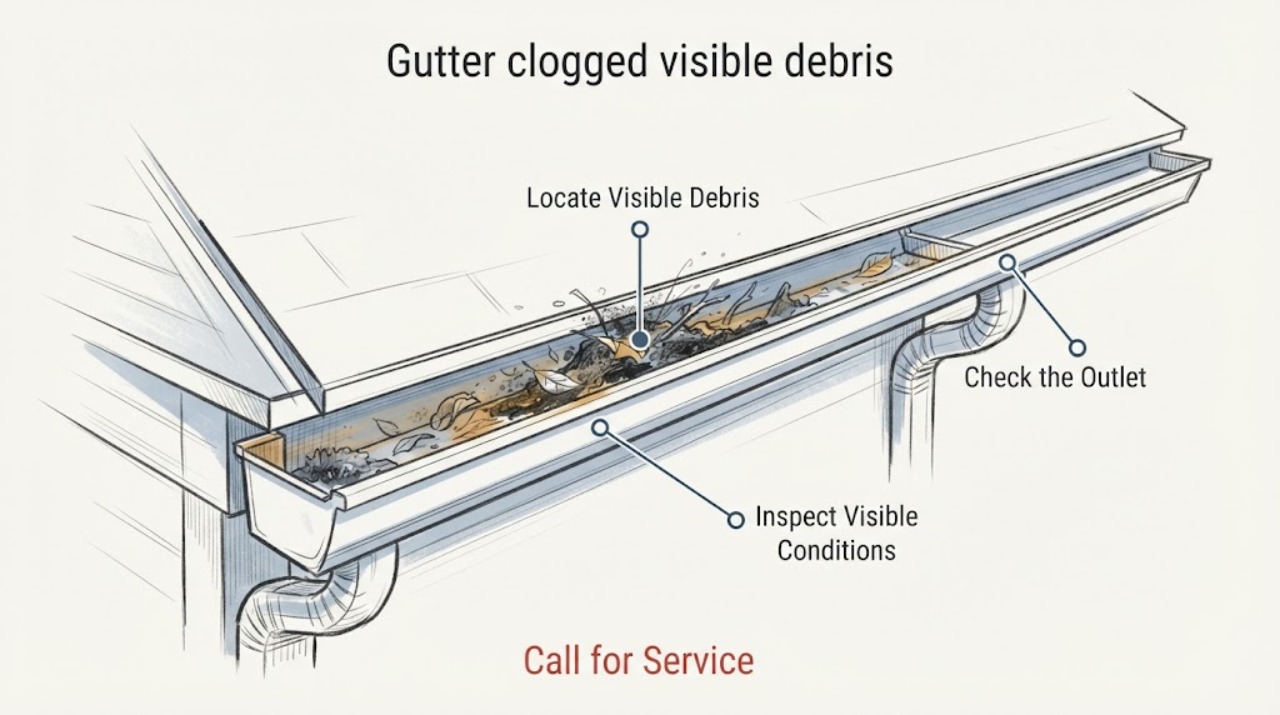
Visible leaves, twigs, or sediment are a clue that a gutter may be clogged, not proof that the whole run is blocked. From the ground, first note where the debris is concentrated, whether the nearest outlet or downspout shows spillover or no discharge during normal rain, and whether the gutter line sags or overflows along its length. Also look for erosion, staining, or pooling near the foundation. A local outlet problem, continuous debris, a sagging or undersized gutter, a downspout restriction, and existing water damage need different service paths. Do not climb a ladder, walk on the roof, reach into the gutter, probe the outlet, or flush it with a hose. Photograph what is visible and arrange qualified gutter service, especially when water is reaching the building.
Before you begin
Safety first
- The provider should inspect the entire gutter run, outlet, downspout, joints, pitch, capacity, discharge point, and nearby water damage, then choose a safe cleaning or repair method. Ladder, roof, reaching, probing, and manual clearing are outside the user observation path.
Work through in order
Diagnostic checks
Use only checks that match the exact appliance or system and its official guide.
-
Check 1
From the ground, inspect the visible gutter line and record where leaves, twigs, sediment, nests, or other debris appear. Use only a stable viewing position; do not climb, reach, or touch the gutter.
Expected result: Note whether debris is confined to one short section, clustered near an outlet or guard, spread continuously along the run, or not actually inside the gutter but on the fascia, roof edge, or ground below.
Next step: Photograph the location from the ground and have a qualified provider inspect the full run and outlet before selecting a cleaning tool or part.
Stop if: Stop if the view requires a ladder, roof access, leaning over an edge, reaching into the gutter, or standing beneath unstable or falling material.
Why this matters
Why: A local visible cluster is a clue for a nearby restriction but does not prove a full blockage. Continuous debris raises the likelihood of reduced capacity, while debris outside the channel may not explain the gutter symptom at all.
-
Check 2
During normal rain, if it can be viewed safely from the ground, compare the section near the visible debris with the nearest downspout outlet and the surrounding wall or eave.
Expected result: Record water spilling over one local section, spilling along much of the run, emerging normally at the downspout, failing to emerge, or returning at a joint. Also note streaks or wet marks below one location.
Next step: Keep clear of the discharge and report the exact section, timing, and flow pattern to gutter service. Do not reach into the outlet, probe it, disconnect a section, or use a hose to force a result.
Stop if: Stop for lightning, slippery ground, falling water or debris, nearby electrical equipment, traffic, or any need to approach the roof edge or downspout opening.
Why this matters
Why: A local spillover near one outlet favors an outlet or nearby obstruction path. Broad spillover with flow at the outlet can point to capacity, pitch, or rain intensity rather than a complete clog. No visible outlet flow or return at a joint shifts attention to the downspout route.
-
Check 3
From the ground, look along the outer gutter edge and compare its apparent line with adjacent roof or fascia reference points without touching it.
Expected result: Note a straight run, one low spot or sag, an open or separated joint, a visibly bent section, or overflow that occurs across the length even when debris is sparse. Record whether the pattern appears only during heavy rain.
Next step: Provide a wide photo and the rain conditions to a gutter professional. Do not push the gutter upward, tighten fasteners, seal a joint, or alter the roof edge as a user check.
Stop if: Stop if the line cannot be viewed from the ground, the fascia appears loose, the gutter is moving, or any inspection would require elevated access or physical contact.
Why this matters
Why: A low spot or separated joint can hold water or spill it before it reaches the outlet, changing the service path from debris removal to support, pitch, or joint repair. Widespread overflow with a sound-looking line can indicate undersized capacity or unusually heavy runoff instead of a local clog.
-
Check 4
Follow the visible downspout from the ground to its outlet or extension and inspect the surrounding soil, siding, foundation, and walkway for water paths. Do not open the downspout, insert a tool, or redirect it.
Expected result: Record a clear outlet, no visible discharge during rain, a detached or leaking joint, water pooling at the base, erosion, soil washout, damp siding, staining, or water moving toward the foundation.
Next step: Photograph the outlet and ground path from a safe position and request a drainage-focused assessment. Treat active water entering the building or rapid damage as a prompt service issue.
Stop if: Do not step into pooled water, open buried or capped connections, probe the outlet, move extensions, or work near unstable soil or electrical equipment.
Why this matters
Why: A downspout or outlet observation can explain why water damage continues even after debris is removed. Pooling, erosion, and foundation wetness may also reflect grading or discharge placement, so they should not be assigned to the gutter alone.
-
Check 5
Document the first safe signs of impact around the gutter system and review when the visible debris, overflow, or damage appeared without repeating a risky inspection.
Expected result: Note foundation or basement dampness, ceiling or wall staining, fascia discoloration, drip-line erosion, soil movement, mold-like odor, and whether the issue followed a storm, leaf fall, ice, or a recent gutter change.
Next step: Send the time line, safe photos, rain conditions, and affected areas to a qualified gutter or drainage professional. Keep people away from unstable or wet interior areas until they are assessed.
Stop if: Stop for structural movement, active interior leakage near electricity, contaminated water, unstable soil, or any need to enter a hazardous area.
Why this matters
Why: Existing water damage raises the priority and may require coordinated gutter, drainage, and building-envelope assessment. A recurring issue after leaf fall suggests debris management, while recurrence with little debris points toward pitch, capacity, outlet, or downspout conditions.
Use your observations
Decision map
Find the observation that best matches what you see, then follow the next safe action.
-
PATH 01Safety boundary
What you see
Debris is visible in one local section, but there is no observed spillover, foundation wetness, or unsafe condition.
Do this next
Arrange routine professional inspection of that section, its outlet, and the downspout path before choosing a cleaning tool or replacement part.
Why this path and its safety boundary
Why it matters: The debris is a useful location clue, not proof that the complete gutter or downspout is blocked.
Safety stop: Do not reach into the gutter, probe the outlet, use a ladder, or flush the system with a hose.
-
PATH 02Safety boundary
What you see
Debris appears along much of the visible run and water spills over during normal rain.
Do this next
Request high-priority ground-safe assessment and report the full-run debris, rain timing, overflow locations, and any damage.
Why this path and its safety boundary
Why it matters: A broader restriction is plausible, but the flow pattern still needs to be separated from low spots, capacity limits, and downspout issues.
Safety stop: No roof work, ladder work, reaching, probing, manual clearing, or hose flushing as a user task.
-
PATH 03Safety boundary
What you see
The gutter spills near one outlet, the outlet has no visible discharge during rain, a joint leaks, or water returns from the downspout.
Do this next
Have a gutter professional inspect the outlet, elbows, joints, extension, and any buried continuation without the user opening or probing them.
Why this path and its safety boundary
Why it matters: The local outlet or downspout path becomes the first service focus; visible debris elsewhere may be incidental.
Safety stop: Do not disconnect sections, insert a tool, direct a hose into the system, or stand in pooled water.
-
PATH 04Safety boundary
What you see
The gutter line visibly sags or separates, or broad overflow occurs even when debris is sparse and the outlet appears to discharge.
Do this next
Request a gutter-system assessment that includes slope, hangers, joints, downspout capacity, and roof runoff rather than ordering a debris-removal part first.
Why this path and its safety boundary
Why it matters: Support, pitch, joint condition, runoff capacity, or rain intensity may be more important than a complete clog.
Safety stop: Do not push, lift, seal, fasten, or alter the gutter from a ladder or roof.
-
PATH 05Safety boundary
What you see
Water is reaching the foundation, basement, wall, fascia, walkway, or soil in a way that shows active or worsening damage.
Do this next
Request prompt gutter and drainage service, document the water line and damage from safe positions, and seek appropriate building or water-mitigation help if interior damage is active.
Why this path and its safety boundary
Why it matters: The service boundary expands from a possible clog to water-damage prevention and drainage assessment.
Safety stop: Do not enter flooded or unstable areas, touch wet electrical equipment, move heavy wet material, or attempt roof access.
-
PATH 06Safety boundary
What you see
The gutter, outlet, or suspected debris cannot be seen from the ground, or the site has steep, slippery, unstable, or otherwise unsafe access.
Do this next
Leave the system undisturbed and hire a qualified provider who can bring appropriate access and fall protection.
Why this path and its safety boundary
Why it matters: The blockage and gutter condition cannot be classified safely from the available viewpoint.
Safety stop: No ladder, roof walking, reaching, probing, or improvised access.
Helpful context
Understand the symptom
Visible debris is evidence, not a complete blockage diagnosis
Debris at one visible section may be caught near an outlet, lodged at a guard, or simply resting in a gutter that still drains. The first useful distinction is local versus continuous: identify where overflow or wet marks occur relative to the debris and downspout rather than assuming every section is blocked. A gutter that looks clean can still spill over when it is undersized or has low spots, so a debris-only observation should not decide the repair by itself.
Use a ground-only observation path
Inspect from the ground or another stable, low position, preferably from several safe viewpoints. Do not use a ladder, step onto the roof, reach over an edge, probe the gutter or downspout, or send water through the system. Observe during normal rain only when you can remain clear of falling water, slippery surfaces, traffic, and electrical hazards.
Follow the water damage, not just the debris
The Northern Virginia Soil and Water Conservation District notes that wetness and erosion near the foundation can come from gutters, downspouts, undersized systems, or poor grading, and recommends looking for watermarks, drip-line erosion, overflow, sags, and downspout performance. If the ground, siding, basement, or foundation is already showing damage, include that evidence in the service request rather than treating this as a simple cleaning visit.
Safety boundary
Stop conditions
- Do not use a ladder, walk on the roof, lean over an edge, or reach into a gutter or downspout.
- Do not probe, disconnect, manually clear, or flush the gutter or downspout with a hose as a user check.
- Stop for lightning, slippery or unstable ground, falling debris, traffic, electrical hazards, or unstable fascia or gutter movement.
- Do not enter pooled, flooded, contaminated, or structurally unstable areas, especially near electrical equipment.
- If the system cannot be viewed safely from the ground, leave it undisturbed and arrange qualified service.
Only after diagnosis
Potential parts
- gutter-scoop
Consider this only as a provider-selected cleaning accessory after the gutter profile, debris type, access, and fall-safety plan are known. Visible debris alone does not prove that manual removal is the right or safe remedy.
Match the scoop shape and reach to the gutter profile and approved access method; do not use it from a ladder or roof as a user task. - downspout-cleaning-tool
Consider this only after a professional confirms that the restriction is in an accessible downspout and that the tool will not damage joints, buried piping, guards, or extensions. A visible gutter debris patch may be unrelated.
Verify downspout size, bends, outlet configuration, buried continuation, and safe access before selection; do not probe or flush the downspout as a homeowner check. - gutter-cleaning-tool
Consider a cleaning tool only after the provider identifies a cleaning need and confirms the tool, access system, and gutter condition are compatible. Tools do not correct sagging, undersized runs, detached joints, or foundation grading.
Match the tool to the gutter material, guards, debris, height, and approved safety setup; do not improvise a reach tool or operate it from a roof or ladder.
When checks do not resolve it
Need a professional?
Arrange routine service for isolated visible debris with no damage. Call promptly for active overflow, no visible downspout discharge, detached or sagging gutters, foundation wetness, interior leakage, erosion, or access that cannot be handled safely from the ground.
Safety scope: The provider should inspect the entire gutter run, outlet, downspout, joints, pitch, capacity, discharge point, and nearby water damage, then choose a safe cleaning or repair method. Ladder, roof, reaching, probing, and manual clearing are outside the user observation path.
Have this ready
- Where debris is visible and whether it is local or continuous along the run
- Overflow, outlet flow, downspout leak or backflow, sag, separation, and rain timing observed from the ground
- Photos of gutter sections, downspout outlet, foundation or drip-line erosion, staining, and pooling
- Any storm, leaf fall, ice, recent installation, prior cleaning, interior water damage, or access limitation
Common questions
FAQ
Does visible debris prove the gutter is completely clogged?
No. Debris may be local, may sit above a still-open outlet, or may not be inside the gutter at all. Compare the debris location with spillover, outlet discharge, sagging, and water marks from the ground.
What if the gutter looks clean but still overflows?
A clean-looking run can still have a low spot, separated joint, undersized capacity, outlet restriction, or unusually heavy runoff. Record where and when it spills and have the full system assessed.
Can I check the downspout with a hose?
Not as this observation path. Do not probe, flush, disconnect, or reach into the system. A professional should choose a safe method after identifying the downspout configuration and any buried continuation.
When does a clogged gutter become a water-damage problem?
Treat it as a water-damage concern when water reaches the foundation, basement, siding, fascia, walkway, or soil in a way that causes staining, pooling, erosion, or active interior leakage. Document it from a safe position and request prompt service.
Can I clean a gutter from a ladder if I can see the debris?
No. This page is limited to ground-level observation. Do not use a ladder, walk on the roof, reach over an edge, or manually clear the gutter; arrange qualified service with suitable access and fall protection.
Read the exact guide
Official sources
- Gutters and Downspouts: Wetness or Erosion ProblemsNorthern Virginia Soil and Water Conservation District, Fairfax County · Supports distinguishing debris and overflow from undersized or sagging gutters, outlet or downspout issues, and water damage near the foundation.
Community feedback
Share a repair observation
Share a plain-text repair observation. Accepted observations are published automatically; this page may take a moment to update.