
On this page
Start here
Quick answer
Treat an overflowing gutter as a drainage and access problem, not a reason to climb onto the roof. From the ground or a safe window, note where water spills, whether the downspout discharges, whether water is pooling or eroding soil near the building, and whether the pattern repeats after ordinary rain. Keep away during storms and do not use a ladder, reach into the gutter, pressure-flush it, or walk on the roof. Give the observations to a gutter or drainage professional, especially when the system is high, damaged, inaccessible, or water is reaching the foundation or interior.
Before you begin
Safety first
- Do not use a ladder, climb a roof, reach into a gutter, approach during a storm, use a pressure tool, disconnect sections, probe a downspout, or handle contaminated or fast-moving water.
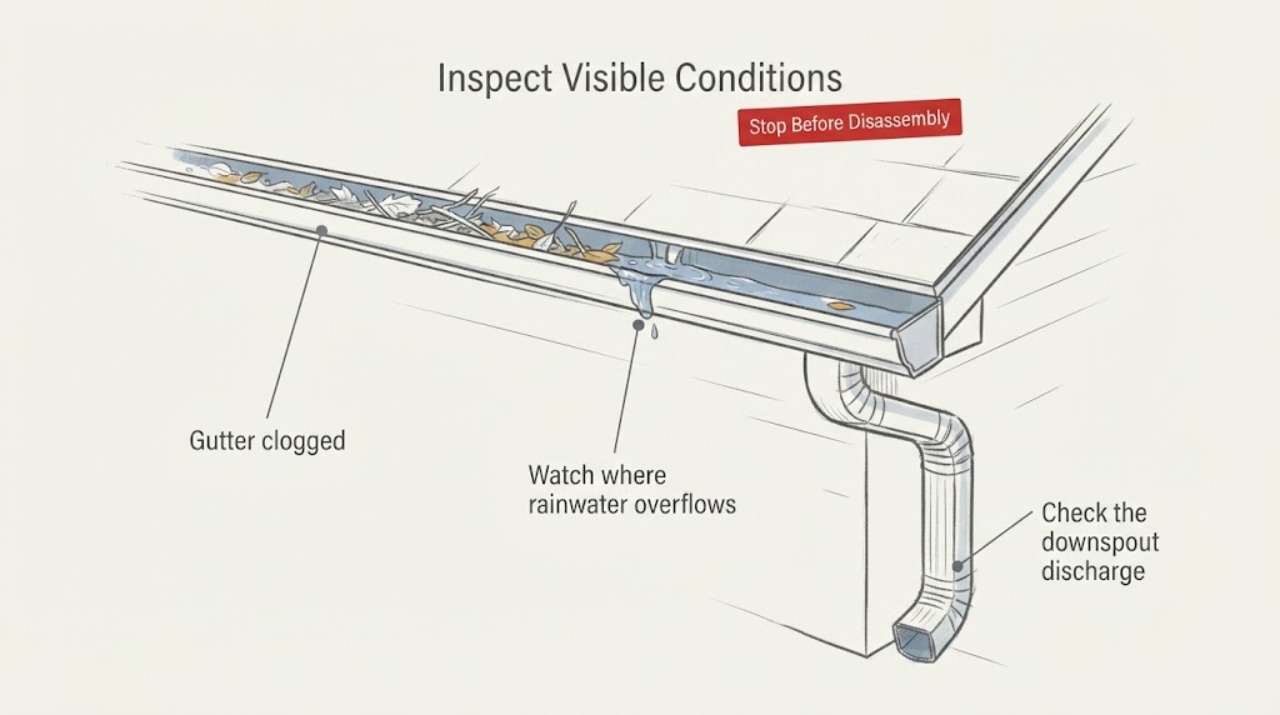
Work through in order
Diagnostic checks
Use only checks that match the exact appliance or system and its official guide.
-
Watch where rainwater overflows
From the ground or a safe window during ordinary, non-severe rain, observe the outside edge of the gutter without approaching the roof; note the section where water spills, pours over a corner, or misses the channel, and stop once the pattern is clear.
Expected result: Water spills at one short section, backs up along a longer run, pours at a corner or seam, or no overflow is visible from the available viewpoint.
Next step: Record the section, weather intensity in plain terms, and whether the overflow repeats, then provide that map to the service professional.
Stop if: Stop observing if rain becomes heavy, wind or lightning develops, the ground floods, or you would need to move under the eave or use elevated access.
Why this matters
Why: A localized spill can point the professional toward a joint, guard, hanger, or local blockage; a long backup can involve the downspout or slope; no visible spill does not rule out a hidden blockage or an intermittent problem.
-
Check the downspout discharge from the ground
From a clear, stable position, look at the bottom of each visible downspout and its extension or splash area; note whether water exits, exits weakly, runs beside the pipe, or is absent while the gutter is overflowing.
Expected result: Water reaches the outlet normally, the outlet is dry during an overflow, flow appears beside a joint, or the discharge area is buried, blocked, or not visible.
Next step: Photograph the outlet from a safe distance and note whether water is moving toward the foundation, a walkway, a basement entrance, or a visible drainage feature.
Stop if: Stop if water is fast-moving, contaminated, pooling around electrical equipment, undermining the ground, or making the walkway slippery.
Why this matters
Why: An absent or weak outlet flow makes a downspout or below-grade connection worth assessing; water beside a joint suggests separation or damage; a normal outlet flow with gutter overflow can point back to the gutter run, capacity, or a local restriction.
-
Look for ground-level damage and indoor signs
After the rain has passed and surfaces are safe, inspect the ground around the visible downspout outlet and the interior wall or ceiling below the roof edge from normal access; note erosion, fresh sediment, dampness, staining, peeling finishes, or a musty area.
Expected result: The soil is unchanged and the interior is dry, or there is repeated erosion, pooling, a wet foundation edge, a ceiling or wall stain, or active interior dripping.
Next step: Document the location and date, protect belongings from active interior water without entering an unsafe area, and request coordinated gutter, roof, or drainage assessment as appropriate.
Stop if: Stop if the ceiling is sagging, water is near electrical fixtures, the structure appears unstable, or access would require climbing or opening a surface.
Why this matters
Why: Erosion or pooling shows that runoff is not being managed at the discharge point. Interior staining or active water raises the priority and may indicate a roof, flashing, wall, or gutter problem that a gutter-only visit may not solve.
-
Compare sections and debris patterns from safe viewpoints
From the ground or a window, compare visible gutter runs, corners, downspouts, guards, and nearby trees; note sagging lines, separated joints, streaks below seams, visible leaf buildup, overhanging debris, or a section that behaves differently after rain.
Expected result: One section looks distorted or separated, debris is visible but unreachable, several sections overflow together, or the system looks intact from below.
Next step: Give the professional the section map and tree or debris context. Do not pull a guard, poke the channel, disconnect a downspout, or attempt elevated cleaning.
Stop if: Stop if the only way to verify the section is by ladder, roof access, reaching, pressure equipment, or approaching during a storm.
Why this matters
Why: A distorted or separated section may need repair as well as clearing. Widespread overflow can indicate capacity, slope, or downspout limitations rather than a single leaf blockage. A clean-looking exterior cannot rule out a hidden obstruction.
-
Decide whether the problem needs prompt service
Ask whether water has reached the foundation, interior, walkway, or electrical area, or whether the gutter or downspout appears loose, cracked, collapsed, or unsafe to access; base the answer only on visible conditions and recent observations.
Expected result: Any active interior leak, foundation pooling, major erosion, loose or collapsing section, inaccessible high roofline, or unsafe weather is present, or none is present.
Next step: Arrange gutter or drainage service and share the exact observed locations; protect people from slippery areas while waiting.
Stop if: Do not perform a DIY clearing attempt when any urgent condition or unsafe access is present.
Why this matters
Why: A yes result needs prompt professional assessment because continued runoff can worsen water or structural damage and the safe repair boundary has already been reached. A no result still warrants service when overflow repeats or the blockage remains inaccessible.
Use your observations
Decision map
Find the observation that best matches what you see, then follow the next safe action.
-
PATH 01Safety boundary
What you see
Overflow is visible at one section, but there is no interior water, foundation pooling, unsafe weather, or elevated-access need.
Do this next
Record the section and arrange a routine professional inspection or cleaning visit that can safely reach it.
Why this path and its safety boundary
Safety stop: Do not turn the observation into a ladder or roof task.
-
PATH 02Safety boundary
What you see
The gutter overflows while the visible downspout outlet is dry or weak.
Do this next
Request assessment of the downspout, elbows, connection, extension, and any below-grade drainage path.
Why this path and its safety boundary
Safety stop: Do not insert a tool, pressure nozzle, or chemical into the downspout.
-
PATH 03Safety boundary
What you see
Water is pooling at the foundation, eroding soil, entering a wall or ceiling, or reaching electrical equipment.
Do this next
Treat the situation as prompt water-intrusion service and request gutter plus roof or drainage assessment as needed.
Why this path and its safety boundary
Safety stop: Stop all exterior observation during active storms, flooding, lightning, or unstable conditions.
-
PATH 04Safety boundary
What you see
The gutter appears clean from below but spills during normal rain.
Do this next
Ask a professional to assess gutter capacity, slope, sagging, joints, guards, roof runoff concentration, and downspout routing.
Why this path and its safety boundary
Safety stop: Do not modify the gutter, guard, roof edge, or discharge route based only on a ground view.
-
PATH 05Safety boundary
What you see
The requested work would require a ladder, roof access, reaching into the gutter, pressure tools, or storm-time approach.
Do this next
Stop and hire a qualified gutter or drainage professional who can use appropriate access and weather controls.
Why this path and its safety boundary
Safety stop: Do not proceed beyond safe ground or window observation.
Helpful context
Understand the symptom
What a ground-level check can tell you
A clog is only one explanation for overflow. Leaves or other debris, a blocked downspout or underground connection, a sagging or undersized section, a separated joint, or a discharge area that cannot absorb the flow can create similar symptoms. The useful first record is where water appears and where it ends up, not an attempt to reach the roof edge.
Keep the observation safe
Observe only from a stable ground-level position or through a normal window, and wait for safe weather. Do not approach during lightning, high winds, heavy rain, icy conditions, or flooding. Do not climb, lean a ladder, reach into a gutter or downspout, use a pressure tool, pull away a guard, disconnect sections, or walk on the roof.
Only after diagnosis
Potential parts
- gutter-cleaning-tool
Consider this category only after a professional evaluates the height, roof access, gutter material, guard design, and safe method; the tool is not a reason for an untrained person to climb or reach.
Match the tool to the gutter system and approved access method, and do not use pressure equipment or a tool that could damage seams or guards. - gutter-scoop
Consider this category only if a qualified service provider specifies a suitable method for an accessible, stable work area; it is not for roof or ladder work by the reader.
Confirm the material and guard arrangement before use, and leave any elevated or inaccessible section to the professional. - downspout-cleaning-tool
Consider this category only after the professional determines that the restriction is in a reachable downspout section rather than an underground or structural drainage problem.
Confirm the downspout material, joints, extension, and safe access method; do not insert tools or use pressure from the ground based on a guess.
When checks do not resolve it
Need a professional?
Request gutter or drainage service when overflow repeats, the downspout outlet is dry or weak, debris or damage is inaccessible, water reaches the foundation or interior, or the system needs ladder or roof access.
Safety scope: Do not use a ladder, climb a roof, reach into a gutter, approach during a storm, use a pressure tool, disconnect sections, probe a downspout, or handle contaminated or fast-moving water.
Have this ready
- Provide the overflow section, rain timing, downspout outlet behavior, visible debris or guard, erosion or pooling location, indoor stains or leaks, tree context, and any weather or access limitation.
Common questions
FAQ
How can I check a clogged gutter without climbing?
From the ground or a safe window, note where water spills, whether the visible downspout outlet discharges, and whether the soil or foundation area shows pooling or erosion. Leave reaching and elevated access to a professional.
What if the gutter looks clean but still overflows?
Overflow can also involve slope, sagging, joints, downspout capacity, runoff concentration, or an inaccessible restriction. Give the professional the section and rain-pattern observations instead of assuming more debris is the cause.
Should I check the gutter during a storm?
Do not approach gutters during lightning, high winds, heavy rain, flooding, or icy conditions. Observe only when the weather and ground are safe, and use a professional for any inaccessible section.
When is a clogged gutter urgent?
Request prompt service when water reaches the foundation or interior, erosion is worsening, a gutter or downspout is loose or collapsing, water is near electricity, or safe access is not available.
Read the exact guide
Official sources
- Minimizing runoff from shoreland propertyUniversity of Minnesota Extension · Supports observing runoff, erosion, discharge direction, and debris-related gutter or downspout problems.
- Gutters and Downspouts: Wetness or Erosion ProblemsNorthern Virginia Soil and Water Conservation District, Fairfax County · Supports using watermarks, spillover, erosion, pooling, and outlet behavior as clues without treating them as a complete diagnosis.
- Mitigate Wind Damage BEFORE The StormNational Weather Service, Mobile/Pensacola · Supports completing gutter maintenance before severe weather rather than approaching during a storm.
- Gutters and DownspoutsU.S. Department of Energy Building America Solution Center · Provides system context for why overflow, blocked drainage, and discharge near foundations deserve professional assessment.
Community feedback
Share a repair observation
Share a plain-text repair observation. Accepted observations are published automatically; this page may take a moment to update.