
On this page
Start here
Quick answer
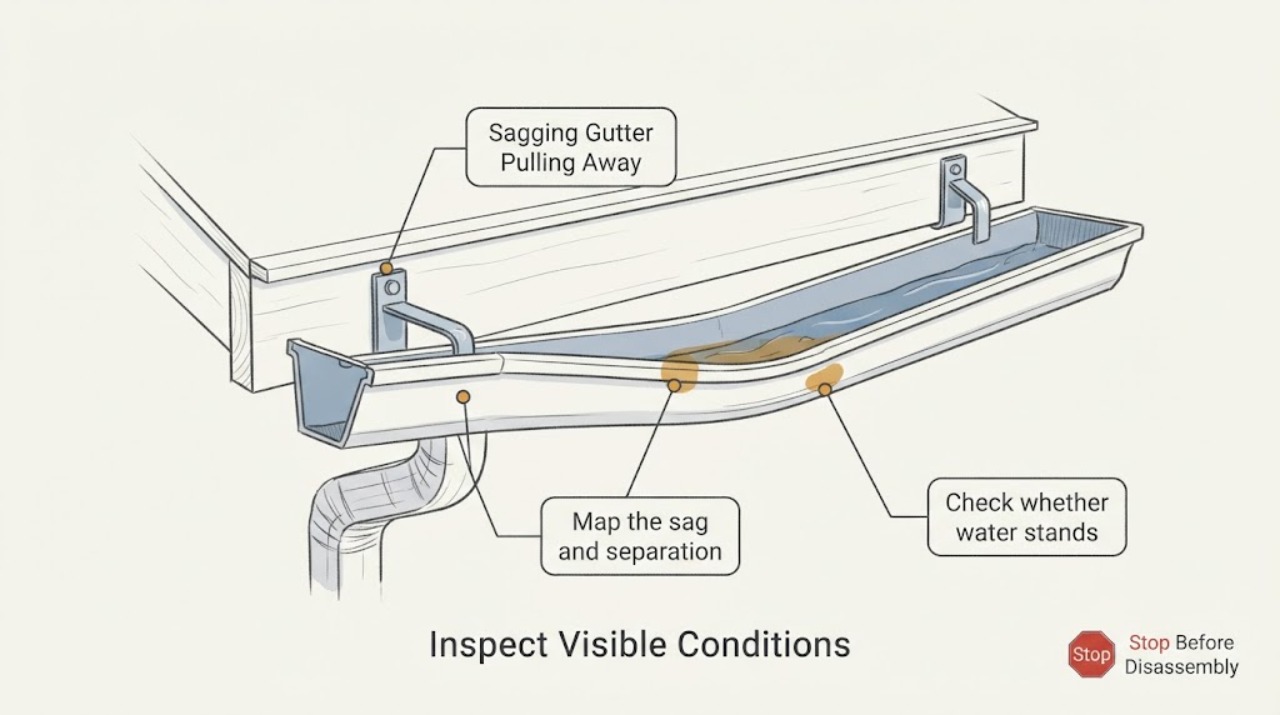
A sagging gutter that is pulling away from the fascia is usually a water-path and attachment problem, not just a cosmetic dip. From the ground, document where the gutter is low, whether water stands or overflows, whether hangers or fasteners appear to pull out, and whether the fascia is soft, split, stained, or visibly rotten. A sound fascia with an isolated sag may need a gutter professional to restore the run's fall and attachment; damaged fascia, a loose section at height, repeated overflow, or water draining against the wall needs repair of the supporting structure and drainage path before the gutter is rehung. Do not climb to adjust pitch, probe rotten wood, or work beneath a loose gutter.
Work through in order
Diagnostic checks
Use only checks that match the exact appliance or system and its official guide.
-
Map the sag and separation from the ground
From a stable ground-level position, photograph the full gutter run and the close areas where it dips, tilts, or pulls away from the fascia. Note the nearest corner, end cap, downspout, seam, and any visible hanger or fastener without reaching, pushing, or standing under a loose section.
Expected result: The sag is isolated or continuous, the gutter is separated at one support or several supports, the downspout connection is pulling, or a long section is visibly loose.
Next step: Keep the photos and mark the lowest visible point for the gutter professional; keep people and pets out of the area below until the section is secure.
Stop if: Stop for a gutter section that is swinging, falling, sharply twisted, blocked over an entrance, or reachable only by a ladder or roof access.
Why this matters
Why: An isolated dip may be a local attachment or slope issue, while continuous sag or multiple pulled supports suggests loading, inadequate support, or a compromised fascia line. The view cannot confirm hidden hanger spacing or the condition inside the fascia.
-
Check whether water stands or overflows
After ordinary rain, or from a safe ground-level view of existing wet conditions, observe the gutter for standing water, overflow at the low point, water spilling behind the back edge, or a downspout that does not receive the flow. Do not climb or create a roof-edge hose test.
Expected result: Water stands in the sag, spills over the front, runs behind the gutter, overflows near a corner or downspout, or the run appears to drain normally.
Next step: Record the weather and exact overflow point, then ask the gutter professional to assess fall, blockage, connections, and attachment before changing the pitch.
Stop if: Do not reach into the gutter, scrape debris from a ladder, walk on the roof, or remain below a gutter that is visibly overloaded or separating.
Why this matters
Why: Standing water supports a fall, blockage, or deflection problem; water behind the gutter raises concern about flashing or fascia wetting; overflow at a connection can also involve a blocked or undersized path. Normal flow in one rain does not prove the run is correctly supported.
-
Look for fascia damage before considering a hidden hanger fix
From the ground, use normal daylight or binoculars if available to observe the fascia, soffit edge, and roof drip edge near the sag. Look for staining, peeling finish, swelling, splits, missing trim, exposed fasteners, darkened wood, or a gap where the gutter has pulled away; do not poke the wood or remove trim.
Expected result: The fascia appears sound, is stained but firm from the visible surface, is split or swollen, shows dark or missing material, or cannot be judged from the ground.
Next step: Give the roof-edge photos to the professional and request that fascia, drip edge, soffit, and hanger anchorage be assessed as one system.
Stop if: Do not probe rotten wood, pull a fastener, remove drip edge, cut fascia, or climb to inspect the back side of the gutter.
Why this matters
Why: A sound-looking face does not prove the attachment substrate is sound, while swelling, splits, darkened material, or missing edge trim can mean the hanger is no longer anchored in reliable material. Gutter rehanging before fascia repair can fail again.
-
Check the visible support pattern without reaching it
From the ground, compare visible hanger or bracket locations along the sagging section with an adjacent section that remains straight. Note missing, tilted, pulled, or widely spaced supports and whether the problem is near a corner, seam, or downspout; do not attempt to add or tighten a support from a ladder.
Expected result: Supports appear intact and evenly placed, one support is pulled, several are missing or widely spaced, or supports are hidden behind the gutter and cannot be seen.
Next step: Share the comparison photos and ask the gutter professional to verify support spacing, fastening location, and the substrate before selecting replacement hangers or brackets.
Stop if: Do not use a ladder against a sagging gutter, stand on a roof edge, fasten into uncertain wood, or pull the gutter into alignment by hand.
Why this matters
Why: A local pulled support may require an attachment repair, while several missing or widely spaced supports can let the gutter deflect under water or seasonal load. Hidden supports require removal or access decisions that depend on fascia condition and height.
-
Follow the downspout discharge away from the wall
At ground level, observe whether the downspout is connected, whether its outlet or splash block is displaced, and whether water collects beside the wall or foundation. Do not detach an elevated section or redirect a buried line without knowing where it leads.
Expected result: The downspout is disconnected, blocked at the visible outlet, discharges against the wall, has a displaced extension, or carries water away from the building without visible pooling.
Next step: Photograph the outlet and pooling, and ask for the downspout, splash control, wall drainage, and gutter repair to be considered together.
Stop if: Do not enter standing water, dig near utilities or the foundation, climb to clear a high blockage, or direct discharge toward a doorway, walkway, or neighboring structure.
Why this matters
Why: A poor discharge path can keep the gutter and fascia wet and can cause moisture problems at the building even after the gutter is rehung. A clear outlet does not prove the upper gutter is free of blockage or correctly pitched.
Use your observations
Decision map
Find the observation that best matches what you see, then follow the next safe action.
-
PATH 01Safety boundary
What you see
The sag is isolated, the visible fascia appears sound, and water stands or overflows at that section without a loose or falling gutter.
Do this next
Request gutter service to verify the run's fall toward the downspout, clear or inspect the water path, and restore attachment with support suited to the actual fascia substrate.
Why this path and its safety boundary
Safety stop: Do not climb to adjust pitch or add a hanger based only on the visible dip.
-
PATH 02Safety boundary
What you see
The gutter is pulling at split, swollen, darkened, missing, or otherwise questionable fascia, or several fasteners have pulled out.
Do this next
Keep the area below clear and arrange coordinated fascia or roof-edge repair before the gutter is rehung; provide the attachment and water-path photos.
Why this path and its safety boundary
Safety stop: Do not fasten into rotten wood, cover the damage with trim, or let a loose gutter remain over an entrance or walkway.
-
PATH 03Safety boundary
What you see
A long section sags, supports are hidden or widely spaced, the problem follows a corner or downspout, or the cause cannot be seen from the ground.
Do this next
Have a gutter professional inspect the complete run, support pattern, seams, downspout connection, and fascia before selecting a pitch or bracket change.
Why this path and its safety boundary
Safety stop: Do not use a ladder or roof access to expose hidden hangers yourself.
-
PATH 04Safety boundary
What you see
A section is swinging, detached, overloaded with water, shedding material, blocking an exit, or positioned where it could fall on people or property.
Do this next
Keep people and vehicles away from the drop zone and request prompt gutter or roof-edge service; use only a safe ground-level route change while waiting.
Why this path and its safety boundary
Safety stop: Do not stand below, brace, catch, climb to, or dismantle the gutter.
Helpful context
Understand the symptom
A low gutter can be the symptom, not the failed part
A gutter may sag because its fall is wrong, a hanger or fastener has pulled out, water or ice has loaded the run, or the fascia no longer provides sound attachment. Standing water and overflow can also wet the roof edge and fascia. The useful first step is to map the low point and the support condition from a safe position, not to force the gutter back into line.
Keep the work at ground level when the support is uncertain
Roof-edge work changes quickly when a fascia board is soft, a fastener is loose, or a gutter section is partially detached. GAF describes fascia as a roof-edge barrier commonly used to attach gutters and warns that rot can progress into rafters and interior materials. Keep people away from the drop zone and have the gutter and supporting roof edge assessed together when the attachment is not clearly sound.
Only after diagnosis
Potential parts
- gutter hanger or support bracket
Consider this category only if the gutter professional confirms that the run, fall, and fascia substrate are sound enough for a replacement support and that the failure is an attachment problem.
Confirm gutter profile, material, support location, load conditions, and sound structural attachment before selecting a bracket; no fit is assumed from a sagging symptom. - fascia roof-edge board
Consider this category only if inspection confirms that rot, splitting, or other substrate damage prevents a secure gutter attachment.
Confirm the roof-edge assembly, moisture source, dimensions, and required flashing or trim details before replacement; repair of the supporting edge may need qualified roof work.
When checks do not resolve it
Need a professional?
Request gutter service for persistent sagging, standing water, overflow, a pulled support, hidden hanger conditions, or a downspout that discharges against the building. Arrange coordinated roof-edge or fascia repair when wood is split, swollen, darkened, soft, or missing. Seek prompt service for a loose section over an entrance, a falling gutter, rapid overflow, or water reaching the wall or interior.
Common questions
FAQ
Why is my gutter sagging and pulling away from the fascia?
Possible causes include a changed fall, a pulled or missing hanger, water or seasonal loading, a failed seam or downspout connection, or fascia that no longer provides sound attachment. Map the sag and support condition from the ground before choosing a repair.
Can I just add another gutter hanger?
Only after the attachment substrate, gutter run, and water path are confirmed sound. A new hanger will not hold reliably in rotten fascia and may not correct a blocked, poorly pitched, or overloaded run. Do not add it from a ladder against a loose gutter.
How do I know whether the gutter needs more slope?
Standing water or overflow at a low point suggests that fall, blockage, or deflection needs assessment, but a ground view cannot establish the correct pitch. Have a professional verify the run and downspout relationship rather than forcing the gutter into line.
What if the fascia behind the gutter is rotten?
Treat the fascia as part of the repair, not just a place to move the fastener. Keep the area below clear and arrange roof-edge or fascia repair before rehanging the gutter, because attachment into damaged wood can fail again.
Read the exact guide
Official sources
- Midwest Weatherization Best Practices Field GuideU.S. Department of Energy · Supports checking gutter fall toward downspouts, strong hanger attachment to fascia or framing, and ground-level downspout discharge away from the building.
- Foundation Drain Gutters DownspoutsU.S. Department of Energy Building Science Education · Supports checking whether roof water saturates soil or pools at the building and whether downspout discharge is carried away from the structure.
- Roof Edge Trim (Soffits and Fascia) Rotting? Here's What to DoGAF · Supports distinguishing fascia from soffit, recognizing that gutters attach to fascia, and treating rot and water damage as roof-edge repair conditions.
- Understanding Roof Flashing: Essential Protection for Every HomeGAF · Supports explaining that drip-edge flashing helps guide water into gutters and protect the fascia and roof edge from water intrusion.
Community feedback
Share a repair observation
Share a plain-text repair observation. Accepted observations are published automatically; this page may take a moment to update.