
On this page
Start here
Quick answer
Start by checking whether the weak airflow affects one register or the whole system, then switch the air conditioner off and inspect the correctly fitted filter and all accessible supply and return grilles. A clogged filter or blocked grille can restrict airflow. If you see ice, water, a burning smell, repeated breaker trips, or a fan that will not run, stop cooling and call a qualified HVAC professional; frozen coils and refrigerant, blower, electrical, and coil faults are not safe homeowner repairs.
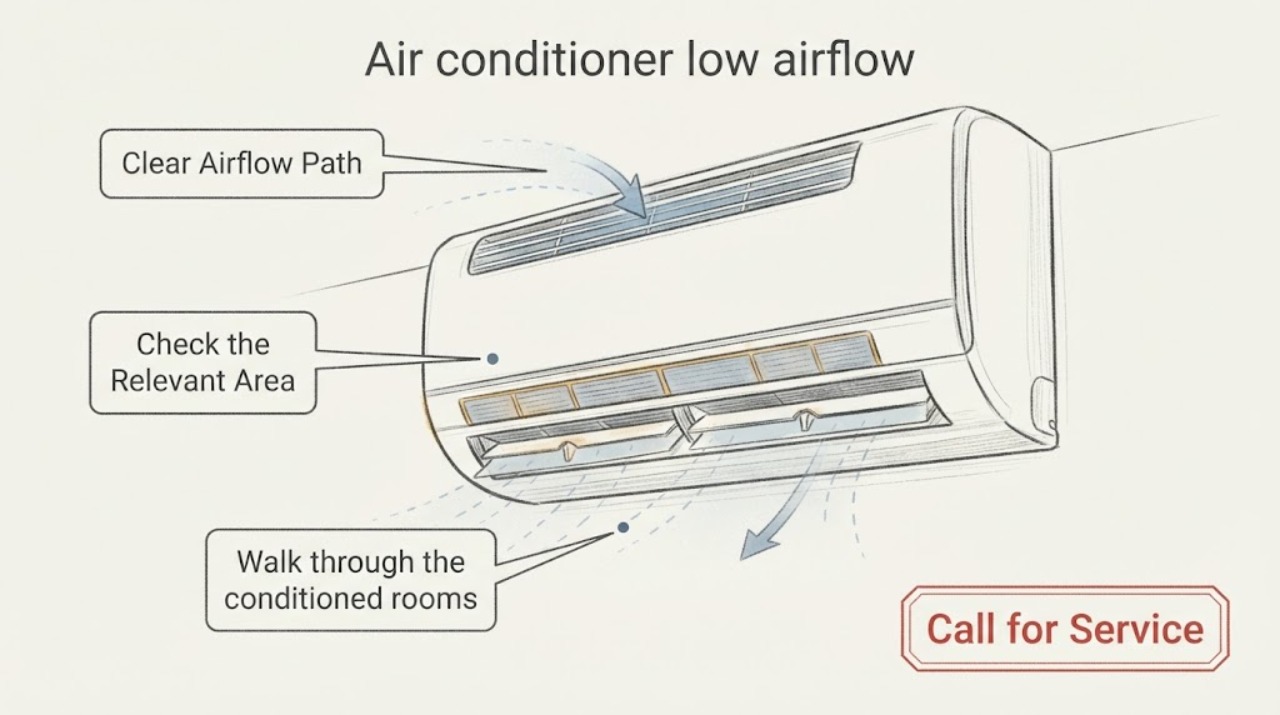
Work through in order
Diagnostic checks
Use only checks that match the exact appliance or system and its official guide.
-
Check 1
Set the thermostat to the normal cooling mode and compare airflow at several supply registers while checking that return grilles are not blocked; note whether one room or the whole system is weak.
Expected result: One register is weak while others are normal, or all registers have noticeably low airflow.
Next step: For one weak register, clear its grille and visible surroundings. For system-wide weakness, continue with the filter and return-air checks before running the system for a long period.
Why this matters
Why: A single weak register points first to a local grille, damper, furniture, or visible duct restriction; low airflow everywhere points toward a shared filter, return, coil, blower, or duct problem.
-
Check 2
Turn the air conditioner off at the thermostat, locate each filter at the return grille or air handler, and check that the filter is not packed with dust and that its airflow arrow points toward the unit; replace it only with the size and type specified by the equipment documentation.
Expected result: The filter is visibly loaded, collapsed, wet, missing, or installed against the airflow arrow; alternatively, it is clean and correctly oriented.
Next step: Fit the documented replacement, secure the cover, and retest briefly. If airflow stays weak, continue to the grille, ice, and outdoor-unit checks rather than opening the air handler.
Why this matters
Why: A dirty or poorly fitted filter can reduce airflow and contribute to a frozen evaporator coil. A clean, correctly fitted filter makes the filter a less likely cause, so do not keep adding more restrictive filters as a guess.
-
Check 3
Walk through the conditioned rooms and open supply registers; move furniture, rugs, or curtains away from supply and return grilles, and make sure a return grille is not covered by a stored item.
Expected result: A register or return was physically blocked and airflow improves after it is cleared, or every grille is already open and unobstructed.
Next step: Leave the grilles clear and monitor the next cooling cycle. If all grilles remain weak, arrange an HVAC inspection instead of cutting into ducts or removing panels.
Why this matters
Why: A blocked register can make a room feel under-supplied and a blocked return can starve the system of air. If clearing visible obstructions changes nothing, the restriction may be inside the duct, coil, filter cabinet, or blower compartment.
-
Check 4
With cooling off, look without touching for frost or ice on accessible refrigerant tubing or around the indoor coil area, and look for unusual water collecting near the indoor unit.
Expected result: Ice or frost is visible, cooling is inadequate, or water appears around the indoor unit; alternatively, no ice or water is visible.
Next step: Leave cooling off and contact a qualified HVAC professional. Do not use a hair dryer, space heater, refrigerant, or tools on the coil; if there is no ice or water, continue with the outdoor-unit observation.
Why this matters
Why: Restricted airflow or low refrigerant can freeze an evaporator coil, and the thawing ice can create excess water. Ice is a stop-use signal, not a condition to scrape or heat away.
-
Check 5
During a brief cooling call, observe the outdoor unit from a safe distance: check whether its fan runs and whether leaves or debris are packed around the cabinet; do not remove the grille or reach inside.
Expected result: The outdoor fan does not run, the unit makes loud or unusual noise, or the cabinet is visibly obstructed; alternatively, the fan runs normally and the air path is clear.
Next step: If the fan is not running, noise is abnormal, or the unit trips power, stop the cooling call and obtain professional service. If only loose debris is present, clear it from around the cabinet without opening the unit, then retest once.
Why this matters
Why: A non-running fan or unusual noise can involve high-voltage motors, capacitors, or compressors. Debris around the outdoor unit can reduce heat rejection, but a clear cabinet does not rule out an indoor airflow fault.
-
Check 6
After correcting a filter or visible obstruction, run the system briefly and watch for repeated shutdowns, water at the indoor unit, a burning smell, or a breaker that trips again.
Expected result: Airflow returns and remains steady without abnormal heat, water, odor, or electrical interruption, or one of those warning signs appears.
Next step: Monitor only if operation is normal. If any warning sign appears, turn cooling off, leave the equipment alone, and call a qualified HVAC professional; do not repeatedly reset a tripping breaker.
Why this matters
Why: Stable airflow after a low-risk maintenance correction supports a restricted-filter or grille explanation. A recurring warning points to a mechanical, refrigerant, drainage, or electrical fault rather than a simple airflow blockage.
Use your observations
Decision map
Find the observation that best matches what you see, then follow the next safe action.
-
PATH 01Next step
What you see
Only one supply register has weak airflow.
Do this next
Clear that register and its visible surroundings, then check the nearby return and accessible duct; if it remains weak, request a duct or distribution inspection.
-
PATH 02Next step
What you see
All registers are weak and the filter is dirty or incorrectly fitted.
Do this next
Replace the filter with the documented size and airflow orientation, secure the cover, and retest briefly; escalate if airflow does not recover.
-
PATH 03Next step
What you see
All registers are weak but the filter and visible grilles are clear.
Do this next
Stop prolonged operation and arrange an HVAC inspection for the blower, indoor coil, ductwork, or other concealed restriction.
-
PATH 04Next step
What you see
Ice or frost, unusual water, a burning smell, repeated breaker trips, or a non-running outdoor fan is present.
Do this next
Turn cooling off and seek professional HVAC service; do not remove panels, handle refrigerant, or keep resetting the electrical supply.
-
PATH 05Next step
What you see
Airflow returns after a documented filter change or clearing a blocked grille and no warning sign returns.
Do this next
Keep the filter and grilles maintained and monitor the next cycle; recurring low airflow needs a professional diagnosis.
Helpful context
Understand the symptom
First separate a room problem from a system problem
Feel the airflow at several supply registers with the same cooling call. If only one register is weak, check that register, its damper, nearby furniture, and the visible section of its duct. If every register is weak, prioritize the return path and filter before assuming the compressor is at fault. This comparison is a diagnostic shortcut, not a reason to open ductwork or the air handler.
Keep the DIY boundary narrow
Filter and grille checks are ordinary maintenance when performed with the equipment off and according to the equipment manual. Do not remove panels, handle refrigerant, reach into a blower or condenser, or probe electrical terminals. A clean filter does not rule out a dirty coil, duct restriction, failed blower, low refrigerant, or another service issue.
When checks do not resolve it
Need a professional?
Use professional service for concealed airflow restrictions, blower or coil faults, refrigerant diagnosis, electrical symptoms, repeated freezing, or any work beyond filter and grille maintenance.
Common questions
FAQ
Is a dirty filter the only cause of low air conditioner airflow?
No. A clogged filter is a common first check, but blocked return or supply grilles, duct restrictions, a dirty or frozen coil, blower problems, and other faults can also reduce airflow. If a documented filter change does not help, do not keep guessing with different filters; arrange an inspection.
Should I run the AC if I see ice on the lines?
No. Turn cooling off and contact a qualified HVAC professional. Restricted airflow and low refrigerant can freeze the evaporator coil, and continuing to operate a frozen system can damage the equipment.
Why is one room getting less air than the others?
Start with that room's register, damper, nearby furniture, curtains, return path, and any visible duct section. If one register remains weak while others are normal, a local distribution or duct issue is more likely than a system-wide filter restriction and should be inspected if it is not accessible.
Can I inspect the evaporator coil or add refrigerant myself?
Do not open the air handler or work on refrigerant. Ice, low cooling, or suspected refrigerant loss needs a qualified HVAC professional, who can diagnose the cause and handle the refrigerant circuit safely.
Read the exact guide
Official sources
- AC Maintenance: Routine Tasks and Tips for HomeownersTrane · Residential central air-conditioning systems
- 8. Air DistributionENERGY STAR / U.S. Environmental Protection Agency · HVAC air-distribution systems
- HomeCooling101U.S. Department of Energy · Residential air-conditioning systems
- HVAC Basics: HVAC System Air FiltersTrane · Residential air-conditioning and heating systems
- Troubleshoot an Air Conditioner: 6 Steps to Fix an AC Not WorkingCarrier · Residential split-system air conditioners
Community feedback
Share a repair observation
Share a plain-text repair observation. Accepted observations are published automatically; this page may take a moment to update.