
On this page
Start here
Quick answer
For low airflow from an air conditioner, first confirm that the thermostat is calling for cooling and that the fan is not limited by its mode or schedule. Then turn the system off and check the accessible air filter, return grille, and supply registers. If airflow is weak at every register, ice or water is visible, the indoor fan does not run, or the problem returns with a clean filter and correct settings, stop operating the system and arrange HVAC service; those signs can indicate a frozen coil, blocked duct, blower fault, condensate safety shutdown, or another condition that needs professional diagnosis.
Work through in order
Diagnostic checks
Use only checks that match the exact appliance or system and its official guide.
-
Check 1
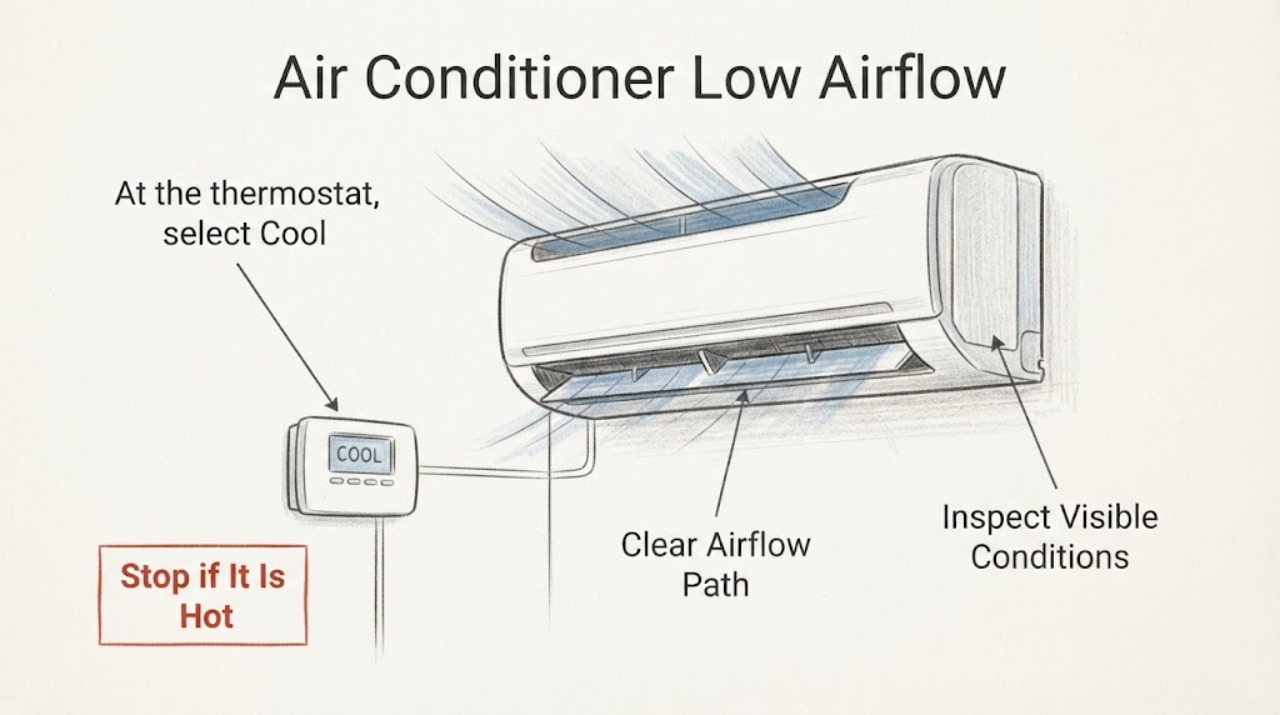
At the thermostat, select Cool, set the target below the current room reading, and set the fan to Auto; check whether a programmed schedule, hold, or fan-only setting is overriding the request.
Expected result: The cooling indicator appears and the indoor fan starts during a cooling call, or the display stays blank, shows a delay, runs the fan without a cooling call, or does not change the system.
Next step: If the call is correct, continue to the filter and register checks. If the screen is blank, the control remains unresponsive, or the delay does not clear according to the thermostat instructions, stop troubleshooting and use HVAC service.
Stop if: Stop if the thermostat or wall wiring is hot, damaged, wet, or smells burnt.
Why this matters
Why: A correct call with normal fan response makes a simple thermostat setting less likely; a blank, delayed, overridden, or nonresponsive control can explain the weak-airflow report or points to a control/power problem.
-
Check 2
After switching the air conditioner off at the thermostat, inspect each accessible return filter without running the unit with the filter removed; replace or clean it only according to its label and the equipment instructions, with the airflow arrow oriented correctly.
Expected result: The filter is visibly loaded with dust, bent, wet, collapsed, or the wrong size, versus clean, dry, correctly seated, and unobstructed.
Next step: Restore the filter and cover, then run one normal cooling call. If airflow remains weak everywhere or the filter becomes wet or heavily loaded again quickly, stop and request HVAC diagnosis.
Stop if: Stop if the filter area has standing water, exposed wiring, sharp damage, or a burning smell.
Why this matters
Why: A loaded or poorly seated filter can restrict return airflow and make the indoor fan work harder; a clean correctly fitted filter shifts attention to the return path, registers, fan, coil, or control system.
-
Check 3
With the system off, walk the return grille and supply registers: open the registers, move furniture or drapes away, and look for a blocked grille or an obvious collapsed or disconnected accessible grille cover.
Expected result: Only one room or branch has weak flow, while the other registers are normal, or every register has weakened airflow.
Next step: If opening an accessible register restores that room, leave the path clear and monitor it. If all registers remain weak or a duct is detached, crushed, wet, or inaccessible, stop and call an HVAC professional.
Stop if: Do not open walls, ceilings, ducts, or equipment panels to reach a suspected restriction.
Why this matters
Why: A single-room pattern is consistent with a register, damper, or branch-duct restriction; a whole-home pattern is more consistent with a shared filter, return, indoor fan, coil, condensate safety switch, or control issue.
-
Check 4
During a brief cooling call, observe the accessible supply air and the indoor-unit area from a safe distance without removing panels; look for ice on visible tubing or coil edges, unusual water, or a condensate pan that appears to be filling.
Expected result: Ice, excessive water, or a rising condensate pan is visible, or there is no ice or water but airflow is still low.
Next step: If ice or unusual water is present, switch cooling off and leave the system off while arranging service. Do not chip ice, open the coil cabinet, clear a hidden drain, or add refrigerant yourself.
Stop if: Stop immediately for water near electrical equipment, active leaking, smoke, a burning smell, or a hot or damaged disconnect.
Why this matters
Why: Ice can result from restricted airflow or another cooling-system fault, and a condensate safety switch can shut down an indoor unit; no visible ice does not rule out a blower, duct, coil, or thermostat-control fault.
-
Check 5
From outside the equipment enclosure, listen and observe whether the indoor fan runs during a cooling call and whether the sound changes to humming, scraping, repeated starting, or silence; do not remove the blower or electrical access cover.
Expected result: The fan runs with steady airflow, runs but airflow is weak, repeatedly starts and stops, or does not run while the thermostat calls for cooling.
Next step: Record the sound, whether the outdoor unit runs, and whether the symptom is limited to cooling or also occurs in fan-only mode. If the fan does not run or the symptom repeats, stop and schedule HVAC service.
Stop if: Do not reach into the blower, touch wiring, or continue testing after smoke, arcing, a burning odor, or a breaker trip.
Why this matters
Why: A running fan with weak flow keeps air-side restriction or an iced coil in play; repeated starts, unusual noise, or a silent indoor fan points toward a motor, wheel, control, safety-switch, or power fault that is not a thermostat-setting repair.
-
Check 6
After the accessible checks, make one normal cooling call and compare several registers with the original symptom; note the thermostat setting, room temperature, fan mode, filter condition, ice or water, and the exact rooms affected.
Expected result: Airflow returns after the setting or filter correction, improves only in one room, or remains weak throughout the home despite an unobstructed filter and registers.
Next step: Keep the documented observations and arrange an HVAC visit when the symptom persists, returns, or the indoor temperature cannot be maintained. Do not attempt refrigerant work or high-voltage diagnosis.
Stop if: Stop the test immediately for ice, water near electrical parts, smoke, burning odor, arcing, repeated breaker trips, or unsafe heat.
Why this matters
Why: A lasting improvement supports a control or maintenance restriction; a location-specific result supports a branch/register issue; persistent whole-home weakness calls for professional measurement of the blower, duct system, coil, condensate safety, and refrigerant circuit.
Use your observations
Decision map
Find the observation that best matches what you see, then follow the next safe action.
-
PATH 01Next step
What you see
The thermostat is not calling for cooling, is overridden by a schedule, or has a blank or unresponsive display.
Do this next
Correct only the documented mode, fan, target, battery, or user setting. If the control still does not respond, stop and call an HVAC professional.
-
PATH 02Next step
What you see
A dirty, wet, damaged, or incorrectly seated filter is found.
Do this next
Turn the system off, install the correct clean or replacement filter as directed by its label and equipment instructions, and reassess once. If airflow stays low or the filter quickly becomes wet or loaded, request service.
-
PATH 03Next step
What you see
Only one room has weak airflow and other registers are normal.
Do this next
Keep that register and return path clear and have the branch duct, damper, or accessible grille assessed if the imbalance persists; do not open concealed ductwork.
-
PATH 04Next step
What you see
All registers are weak, the indoor fan is silent or cycling, or the system has unusual noise.
Do this next
Stop repeated testing and arrange HVAC service for the blower, controls, safety switch, coil, return, and duct system. Do not open electrical panels or work on refrigerant components.
-
PATH 05Next step
What you see
Ice, active water, smoke, burning odor, arcing, or repeated breaker trips are present.
Do this next
Turn the system off from a safe control if possible, keep people away from wet or damaged equipment, and use urgent HVAC or electrical help as appropriate.
Helpful context
Understand the symptom
Low airflow is a symptom, not a diagnosis. Because this topic points to the thermostat, begin at the wall control and compare what the system does during a cooling call with what it does in fan-only operation. A setting, schedule, battery, or time delay can make the equipment appear weak or unresponsive even when the thermostat is the only problem.
If the thermostat is requesting cooling correctly, the restriction may be on the air side: a loaded filter, covered return, closed register, blocked duct, or ice on the indoor coil. Check only accessible surfaces. Do not remove electrical panels, reach into the blower, work on refrigerant tubing, or force a frozen system to run.
A difference between one weak room and weak airflow everywhere is useful evidence. A single-room pattern points toward a register, damper, or branch duct, while a whole-home pattern points toward the filter, return path, indoor fan, coil, condensate safety switch, or controls. Record the pattern and the stage when it occurs so the technician can start with the right part of the system.
A clean filter and correct thermostat settings do not prove that the thermostat is healthy. If the screen is blank, the system ignores a cooling call, the indoor fan will not run, or the system repeatedly stops, use the service boundary below rather than repeatedly resetting or opening the equipment.
Safety boundary
Stop conditions
- Stop immediately for smoke, a burning or electrical odor, arcing, a hot or damaged switch/disconnect, or a breaker that trips again.
- Stop cooling when ice or active water is visible, especially near electrical equipment; do not chip ice or restart repeatedly.
- Stop if a filter or accessible cabinet area is wet, damaged, sharp, or exposes wiring, or if the check would require opening a wall, duct, panel, or coil cabinet.
Only after diagnosis
Potential parts
- HVAC air filter
Consider a replacement only when the existing filter is loaded, wet, damaged, or due for replacement and the size and filter type are confirmed from the existing filter or equipment instructions.
Confirm the exact dimensions, airflow direction, and equipment requirements before installing any filter. - thermostat batteries
Consider batteries only if the thermostat model uses user-replaceable batteries and its display is blank or reports low power.
Use the battery type and replacement procedure specified by the thermostat manufacturer; do not infer compatibility from the HVAC brand. - thermostat or HVAC control
This is a professional diagnosis item only if the control remains unresponsive or fails to send a cooling/fan call after safe setting and power checks.
A qualified technician must confirm system wiring, equipment type, voltage class, and control compatibility before replacement.
When checks do not resolve it
Need a professional?
Call an HVAC professional if low airflow remains after one correct thermostat setup and an accessible filter/register check., Arrange prompt service for visible ice, condensate overflow, a silent or repeatedly cycling indoor fan, persistent control errors, or weak airflow throughout the home., Do not perform refrigerant work, open high-voltage equipment, reach into the blower, or bypass a condensate or electrical safety device.
Common questions
FAQ
Can a thermostat cause low air conditioner airflow?
Yes. An incorrect mode or fan setting, an overridden schedule, a blank display, or a control that does not complete the cooling call can make airflow appear weak or absent. If settings are correct but the symptom persists, the cause may be in the filter, return path, blower, coil, safety switch, ductwork, or refrigeration system.
Should I run the air conditioner with the filter removed to test airflow?
No. Turn the system off before inspecting or replacing an accessible filter, and reinstall the correct filter before a normal test. If airflow remains low with a clean, correctly seated filter, arrange professional diagnosis rather than running without filtration.
What does ice on the air conditioner mean when airflow is low?
Ice can accompany restricted airflow or another cooling-system problem. Turn cooling off and arrange HVAC service; do not chip the ice, open the coil cabinet, or attempt refrigerant work.
Why is one room's airflow weak while the others are normal?
A single-room pattern makes an obstructed register, return, damper, or branch duct more likely than a thermostat setting that affects the whole system. Keep accessible grilles clear and have concealed ductwork or dampers assessed if the imbalance continues.
Read the exact guide
Official sources
- Troubleshoot an Air Conditioner: 6 Steps to Fix an AC Not WorkingCarrier · Carrier residential air conditioner troubleshooting
- Common Thermostat Issues and How to TroubleshootCarrier · Carrier residential thermostat troubleshooting and safety
- AC Not Blowing Cold Air? Learn What to DoTrane · Trane residential air conditioner troubleshooting
- Central AC Maintenance: Routine Tasks and TipsTrane · Trane residential central air conditioner maintenance
Community feedback
Share a repair observation
Share a plain-text repair observation. Accepted observations are published automatically; this page may take a moment to update.