
On this page
Start here
Quick answer
Set the thermostat to OFF so the compressor stops, allow the ice on the evaporator coil to melt naturally, and do not chip it away or use heat. While the system is off, check only the thermostat display and accessible filter, return, supply, and drain areas. A dirty filter, blocked airflow, a condensate problem, low refrigerant, or a control fault can all be associated with a frozen coil; recurring ice or weak airflow needs an HVAC technician rather than a thermostat or refrigerant repair.
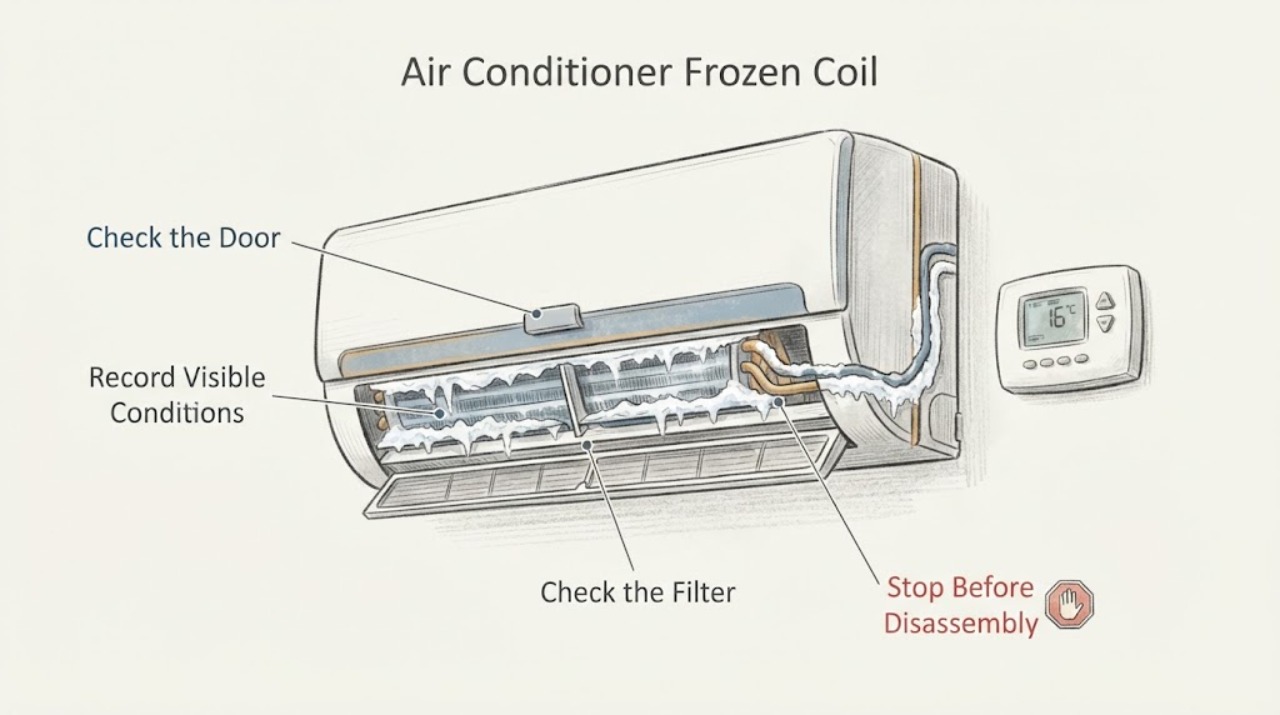
Work through in order
Diagnostic checks
Use only checks that match the exact appliance or system and its official guide.
-
Check 1
At the thermostat, change the mode from COOL to OFF and leave cooling off while ice is visible. Note whether the indoor fan is set to AUTO or ON, but do not remove the thermostat or its wiring.
Expected result: The outdoor compressor stops and the ice remains while it thaws; the fan setting and thermostat display can be recorded without opening the equipment.
Next step: Allow a full natural thaw. If water reaches electrical equipment, stop and call HVAC service; do not turn cooling back on to test the result.
Why this matters
Why: OFF removes the cooling call so the coil can thaw. A fan that runs continuously may point to a setting or control issue, while the setting alone cannot confirm a thermostat failure.
-
Check 2
Read the thermostat display after the system is off. Record the room temperature, setpoint, mode, fan state, schedule or hold indicator, and any displayed alert exactly as shown.
Expected result: The display may show COOL with a low setpoint, a schedule that changes the setpoint, a fan call that continues, or an alert; it may also be normal with no alert.
Next step: After the thaw, use the normal manufacturer-approved comfort setting and observe one cycle. If an alert returns or the system keeps calling unexpectedly, give the exact display information to an HVAC technician.
Why this matters
Why: A mode, schedule, or control indication can explain an extended cooling call, but a normal display does not rule out restricted airflow or a refrigeration fault.
-
Check 3
With cooling still OFF, inspect the accessible air filter and the return grilles. Replace or clean the filter only in the manner allowed by its label, and move furniture, curtains, or boxes away from returns and supply registers.
Expected result: A filter may be visibly loaded, wet, collapsed, or the wrong size; a return or supply may be blocked, while the accessible airflow path may look clear.
Next step: Do not restart cooling until the ice and any pooled water are gone. If the filter becomes wet, the airflow stays weak, or icing returns, stop using COOL and book HVAC service.
Why this matters
Why: A restricted air path can reduce air over the evaporator and promote icing. A clear filter and open grilles shift attention toward coil cleanliness, blower performance, refrigerant, or controls.
-
Check 4
After the coil has fully thawed and no water is near electrical parts, run a brief normal cooling call while observing airflow from several supply registers without touching the equipment.
Expected result: Airflow may be steady at all registers, weak at several registers, weak at one zone, or absent while the outdoor unit runs; note whether frost begins again.
Next step: Turn COOL back to OFF if frost reappears, airflow falls, or the indoor unit leaks. Do not continue cycling the system for comparison; provide the airflow pattern and timing to the technician.
Why this matters
Why: Weak or uneven airflow supports an air-distribution, filter, blower, duct, or coil restriction. Frost that returns quickly with acceptable airflow makes a refrigerant, metering, coil, or control problem more likely.
-
Check 5
Look from a safe, dry position at the accessible condensate pan or drain outlet, if visible without removing a cover. Do not reach into the air handler or pour cleaner into an unknown drain.
Expected result: There may be a clear drain outlet, standing water, overflow staining, or water near wiring; there may also be no visible drain access.
Next step: Keep the system OFF and call HVAC service for standing water, overflow, or inaccessible drainage. Never restore power to wet equipment yourself.
Why this matters
Why: A blocked condensate path can cause water damage as ice melts, and water near electrical equipment changes this from a routine observation to a safety issue.
-
Check 6
From outside the equipment, check that the outdoor unit has open space around it and note the outdoor temperature, recent weather, and whether the outdoor fan runs during a normal call. Do not remove the outdoor cabinet or touch the fan.
Expected result: The condenser area may be clear or packed with leaves; the fan may run normally, fail to run, or stop while the compressor continues, depending on the system and conditions.
Next step: Keep hands and tools out of the unit. If the fan does not run, the unit makes unusual noise, or frost returns, turn COOL OFF and arrange HVAC service.
Why this matters
Why: Outdoor restriction or a fan fault can reduce system performance, but outdoor observations cannot establish refrigerant charge or electrical condition. A system that freezes in mild weather or shortly after restart needs a professional assessment.
-
Check 7
Compare the next symptom only after a complete thaw and one normal, supervised cycle: thermostat behavior, airflow, water, frost location, and whether the compressor or fan runs.
Expected result: The problem may clear after a filter or airflow correction, remain with normal airflow, recur at the same coil area, or return with water or an alert.
Next step: Stop the cooling call when ice returns and give the technician the exact sequence, settings, weather, filter condition, airflow pattern, and water observations. Do not open the system or add refrigerant.
Why this matters
Why: A one-time icing event after a blocked filter can differ from repeated icing with good airflow. Repeated or localized frost can involve the coil, refrigerant circuit, blower, sensor, or control and cannot be assigned to the thermostat from observation alone.
Use your observations
Decision map
Find the observation that best matches what you see, then follow the next safe action.
-
PATH 01Next step
What you see
Smoke, burning odor, arcing, an unusually hot electrical part, or a tripped breaker is present.
Do this next
Arrange qualified service and follow the exact model guidance.
Why this path and its safety boundary
Why it matters: Stop using the system, leave the area if there is immediate danger, and use emergency services when there is smoke or fire. Do not reset the breaker or touch the equipment.
-
PATH 02Next step
What you see
Ice is visible but there is no smoke, electrical damage, or nearby water.
Do this next
Arrange qualified service and follow the exact model guidance.
Why this path and its safety boundary
Why it matters: Set the thermostat to OFF, allow natural thawing, and perform only the accessible filter, grille, thermostat-display, and drain observations.
-
PATH 03Next step
What you see
The filter or return path is clearly restricted and the coil does not refreeze after a complete thaw and correction.
Do this next
Arrange qualified service and follow the exact model guidance.
Why this path and its safety boundary
Why it matters: Monitor one normal cycle, then arrange routine HVAC maintenance if airflow remains weak or the symptom returns.
-
PATH 04Next step
What you see
Airflow is normal but frost returns, frost is localized, or cooling performance remains poor.
Do this next
Arrange qualified service and follow the exact model guidance.
Why this path and its safety boundary
Why it matters: Keep COOL off and request HVAC diagnosis for coil condition, blower operation, refrigerant circuit, metering, sensors, and controls.
-
PATH 05Next step
What you see
Water is overflowing, reaches wiring or an electrical enclosure, or the indoor unit is wet.
Do this next
Arrange qualified service and follow the exact model guidance.
Why this path and its safety boundary
Why it matters: Leave the system off, keep clear of wet electrical areas, and request HVAC service; do not restore power or remove a panel.
-
PATH 06Next step
What you see
The thermostat shows an alert, changes mode unexpectedly, or keeps calling for cooling after the setpoint is met.
Do this next
Arrange qualified service and follow the exact model guidance.
Why this path and its safety boundary
Why it matters: Record the exact display and schedule behavior, leave cooling off if icing is present, and give those details to an HVAC technician.
Helpful context
Understand the symptom
A frozen coil usually means the indoor evaporator is below the conditions needed to keep moisture from freezing. The thermostat is still worth checking because a wrong mode, an unusually low setpoint, or a control that keeps calling for cooling can keep the system running, but the thermostat is not proof of the root cause. Treat visible ice as a reason to stop cooling first.
This page covers external checks only. Do not remove an air-handler panel, open a refrigerant circuit, disconnect thermostat wires, test live voltage, add refrigerant, or use a tool, hot water, or flame to melt ice. Keep people away from wet electrical equipment and arrange HVAC service when the safe checks do not resolve the condition.
Let the ice melt completely before judging the result. Water may appear at the indoor unit as the ice thaws, so protect nearby belongings without blocking the drain or touching electrical parts. If the coil freezes again after a normal cooling cycle, continued operation can stress the compressor and the system needs professional diagnosis.
Safety boundary
Stop conditions
- Stop immediately for smoke, fire, burning odor, arcing, a hot plug or enclosure, repeated breaker trips, or an electrical part that is wet.
- Do not chip, scrape, or pry ice from the coil, and do not use hot water, a heat gun, a flame, or another heat source to thaw it.
- Do not remove the air-handler or outdoor-unit cover, disconnect thermostat wiring, test live voltage, open the refrigerant circuit, or add refrigerant.
- Keep cooling OFF when ice returns, airflow becomes weak, the compressor or fan behaves abnormally, or water reaches an electrical area.
- Request professional HVAC service when the cause is not corrected by an accessible filter or airflow obstruction, or when icing recurs after a complete thaw.
When checks do not resolve it
Need a professional?
Call an HVAC technician for repeated or localized icing, weak airflow after the filter path is clear, a thermostat that behaves unexpectedly, abnormal fan or compressor behavior, a blocked or overflowing condensate path, or any suspected refrigerant, coil, blower, sensor, or control fault. Use emergency services for smoke or fire, and do not approach energized or wet electrical equipment.
Have this ready
- Give the technician the exact thermostat mode, setpoint, fan state, alert text, time to refreeze, filter condition, airflow pattern, drain observations, outdoor conditions, and any water or unusual sound.
Common questions
FAQ
Can the thermostat cause an air conditioner coil to freeze?
A wrong mode, an unusually low setpoint, a schedule, or an unexpected cooling call can keep the system operating, but a frozen coil more often requires checking airflow, coil condition, condensate drainage, refrigerant, and controls. The thermostat display cannot prove which component is at fault.
Should I set the fan to ON to thaw the coil?
Set COOL to OFF first. Use a fan-only setting only if the equipment manual permits it and no water is near electrical parts; otherwise leave the system off and let the ice melt naturally. Never use heat or scrape the ice.
How long should a frozen coil thaw?
The time depends on the amount of ice, indoor conditions, and airflow, so do not restart cooling while any ice remains. If water appears near electrical equipment or the drain overflows, keep the system off and call HVAC service.
Can I add refrigerant after the coil freezes?
No. A frozen coil can have several causes, and refrigerant diagnosis and charging belong to a qualified HVAC technician. Keep cooling off if the frost returns and provide the technician with the observed sequence.
When is a frozen coil an emergency?
Smoke, fire, arcing, a burning odor, repeated breaker trips, or water reaching electrical equipment requires immediate stopping and a safety response. Leave if there is immediate danger and use emergency services for smoke or fire; do not touch wet or energized equipment.
Read the exact guide
Official sources
- HVAC FAQs: Heating & Cooling AnswersCarrier · Manufacturer homeowner guidance on thermostat controls, alerts, filters, and HVAC service support
- Measure Guideline: Air Conditioner Diagnostics, Maintenance, and ReplacementU.S. Department of Energy, Building Technologies Office · Air conditioner evaporator coil fouling, restricted airflow, icing risk, compressor protection, and professional diagnostics
- Maintenance ChecklistENERGY STAR · Central air conditioner maintenance, filters, coils, blower airflow, controls, refrigerant checks, and condensate drain checks
- HVAC Quality InstallationENERGY STAR · Residential HVAC airflow, refrigerant charge, duct evaluation, and qualified contractor guidance
- Evaporator Coils for Residential ACCarrier · Residential evaporator coil symptoms, coil matching, visible frost, water pooling, and licensed installation boundaries
Community feedback
Share a repair observation
Share a plain-text repair observation. Accepted observations are published automatically; this page may take a moment to update.