
On this page
Start here
Quick answer
If an air conditioner has ice on the evaporator coil or refrigerant line, switch the thermostat from COOL to OFF and do not chip the ice or keep running the system. Trane identifies restricted airflow from a dirty filter, blocked return vents, or a dirty coil as common causes, while low refrigerant, a blower problem, or thermostat trouble can also freeze the coil. Replace a visibly dirty filter with the correct type, make sure return and supply vents are not blocked, and let the system thaw with the cooling call off. Check for water under the indoor unit as ice melts. If the coil refreezes, airflow remains weak, the blower or outdoor fan does not operate, the capacitor may be involved, or there is an oily residue or suspected refrigerant leak, stop and arrange licensed HVAC service; do not open the coil case or handle refrigerant.
Before you begin
Safety first
- A qualified HVAC professional may need to measure airflow, inspect the evaporator coil and blower, test the capacitor and controls, evaluate refrigerant charge and leaks, and verify safe operation. This article does not authorize live electrical testing, capacitor handling, refrigerant work, coil-case access, or sharp-tool defrosting.
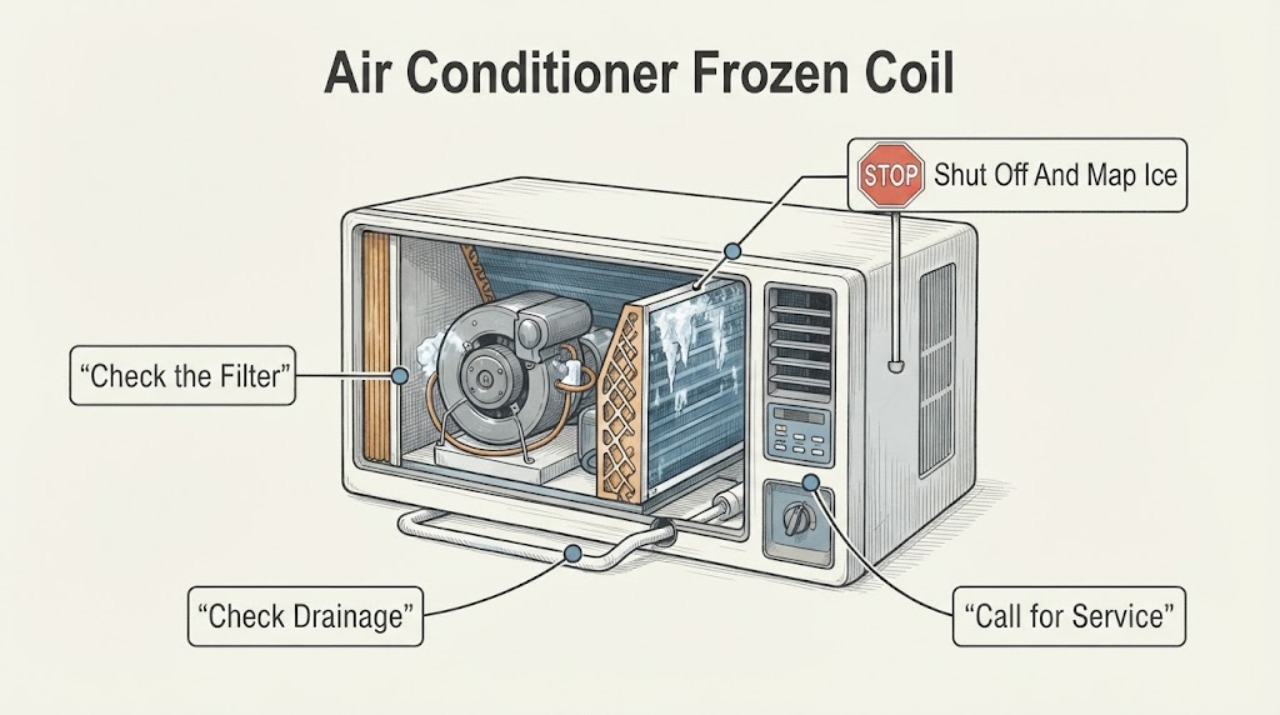
Work through in order
Diagnostic checks
Use only checks that match the exact appliance or system and its official guide.
-
Check 1
Switch the thermostat from COOL to OFF when ice is visible on the indoor evaporator coil, its cabinet, or a nearby refrigerant line; from a dry stable position, note the ice location, dripping water, airflow at a nearby supply vent, and whether the system is still calling for cooling.
Expected result: Ice is visible, water is dripping, airflow is weak or absent, or the system is not visibly iced but the complaint is only reduced cooling.
Next step: Leave COOL off and keep the area clear while the coil thaws. Use a towel or container only where it can be placed without entering water or contacting electrics, and continue only with the dry, user-accessible filter and vent check.
Stop if: Stop for water near electrical equipment, smoke, burning odor, sparks, damaged wiring, a suspected refrigerant leak, or an unsafe attic, crawlspace, or roof access.
Why this matters
Why: Visible ice is a frozen-coil stop condition. Weak airflow supports an airflow branch, while water during thaw is expected evidence to contain safely; reduced cooling without visible ice still needs a normal filter, vent, and service assessment rather than a refrigerant guess.
-
Check 2
After the cooling call is off and the filter area is safe to reach, inspect the installed air filter and visible return and supply openings; replace only a clearly dirty filter with the model-specified type and remove loose furniture, dust, or drapes blocking airflow.
Expected result: The filter is loaded, a return or supply opening is blocked, the filter is clean and vents are open, or the restriction is behind a grille or cabinet.
Next step: Restore ordinary airflow without changing equipment design, then allow complete thaw and perform one supervised cooling test only if no safety concern remains. Request service for a hidden restriction or refreezing.
Stop if: Do not remove the coil case, reach into a blower, use a sharp tool on ice, wash an energized unit, or install an unapproved filter that restricts airflow.
Why this matters
Why: Trane identifies a clogged filter and blocked return vents as common restricted-airflow contributors to freezing. A clean filter and open vents do not clear a dirty indoor coil or prove the blower and refrigerant circuit are healthy.
-
Check 3
While COOL remains off, observe the thaw from outside the air handler and check for water under the indoor unit or in an accessible drain pan without touching the coil, entering pooled water, or using a heat gun or open flame.
Expected result: Ice melts with controlled drainage, water accumulates or leaks outside the expected pan, the coil remains frozen for an unusually long period, or there is no visible ice but airflow remains abnormal.
Next step: Keep cooling off, protect nearby materials from water, and arrange service for overflow, persistent ice, or any inaccessible drainage. Do not clear an internal drain or open the cabinet as part of this check.
Stop if: Stop for water near wiring, ceiling damage, sewage or contaminated water, structural instability, or any need to enter an unsafe equipment space.
Why this matters
Why: Water from thaw confirms that ice was present but does not identify why the coil froze. A leak, overflow, inaccessible drain, persistent ice, or abnormal airflow needs professional attention; the absence of visible water does not prove the coil is clear.
-
Check 4
After all accessible ice has thawed and the filter or vent issue has been corrected, make one supervised cooling call and observe supply airflow, indoor blower response, outdoor-unit fan response from a safe distance, and whether frost begins returning; do not bypass a door switch or place hands near moving parts.
Expected result: Airflow is normal and cooling returns, airflow remains weak, the indoor blower or outdoor fan does not run, the system hums and stops, or frost returns quickly.
Next step: Turn COOL off at the first sign of returning ice and arrange HVAC service for any abnormal response. Keep the observation record instead of repeating the test.
Stop if: Do not open electrical panels, touch fan blades, test a capacitor, bypass interlocks, or keep running a system that begins icing again.
Why this matters
Why: Normal airflow and cooling after a clear filter or vent issue support an airflow-related event but do not guarantee that it will not recur. Weak or absent airflow, a non-running fan, humming, or rapid refreezing points to a blower motor, capacitor, coil, control, or refrigerant diagnosis.
-
Check 5
From outside the coil case and without disturbing tubing, look for an oily residue, damaged refrigerant line, hissing, or a repeated ice pattern after the filter and vent checks; note whether cooling output is warm or the system short-cycles.
Expected result: There is residue or tubing damage, repeated ice on a similar section, warm air with low cooling, short cycling, or no visible leak evidence.
Next step: Leave the system off and arrange licensed HVAC service for suspected leak or repeated freezing. Do not add refrigerant, tighten fittings, puncture insulation, or open the coil case.
Stop if: Stop for a damaged or exposed line, strong chemical odor, hissing, frostbite risk, or any request to handle refrigerant without the required professional equipment and authorization.
Why this matters
Why: A repeated or localized frost pattern and oily residue can support a refrigerant or coil service branch, but visual inspection cannot measure charge or confirm a leak. No visible residue does not rule out a sealed-system fault.
-
Check 6
Record the equipment model, thermostat mode, filter type and condition, blocked or open vents, ice location, thaw water, airflow, fan response, outdoor conditions, and whether icing returned after one supervised test; do not perform live electrical or refrigerant tests.
Expected result: A filter or vent correction prevents recurrence, the coil refreezes, airflow remains low, a fan or capacitor symptom appears, or cooling remains weak after thaw.
Next step: Monitor only when cooling and airflow are normal with no ice. Otherwise leave COOL off and give the full record to a licensed HVAC professional.
Stop if: Do not keep resetting the thermostat, operate with a frozen coil, open the air handler, or bypass a safety or electrical device.
Why this matters
Why: A successful correction supports an airflow-related cause, while refreezing or low airflow requires diagnosis beyond a filter change. A capacitor, blower, refrigerant, coil, thermostat, or control cannot be identified safely from the symptom alone.
Use your observations
Decision map
Find the observation that best matches what you see, then follow the next safe action.
-
PATH 01Safety boundary
What you see
Is ice visible on the evaporator coil, cabinet, or refrigerant line?
Do this next
Set COOL to OFF, do not chip the ice, contain thaw water from a safe dry position, and arrange service if the cause is not immediately clear.
Why this path and its safety boundary
Safety stop: Do not run cooling against visible ice.
-
PATH 02Safety boundary
What you see
Is the filter dirty or is a return or supply opening visibly blocked?
Do this next
Replace the filter with the specified type or clear only the loose obstruction, then allow complete thaw before one supervised test.
Why this path and its safety boundary
Safety stop: No coil-case access, improvised filter, or sharp-tool defrost.
-
PATH 03Safety boundary
What you see
Does thaw water overflow, reach electrical equipment, or damage the surrounding ceiling or floor?
Do this next
Keep COOL off, stay out of unsafe water, isolate power only when safe, and arrange qualified HVAC or building service.
Why this path and its safety boundary
Safety stop: No entry into pooled or contaminated water.
-
PATH 04Safety boundary
What you see
After thaw, is airflow weak or is an indoor or outdoor fan absent, humming, or stopping abnormally?
Do this next
Turn COOL off and arrange professional diagnosis of the blower motor, capacitor, fan, power, or controls.
Why this path and its safety boundary
Safety stop: Do not touch moving parts, capacitors, or live panels.
-
PATH 05Safety boundary
What you see
Does the coil refreeze after the airflow correction, or is there a repeated frost pattern or suspected refrigerant leak?
Do this next
Leave COOL off and arrange licensed HVAC service for airflow, coil, refrigerant, thermostat, and control diagnosis.
Why this path and its safety boundary
Safety stop: No refrigerant handling, sealed-system opening, or repeated cooling tests.
Helpful context
Understand the symptom
A frozen coil is a stop condition, not a performance setting
Ice on the indoor coil, cabinet, or nearby refrigerant line means the system is not moving heat normally. Continuing to run the compressor against a frozen coil can worsen the fault. Turn cooling off at the thermostat, leave the fan setting in the state recommended by the equipment manual, and keep people away from dripping water or an attic or utility-closet air handler until the area is safe.
Restore only ordinary airflow conditions
Once the cooling call is off and the coil has thawed enough to avoid contact with ice, check the filter and visible return and supply openings. Replace a loaded filter with the specified size and type, remove furniture or curtains blocking vents, and do not close many registers to redirect air. Do not wash or brush the evaporator coil, open the coil case, or use a heat source to force defrosting.
Refreezing points to a professional diagnosis
A clean filter does not rule out a failed blower motor, capacitor, thermostat, dirty coil, low refrigerant, leak, or another airflow restriction. A technician can verify airflow, coil condition, refrigerant charge and leak evidence, fan operation, and controls. A frozen coil that returns after the filter and vent check is evidence to provide to service, not a reason to keep resetting the system.
Only after diagnosis
Potential parts
- air filter
Consider this category only when the installed filter is visibly loaded and the equipment manual confirms the correct size and type.
Confirm the equipment model, dimensions, airflow rating, and manufacturer's requirements before selecting a filter. - blower motor or capacitor
Consider these categories only when airflow remains weak or the blower hums, fails to start, or stops after the coil has thawed and the filter and vents are clear.
Capacitor and motor specifications are equipment-specific and hazardous to test; qualified HVAC service should confirm the diagnosis and fit. - evaporator coil or refrigerant-circuit component
Consider this category only when a licensed technician confirms repeated freezing, leak evidence, a damaged coil, or a sealed-system performance fault after airflow checks.
Confirm equipment model, refrigerant requirements, and applicable professional procedures; do not open the sealed circuit or add refrigerant by guesswork.
When checks do not resolve it
Need a professional?
Arrange licensed HVAC service whenever the coil refreezes, airflow remains weak, a blower or outdoor fan does not operate, the filter and vents are clear but cooling is poor, or there is suspected refrigerant leakage, oily residue, water overflow, or equipment damage. Keep COOL off while waiting. Use emergency help for smoke, fire, dangerous electrical conditions, or structural water damage.
Safety scope: A qualified HVAC professional may need to measure airflow, inspect the evaporator coil and blower, test the capacitor and controls, evaluate refrigerant charge and leaks, and verify safe operation. This article does not authorize live electrical testing, capacitor handling, refrigerant work, coil-case access, or sharp-tool defrosting.
Have this ready
- Equipment model and thermostat mode when icing occurred
- Ice location, frost pattern, thaw water, and whether the coil refroze
- Filter type and condition and which return or supply openings were blocked or clear
- Indoor airflow, blower response, outdoor fan response, humming, short cycling, and cooling output
- Any oily residue, damaged tubing, electrical odor, breaker event, or water damage
Common questions
FAQ
Should I turn off an air conditioner with a frozen coil?
Yes. Switch the thermostat from COOL to OFF and do not chip the ice or keep running the system against a frozen coil. Let it thaw safely, check only the filter and visible vents, and arrange HVAC service if the cause is not clearly corrected.
Can a dirty filter freeze an AC coil?
A clogged filter can restrict airflow and contribute to coil freezing. Replace a visibly dirty filter only with the type and size specified for the equipment, keep return and supply openings clear, and request service if ice returns.
Can low refrigerant cause an evaporator coil to freeze?
Low refrigerant or a refrigerant leak can be associated with frost or ice, but visual ice does not prove the charge is low. A licensed HVAC professional should test the system and locate any leak; do not add refrigerant or open the sealed circuit yourself.
How do I thaw a frozen AC coil?
Turn COOL off and allow the ice to thaw naturally while protecting the surrounding area from meltwater. Do not chip the ice, use improvised heat, run the compressor, or open the coil case. Persistent ice or overflow needs professional service.
When should a frozen AC coil be serviced?
Arrange service if the coil refreezes, airflow stays weak, the blower or outdoor fan does not run, the filter and vents are clear but cooling is poor, water overflows, or you see oily residue or damaged refrigerant tubing. Stop for smoke, sparks, burning odor, or dangerous electrical conditions.
Read the exact guide
Official sources
- AC Fan Not Working? Reasons Why It Stopped SpinningTrane · Split-system air conditioners where indoor or outdoor fan behavior accompanies poor cooling or icing.
- Air Handler Freezing Up: Causes and SolutionsTrane · Central air-conditioning and air-handler systems with a frozen evaporator coil; confirm the exact equipment manual for controls and access.
- What Is an Evaporator Coil and Why Is Cleaning It Important?Trane · Air-conditioning evaporator coils showing icing, warm air, odd noise, or possible refrigerant leakage.
- Coils Troubleshooting GuideTrane · Air conditioners, heat pumps, and air handlers with coil performance or ice concerns.
Community feedback
Share a repair observation
Share a plain-text repair observation. Accepted observations are published automatically; this page may take a moment to update.