
On this page
Start here
Quick answer
If an air conditioner has a frozen evaporator coil, switch the thermostat from COOL to OFF and leave cooling off while the ice melts naturally. Do not chip the ice, pour hot water on it, use a flame, open the coil cabinet, or touch electrical or refrigerant parts. While the system is off and the area is safe, check the accessible air filter, return grilles, and supply registers for blockage and replace a visibly dirty filter with the exact specified type. Watch for thaw water and protect nearby flooring without touching wet electrical equipment. If the indoor blower does not run, the coil refreezes, airflow remains weak, an oily residue or refrigerant concern appears, or the system has smoke, burning odor, electrical noise, or water near controls, leave it off and call an HVAC professional. Restricted airflow is common, but low refrigerant, a dirty coil, thermostat issue, fan fault, or another refrigeration problem requires professional diagnosis.
Before you begin
Safety first
- This article supports thermostat shutoff, dry room-side filter and grille observation, and property protection from a safe position only. Do not chip ice, apply heat, open the air handler, touch electrical or refrigerant components, or perform sealed-system tests.
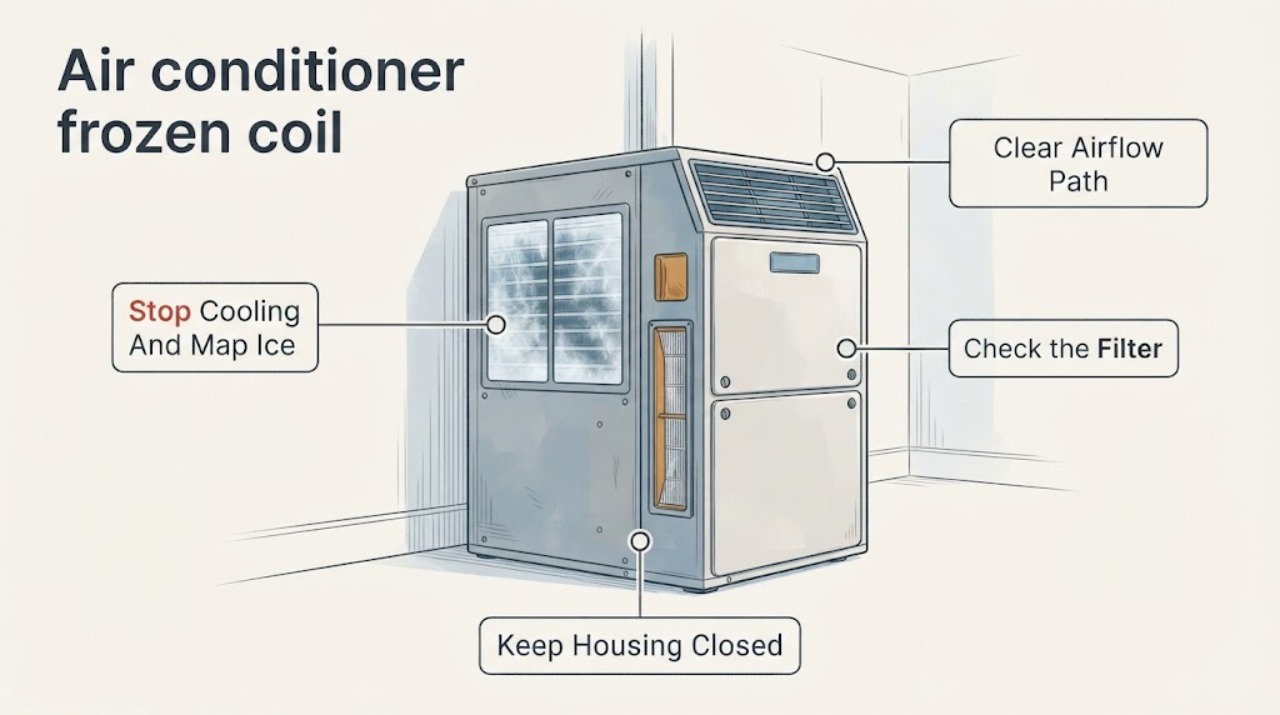
Work through in order
Diagnostic checks
Use only checks that match the exact appliance or system and its official guide.
-
Check 1
Set the thermostat from COOL to OFF and leave the air conditioner off; from a safe position, note visible ice on the indoor coil cabinet or accessible refrigerant line, weak or warm airflow, and any thaw water without touching the ice or opening the unit.
Expected result: Ice is visible, the system is only blowing warm air, water is pooling as ice melts, or there is no visible ice but cooling remains poor.
Next step: Keep COOL off, protect the floor from thaw water from a dry position, and continue only with accessible filter and airflow observations after the unit is safe.
Stop if: Do not chip, scrape, bend, or pull ice; stop for water near electrical equipment, smoke, burning odor, unusual electrical noise, or damaged insulation.
Why this matters
Why: Visible ice or thaw water supports a frozen-coil condition and makes continued cooling unsafe for the equipment. Poor cooling without visible ice can have another cause and still needs airflow and system checks.
-
Check 2
With cooling off and the filter access reachable from a dry position, inspect the accessible air filter without opening the coil cabinet or touching wet equipment; replace it only if it is visibly loaded and the exact specified replacement is known.
Expected result: The filter is heavily dirty, only lightly dusty, clean, missing, incorrectly seated, or cannot be reached without wet or electrical access.
Next step: Fit the correct filter in the indicated airflow direction and keep cooling off until the ice has melted; call HVAC service if the filter is clean, the filter fit is uncertain, or access is unsafe.
Stop if: Do not remove wet filter material near controls, reach into the air handler, wash an unknown filter in place, or run COOL to test an ice-covered coil.
Why this matters
Why: A heavily restricted filter can reduce airflow and contribute to freezing. A clean or inaccessible filter does not rule out a blocked coil, blower, duct, thermostat, or refrigeration fault.
-
Check 3
From the room side, check that return grilles and supply registers are open and not blocked by furniture, drapes, rugs, dust, or stored items; do not enter the air handler or remove duct panels.
Expected result: A return or supply path is blocked, airflow is weak at several registers, airflow is normal, or the issue is limited to one register.
Next step: Clear only loose room-side obstructions and leave cooling off while the coil thaws; arrange HVAC service when airflow remains weak or the system refreezes.
Stop if: Do not remove registers, open ducts, brush the indoor coil, or continue operation if water, smoke, burning odor, or electrical damage is present.
Why this matters
Why: Blocked return or supply airflow can starve the evaporator of moving air and contribute to icing. Weak airflow in several rooms points toward a filter, blower, coil, or duct issue; one weak register may be a local grille or duct problem.
-
Check 4
While COOL remains OFF and after the ice has had time to melt naturally, observe from the thermostat and room registers whether the indoor blower operates in a permitted fan-only mode and whether thaw water drains without approaching electrical equipment; do not force a fan cycle or touch the air handler.
Expected result: The blower provides normal room airflow, airflow is absent or weak, thaw water is controlled, water is overflowing, or the coil remains iced after a natural thaw period.
Next step: Keep cooling off and call HVAC service for absent airflow, overflow, persistent ice, or a system that cannot thaw safely; protect property only from a dry position.
Stop if: Do not touch wet wiring, motors, controls, drain pans, or electrical equipment; stop for flooding, smoke, burning odor, or a hot or tripping electrical component.
Why this matters
Why: No or weak blower airflow can itself cause coil freezing. Overflowing water or persistent ice can indicate a condensate, blower, coil, or refrigeration problem beyond a filter change.
-
Check 5
Record the thermostat mode and setpoint, indoor temperature, whether the system was run continuously, the outdoor conditions, and whether the coil froze again after a safe thaw; do not lower the setpoint or restart COOL to force a result.
Expected result: The freeze occurred during extended cooling, in unusually cool outdoor conditions, after an airflow restriction, or returns despite a clean filter and clear room vents.
Next step: Leave the system off or use only a safe non-cooling mode if the manual permits, and provide the timeline and repeat-freeze result to HVAC service.
Stop if: Do not continue cooling through ice, change wiring or controls, open the refrigerant circuit, or use the system if smoke, burning odor, water damage, or electrical faults appear.
Why this matters
Why: The timing helps a technician separate an operating-condition or airflow trigger from recurring low airflow, thermostat, blower, coil, or refrigerant concerns, but it does not prove the cause.
-
Check 6
Give the HVAC technician the equipment model, ice location, filter condition, airflow observations, thaw-water behavior, thermostat setting, outdoor conditions, and whether freezing returned; leave the coil and refrigerant lines untouched.
Expected result: The coil refreezes, airflow remains weak, oily residue or a suspected refrigerant leak is visible, the blower or controls fail, or the system works normally only after a filter change and complete thaw.
Next step: Keep COOL off for recurrence or unresolved symptoms and schedule HVAC service; only resume normal cooling after the ice is fully gone and the system has no warning sign.
Stop if: Do not handle refrigerant, open the coil cabinet, scrape fins, use heat, or continue operating a system with water, smoke, burning odor, electrical noise, or repeated freezing.
Why this matters
Why: Recurring ice, weak airflow after filter correction, oily residue, blower failure, or control symptoms require professional inspection of the coil, fan, duct path, thermostat, and sealed refrigerant circuit.
Use your observations
Decision map
Find the observation that best matches what you see, then follow the next safe action.
-
PATH 01Safety boundary
What you see
The coil is iced and the accessible filter is heavily dirty or airflow is visibly restricted.
Do this next
Leave COOL off, replace only the exact accessible filter, clear room-side return and supply obstructions, and call HVAC service if airflow or freezing does not normalize.
Why this path and its safety boundary
Why it matters: Restricted airflow is a plausible contributor, but the frozen coil must thaw before cooling is evaluated.
Safety stop: Do not chip ice, apply heat, open the coil cabinet, or run COOL while ice remains.
-
PATH 02Safety boundary
What you see
The filter is clean or replaced but airflow is weak at several registers, the blower is absent, or ice remains or returns.
Do this next
Keep cooling off and call an HVAC professional to inspect the airflow and system; do not access internal parts.
Why this path and its safety boundary
Why it matters: A blower, internal coil, duct, thermostat, control, or refrigeration issue is possible and is not established as a filter fault.
Safety stop: Stop for water near electrical equipment, smoke, burning odor, electrical noise, a hot component, or a tripped protection device.
-
PATH 03Safety boundary
What you see
The coil freezes again after a complete natural thaw and accessible airflow correction, or oily residue or line icing suggests a sealed-system concern.
Do this next
Leave COOL off and arrange HVAC service; provide the recurrence timeline and visible observations without handling the lines or refrigerant.
Why this path and its safety boundary
Why it matters: Low refrigerant, a leak, dirty internal coil, thermostat issue, fan fault, or another refrigeration problem requires professional diagnosis.
Safety stop: Do not add refrigerant, open service ports, handle refrigerant, scrape ice, or run the system through another freeze.
-
PATH 04Safety boundary
What you see
Ice is melting into puddles, the condensate path overflows, or water approaches the air handler, controls, or nearby wiring.
Do this next
Keep cooling off, protect the area only from a dry position, and call HVAC service for drainage or equipment assessment.
Why this path and its safety boundary
Why it matters: The water hazard can damage equipment and create electrical risk; the system should not be run or reached into.
Safety stop: Do not touch wet electrical parts, stand in water, open panels, or restart cooling while water is uncontrolled.
-
PATH 05Safety boundary
What you see
The system has a burning odor, smoke, electrical noise, a hot component, repeated trip, damaged wiring, or another unsafe condition.
Do this next
Move away, leave the system off, and contact HVAC or electrical emergency help as appropriate from a safe position; do not approach wet or smoking equipment.
Why this path and its safety boundary
Why it matters: This is an electrical, fire, or equipment hazard rather than a filter troubleshooting branch.
Safety stop: Do not use heat or flame to thaw ice, use water on electrical equipment, reset protection repeatedly, or reopen the system.
Helpful context
Understand the symptom
A frozen coil needs a pause before a diagnosis
Ice on the indoor evaporator or refrigerant line, weak airflow, warm air, and thaw water are typical signs of a frozen coil. Continuing to run COOL can stress the system and may damage it. Turn cooling off at the thermostat and let the ice melt without tools or heat. The filter and return-air checks come after the system is off and can be done without opening the coil cabinet.
The filter is a clue, not a complete repair
A clogged filter or blocked return can reduce airflow across the evaporator and contribute to freezing. Replace only an accessible, visibly dirty filter with the specified type and clear furniture or drapes from return and supply grilles. If the filter is clean but airflow is weak, the blower, coil, duct path, thermostat, or refrigeration circuit needs an HVAC technician.
Low refrigerant and the indoor coil are professional boundaries
Low refrigerant, a leaking coil, a dirty internal coil, a failed blower, or a control problem cannot be confirmed safely by guessing from frost. Do not open the air handler, handle refrigerant, scrape fins, or use a pressure instrument. Repeated freezing after a filter and airflow correction is a service call, not a reason to keep running the system.
Safety boundary
Stop conditions
- Switch COOL to OFF for a frozen coil and do not run the air conditioner while ice remains.
- Do not chip, scrape, puncture, or pry ice; do not use hot water, a heat gun, a flame, or another heat source to thaw the coil.
- Do not open the air handler or coil cabinet, touch electrical parts, handle refrigerant, open service ports, or use pressure instruments.
- Stop for water near electrical equipment, flooding, smoke, burning odor, unusual electrical noise, hot components, damaged wiring, or repeated protection trips.
- Do not keep lowering the thermostat or restarting cooling to reproduce a freeze, and do not ignore repeated icing after a filter change.
- Treat low refrigerant, oily residue, an inaccessible or dirty coil, absent blower airflow, and recurring freezing as HVAC service conditions.
Only after diagnosis
Potential parts
- air filter
Consider this category only when the accessible filter is visibly restricted and the exact system specification confirms the replacement type and size.
Confirm the equipment manual, filter dimensions, airflow direction, and filter specification; a thicker or different filter is not automatically suitable. - indoor blower motor or fan component
Consider this category only when an HVAC professional confirms absent or inadequate blower airflow after the accessible filter and room-side checks.
Confirm the exact air-handler model and professional diagnosis; do not open the unit or replace an electrical motor as a user check. - evaporator coil or refrigerant-system repair
Consider this category only when a qualified HVAC assessment confirms a leaking, damaged, or persistently freezing coil or sealed-system fault.
Coil and refrigerant work requires exact system matching, recovery equipment, and qualified service; do not infer a replacement from frost alone.
When checks do not resolve it
Need a professional?
Call an HVAC professional when the coil refreezes, airflow remains weak after an exact filter and room-side vent check, the blower does not run, thaw water overflows, oily residue or a refrigerant concern appears, the coil is inaccessible, or the thermostat and controls do not behave normally. Stop immediately for smoke, burning odor, electrical noise, hot or wet equipment, damaged wiring, or repeated trips and use qualified HVAC or electrical emergency help as appropriate.
Safety scope: This article supports thermostat shutoff, dry room-side filter and grille observation, and property protection from a safe position only. Do not chip ice, apply heat, open the air handler, touch electrical or refrigerant components, or perform sealed-system tests.
Common questions
FAQ
What should I do first when my AC coil freezes?
Set the thermostat from COOL to OFF and let the ice melt naturally. Do not chip the ice or use hot water, a flame, or another heat source. Protect thaw water from a dry position and keep electrical equipment dry.
Can a dirty filter cause a frozen air conditioner coil?
Yes. A clogged filter can restrict airflow across the evaporator and contribute to freezing. Replace only an accessible dirty filter with the exact specified type and clear room-side return obstructions; recurring ice still needs HVAC diagnosis.
Why does my AC freeze again after I change the filter?
Recurring freezing can involve weak blower airflow, a dirty internal coil, blocked ductwork, thermostat or control trouble, low refrigerant, or a leak. Leave COOL off and call an HVAC professional instead of running another freeze cycle.
Can I scrape or melt the ice faster?
No. Scraping can damage the coil, and direct heat or hot water can damage the equipment or create a safety hazard. Let it thaw naturally with cooling off and keep internal coil work with an HVAC technician.
When is a frozen coil an emergency?
Stop immediately for water near electrical equipment, flooding, smoke, burning odor, unusual electrical noise, hot components, damaged wiring, repeated trips, or suspected refrigerant leakage. Leave the system off and obtain qualified HVAC or electrical help as appropriate.
Read the exact guide
Official sources
- Coil TroubleshootingTrane · Official Trane coil guidance used for general HVAC observations; it does not authorize access to an unspecified air handler or coil.
- HVAC Maintenance Tips & Checklist - Seasonal GuideTrane · Official Trane maintenance guidance used for accessible filter and grille observations and escalation boundaries; equipment manuals control model-specific procedures.
- What Is an Evaporator Coil and Why Is Cleaning It Important?Trane · Official Trane explanation used for coil mechanics and the boundary against user access to internal HVAC and refrigerant components.
- What To Do If the AC Evaporator Coil Is FrozenTrane · Official Trane HVAC guidance used for general frozen-coil mechanism and safety boundaries; exact equipment and controls vary by manufacturer and model.
Community feedback
Share a repair observation
Share a plain-text repair observation. Accepted observations are published automatically; this page may take a moment to update.