
On this page
Start here
Quick answer
If ice is visible on the indoor evaporator coil, refrigerant lines, or nearby tubing, turn the thermostat's cooling mode to Off and leave the compressor off while the coil defrosts. Do not chip the ice, use a heat gun, or keep running cooling against a frozen coil. A frozen coil commonly reflects restricted airflow, a dirty filter or evaporator, a blocked return, a blower motor or fan problem, a thermostat that keeps calling for cooling, or low refrigerant; the last group requires qualified HVAC diagnosis. Once the system is off and the accessible filter and return vents are safe to inspect, check the filter condition, supply and return airflow, thermostat mode and fan setting, and whether the indoor blower starts after the ice has cleared. If the blower is silent, weak, intermittently stopping, making a hot or burning smell, or the breaker trips, keep the system off. If the coil freezes again after a clean filter and unobstructed airflow, do not add refrigerant or open the air handler; arrange service to check airflow, blower motor and capacitor, coil condition, drain protection, and refrigerant charge.
Before you begin
Safety first
- A user may turn cooling off, allow safe defrosting, replace a correct accessible filter, clear visible vent obstructions, and observe equipment from outside its cabinet. Blower motors, capacitors, coils, refrigerant, electrical controls, compressors, and concealed drains require qualified HVAC service.
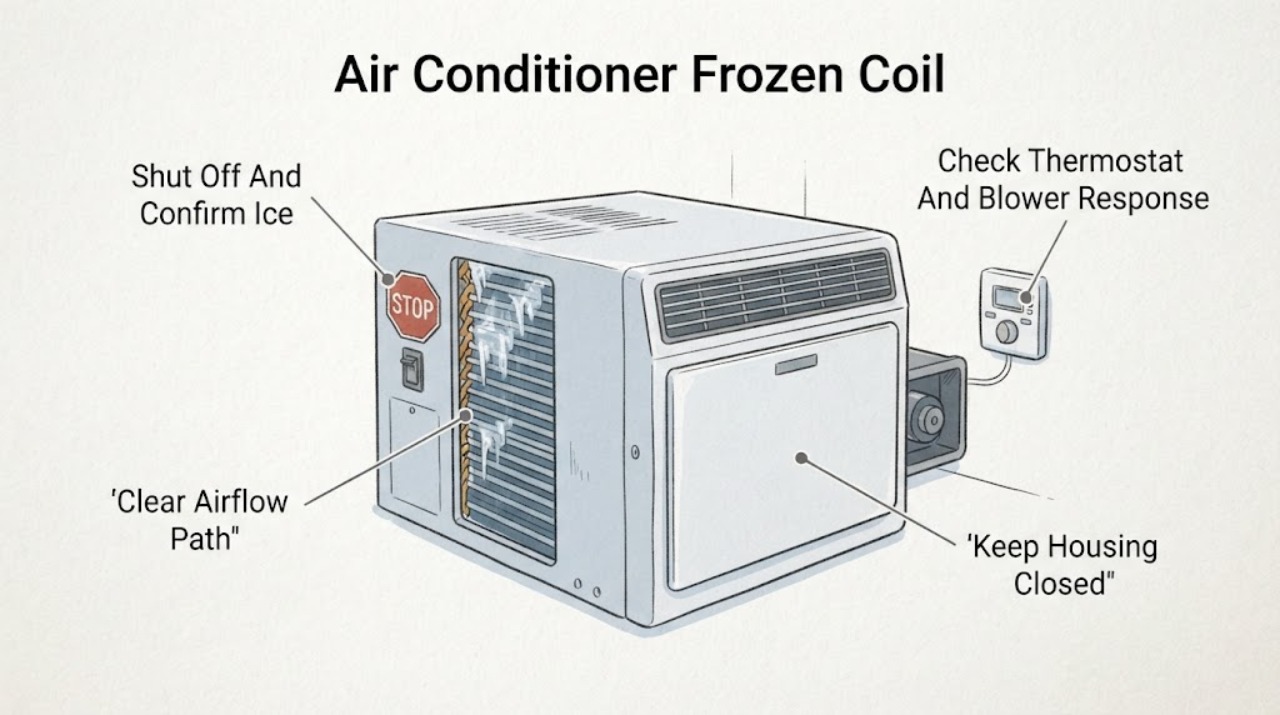
Work through in order
Diagnostic checks
Use only checks that match the exact appliance or system and its official guide.
-
Check 1
Set the thermostat from Cool to Off and look from a dry, safe position for ice on the accessible refrigerant lines or air-handler area, frost at the coil, weak or absent airflow, and meltwater around the indoor unit; do not touch the ice or wet electrical parts.
Expected result: Record where ice is visible, whether the indoor blower is still running, whether air from the registers is weak or warm, and whether water is collecting as the ice begins to melt.
Next step: Leave cooling off and allow the coil to defrost. Protect the floor from meltwater without opening the air handler; continue only with safe external checks after the ice is gone.
Stop if: Stop for smoke, burning odor, arcing, a hot electrical part, uncontrolled water, or a damaged cabinet and arrange qualified HVAC or electrical service.
Why this matters
Why: Visible ice plus poor cooling or airflow supports a frozen evaporator-coil condition. Continuing to run cooling can stress the compressor and does not address the airflow, blower, or refrigerant cause.
-
Check 2
With cooling off and the system safe, inspect only the user-accessible air filter and return grilles; replace a visibly clogged filter with the correct type and clear furniture, dust, or other obstructions from returns and supply registers.
Expected result: Note whether the filter is loaded, whether return air is unobstructed, whether airflow was weak before the freeze, and whether the accessible filter change restores stronger airflow after the coil is fully clear.
Next step: Keep cooling off until all ice has melted. If the filter and visible vents are clear but airflow remains weak or the coil freezes again, arrange HVAC service.
Stop if: Do not remove an evaporator-coil cover, spray cleaner into the coil, or operate the system with water near electrical components.
Why this matters
Why: Carrier and Trane identify restricted airflow, dirty filters, and blocked returns as contributors to frozen coils. Better airflow after a filter change supports an airflow restriction, but it does not prove the coil, blower, or refrigerant circuit is healthy.
-
Check 3
After the coil is fully defrosted and the filter and return path are clear, confirm the thermostat is set to the intended cooling mode and fan behavior, then make one brief call for indoor airflow while observing the registers and listening from outside the air-handler cabinet.
Expected result: Record whether the blower starts promptly, airflow is normal, the fan runs continuously or only with a cooling call, and whether it is silent, humming, slow, intermittently stopping, or producing an unusual odor.
Next step: If airflow is restored and remains normal, monitor for recurrence without forcing a long cooling cycle. If the blower is abnormal, keep cooling off and arrange qualified diagnosis of the blower motor, capacitor, controls, and airflow path.
Stop if: Do not reach into the blower, remove an access panel, spin a fan by hand, or test a capacitor or motor wiring.
Why this matters
Why: A blower that does not move air can let the coil freeze again even if the outdoor unit runs. Carrier associates a non-spinning fan with filter, motor, capacitor, and frozen-coil conditions; humming, heat, or a silent motor can involve high-voltage parts.
-
Check 4
From outside the equipment enclosure and without touching it, observe whether the outdoor fan runs when a normal cooling call is made after defrosting, whether the grille is visibly blocked by leaves, and whether there are unusual noises or excessive heat.
Expected result: Note whether the outdoor unit is silent, starts and stops rapidly, has a fan that does not rotate, or has visible debris restricting the grille; do not remove the cover or reach through the grille.
Next step: Clear only loose debris that can be removed without opening or contacting equipment, then leave the system off if the fan still does not run, the unit is hot, or the coil freezes again; arrange qualified service.
Stop if: Do not touch a running fan, open the disconnect, reset a breaker repeatedly, or open the condenser cabinet.
Why this matters
Why: An outdoor unit that does not run or has a non-spinning fan can prevent heat rejection and may coexist with icing, but a visual check cannot distinguish a motor, capacitor, control, refrigerant, or power fault.
-
Check 5
Once the ice is gone and safe airflow checks are complete, observe one normal cooling cycle only if there are no hazards; record whether the coil or lines frost again, whether cooling remains weak, whether the system runs continuously, and whether there is unusual condensate or an oily or hissing clue near accessible tubing.
Expected result: Compare the airflow before and after the filter change, the time until any frost returns, the indoor temperature response, and whether water or unusual tubing signs appear around the equipment.
Next step: Turn cooling off again if any frost returns or performance remains abnormal, and provide the observations to a qualified HVAC technician for airflow, blower, coil, drain, electrical, and refrigerant checks.
Stop if: Do not add refrigerant, connect gauges, puncture tubing, scrape ice, or continue cooling to obtain more data.
Why this matters
Why: Rapid recurrence after clear airflow suggests a fault beyond a simple filter, including a dirty inaccessible coil, blower performance, thermostat control, or low refrigerant. Refrigerant leak and pressure diagnosis cannot be confirmed safely from appearance.
-
Check 6
Keep the system off and arrange qualified HVAC service when the blower motor is silent or weak, the coil freezes again, the outdoor fan fails, the breaker trips, or a refrigerant or concealed-coil problem is suspected; provide the complete observation record.
Expected result: Give the technician the equipment type and model, location of ice, filter and airflow condition, blower and outdoor-fan behavior, thermostat settings, recurrence timing, condensate behavior, any odor or noise, and power events.
Next step: Ask for a root-cause diagnosis before replacing a blower motor or adding refrigerant; the repair decision should follow the measured airflow and system condition.
Stop if: Do not open the air handler or condenser, handle a capacitor, test live wiring, or work on the refrigerant circuit.
Why this matters
Why: These observations separate user-accessible airflow restrictions from internal blower, capacitor, coil, refrigerant, drain protection, control, or electrical faults without encouraging hazardous testing.
Use your observations
Decision map
Find the observation that best matches what you see, then follow the next safe action.
-
PATH 01Safety boundary
What you see
Ice is visible on the evaporator area or refrigerant lines, or the indoor unit has weak airflow and frost.
Do this next
Turn cooling Off, let the coil defrost, protect against meltwater, and inspect only the accessible filter and vents afterward.
Why this path and its safety boundary
Safety stop: Do not run cooling against ice or chip the ice.
-
PATH 02Safety boundary
What you see
The filter is visibly clogged or return and supply airflow is blocked.
Do this next
Replace the filter with the correct type and clear only safe, visible obstructions while cooling remains off.
Why this path and its safety boundary
Safety stop: If airflow stays weak or icing returns, arrange service rather than opening the coil cabinet.
-
PATH 03Safety boundary
What you see
The indoor blower is silent, slow, intermittent, humming, hot, or has a burning odor after defrosting.
Do this next
Keep cooling off and arrange qualified diagnosis of the blower motor, capacitor, control, and airflow path.
Why this path and its safety boundary
Safety stop: Do not open the air handler, spin the wheel, or handle electrical components.
-
PATH 04Safety boundary
What you see
The outdoor fan does not run, the outdoor unit is silent or unusually hot, or the system short-cycles.
Do this next
Stop cooling and provide the outdoor observations to an HVAC technician.
Why this path and its safety boundary
Safety stop: Do not reach through the grille, open the condenser, or reset a tripping breaker repeatedly.
-
PATH 05Safety boundary
What you see
The coil freezes again after the filter and visible airflow path are corrected.
Do this next
Leave cooling off and request a root-cause visit for blower performance, coil cleanliness, thermostat control, drain protection, and refrigerant condition.
Why this path and its safety boundary
Safety stop: Do not add refrigerant or keep cycling the system to reproduce the ice.
-
PATH 06Safety boundary
What you see
There is smoke, burning odor, arcing, a hot connection, standing water near electrical parts, or repeated breaker trips.
Do this next
Keep away from the equipment, shut off power only from a safe accessible control if appropriate, and arrange qualified HVAC or electrical service.
Why this path and its safety boundary
Safety stop: Do not touch wet or energized components or attempt a live test.
Helpful context
Understand the symptom
Protect the compressor before diagnosing the blower
A frozen evaporator coil is not a normal cooling condition. Ice may block airflow and can return if the underlying cause remains. The indoor blower motor matters because it has to move air across the coil, but the same ice pattern can result from a restricted filter or return, a dirty coil, thermostat behavior, or low refrigerant. Shut off cooling first and collect observations rather than trying to make the compressor run through the ice.
Defrost without damaging the coil
Let the ice melt with cooling off. Put towels or a suitable container where meltwater can be handled safely, and keep the air handler and electrical parts dry. Trane warns against chipping ice because the coil can be damaged and leak. A thermostat fan setting may be useful only when the indoor blower operates normally and the air handler can handle the meltwater; a silent or abnormal blower is a reason to keep the system off.
Use airflow clues to separate a simple filter issue from a motor fault
A visibly loaded filter, blocked return grille, or closed supply register can reduce the air crossing the evaporator. After the coil has fully cleared, a new correct filter and open vents may restore airflow. If the blower remains silent, hums, runs slowly, stops intermittently, or produces a hot or burning smell, do not open the electrical compartment: motors, capacitors, and controls need qualified testing.
A recurrence needs a root-cause visit
If ice forms again after the filter and visible airflow path are corrected, the cause may be an inaccessible dirty coil, blower performance, thermostat control, drain or safety protection, or insufficient refrigerant. Carrier and Trane both direct refrigerant and internal coil diagnosis to HVAC professionals. Record when the freeze begins, airflow strength, blower behavior, outdoor-unit status, and any water around the indoor unit for the technician.
Only after diagnosis
Potential parts
- blower motor or motor capacitor
Consider only when the filter and visible return path are clear but the indoor blower is silent, weak, slow, or intermittent.
Motor and capacitor selection and testing are system-specific and require qualified service. - air filter
Replace only when the accessible filter is visibly loaded or the equipment manual specifies a replacement interval and type.
Use the size and airflow rating specified for the installed system; a filter change does not prove the root cause is resolved. - evaporator coil or coil-cleaning service
Consider only when recurrence continues after safe filter and vent checks or visible contamination is reported by a technician.
The indoor coil is often concealed; cleaning and repair should be performed by a qualified HVAC professional. - thermostat or temperature control
Consider only when the system runs beyond the call, the control setting behaves unexpectedly, or icing follows thermostat behavior.
Confirm system type and control compatibility before replacement. - refrigerant circuit or leak repair
Consider only after qualified measurements support low charge or a leak; ice alone does not prove refrigerant loss.
Refrigerant recovery, leak repair, charging, and pressure testing require certified service and appropriate equipment. - condensate drain or float safety switch
Consider only when meltwater, a backed-up drain, or an equipment safety shutdown accompanies the freeze.
Do not pour water into concealed drain paths or bypass a float switch without qualified guidance.
When checks do not resolve it
Need a professional?
Arrange qualified HVAC service for a recurring frozen coil, a blower motor that is silent, weak, hot, or intermittent, an outdoor fan that will not run, suspected low refrigerant, a dirty inaccessible coil, repeated breaker trips, smoke or burning odor, standing water near electrical parts, or any need to open the air handler or condenser.
Safety scope: A user may turn cooling off, allow safe defrosting, replace a correct accessible filter, clear visible vent obstructions, and observe equipment from outside its cabinet. Blower motors, capacitors, coils, refrigerant, electrical controls, compressors, and concealed drains require qualified HVAC service.
Have this ready
- Provide the equipment type and model, ice location, thermostat mode and fan setting, filter condition, supply and return airflow, blower and outdoor-fan behavior, recurrence timing, condensate or water observations, noises or odors, and power events.
Common questions
FAQ
Can I run my air conditioner while the coil is frozen?
No. Turn cooling off and allow the coil to defrost. Running against ice can restrict airflow and damage the system; do not chip the ice or keep restarting cooling.
Can a bad blower motor cause a frozen air-conditioner coil?
Yes. A silent, weak, slow, or intermittent indoor blower can reduce airflow across the evaporator coil. After safe filter and vent checks, keep the system off and have the motor, capacitor, controls, and airflow diagnosed by a professional.
Will changing the air filter fix a frozen coil?
A clogged filter can restrict airflow and contribute to freezing, so replacing a visibly loaded filter may help. If ice returns after the filter and visible vents are clear, the root cause may be the blower, coil, thermostat, drain protection, or refrigerant circuit.
How long should I let a frozen AC coil thaw?
Leave cooling off until all visible ice has melted; the time varies with the amount of ice and the equipment. Do not chip it or apply aggressive heat. Protect against meltwater and keep the air handler dry.
When is a frozen coil an emergency?
Keep the system off and seek prompt service for smoke, burning odor, arcing, a hot electrical connection, repeated breaker trips, uncontrolled water, a blower that overheats, or ice that repeatedly returns after safe airflow checks.
Read the exact guide
Official sources
- AC Fan Not Spinning? Here’s Why and How to Fix ItCarrier · The guide discusses indoor blower and outdoor fan symptoms; exact motor, capacitor, and access arrangements vary by system.
- Troubleshoot an Air Conditioner | AC TroubleshootingCarrier · Carrier's guide covers split-system central air conditioners; system layout and accessible checks vary by installation.
- Top 5 Causes of Frozen AC Coils and How to Fix ThemTrane · Trane's guidance applies to typical residential AC or heat-pump systems; the outdoor-coil behavior differs between cooling and heating modes.
- Troubleshoot an Air Conditioner: 6 Steps to Fix an AC Not WorkingCarrier · The guide covers basic homeowner observations for residential central AC; electrical, refrigerant, and internal component work is excluded from the user checks.
Community feedback
Share a repair observation
Share a plain-text repair observation. Accepted observations are published automatically; this page may take a moment to update.