
On this page
Start here
Quick answer
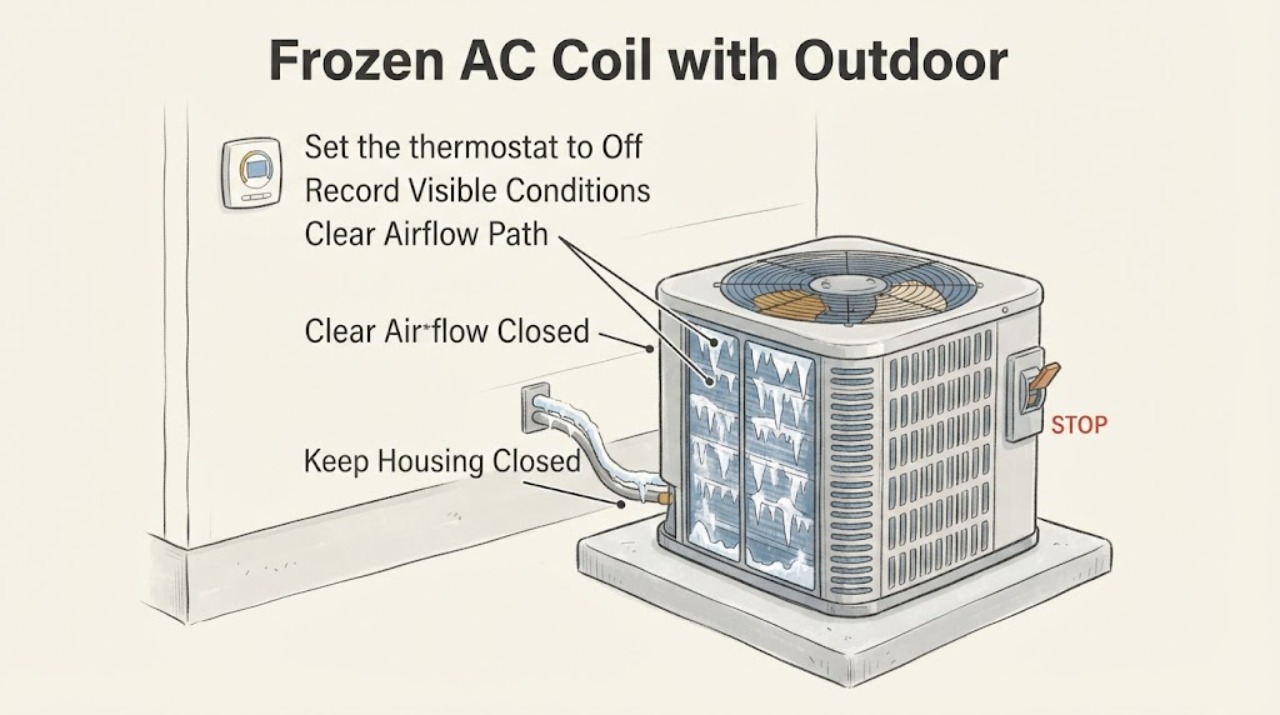
Turn the thermostat out of cooling mode immediately and leave the AC off while the ice melts naturally. A frozen evaporator coil together with an outdoor fan motor that is not running can damage the compressor if cooling continues. From a safe position, record the thermostat mode, indoor airflow, filter condition, ice or water, outdoor fan movement, outdoor-unit sound, and breaker or disconnect appearance. Only inspect the filter and exterior; do not open the unit, hand-start the fan, touch wiring, test voltage or a capacitor, or open the refrigerant circuit. A dirty filter or incorrect thermostat setting may be visible, but a non-running outdoor fan after the coil has thawed requires HVAC service to diagnose the fan motor, capacitor, contactor, power, or refrigerant condition.
Before you begin
Safety first
- Keep cooling off. Do not open panels, hand-start the fan, touch wiring, test voltage or capacitors, bypass controls, or open the refrigerant circuit.
Work through in order
Diagnostic checks
Use only checks that match the exact appliance or system and its official guide.
-
Check 1
Set the thermostat to Off or otherwise cancel cooling, then leave the system off and allow visible ice to thaw naturally; do not chip the ice, apply a heat source, or restart cooling while ice remains.
Expected result: Ice remains on the indoor coil or refrigerant lines, meltwater appears below the air handler, or the system stops producing ice after it is off.
Next step: Keep cooling off. If water approaches electrical equipment or the area cannot stay dry, do not approach it; isolate power only from a safe location and call qualified emergency or HVAC help.
Why this matters
Why: The frozen coil is an active symptom and continued cooling can overload the compressor or worsen the freeze. Meltwater also creates a separate electrical and property-risk boundary.
-
Check 2
Read the thermostat display and settings without repeatedly calling for cooling: record Cool/Heat/Off mode, the fan setting, the setpoint relative to room temperature, and any schedule or alert.
Expected result: The thermostat is not calling for cooling, the fan is set to On rather than Auto, the schedule is overriding the call, or cooling is requested while the outdoor fan remains stopped.
Next step: Leave cooling off while the coil thaws. Record the setting and later give it to the HVAC technician; do not keep changing the setpoint to force another call.
Why this matters
Why: A control setting can explain an idle fan, but it does not explain ice that persists or a fan that fails during a valid cooling call. The thermostat cannot confirm a motor, capacitor, contactor, or refrigerant fault.
-
Check 3
When the system is off and the filter is safely accessible, inspect the filter for heavy dust or blockage and note the airflow from supply registers without opening the air handler or coil cabinet.
Expected result: The filter is visibly blocked, airflow was weak before shutdown, or the filter is clean but the coil froze with poor or normal airflow.
Next step: Replace a filter only with the correct type and fit specified for the system, then keep cooling off until the ice has thawed and the fan fault has been evaluated. Do not clean an inaccessible coil or blower yourself.
Why this matters
Why: Restricted airflow can contribute to a frozen evaporator coil, but a clean filter does not rule out a dirty internal coil, blower problem, low refrigerant, or the separate outdoor-fan fault.
-
Check 4
From outside the condenser and without reaching through the grille, record whether the fan blade is stationary, whether the compressor or unit is humming, whether the cabinet appears unusually hot, and whether a blade is visibly damaged.
Expected result: The blade is still during a previously observed cooling call, the unit hums without fan movement, the cabinet is unusually hot, the blade is damaged, or the entire outdoor unit is silent.
Next step: Keep the AC off. Never hand-start or spin the fan, touch the blade, open the top or side panel, or continue running the compressor. Give the sound, heat, and blade observations to the HVAC technician.
Why this matters
Why: A stopped or slow fan can involve a motor, capacitor, control, or power problem; a damaged blade can contact components; a silent unit can indicate an electrical interruption. None is safe to troubleshoot through the grille.
-
Check 5
Look at the indoor electrical panel and the outdoor disconnect from a dry, safe position without opening either enclosure or restoring a tripped circuit; note only the visible handle or switch position and any external heat, discoloration, smoke, or odor.
Expected result: The AC breaker or disconnect appears tripped, the enclosure is hot or discolored, there is smoke or burning odor, or the visible controls look normal.
Next step: Leave a tripped or suspicious circuit off. For smoke, burning odor, arcing, or a hot enclosure, leave the area and contact emergency services. Do not reset repeatedly or open the disconnect; request qualified electrical/HVAC service.
Why this matters
Why: A tripped protective device can indicate an electrical fault, while heat, odor, or smoke is an urgent hazard. A normal handle does not prove that the fan circuit or motor is safe.
-
Check 6
After the ice has fully thawed and the area is dry, compare the recorded indoor airflow and outdoor-unit observations with the service instructions for the exact system; do not re-enable cooling solely to see whether the fan starts.
Expected result: The outdoor fan remains known to be nonfunctional from the prior safe observation, cooling previously caused recurring ice, or the system has no safe, documented operating check available to the homeowner.
Next step: Keep the system off and schedule HVAC service. Ask the technician to assess airflow, coil condition, outdoor fan motor/capacitor/contactor, power, and refrigerant as applicable to the model.
Why this matters
Why: A thawed coil does not repair the cause. Recurring ice points toward airflow, refrigerant, or coil issues, while a non-running outdoor fan points toward the outdoor electrical or motor system.
-
Check 7
Record any meltwater, drain-pan overflow, refrigerant-line frost, weak register airflow, unusual outdoor sound, prior short cycling, or repeat breaker event together with the model and the time the fan stopped.
Expected result: The same combination returns after service or after a later authorized run, or the system remains off with no new hazard.
Next step: Do not continue operating to collect more data. Give the timeline to the HVAC technician and keep cooling disabled until the system is cleared.
Why this matters
Why: A symptom timeline helps distinguish airflow, condensate, electrical, fan, and sealed-system paths; recurrence means the root cause remains unresolved even if the ice temporarily disappears.
Use your observations
Decision map
Find the observation that best matches what you see, then follow the next safe action.
-
PATH 01Next step
What you see
Ice is visible, the outdoor fan is not running, or cooling has produced weak airflow and meltwater.
Do this next
Turn cooling off, allow natural thawing, protect the area from meltwater, and arrange HVAC service.
-
PATH 02Next step
What you see
Smoke, burning odor, arcing, a hot electrical enclosure, water near electrical equipment, or a repeated breaker trip is present.
Do this next
Stop immediately, leave the danger area, isolate power only from a safe dry position if possible, and contact emergency or qualified electrical help.
-
PATH 03Next step
What you see
The thermostat is not calling for cooling or is in the wrong mode, and there is no remaining ice or hazard.
Do this next
Record the setting and follow the exact system instructions; do not use repeated calls as a fan test. Persistent ice or a stopped fan still needs HVAC diagnosis.
-
PATH 04Next step
What you see
The filter is blocked or indoor airflow is weak, but the outdoor fan fault has also been observed.
Do this next
Replace only an accessible filter with the correct specified type, keep cooling off, and have the technician evaluate airflow and the outdoor fan system together.
-
PATH 05Next step
What you see
The filter is clean and the outdoor unit is silent, humming without fan motion, hot, or visibly damaged.
Do this next
Keep the system off and call HVAC service; motor, capacitor, contactor, power, and refrigerant work are professional-only.
-
PATH 06Next step
What you see
The ice melts but returns after an authorized later run or the system cannot cool normally.
Do this next
Stop operating it and request service for airflow, coil, refrigerant, fan, and control diagnosis.
Helpful context
Understand the symptom
Stop cooling before looking for a cause
Ice on the indoor evaporator coil or refrigerant lines means the system is not transferring heat normally. With the outdoor fan also stopped, the condenser cannot reject heat as designed. Turn cooling off and let the ice thaw without chipping it, applying heat, or restarting the compressor. Expect meltwater and protect the area without bringing electrical equipment into contact with it.
Use safe observations to separate airflow from an outdoor-unit fault
A thermostat set incorrectly, a blocked filter, or weak indoor airflow can contribute to freezing. A stopped outdoor fan, a loud hum, an unusually hot cabinet, a tripped breaker, or a damaged blade points to the outdoor unit or its power path. These observations narrow the service call; they do not justify opening the cabinet or handling a capacitor.
Why the fan motor, capacitor, contactor, and refrigerant stay professional-only
The outdoor section contains high-voltage electrical components and the sealed refrigerant circuit. The same symptom can come from loss of power, a failed motor or capacitor, a control/contactor fault, airflow restriction, or low refrigerant. Have a qualified HVAC technician determine the cause after the system is safely off and thawed.
Safety boundary
Stop conditions
- Stop cooling immediately while ice is present or the outdoor fan is not running; do not hand-start the fan or run the compressor to test it.
- Stop and leave the area for smoke, burning odor, arcing, a hot enclosure, repeated electrical trips, or water near electrical equipment.
- Never open the condenser, air-handler, disconnect, or electrical panel; do not touch wiring, measure voltage, test a capacitor, bypass a contactor, or open the refrigerant circuit.
- Do not chip ice, apply heat, use water near electrical equipment, or restore power repeatedly. Keep the system off until qualified HVAC or electrical service clears it.
When checks do not resolve it
Need a professional?
Call HVAC service when a frozen coil is paired with an outdoor fan that is not running, when ice returns after thawing, when the outdoor unit hums or is unusually hot, when airflow remains weak after an accessible filter check, or when a breaker or disconnect event occurs. Call emergency services for smoke, arcing, fire, or rapidly worsening heat or odor. Provide the model, thermostat setting, indoor airflow, ice and meltwater location, outdoor fan and sound observations, filter condition, and breaker/disconnect appearance.
Safety scope: Keep cooling off. Do not open panels, hand-start the fan, touch wiring, test voltage or capacitors, bypass controls, or open the refrigerant circuit.
Have this ready
- system model and type
- thermostat mode and fan setting
- location and extent of ice
- indoor airflow and filter condition
- outdoor fan movement
- outdoor unit sound and apparent heat
- breaker or disconnect appearance
- meltwater, odor, smoke, arcing, or prior trip
Common questions
FAQ
Should I keep running the AC to melt a frozen coil if the outside fan is not spinning?
No. Turn cooling off and allow the ice to thaw naturally. Running with a stopped outdoor fan can overheat the compressor and worsen the freeze; arrange HVAC service.
Can a dirty filter cause a frozen coil and a stopped outdoor fan?
Restricted airflow from a blocked filter can contribute to coil freezing, but it does not prove why the outdoor fan stopped. Replace only an accessible filter with the specified type, keep cooling off, and have the fan and sealed system evaluated.
Can I spin the outdoor fan by hand or test its capacitor?
No. Do not hand-start the fan, open the condenser, or test a capacitor or wiring. These components require qualified HVAC service, especially when ice and a non-running fan occur together.
Read the exact guide
Official sources
- Measure Guideline: Air Conditioner Diagnostics, Maintenance, and ReplacementU.S. Department of Energy · Air-conditioner airflow, evaporator-coil fouling and freezing, compressor protection, and professional diagnostics
- AC Fan Not Spinning? 8 Causes & How to Fix ThemCarrier · Air-conditioner outdoor fan not running, frozen evaporator coil, filter, breaker, fan motor, capacitor, and professional service guidance
- Coil TroubleshootingTrane · Air-conditioner evaporator-coil freezing, airflow/filter observations, thawing, water leakage, refrigerant-frost, and professional service
- AC Fan Not Working? Reasons Why It Stopped SpinningTrane · Air-conditioner indoor/outdoor fan distinction, frozen evaporator coil, capacitor, damaged blade, fan motor, and professional assistance
- Troubleshoot an Air Conditioner: 6 Steps to Fix an AC Not WorkingCarrier · Air-conditioner frozen coil, thermostat, filter, outdoor condenser fan, breaker, refrigerant, and professional diagnosis
Community feedback
Share a repair observation
Share a plain-text repair observation. Accepted observations are published automatically; this page may take a moment to update.