
On this page
Start here
Quick answer
If you see ice on the indoor evaporator coil, the copper refrigerant line, or the air-handler cabinet, stop cooling immediately. Set the thermostat to COOL OFF; if the indoor blower is operating normally and meltwater is not threatening the equipment, FAN ON can help thaw the coil. Check the filter and visible registers without opening the cabinet, and do not chip the ice or use a hair dryer or heater. Do not restart while ice or active overflow remains. If airflow is still weak, the coil freezes again after a complete thaw, water reaches electrical equipment, or you suspect a refrigerant, blower, or electrical fault, leave the system off and arrange qualified HVAC service. [src-carrier-frozen-coils, src-trane-air-handler-freeze, src-trane-evaporator-coil]
Before you begin
Safety first
- The homeowner portion is limited to normal thermostat controls and safe visual observations. A qualified technician determines airflow performance, coil/blower condition, controls, refrigerant charge or leakage, and any repair or replacement scope.
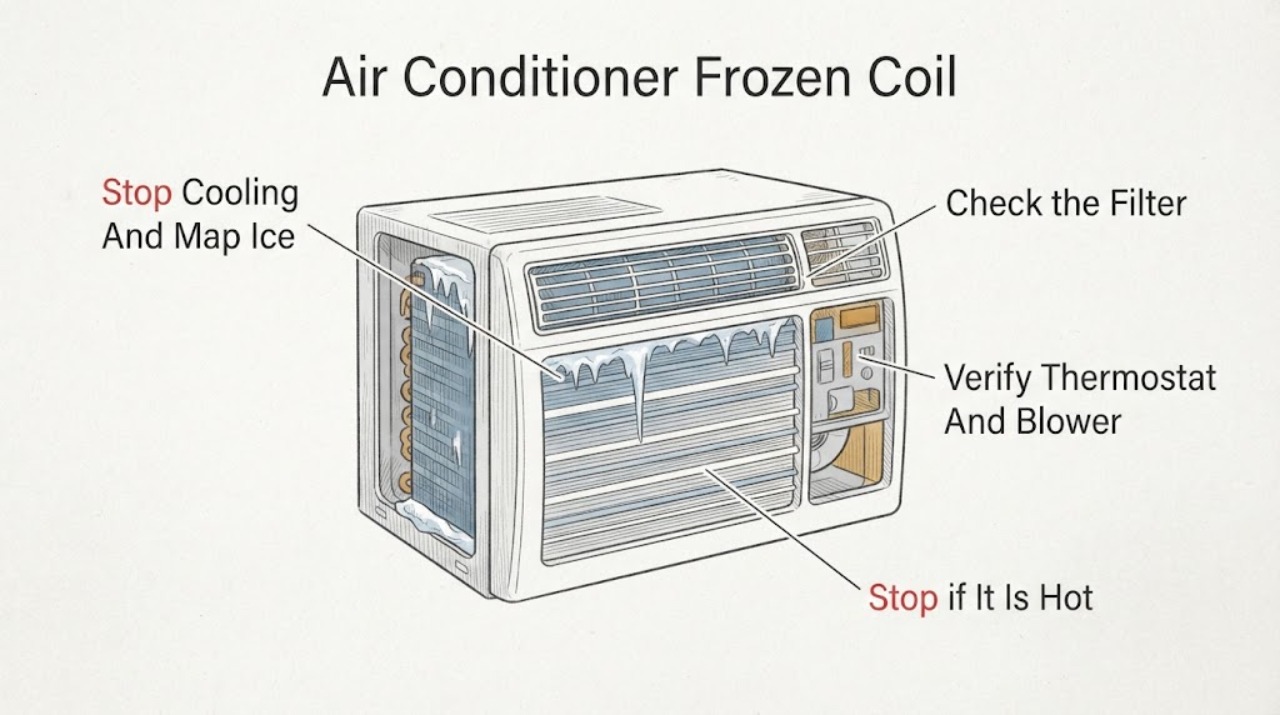
Work through in order
Diagnostic checks
Use only checks that match the exact appliance or system and its official guide.
-
Check 1
From a dry, stable position, note where the ice is visible—at a supply line, the air-handler cabinet, an accessible inspection window, or the outdoor unit—and stop the cooling call at the thermostat by selecting COOL OFF.
Expected result: Record visible frost or solid ice, reduced airflow, warm air, dripping water, water near the indoor unit, or no visible ice despite the reported symptom. Do not open the cabinet to look for more.
Next step: Keep cooling off and photograph the location, airflow symptom, and any water from a safe position. If the indoor blower normally operates and no water is approaching electrical equipment, FAN ON may help move room air over the coil; otherwise leave the entire system off.
Stop if: Do not chip, scrape, bend, puncture, or pry ice from the coil or tubing. Stop and keep clear for water near electrical parts, smoke, burning or chemical odor, sparks, a leaking ceiling, or unstable equipment.
Why this matters
Why: Ice on the visible line or cabinet can indicate a frozen indoor evaporator coil, and the hidden portion may take substantially longer to thaw. The location and accompanying airflow or water clues help a technician choose the first inspection path; they do not identify the failed component.
-
Check 2
After the cooling call is off, inspect only the user-accessible air filter, return grille, and supply registers. Replace the filter only if it is visibly dirty or damaged, using the same size and the airflow direction marked on the filter; remove obvious furniture or coverings from registers without forcing anything.
Expected result: The filter is clean and seated, visibly loaded with dust, wet, collapsed, or the wrong size; return or supply openings are clear, blocked, or unusually weak at several registers.
Next step: Note the filter condition and which registers are weak, then let the coil thaw completely. If the filter is wet, repeatedly clogs, airflow remains weak, or access would require removing a panel, stop at these observations and book HVAC service.
Stop if: Do not wash or spray the filter, remove the air-handler panel, touch the coil or blower, insert tools into a grille, or use a filter change as a reason to keep running a frozen system.
Why this matters
Why: A dirty or incorrectly seated filter and blocked air path can reduce heat carried across the evaporator coil, allowing moisture to freeze. A clean filter and clear openings do not rule out a dirty indoor coil, blower problem, duct restriction, or refrigerant fault.
-
Check 3
Check the thermostat display and settings without entering service menus: confirm the mode, fan setting, set point, schedule, and any filter alert, then observe whether the indoor blower starts when FAN ON is selected after cooling remains off.
Expected result: The thermostat is not calling for cooling, the fan is set to a surprising mode, the display or schedule is abnormal, the blower runs with normal airflow, or the blower does not run or sounds abnormal.
Next step: Record the settings and sound/airflow observation for the HVAC technician. Use only normal thermostat controls; do not remove covers, alter wiring, change fan-speed taps, or reset controls inside the equipment.
Stop if: Stop for a blank or sparking thermostat, burning smell, repeated breaker trip, humming without airflow, grinding, exposed wiring, or any need to access the electrical compartment.
Why this matters
Why: A control or schedule mismatch can mimic poor cooling, while a non-running or abnormal indoor blower can create or worsen coil icing. A normal-sounding blower does not prove adequate airflow or clear a refrigerant problem.
-
Check 4
With cooling off, monitor the equipment from outside the cabinet as it thaws; keep a towel or container only where it cannot contact electricity or obstruct a drain, and do not accelerate melting with a heat source.
Expected result: Ice remains on tubing or the cabinet, water is still draining, airflow has not returned, the condensate path appears to overflow, or the equipment becomes dry and free of visible ice.
Next step: Leave cooling off until no ice remains, water has stopped draining abnormally, and the area is dry. If the thaw causes overflow or the coil does not clear after several hours, stop and request service rather than restarting it.
Stop if: Never use a hair dryer, space heater, open flame, hot water, or sharp tool on the coil or tubing. Do not touch wet electrical parts or open the air handler to speed the thaw.
Why this matters
Why: Visible melting outside the unit does not prove the indoor coil is clear. Remaining ice can continue to block airflow, and meltwater can expose a drain or pan problem. A complete thaw is a prerequisite for any later cooling assessment, not proof that the underlying cause is fixed.
-
Check 5
From ground level and without opening the outdoor unit, observe whether vegetation, leaves, snow, fencing, covers, or other debris is visibly crowding the outdoor condenser and whether its fan has an abnormal sound or fails to run during a normal cooling call after the coil is fully thawed.
Expected result: The outdoor air path is visibly obstructed, the fan is not operating when expected, unusual noise is present, or the outdoor unit appears clear and normal from the outside.
Next step: Move only loose, clearly non-attached debris that can be removed without reaching into or touching the equipment; otherwise photograph the condition and ask HVAC service to inspect it. Do not resume cooling merely because the outdoor cabinet looks clear.
Stop if: Do not remove panels, reach through the grille, touch the fan, wash the coil, reset a disconnect, or inspect capacitors, wiring, or refrigerant lines.
Why this matters
Why: Poor outdoor heat rejection or a failed fan can contribute to inadequate cooling, but a clear exterior does not exclude an indoor airflow, refrigerant, control, or mechanical issue. A frozen indoor coil should not be diagnosed from outdoor appearance alone.
-
Check 6
Use the thaw, filter, airflow, thermostat, water, and recurrence notes to decide whether a qualified HVAC visit is required; do not use repeated restart attempts as a diagnostic test.
Expected result: The coil freezes again, airflow is still weak, cooling runs continuously without reaching the set point, the filter and registers are clear but icing returns, water overflows, or no safe observation explains the freeze.
Next step: Leave cooling off and arrange qualified HVAC service. Provide photos, filter condition, thermostat settings, airflow changes, thaw duration, water behavior, outdoor observations, and whether the freeze returned after a clean filter.
Stop if: Do not add refrigerant, vent refrigerant, bypass a control, test live voltage, adjust charge or fan speed, open the sealed system, or keep running the unit while it is icing.
Why this matters
Why: Recurrence after a complete thaw and basic airflow check points to a remaining restriction, low refrigerant or leak, blower/control issue, or another mechanical cause. Refrigerant pressure and sealed-system diagnosis require professional tools; the observation cannot establish which one.
Use your observations
Decision map
Find the observation that best matches what you see, then follow the next safe action.
-
PATH 01Safety boundary
What you see
Ice is still visible, airflow is falling, or meltwater is active near the indoor unit.
Do this next
Keep COOL off, use FAN ON only when the blower and surrounding area are safe, and wait for a complete natural thaw; arrange service if water threatens the equipment or does not drain normally.
Why this path and its safety boundary
Safety stop: Do not run cooling, chip ice, use a heat source, or touch wet electrical equipment.
-
PATH 02Safety boundary
What you see
The filter is dirty or damaged, registers/returns are blocked, or airflow is weak at several vents.
Do this next
Correct only the visible filter or room-level obstruction, let the coil thaw fully, and request service if airflow remains weak or the filter becomes wet or repeatedly dirty.
Why this path and its safety boundary
Safety stop: Do not open the air handler or clean an inaccessible coil or blower as a homeowner test.
-
PATH 03Safety boundary
What you see
The filter and visible air paths are clear but the coil freezes again, or the system runs continuously and does not cool normally.
Do this next
Stop cooling and book qualified HVAC diagnosis for airflow measurement, coil/blower inspection, controls, and refrigerant/leak evaluation as applicable.
Why this path and its safety boundary
Safety stop: Do not recharge refrigerant, open the sealed system, or keep restarting the unit to compare symptoms.
-
PATH 04Safety boundary
What you see
Water reaches electrical equipment, a breaker trips again, there is smoke, burning odor, sparking, exposed wiring, or the blower/outdoor fan is abnormal.
Do this next
Keep clear, leave the HVAC system off if it can be done without contacting a hazard, and arrange appropriate qualified HVAC/electrical help; use emergency help for smoke or fire.
Why this path and its safety boundary
Safety stop: Do not touch wet equipment, reset a repeatedly tripping breaker, remove panels, or perform live electrical testing.
-
PATH 05Safety boundary
What you see
The coil has thawed and visible airflow checks are inconclusive, or the suspected component is inside an inaccessible cabinet.
Do this next
Keep the observation record and schedule HVAC service rather than ordering a part from the symptom alone.
Why this path and its safety boundary
Safety stop: Do not infer a refrigerant charge, part compatibility, or repair method from ice location alone.
Helpful context
Understand the symptom
A frozen coil is a symptom, not a diagnosis
In a typical split system, the evaporator coil is indoors in the air handler or furnace cabinet. Ice on a visible refrigerant line may therefore be only the part of a larger freeze-up that cannot be seen. Restricted airflow from a dirty filter, blocked return or supply path, or a dirty coil is a common route; low refrigerant, thermostat trouble, or another mechanical problem can look similar. The observation sequence below separates safe homeowner checks from work that requires HVAC equipment and training. [src-trane-air-handler-freeze, src-carrier-frozen-coils, src-trane-evaporator-coil]
Protect the system while the ice melts
Continuing to run a frozen coil can reduce airflow further and put the cooling system at risk. Ice can also melt into a pan or drain path that was not designed for an overflow. Keep children and pets away from the equipment, use only normal thermostat controls, and leave cabinet access, refrigerant work, electrical testing, coil cleaning, and blower repairs to a qualified HVAC professional. [src-carrier-frozen-coils, src-trane-air-handler-freeze, src-carrier-ac-troubleshooting]
Safety boundary
Stop conditions
- Do not run the air conditioner while the evaporator coil or refrigerant line is frozen.
- Do not chip, scrape, puncture, bend, or pry ice, and do not use a hair dryer, space heater, flame, or hot water to thaw it.
- Do not open the air handler, touch wet electrical parts, test live voltage, bypass controls, or reset a breaker that trips again.
- Do not add, release, or diagnose refrigerant, open the sealed system, or adjust blower or compressor components as a homeowner step.
Only after diagnosis
Potential parts
- replacement air filter
Consider this only when the existing user-accessible filter is visibly dirty, damaged, wet, or the wrong size. A filter replacement is not a diagnosis and cannot resolve a refrigerant or mechanical fault.
Match the existing filter dimensions and airflow direction; do not upgrade to an unknown restrictive filter or run cooling while the coil is frozen.
When checks do not resolve it
Need a professional?
Arrange qualified HVAC service for any recurrent freeze, persistent weak airflow, abnormal blower or outdoor fan, suspected dirty inaccessible coil, water overflow, continuous operation without cooling, or an unresolved cause after a complete thaw and visible filter/register check. Request urgent help when water is near electrical equipment, the breaker trips, there is smoke, burning odor, sparking, exposed wiring, or equipment instability.
Safety scope: The homeowner portion is limited to normal thermostat controls and safe visual observations. A qualified technician determines airflow performance, coil/blower condition, controls, refrigerant charge or leakage, and any repair or replacement scope.
Common questions
FAQ
Can I run my air conditioner with a frozen coil?
No. Turn cooling off and let the coil thaw naturally. Continuing to run it can worsen airflow and damage the system. If the ice returns after a complete thaw and visible filter check, arrange HVAC service. [src-carrier-frozen-coils, src-trane-evaporator-coil]
Should I use a hair dryer to thaw an AC coil?
No. Do not use a hair dryer, space heater, flame, hot water, or a sharp tool. Turn cooling off and allow natural thawing; keep clear of meltwater and electrical equipment. [src-carrier-frozen-coils, src-trane-air-handler-freeze]
Does a dirty filter cause an air conditioner coil to freeze?
It can. A clogged filter or blocked air path may reduce airflow over the evaporator coil, but a clean filter does not rule out a dirty coil, blower or duct restriction, thermostat problem, or low refrigerant. [src-carrier-frozen-coils, src-trane-air-handler-freeze]
Why did my AC freeze again after I changed the filter?
Recurrence means the filter was not the only possible cause, or the airflow problem remains. Leave cooling off and have a qualified HVAC technician evaluate airflow, the indoor coil and blower, controls, and refrigerant or leak conditions. [src-carrier-frozen-coils, src-trane-air-handler-freeze, src-carrier-ca-troubleshooting]
What if water is leaking from the indoor AC unit while the coil thaws?
Keep cooling off and watch from a safe, dry position. If water overflows, approaches electrical equipment, or does not drain normally, keep clear and arrange qualified HVAC or electrical help rather than opening the cabinet. [src-trane-air-handler-freeze, src-carrier-ac-troubleshooting]
Read the exact guide
Official sources
- Air Handler Freezing Up: Causes and SolutionsTrane · General residential air-handler and evaporator-coil freeze guidance; not model-specific.
- What Is an Evaporator Coil and Why Is Cleaning It Important?Trane · General residential evaporator-coil function and safety; not model-specific.
- Will Frozen AC Fix Itself? A Guide To Frozen AC CoilsCarrier · General residential air-conditioner frozen-coil symptoms, safe thawing, airflow causes, and escalation; not model-specific.
- Troubleshoot an Air ConditionerCarrier · General residential split-system guidance; regional Carrier page, not model-specific.
- Troubleshoot an Air Conditioner: 6 Steps to Fix an AC Not WorkingCarrier · General split-system residential troubleshooting; not model-specific.
- Frozen CoilsReddit r/hvacadvice · Community discussion used only as an anecdotal illustration of hidden indoor ice, airflow clues, and recurrence uncertainty; not proof of a repair outcome.
Community feedback
Share a repair observation
Share a plain-text repair observation. Accepted observations are published automatically; this page may take a moment to update.