
On this page
Start here
Quick answer
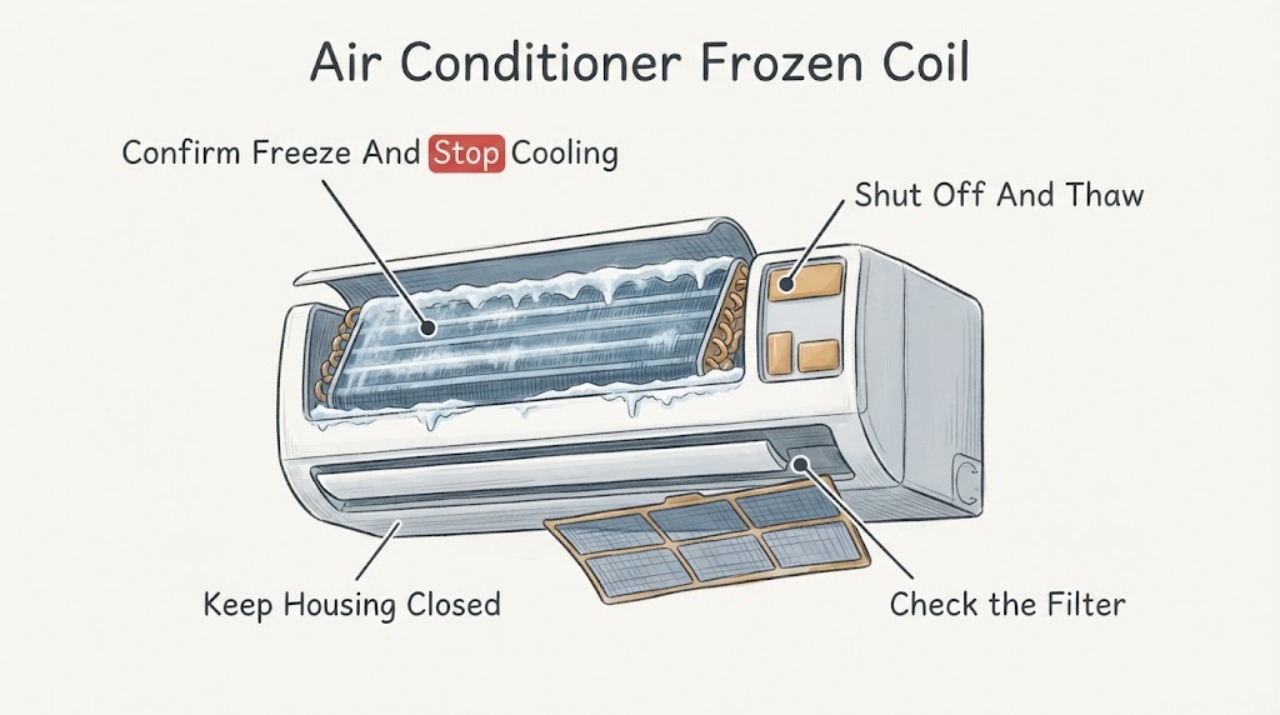
Turn the cooling function off as soon as you see ice on the evaporator coil, copper lines, or indoor unit. Let the coil thaw naturally; do not use a hair dryer, space heater, hot water, or another heat source. If the thermostat and system are dry and safe, the indoor fan may be set to On while cooling remains Off, but stop if melting water reaches electrical parts or threatens an overflow. Once the ice is completely gone, install a clean, model-compatible filter, open blocked supply and return vents, and make one supervised test. A coil that freezes again, a dirty or inaccessible coil, weak airflow, unusual hissing, persistent warm air, or suspected low refrigerant needs qualified HVAC service. Do not add refrigerant, open the sealed circuit, remove coil panels, or test live electrical components yourself.
Before you begin
Safety first
- Turn cooling Off for any ice. Allow natural thawing only; never use a heat source or hot water. Do not open panels, work on live electrical parts, handle refrigerant, add refrigerant, vent refrigerant, or restart a wet or repeatedly freezing system.
Work through in order
Diagnostic checks
Use only checks that match the exact appliance or system and its official guide.
-
Check 1
From a dry, safe position, look for ice or frost on the indoor unit, accessible copper lines, or outdoor tubing and note reduced airflow, warm supply air, poor cooling, or unusual condensate. Do not touch the ice, tubing, coil fins, or wiring.
Expected result: Record ice or frost present, only water after thawing, no ice but weak airflow, or an uncertain symptom; note whether the indoor unit is wet or whether water is near electrical parts.
Next step: If ice is present and the area is dry, continue to the safe shutdown and thaw action. If water reaches wiring or a control, isolate the system only by a normal safe control and arrange urgent qualified service.
Stop if: Do not keep cooling enabled, probe the coil, chip ice, or approach wet electrical equipment.
Why this matters
Why: Ice plus reduced cooling or airflow is consistent with a frozen evaporator coil, but appearance alone cannot prove low refrigerant or another root cause. Water near electrics creates a separate stop condition.
-
Check 2
Set the thermostat to Cool Off immediately. If the indoor unit is dry, no electrical or burning hazard is visible, and the installation permits fan-only operation, set Fan On while cooling stays Off; otherwise leave the entire system off. Protect the floor from meltwater without placing towels or pans against wiring.
Expected result: Ice gradually softens and water remains controlled, or water overflows, an electrical smell appears, a breaker trips, or the ice does not melt after a reasonable natural-thaw period.
Next step: Keep cooling Off until all ice is gone and the area is dry. For overflow or electrical symptoms, stop the fan if safe, keep the system off, and call qualified service.
Stop if: Never use a hair dryer, space heater, heat gun, hot water, open flame, or sharp tool to accelerate thawing.
Why this matters
Why: Natural thaw with controlled drainage is the expected safe path. Overflow, electrical symptoms, or a persistent block means the system should not be restarted and may have a drainage, airflow, or equipment fault.
-
Check 3
Only after the coil is fully thawed and the surrounding area is dry, remove the filter from its normal user-accessible slot and compare it with the model instructions. Replace a dirty, clogged, wet, or collapsed filter with a compatible filter of the specified size and type.
Expected result: The filter is clean and correctly seated, or it is visibly loaded, wet, damaged, backwards, or the slot is empty; note whether airflow had been weak before shutdown.
Next step: Correct only the filter issue described by the manual, then check registers and returns. If the filter is wet from an overflow or the correct filter cannot be identified, keep cooling Off and seek service or model-specific guidance.
Stop if: Do not run for an extended time without a filter, force a filter into the slot, or remove an air-handler panel to reach a hidden filter.
Why this matters
Why: A loaded or incorrectly installed filter can restrict airflow across the evaporator and contribute to freezing. A clean filter shifts attention to vents, return airflow, blower operation, coil fouling, refrigerant, or another fault.
-
Check 4
With the system still off, open supply registers and return grilles and remove only obvious furniture, rugs, or stored items blocking them. Confirm that the return path is not covered and that the filter arrow follows the airflow direction stated by the manual.
Expected result: All grilles are open and unobstructed with a normal return path, or one or more are blocked, closed, unusually dirty, or producing much weaker airflow than the others.
Next step: Correct a simple visible obstruction and make one supervised cooling test only after thawing is complete and the drain area is dry. If airflow remains weak, leave cooling Off and arrange HVAC diagnosis.
Stop if: Do not remove ducts, access the blower, or operate with a blocked or wet return path just to reproduce freezing.
Why this matters
Why: A blocked return or supply can reduce coil airflow even with a new filter. Uneven or weak airflow after clearing visible obstructions may indicate duct, blower, control, or coil problems that cannot be confirmed from the grille.
-
Check 5
After thawing, inspect only the visible drain pan and floor around the indoor unit for standing water, overflow, staining, or a wet control area. Keep hands and tools away from the air handler, wiring, and panels.
Expected result: The pan and floor are dry, meltwater drains normally, or water remains, leaks beyond the pan, reaches wiring, or the drain path appears blocked.
Next step: Keep cooling Off for persistent water, an overflow, or water near electrics; document the location and call service. If dry, proceed to a single post-thaw test after all ice is gone.
Stop if: Do not pour chemicals into the drain, open the cabinet, cut a drain line, or energize wet electrical equipment.
Why this matters
Why: A dry drain area supports a controlled restart test. Standing or escaping water can damage the building and create electrical danger; a restricted internal condensate system needs service rather than repeated operation.
-
Check 6
When the ice has completely melted, the filter and visible airflow path are corrected, and the area is dry, restore a normal thermostat setting and supervise one cooling cycle without touching the coil or refrigerant lines.
Expected result: Airflow is normal and cooling returns without new frost, or airflow remains weak, the air is warm, the system runs continuously, or frost begins forming again.
Next step: If stable, monitor and schedule maintenance if the filter or coil was dirty. If frost returns or performance remains abnormal, switch cooling Off and hand the diagnosis to a qualified HVAC technician.
Stop if: Do not repeat start-stop tests, lower the thermostat aggressively, or continue operating with any new ice.
Why this matters
Why: A one-time recovery after a clearly dirty filter or blocked grille supports an airflow contribution, but it does not prove the system is repaired. Any recurrence indicates an unresolved cause.
-
Check 7
Without opening panels or touching tubing, note whether a clean filter and unobstructed vents were followed by recurring ice, warm air, unusually long runtimes, hissing or bubbling, or inadequate cooling.
Expected result: The problem recurs despite corrected visible airflow, or no recurrence follows the correction; no observation can establish refrigerant charge from sight alone.
Next step: Keep the cooling circuit Off and request HVAC service for recurrence or refrigerant suspicion. Give the technician the timing, ice location, airflow, filter, water, and sound observations.
Stop if: Do not add refrigerant, vent gas, use sealant, connect gauges, pierce tubing, or assume that topping up solves the cause.
Why this matters
Why: Recurrence can be associated with low refrigerant, a leak, dirty inaccessible coil, blower or control fault, condenser problem, or another mechanical issue. Hissing or bubbling increases the need for a professional sealed-system assessment.
-
Check 8
Stop and arrange qualified HVAC service for water near electrical components, a burning smell, repeated breaker trips, exposed wiring, inaccessible coil dirt, recurring freeze, or any need to open the air handler or sealed circuit.
Expected result: The system has a clear safety hazard or the issue is not resolved by a clean filter and unobstructed airflow after a complete thaw; otherwise the single test remains stable.
Next step: Keep the system off when a hazard or recurrence is present. Provide the model, symptom timeline, photos from a safe dry position, filter details, water location, and test result to the technician.
Stop if: Do not reset a repeatedly tripping breaker, work on live circuits, remove panels, bypass controls, or restart a wet or repeatedly freezing system.
Why this matters
Why: HVAC service can involve high voltage, moving equipment, refrigerant, and condensate drainage. A stable test does not justify opening equipment, and a hazard overrides all homeowner checks.
Use your observations
Decision map
Find the observation that best matches what you see, then follow the next safe action.
-
PATH 01Safety boundary
What you see
Ice is present but the indoor unit and surrounding floor are dry, with no electrical smell or exposed wiring.
Do this next
Turn Cool Off, use Fan On only when the dry installation makes that safe, and allow a natural thaw while monitoring meltwater.
Why this path and its safety boundary
Why it matters: Protect the compressor and coil by stopping cooling; restricted airflow and low refrigerant are both possible and cannot be distinguished by ice alone.
Safety stop: No heat source, hot water, sharp tool, or continued cooling.
-
PATH 02Safety boundary
What you see
The filter is clogged or the visible supply/return path is blocked, and there is no water or electrical hazard after thawing.
Do this next
Install the model-specified clean filter, open visible grilles, and make one supervised test only after the coil is fully thawed and the drain area is dry.
Why this path and its safety boundary
Why it matters: Restricted airflow is a plausible contributor to the freeze, but correcting the filter does not rule out a second fault.
Safety stop: Stop for weak airflow, new frost, warm air, or water; do not remove air-handler panels.
-
PATH 03Safety boundary
What you see
The coil fully thaws, the filter and airflow path are corrected, and one normal test has no new frost or abnormal water.
Do this next
Monitor cooling and airflow; arrange routine coil, drain, and system maintenance if dirt or filter neglect was identified.
Why this path and its safety boundary
Why it matters: A visible airflow restriction may have contributed, but a single successful cycle is not proof of a complete repair.
Safety stop: Stop immediately if ice, weak airflow, warm air, or overflow returns.
-
PATH 04Safety boundary
What you see
The coil freezes again after a complete thaw, clean compatible filter, and unobstructed visible airflow path.
Do this next
Leave cooling Off and book qualified HVAC diagnosis; provide the technician with the freeze location, timing, filter status, airflow, and runtime details.
Why this path and its safety boundary
Why it matters: The remaining cause may be low refrigerant or a leak, dirty inaccessible coil, blower or control failure, condenser issue, or another mechanical fault.
Safety stop: Do not keep running the system, add refrigerant, use sealant, or open the sealed circuit.
-
PATH 05Safety boundary
What you see
Ice recurs with corrected visible airflow, or the system has warm air, unusually long runtimes, hissing, or bubbling.
Do this next
Keep the system off and request a technician to check airflow and refrigerant, locate any leak, recover refrigerant, repair the cause, and charge to the manufacturer's specification.
Why this path and its safety boundary
Why it matters: These signs can accompany low refrigerant or a leak but do not identify charge or leak location; sealed-system work requires certification and recovery equipment.
Safety stop: Do not connect gauges, vent refrigerant, recharge, braze, or use an unverified leak product.
-
PATH 06Safety boundary
What you see
Meltwater overflows, reaches wiring or controls, a burning smell appears, exposed wiring is visible, or a breaker trips repeatedly.
Do this next
Keep the system off, keep people away from wet electrical areas, and contact qualified HVAC or electrical service as appropriate; use emergency services for active fire or immediate danger.
Why this path and its safety boundary
Why it matters: The immediate risk is water damage, electric shock, fire, or equipment damage, not a filter adjustment.
Safety stop: Do not touch wet components, reset a repeatedly tripping breaker, open a live panel, or restart the unit.
Helpful context
Understand the symptom
Ice is a stop signal, not a reason to lower the thermostat
A frozen air-conditioner coil can show up as ice on the indoor evaporator area, frost on the copper refrigerant lines, reduced airflow, warm supply air, poor cooling, or water as the ice begins to melt. Carrier lists restricted airflow, a clogged filter, dirt on the indoor or outdoor coil, and low refrigerant among the possible causes. The first decision is to stop cooling and protect the compressor, then separate a simple airflow restriction from a fault that needs a technician. Do not keep cycling the system to see whether it clears while running.
Thaw safely and control the water
Set the thermostat from Cool to Off immediately. If the indoor unit is dry, there is no electrical smell or visible electrical damage, and a normal fan-only setting is safe for this installation, Fan On can move room-temperature air across the coil while the cooling circuit stays off. Otherwise leave the system off. Put a pan or towels where they cannot contact wiring, watch the drain pan and floor, and allow the ice to melt naturally. Carrier specifically warns against hair dryers and space heaters; hot water can damage components through thermal shock. Do not chip ice from the coil or restart merely because part of the surface looks clear.
Use the filter and airflow checks to test the simplest branch
After the coil is fully thawed and the wet area is dry, inspect the filter at its normal user-accessible location. Replace a visibly loaded or collapsed filter with the size and type specified by the equipment instructions; do not operate for an extended period with the filter removed. Confirm that supply registers and return grilles are open and not covered by furniture, rugs, or stored items. A dirty filter or closed return can reduce the air crossing the evaporator coil enough to promote freezing. If airflow remains weak after the filter and grilles are corrected, stop rather than opening the air handler.
Do not treat an inaccessible coil as a cleaning project
The evaporator coil is commonly inside an air handler or furnace cabinet. Look only through a normal user-accessible opening for obvious dust at the filter and for water around the drain pan; do not remove access panels, bend fins, spray cleaner, or reach toward a blower, wiring, or refrigerant tubing. Carrier recommends that evaporator-coil cleaning be handled by a trained technician because the coil is attached to the furnace or air handler and the work also involves the drain system. A visible dirty coil, repeated freezing after a clean filter, or uncertain access is a service handoff, not a reason to improvise.
A recurrence changes the diagnosis
Once all ice is gone, make one normal cooling test only if the filter is correct, airflow is present, the drain area is dry, and there is no safety concern. Watch the supply airflow and the system's behavior without touching the coil or refrigerant lines. If cooling returns and the coil does not refreeze, continue monitoring and arrange routine maintenance if the filter or coil was dirty. If ice returns, airflow weakens again, the system runs unusually long, or the air stays warm, turn cooling Off and leave it off for service. A recurrence indicates that the filter was not the whole cause; possibilities include an inaccessible dirty coil, blower or control fault, condenser problem, or low refrigerant.
Refrigerant symptoms require a sealed-system professional
Low refrigerant is not a normal consumable condition. Suspect a professional diagnosis when a clean filter and open grilles do not restore cooling, ice returns, the system runs continuously, the indoor air remains warm, or you hear hissing or bubbling near the refrigerant circuit. Those signs do not prove a leak, and a pressure reading or amount of refrigerant cannot be safely inferred from appearance. Do not pierce tubing, connect gauges, vent refrigerant, add a can of refrigerant, use leak sealant, or attempt a recharge. Carrier describes electronic detection, recovery, repair or component replacement, pressure testing, evacuation, and manufacturer-specified charging as technician work.
Electrical and condensate boundaries come before troubleshooting
Stop immediately if water is approaching wiring, the air handler, a disconnect, an outlet, or a control board; if you smell burning insulation; if a breaker trips again; or if the outdoor unit is damaged. Do not reset a repeatedly tripping breaker, open a live panel, or work around a 220/240-volt disconnect. As ice melts, a blocked or undersized condensate path can overflow, but clearing an internal drain or opening equipment is not a substitute for service when water reaches electrical parts. Move people and valuables away from the spill, isolate the system using the normal safe control if possible, and call a qualified HVAC technician.
What to give the technician
Record the equipment make and model, where the ice appeared, whether the indoor airflow was weak, filter condition and replacement date, thermostat setting, outdoor-unit behavior, water location, unusual sounds, and whether the symptom returned after a full thaw. Take photos only from a dry, safe position. Tell the technician that cooling was stopped, whether Fan On was used, and whether a breaker or condensate overflow was involved. This evidence helps the technician check airflow, coil and condenser fouling, blower operation, condensate drainage, electrical controls, and refrigerant charge in the correct order.
When checks do not resolve it
Need a professional?
Safety scope: Turn cooling Off for any ice. Allow natural thawing only; never use a heat source or hot water. Do not open panels, work on live electrical parts, handle refrigerant, add refrigerant, vent refrigerant, or restart a wet or repeatedly freezing system.
Common questions
FAQ
Can I run an air conditioner with a frozen coil?
No. Turn cooling Off immediately and let the ice thaw naturally. Continuing to operate a frozen coil can damage the coil or compressor. Do not use a hair dryer, space heater, hot water, or a sharp tool to speed thawing.
What should I check after an AC coil thaws?
After the coil is fully thawed and the area is dry, check the filter in its normal user-accessible location, replace it if dirty with the model-specified type, and open visible supply and return grilles. If airflow remains weak or ice returns, keep cooling Off and arrange HVAC service.
Does a frozen AC coil always mean low refrigerant?
No. Restricted airflow from a dirty filter, blocked grilles, a dirty coil, or a blower problem can also contribute. Low refrigerant or a leak is one possibility, especially when freezing recurs with corrected airflow, but only a qualified technician can diagnose and repair the sealed system.
Can I add refrigerant myself when the coil freezes?
Do not add refrigerant yourself. A low charge indicates a possible leak, and Carrier describes leak detection, recovery, repair, pressure testing, evacuation, and manufacturer-specified charging as certified-technician work.
What if water appears while the frozen coil thaws?
Control meltwater without placing towels or pans against wiring, and watch for overflow. Keep the system Off if water reaches electrical parts, remains in the pan, leaks onto the floor, or the drain appears restricted; arrange qualified service rather than energizing wet equipment.
When is a frozen coil an urgent service call?
Arrange prompt service for recurring ice, weak airflow after a clean filter, warm air, hissing or bubbling, an inaccessible dirty coil, or unusually long runtimes. Treat water near electrical parts, burning smell, exposed wiring, or repeated breaker trips as an immediate stop condition and keep the system off.
Read the exact guide
Official sources
- How to Clean Evaporator CoilsCarrier · Carrier maintenance guidance; access and cleaning instructions vary by equipment and should follow the manual or a trained technician.
- Will Frozen AC Fix Itself? A Guide To Frozen AC CoilsCarrier · Carrier homeowner guidance for a frozen AC; the system manual and a qualified technician control installation-specific safety decisions.
- Measure Guideline: Air Conditioner Diagnostics, Maintenance, and ReplacementU.S. Department of Energy, Building America · DOE technical guideline for trained home-performance contractors and HVAC technicians; it is not a substitute for the equipment manual or local code.
- Troubleshooting an AC Not WorkingCarrier · Carrier homeowner troubleshooting guidance; exact equipment manuals and qualified local service control a particular installation.
- How to Fix a Refrigerant Leak in Your AC UnitCarrier · Carrier homeowner HVAC guidance; local law, certification requirements, model documentation, and technician diagnosis control the repair.
Community feedback
Share a repair observation
Share a plain-text repair observation. Accepted observations are published automatically; this page may take a moment to update.