
On this page
Start here
Quick answer
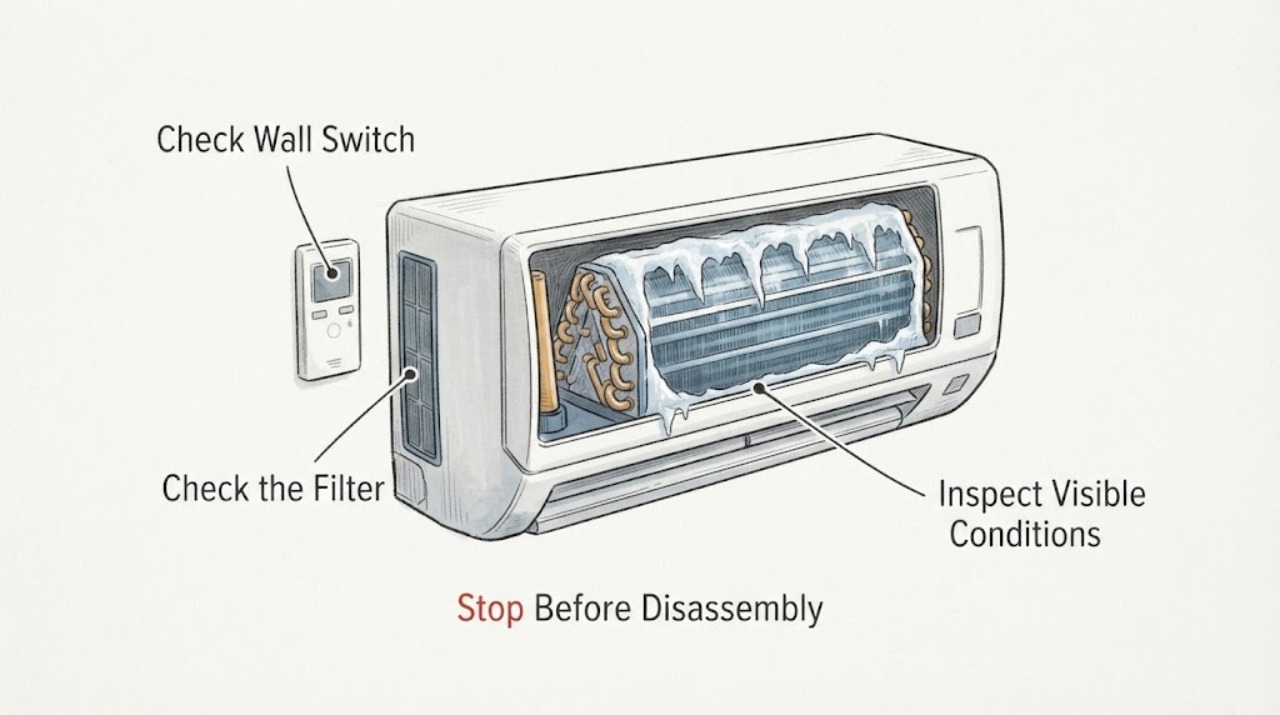
If ice is forming on an air conditioner's evaporator coil or refrigerant line, switch the thermostat from COOL to OFF and let the coil thaw naturally; do not chip at the ice or keep running the compressor against a frozen coil. Once the ice is gone and the equipment is dry, check the return-air filter, make sure supply and return grilles are open, and confirm the indoor blower is moving normal air. A dirty filter, blocked airflow, dirty coil, blower fault, low outdoor temperature, or low refrigerant can all be involved, so a clean filter does not prove the system is repaired. Do not open the refrigerant circuit, attach gauges, add refrigerant, handle capacitors, or work inside energized equipment. If ice returns, water leaks below the air handler, airflow remains weak, the blower or outdoor fan does not run, or the system trips a breaker, leave cooling off and arrange service with a qualified HVAC technician.
Work through in order
Diagnostic checks
Use only checks that match the exact appliance or system and its official guide.
-
Check 1
At the thermostat, switch COOL to OFF and leave the air conditioner off while the evaporator coil thaws naturally; keep clear of any moving fan and do not chip, scrape, or pry at the ice.
Expected result: Ice or frost is visible on the indoor coil or line, the coil has fully thawed, or water is already reaching wiring, a ceiling, or other building material.
Next step: If water is near electrical parts, a ceiling, or equipment controls, keep the system off and arrange HVAC service. Otherwise wait until the ice is gone, dry visible accessible surfaces, and continue only with external airflow checks.
Stop if: Stop for water near wiring, ceiling damage, exposed electrical parts, a frozen drain pan, or any need to chip, pry, heat, or disassemble the coil.
Why this matters
Why: Running a frozen coil can worsen the underlying fault and thaw water can create a secondary property or electrical hazard. Natural thawing provides a safe starting state for limited external checks.
-
Check 2
With cooling still off and the coil thawed, inspect the return-air filter and accessible return and supply grilles; replace or clean the filter only according to the equipment instructions and remove only loose external obstructions.
Expected result: The filter is visibly loaded, a return or supply path is blocked, the filter is clean and grilles are open, or the filter location and service method are unclear.
Next step: Correct the safe external restriction, then leave cooling off until the coil is completely thawed. If the filter is clean and airflow was weak, do not remove the air-handler panel; arrange HVAC diagnosis.
Stop if: Stop for a wet filter, mold or heavy debris inside the cabinet, a blocked duct, a damaged filter rack, or any need to clean the internal coil or blower.
Why this matters
Why: Restricted airflow can lower coil temperature enough to create ice. A clean filter and open grilles make a simple airflow restriction less likely but do not rule out a dirty internal coil or blower fault.
-
Check 3
After thawing and only if there is no water or electrical hazard, call for a brief normal cooling operation and observe airflow at several supply grilles and the indoor blower sound without placing hands near moving parts or opening panels.
Expected result: Airflow is strong and even, airflow is weak or absent, the blower hums but does not move air, or the system trips, smells hot, or makes an abnormal noise.
Next step: Stop the cooling call if airflow is weak, the blower does not run, a breaker trips, or an abnormal sound or odor appears. Keep the system off and request HVAC service rather than testing a motor, capacitor, or control.
Stop if: Stop for a non-running fan, repeated breaker trip, hot electrical odor, exposed wiring, loose fan blade, capacitor symptoms, or any need to reach into the air handler.
Why this matters
Why: Weak or absent indoor airflow can allow the evaporator coil to freeze and points toward the blower, motor, filter, duct, or control path. Electrical or mechanical symptoms override further operation.
-
Check 4
Check the thermostat is actually calling for cooling and, from outside the equipment enclosure, observe whether the outdoor fan and system start normally; do not remove the disconnect cover or touch the fan, compressor, capacitor, or wiring.
Expected result: The thermostat setting is wrong, the indoor unit runs but the outdoor unit does not, the outdoor fan runs abnormally, or the equipment starts normally with no immediate frost.
Next step: Correct only a documented thermostat mode or setpoint issue. For a non-running or abnormal outdoor unit, leave cooling off and arrange qualified HVAC service; do not repeatedly reset a breaker or open the disconnect enclosure.
Stop if: Stop for a tripped breaker that returns, buzzing, arcing, a seized or damaged fan, hot components, exposed wiring, or any work inside the outdoor enclosure.
Why this matters
Why: A control or outdoor-unit problem can stop normal heat transfer and make the indoor coil symptom misleading. Fan and electrical components carry stored or live energy even when the symptom seems simple.
-
Check 5
After safe airflow checks, compare the post-thaw symptom with the original one: note whether frost returns, whether cooling capacity remains poor, whether airflow is normal, and whether water reappears below the indoor unit; do not attach gauges or add refrigerant.
Expected result: Ice returns with clear external airflow, cooling remains weak, the coil is dirty behind a panel, the system leaks water, or the coil stays clear and cooling is restored.
Next step: For recurrent frost, weak cooling, internal dirt, or recurring water, leave cooling off and arrange a technician to check airflow, drain, coil condition, and refrigerant circuit together. Do not treat a refill as a complete repair without leak diagnosis.
Stop if: Stop for refrigerant lines, gauges, suspected leaks, oil residue, a dirty internal coil, or any request to open the sealed circuit or handle electrical components.
Why this matters
Why: Recurring ice despite safe external airflow raises concern about refrigerant, a concealed coil or blower issue, thermostat control, or another system fault. A clear coil with restored cooling supports a corrected external condition but does not prove the sealed circuit is healthy.
-
Check 6
Document the equipment model and refrigerant label if visible without removing covers, thermostat setting, location and extent of ice, thaw-water location, filter condition, airflow result, fan behavior, breaker events, and when the frost returned.
Expected result: The coil remains clear after an external airflow correction, or freezing recurs or is accompanied by weak airflow, water damage, poor cooling, or electrical symptoms.
Next step: Keep cooling off for recurrent freezing or any hazard and book qualified HVAC service. Ask the technician to diagnose the cause, inspect the airflow and drain, and repair a refrigerant leak rather than merely adding charge without finding the cause.
Stop if: Stop DIY work for refrigerant recovery or charging, sealed-line work, panel removal, capacitor testing, live electrical measurements, or coil removal.
Why this matters
Why: A repeatable record helps separate an airflow correction from a sealed-system, blower, drain, thermostat, or electrical fault. Refrigerant and energized-system work require a qualified technician.
Use your observations
Decision map
Find the observation that best matches what you see, then follow the next safe action.
-
PATH 01Next step
What you see
Ice is thawing near wiring, controls, a ceiling, or building materials, or water is pooling below the air handler.
Do this next
Arrange qualified service and follow the exact model guidance.
Why this path and its safety boundary
Why it matters: Keep cooling off, protect the area only without touching electrical parts, and arrange HVAC service to check the drain and equipment before restarting.
-
PATH 02Next step
What you see
The filter is loaded, grilles are blocked, or airflow is weak after the coil thaws.
Do this next
Arrange qualified service and follow the exact model guidance.
Why this path and its safety boundary
Why it matters: Correct only the accessible filter or grille condition permitted by the equipment instructions. Do not open the cabinet; arrange service if airflow remains weak.
-
PATH 03Next step
What you see
The indoor or outdoor fan does not run, hums, makes an abnormal noise, or a breaker trips.
Do this next
Arrange qualified service and follow the exact model guidance.
Why this path and its safety boundary
Why it matters: Leave the system off and use qualified HVAC service. Do not touch capacitors, wiring, fan blades, disconnects, or energized equipment.
-
PATH 04Next step
What you see
Ice returns with normal external airflow, cooling remains poor, or the internal coil appears dirty or damaged.
Do this next
Arrange qualified service and follow the exact model guidance.
Why this path and its safety boundary
Why it matters: Request a qualified HVAC technician to diagnose the coil and sealed circuit. Do not attach gauges, add refrigerant, cut lines, or accept a charge without leak diagnosis.
-
PATH 05Next step
What you see
The thermostat does not call for cooling correctly or the outdoor unit does not start while the indoor blower runs.
Do this next
Arrange qualified service and follow the exact model guidance.
Why this path and its safety boundary
Why it matters: Correct only an obvious documented thermostat setting. Persistent control or outdoor-unit failure needs qualified service with the system off.
-
PATH 06Next step
What you see
The coil fully thaws, airflow is normal, cooling returns, and no ice or water reappears during monitoring.
Do this next
Arrange qualified service and follow the exact model guidance.
Why this path and its safety boundary
Why it matters: Keep the filter and air paths maintained and monitor. Stop cooling and call for service if frost, weak airflow, water, or poor cooling returns.
Helpful context
Understand the symptom
Turn cooling off and let the evaporator coil thaw
Ice is a symptom, not a repair. Set the thermostat to OFF, keep the cooling call off, and allow the evaporator coil to thaw on its own. Put a safe container or absorbent material below a known drain area only if it does not touch wiring or block access. Never scrape, hammer, or pick at the ice, and do not switch to a heating mode unless the exact system instructions allow it.
Start with airflow checks that do not require disassembly
After the ice has cleared, inspect the return-air filter and replace or clean it only as the equipment instructions permit. Make sure return grilles and supply registers are open and not covered by furniture. Observe whether the indoor blower produces normal airflow and whether the outdoor unit runs when there is a legitimate cooling call. A weak or absent blower can let the coil freeze again even with a clean filter.
A clean filter does not rule out refrigerant or coil faults
A dirty evaporator coil, low refrigerant, a blower or motor problem, a thermostat issue, or conditions outside the system's intended operating range can also cause ice. Do not infer a refrigerant charge from frost pattern, temperature, or a home thermometer. Refrigerant diagnosis and any work that opens the sealed circuit belong to a qualified HVAC technician.
Treat thaw water and electrical symptoms as evidence
Thawing ice can produce water below the indoor unit, but a recurring puddle, blocked drain, wet electrical area, or ceiling damage needs service. If the indoor or outdoor fan does not run, a breaker trips, a capacitor hums or bulges, or wiring is exposed, keep the system off. Record what froze, how airflow felt after thawing, and whether ice returned for the service visit.
Only after diagnosis
Potential parts
Only when an accessible, correctly specified filter or damaged rack is confirmed by the equipment instructions; a new filter does not resolve recurring ice by itself.
Only after qualified diagnosis links weak airflow, fan failure, or control behavior to the exact component; do not test or replace energized parts at home.
Only after a qualified HVAC inspection confirms the fault and handles refrigerant recovery, leak repair, or sealed-system work under the applicable requirements.
When checks do not resolve it
Need a professional?
Ice returns after the filter and accessible airflow path are corrected, or cooling remains weak., The indoor or outdoor fan does not run, runs slowly, hums, makes an unusual noise, or a breaker trips., Thaw water reaches wiring, controls, a ceiling, or other building materials, or a drain problem is suspected., The evaporator coil is dirty, damaged, concealed behind a panel, or frozen again despite normal external airflow., The system may have low refrigerant, a leak, or a sealed-circuit problem; ask for leak diagnosis rather than an unsupported refill., Repair would require opening the refrigerant circuit, attaching gauges, handling a capacitor, measuring live electricity, removing panels, or reaching into moving equipment.
Common questions
FAQ
What should I do first when my air conditioner evaporator coil freezes?
Set the thermostat to OFF and let the ice thaw naturally. Do not chip at it or continue running cooling. After thawing, check the filter, return and supply airflow, and fan behavior without opening the equipment.
Can a dirty air filter cause a frozen coil?
Yes. Restricted airflow from a dirty filter or blocked return can contribute to freezing, but a clean filter does not rule out a dirty internal coil, blower fault, thermostat issue, or low refrigerant. Recurring frost needs HVAC diagnosis.
Should I add refrigerant when the coil is covered in ice?
No. Ice does not identify the charge or prove a leak. Do not attach gauges or open the sealed circuit. Ask a qualified technician to check airflow and diagnose and repair any refrigerant leak before charging the system.
Can I use a heat gun or scrape the ice off the coil?
Do not chip, pry, or apply direct heat to the evaporator coil. Turn cooling off and allow natural thawing. Tools or force can damage the coil and create a refrigerant or water problem.
When is a frozen coil an emergency?
Keep the system off and seek prompt professional help for water near wiring, ceiling damage, a non-running or abnormal fan, repeated breaker trips, burning odor, exposed electrical parts, or ice that returns after safe thawing and airflow checks.
Read the exact guide
Official sources
- Section 608 Technician CertificationU.S. Environmental Protection Agency · Opened official EPA certification page; certification and local requirements apply to professionals performing work that could release refrigerant.
- AC Fan Not Working? Reasons Why It Stopped SpinningTrane · Opened official Trane troubleshooting page; exact equipment type and installation instructions take precedence.
- Coil Troubleshooting GuideTrane · Opened official Trane troubleshooting guide; it provides general HVAC guidance and the exact equipment manual and qualified technician control the applicable procedure.
- Homeowners and Consumers: Frequently Asked QuestionsU.S. Environmental Protection Agency · Opened official EPA homeowner guidance; local law and the equipment's refrigerant label also apply.
Community feedback
Share a repair observation
Share a plain-text repair observation. Accepted observations are published automatically; this page may take a moment to update.