
On this page
Start here
Quick answer
Turn the thermostat from COOL to OFF as soon as you see ice or frost, and do not keep running the compressor while the coil is frozen. Let the ice thaw naturally, then check only the accessible air filter, supply registers, return grilles, and outdoor-unit clearance. A clean filter does not rule out a blocked indoor coil, blower problem, low refrigerant, or leak; recurring ice, weak airflow, water near electrical equipment, or a breaker trip needs an HVAC technician rather than refrigerant or electrical work at home.
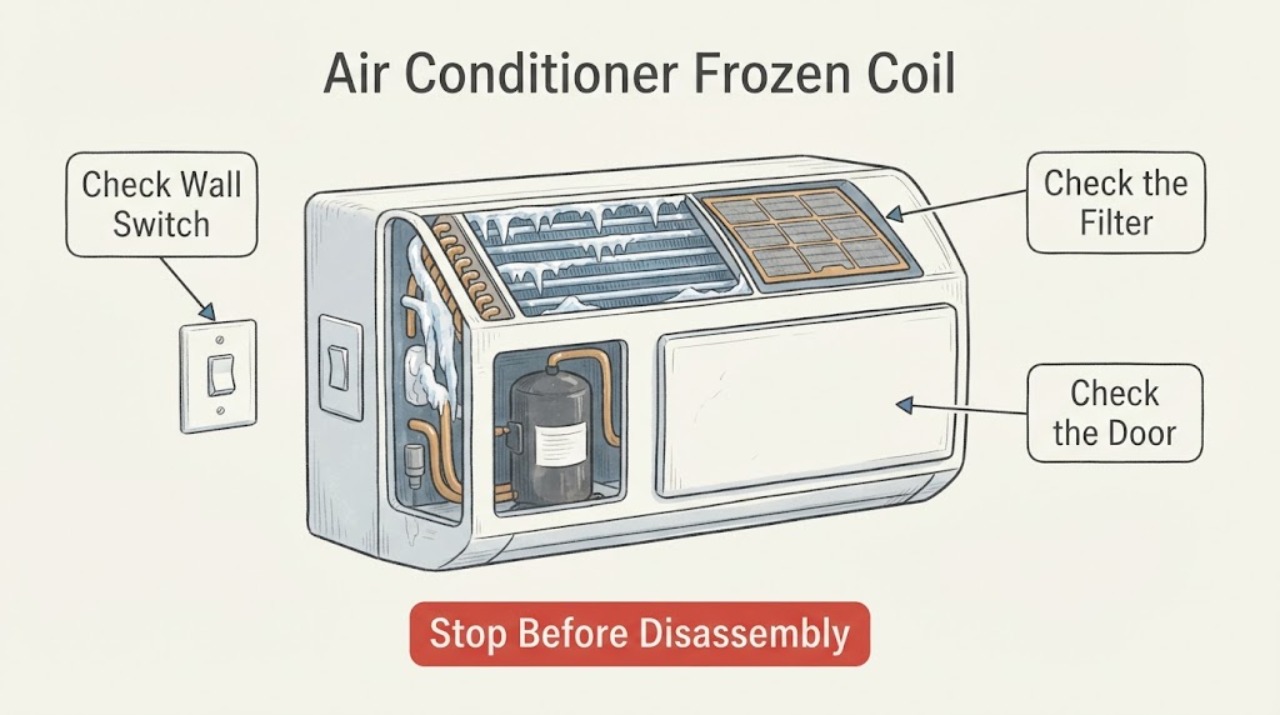
Work through in order
Diagnostic checks
Use only checks that match the exact appliance or system and its official guide.
-
Check 1
At the thermostat, switch the air conditioner from COOL to OFF. If your controls have a separate indoor fan setting, do not use it to force air through a heavily iced coil; let the ice melt without tools or heat.
Expected result: The outdoor compressor stops, and the ice remains while the indoor unit may drip as it thaws.
Next step: Place towels or a shallow container where normal thaw water can be caught without covering electrical equipment, then continue with only external checks.
Why this matters
Why: The immediate risk is continued operation against a frozen coil, not a setting that can safely be corrected by changing compressor controls.
-
Check 2
Once the system is off and the filter is accessible without opening a sealed cabinet, inspect the return-air filter and compare it with the replacement instructions in the equipment documentation. Replace a visibly loaded or damaged filter with the correct type and size; do not operate without a filter.
Expected result: The filter is packed with dust, collapsed, wet, or installed backward; or it is clean and correctly seated.
Next step: Restore the filter correctly after thawing. If airflow stays weak or the coil ices again, stop testing and arrange HVAC diagnosis.
Why this matters
Why: A restricted filter can reduce airflow enough to contribute to coil icing. A clean filter makes a filter blockage less likely but does not clear the evaporator coil, blower, duct, or refrigerant causes.
-
Check 3
With the system still off, walk the rooms served by the unit and make sure supply registers and return grilles are not covered by furniture, rugs, curtains, or stored items. Make only visual checks around the outdoor condenser; remove loose leaves or grass from its exterior clearance without removing panels.
Expected result: Several registers or a return are obstructed, or debris is pressed against the outdoor unit; alternatively, the air paths and outdoor clearance look open.
Next step: Clear only loose, reachable obstructions. Do not bend coil fins, spray into the cabinet, or dismantle the unit; continue to a professional if symptoms persist.
Why this matters
Why: Obstructed air paths can reduce the air crossing the indoor coil. Clear external obstructions are useful maintenance, but they do not prove the indoor coil, blower, or compressor circuit is healthy.
-
Check 4
After all visible ice has melted, note the airflow and condensate behavior during a brief normal call for cooling only if there is no standing water near wiring, no burning smell, and no electrical warning. Stop immediately if ice begins returning or water reaches electrical equipment.
Expected result: Airflow is weak, the indoor unit is not moving air, water is excessive, or frost reappears on the tubing; or airflow is normal and cooling returns without renewed ice.
Next step: Leave the system off and give the technician the timing, airflow change, frost location, and any water evidence. Do not measure refrigerant pressure or open electrical covers.
Why this matters
Why: Weak airflow points toward a blower, control, duct, filter, or indoor-coil problem. Fast re-icing despite an accessible clean filter raises concern about airflow or refrigerant issues; a temporary clear cycle does not establish a repair.
-
Check 5
Check the home electrical panel only from the outside and only for an obvious tripped air-conditioner breaker; do not remove covers or touch wiring. If the breaker has tripped, leave the system off rather than repeatedly resetting it.
Expected result: The breaker is tripped, trips again, or there is a burning smell, buzzing, melted insulation, or visible damage; or there is no electrical warning.
Next step: Keep the circuit off and request qualified electrical/HVAC service when any trip repeats or damage is visible. Otherwise use the airflow and re-icing results to decide whether HVAC service is still needed.
Why this matters
Why: A repeated trip or heat/damage warning may involve the compressor, fan, capacitor, wiring, or controls and is not a homeowner reset problem. No tripped breaker does not eliminate a frozen-coil airflow or refrigerant fault.
-
Check 6
Before service, record whether ice was on the indoor cabinet, suction line, or outdoor tubing; whether the filter was dirty; whether airflow was weak; how long the thaw took; and whether the issue returned. Photograph the frost only after the system is safely off and without touching the coil.
Expected result: The ice returns after a thaw, cooling is still weak, the system runs continuously, or the problem has happened more than once.
Next step: Provide the log and equipment model information to an HVAC professional; ask that any leak be located and repaired instead of simply adding refrigerant.
Why this matters
Why: Recurrence needs a root-cause inspection rather than repeated thawing. The technician should check airflow before evaluating charge, inspect for leaks, and confirm compressor and control operation using the equipment procedure.
Use your observations
Decision map
Find the observation that best matches what you see, then follow the next safe action.
-
PATH 01Next step
What you see
Only the filter is visibly blocked, there is no standing water or electrical warning, and the coil is fully thawed
Do this next
Install the correct replacement filter and verify that return and supply air paths are open.
-
PATH 02Next step
What you see
The filter is clean or replacement does not restore airflow
Do this next
Treat the indoor coil, blower, duct, control, or return-air restriction as unresolved.
-
PATH 03Next step
What you see
The coil or tubing re-freezes after thawing
Do this next
Stop cooling again; recurring ice can reflect airflow restriction or low refrigerant/leak conditions.
-
PATH 04Next step
What you see
The breaker trips again, there is a burning smell, visible electrical damage, or water is reaching electrical components
Do this next
Do not reset or operate the air conditioner.
-
PATH 05Next step
What you see
There is no ice after thawing and cooling remains normal with normal airflow
Do this next
The immediate symptom has cleared, but record the event and maintain the filter and clear air paths.
Helpful context
Understand the symptom
Ice on an air conditioner coil is a symptom, not a compressor adjustment. It can appear with a dirty filter or blocked airflow, but it can also indicate a dirty or inaccessible evaporator coil, blower or control problem, or low refrigerant. The safe homeowner path is to stop cooling, protect the compressor, and separate simple airflow checks from sealed-system and electrical work.
What the frost pattern tells you
Warm air from the registers, longer-than-normal run time, weak airflow, frost on copper tubing, or water beneath the indoor unit can all accompany a frozen evaporator coil. Frost that returns after thawing is not proof that the compressor itself has failed; it is a reason to have airflow, refrigerant charge and leak status, coil condition, blower operation, and controls tested in sequence.
Do not chip the ice or add refrigerant
Do not scrape or chip ice from the coil, open the cabinet around a concealed coil, test live electrical terminals, or connect a charging cylinder. Refrigerant must not be intentionally vented, and the correct charge cannot be inferred from frost alone. If you smell burning, see damaged wiring, hear arcing, or the breaker trips again, leave the system off and use a qualified HVAC service professional.
Safety boundary
Stop conditions
- Stop immediately if refrigerant lines, coil panels, wiring, capacitors, or other sealed electrical/refrigeration components would need to be opened or tested.
- Keep the air conditioner off if the breaker trips, there is a burning smell, arcing, damaged insulation, or water near electrical equipment.
- Do not chip ice, apply a torch or heat source, bypass a control, vent refrigerant, or repeatedly run the compressor to force a thaw.
Only after diagnosis
Potential parts
- air filter
Only if the existing filter is loaded, damaged, or overdue and the replacement is confirmed against the equipment instructions.
Match the actual dimensions, airflow rating, and system requirements; do not infer fit from the symptom or brand alone. - blower motor or blower control
Consider only if a technician confirms weak/no indoor airflow after filter and accessible obstruction checks.
Requires equipment-specific diagnosis and model verification; do not order from a frozen-coil symptom alone. - evaporator-coil or refrigerant-circuit repair
Consider only after a qualified technician confirms a coil fault or refrigerant leak; ice itself does not identify a failed part.
Sealed-system work requires trained service, recovery equipment, and exact equipment specifications.
When checks do not resolve it
Need a professional?
Call HVAC service when ice returns after a complete thaw, airflow is weak despite a correctly installed clean filter, or cooling remains inadequate., Request refrigerant and leak diagnosis from a qualified technician; do not accept a diagnosis based only on frost location or attempt a recharge yourself., Use urgent electrical or emergency assistance for smoke, fire, arcing, exposed energized wiring, or an immediate safety hazard.
Common questions
FAQ
Can I keep the air conditioner running while the coil is frozen?
No. Switch COOL to OFF and let the ice thaw naturally. Continuing to operate a frozen system can damage the equipment; do not chip the ice.
Does a new filter fix every frozen-coil problem?
No. A loaded filter can restrict airflow, but a clean filter does not rule out a dirty indoor coil, blower or duct restriction, control problem, low refrigerant, or leak.
Can I add refrigerant myself when the coil freezes?
No. Frost does not identify the charge, and refrigerant leaks should be located and repaired by a qualified technician using approved recovery equipment.
When is a frozen coil an electrical emergency?
Keep the system off for a repeated breaker trip, burning smell, arcing, damaged insulation, smoke, or water at electrical equipment. Do not remove covers or repeatedly reset the breaker.
Read the exact guide
Official sources
- Homeowners and Consumers: Frequently Asked QuestionsU.S. Environmental Protection Agency · refrigerant leak repair, certified technician selection, and prohibition on intentional refrigerant venting
- Troubleshoot an Air Conditioner | AC TroubleshootingCarrier · frozen evaporator coil symptoms, filter and airflow checks, low refrigerant warnings, electrical cautions, and professional service boundaries
- Midwest Weatherization Best Practices Field GuideU.S. Department of Energy · professional HVAC airflow, refrigerant, leak, coil, and electrical inspection sequence
- Coil Troubleshooting GuideTrane · coil icing, thermostat-off thaw guidance, airflow/dirty coil causes, and refrigerant leak service boundary
Community feedback
Share a repair observation
Share a plain-text repair observation. Accepted observations are published automatically; this page may take a moment to update.