
On this page
Start here
Quick answer
A loud air conditioner is diagnosed first by where the sound occurs and whether it starts at a thermostat cooling call, during steady operation, or at shutdown. Check the thermostat settings, filter, registers, and outdoor clearance from the outside only. A startup hum or repeated click with a fan that does not start can be a capacitor or motor clue, while rapid cycling can involve the thermostat, airflow, or another system fault; both need HVAC service rather than an opened cabinet.
Work through in order
Diagnostic checks
Use only checks that match the exact appliance or system and its official guide.
-
Check 1
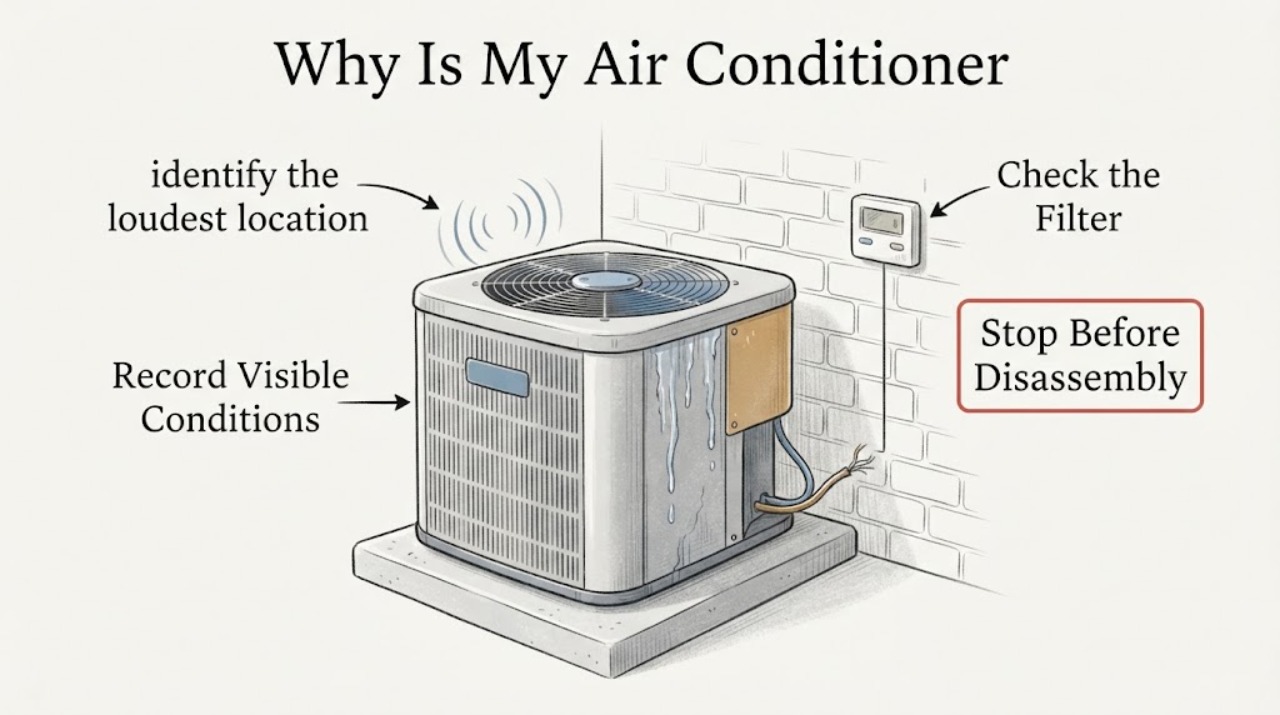
From a safe distance, identify the loudest location and note whether the sound begins at a thermostat cooling call, during steady cooling, at shutdown, or while the thermostat is idle. Do not remove panels or reach into any unit.
Expected result: An indoor whoosh or grille rattle, an outdoor rattle or grind, a startup hum or click, and a sound that continues after the call ends are different patterns.
Next step: Follow the matching branch below and stop if the sound is accompanied by smoke, burning odor, sparks, severe heat, water near electrical equipment, or a breaker trip.
Why this matters
Why: Location and timing narrow the next check: airflow or a loose external grille is more plausible for indoor noise, while outdoor startup noise can point to a fan, motor, capacitor, or control issue that requires professional diagnosis.
-
Check 2
Read the thermostat without opening it. Confirm Cooling mode and the fan setting, note the displayed room and target temperatures, and record whether the display shows a delay or an alert. Avoid repeated off-and-on commands.
Expected result: If the noise starts only when the thermostat calls for cooling, or the system starts and stops rapidly, the control call or a protective delay is part of the pattern. If the noise continues with no cooling call, the thermostat is less likely to be the direct trigger.
Next step: Keep the settings at their normal values for one observation period. If rapid cycling persists, the display stays in delay, or the noise occurs without a call, arrange HVAC service and provide the recorded timing.
Why this matters
Why: A thermostat setting, time delay, or short-cycle pattern can mimic an equipment fault, but rapid cycling can also result from airflow or mechanical and refrigerant problems; it does not identify a failed thermostat by itself.
-
Check 3
With the system stopped at the thermostat, inspect the return filter and visible supply grilles. Replace the filter only if the exact equipment instructions allow it, and visually move loose leaves or stored items away from the outside cabinet without opening or washing the cabinet.
Expected result: A visibly loaded filter, weak airflow, a vibrating grille, or blocked outdoor clearance supports an airflow or external vibration path. No visible restriction does not rule out a fan, motor, capacitor, compressor, or duct problem.
Next step: After the simple correction, observe one normal call from a safe distance. If the loud sound remains, cooling is poor, or the system cycles rapidly, stop further testing and request HVAC diagnosis.
Why this matters
Why: Restricted airflow can make the system work harder and can contribute to short cycling, while outdoor debris can make the condenser work harder. Internal coil, blower, electrical, and refrigerant work is not a homeowner check.
-
Check 4
During one normal cooling call, watch and listen from outside the cabinet perimeter only. Note whether the outdoor fan starts, whether there is a brief click followed by a hum, and whether the unit stops and tries again. Do not touch the cabinet, grille, wiring, contactor, capacitor, or refrigerant tubing.
Expected result: A hum or click with no fan start, repeated start attempts, or a loud grind or bang at the outdoor unit is an abnormal service clue. A steady fan with a new rattle points more toward vibration, debris, or a mechanical component, but sound alone cannot identify the part.
Next step: Turn the system off at the thermostat and leave it off if the fan does not start, the unit repeatedly tries to start, or the noise is harsh. Schedule an HVAC technician to inspect the capacitor, motor, controls, and compressor safely.
Why this matters
Why: Carrier identifies loud outdoor noise and a non-starting fan as condenser warning signs and lists capacitor, motor, and compressor faults as professional issues. A capacitor stores electrical energy even when the system is off.
-
Check 5
Look for ice on visible lines or the indoor unit area and for water near the air handler, using only a dry, clear view. Do not chip ice, handle wet electrical equipment, or restart the system to see whether the sound changes.
Expected result: Ice, unusual water, weak cooling, or a loud system that runs for long periods changes the case from a sound-only complaint to a possible airflow, refrigerant, drain, or equipment fault.
Next step: Switch the system off at the thermostat. If it is safe and dry to do so, keep people away from wet equipment; request HVAC service. If there is smoke, burning odor, arcing, severe heat, or a breaker trip, use the emergency stop guidance and do not restore power.
Why this matters
Why: A frozen coil can damage the compressor and generally needs professional diagnosis. Water near powered equipment adds an electrical hazard, even if the original complaint was noise.
Use your observations
Decision map
Find the observation that best matches what you see, then follow the next safe action.
-
PATH 01Next step
What you see
The sound is an indoor whoosh, grille rattle, or vibration and airflow is weak.
Do this next
Check the filter and visible grilles as in Action 3. If a clean filter and clear grille do not change the sound, request HVAC service for blower, duct, mounting, and coil checks.
-
PATH 02Next step
What you see
The sound is an outdoor rattle, grind, bang, or vibration.
Do this next
Stop the cooling call if the sound is harsh or new. Do not open the outdoor cabinet; arrange HVAC service for fan, motor, compressor, mounting, and capacitor diagnosis.
-
PATH 03Next step
What you see
A click or hum occurs at startup, the outdoor fan does not start, or the unit repeatedly tries to start.
Do this next
Leave the system off and request an HVAC technician. This is a capacitor, motor, control, or compressor service clue, not a reason to touch or replace a high-voltage part.
-
PATH 04Next step
What you see
The sound follows a thermostat call or the system rapidly starts and stops.
Do this next
Record the mode, displayed delay or alert, and cycle timing. Check only external settings and the filter; if the pattern persists, request HVAC diagnosis for thermostat, airflow, refrigerant, and equipment causes.
-
PATH 05Next step
What you see
Ice, water near electrical equipment, smoke, burning odor, sparks, severe heat, or a tripped breaker is present.
Do this next
Stop the system immediately. Do not reset a breaker repeatedly or handle wet equipment. From a dry, safe position, isolate power only if that can be done without contact with water or damaged equipment, then use qualified HVAC or electrical service; smoke, fire, or active arcing needs emergency help.
Helpful context
Understand the symptom
Start with the sound map
Write down whether the noise is at an indoor air handler or register, at the outdoor cabinet, in a duct, or at the wall control. Also note whether it happens at startup, while cooling is steady, when the system stops, or when the thermostat is idle. A short recording made from a safe distance can help a technician compare the sound without another test run. Do not remove a cabinet panel to find the source.
What capacitor and thermostat clues can and cannot show
A capacitor is a high-voltage starting and running component for motors. A hum or click at a cooling call, especially when the outdoor fan does not start, is only a service clue and does not prove the capacitor is the cause. A thermostat can create a call for cooling, a delay, or rapid cycling, but the same pattern can come from airflow, refrigerant, controls, or the equipment itself. These clues do not justify opening the cabinet, touching a contactor, discharging or measuring a capacitor, or opening the refrigerant circuit.
One safe confirmation after a simple correction
After a dirty filter is replaced or an obstruction is moved from the outside of the unit, allow the system to settle before judging the result. If the same loud sound returns, the system short cycles, or cooling remains poor, stop trying to isolate it and give the HVAC technician the sound location, timing, thermostat display, filter condition, ice or water observations, and any breaker event.
Safety boundary
Stop conditions
- Stop immediately for smoke, a burning or electrical odor, visible sparks or arcing, a hot or damaged plug or disconnect, severe cabinet heat, or a breaker that trips again.
- Stop and keep clear if water or ice is near powered equipment, the indoor unit is leaking, or the floor is wet. Do not handle wet electrical equipment.
- Do not remove panels, touch a contactor or capacitor, discharge or measure a capacitor, perform live electrical tests, or open the refrigerant circuit.
- Do not keep restarting a unit that hums without starting, grinds, bangs, short cycles, or fails to cool.
Only after diagnosis
Potential parts
- AC capacitor
Consider this category only if a qualified technician confirms a capacitor fault after the startup hum, click, fan-start, and electrical checks.
Capacitor ratings and physical fit vary by equipment. Confirm the exact model and manufacturer requirements with the technician before any part is selected. - thermostat
Consider this category only if the thermostat call, display, settings, and equipment wiring are professionally diagnosed as the cause of the noise or rapid cycling.
A replacement control must match the HVAC system and wiring. Do not assume a generic control is compatible.
When checks do not resolve it
Need a professional?
Request HVAC diagnosis for persistent loud noise, startup hum or click, repeated cycling, a non-starting outdoor fan, ice, water, or any internal component suspicion.
Common questions
FAQ
Does a loud hum mean the air conditioner capacitor is bad?
A startup hum or click with a fan that does not start can be a capacitor clue, but it can also involve a motor, control, or compressor. Leave the system off and have an HVAC professional diagnose it; do not open the cabinet or handle the capacitor.
Can a thermostat cause loud air conditioner noise?
A thermostat can create a cooling call, delay, or rapid cycling pattern that makes an equipment problem more noticeable. Check only its external mode, fan setting, display, and timing. Persistent cycling or noise needs HVAC diagnosis because airflow and equipment faults can look similar.
What should I do if the outdoor air conditioner rattles or grinds?
Turn the cooling call off and keep clear of the cabinet if the sound is harsh, new, or accompanied by poor cooling. Do not open the cabinet or remove debris through the grille. Arrange HVAC service for safe checks of the fan, motor, mounting, capacitor, and compressor.
Read the exact guide
Official sources
- What is an AC Condenser Unit? | Function, Cost & RepairCarrier · Carrier residential condenser operation, outdoor noise, airflow, capacitor, motor, compressor, and overheating clues
- Common Thermostat Issues and How to TroubleshootCarrier · Carrier thermostat settings, time delays, short cycling, filter effects, and professional escalation
- Maintenance ChecklistENERGY STAR · ENERGY STAR residential air conditioner maintenance, filter, airflow, condensate, controls, and coil guidance
- AC Capacitor | Air Conditioner CapacitorCarrier · Carrier air conditioner capacitor function, startup symptoms, compatibility, and professional safety boundary
- Troubleshoot an Air Conditioner: 6 Steps to Fix an AC Not WorkingCarrier · Carrier residential air conditioner troubleshooting, thermostat settings, airflow, outdoor unit, ice, and electrical safety guidance
Community feedback
Share a repair observation
Share a plain-text repair observation. Accepted observations are published automatically; this page may take a moment to update.