
On this page
Start here
Quick answer
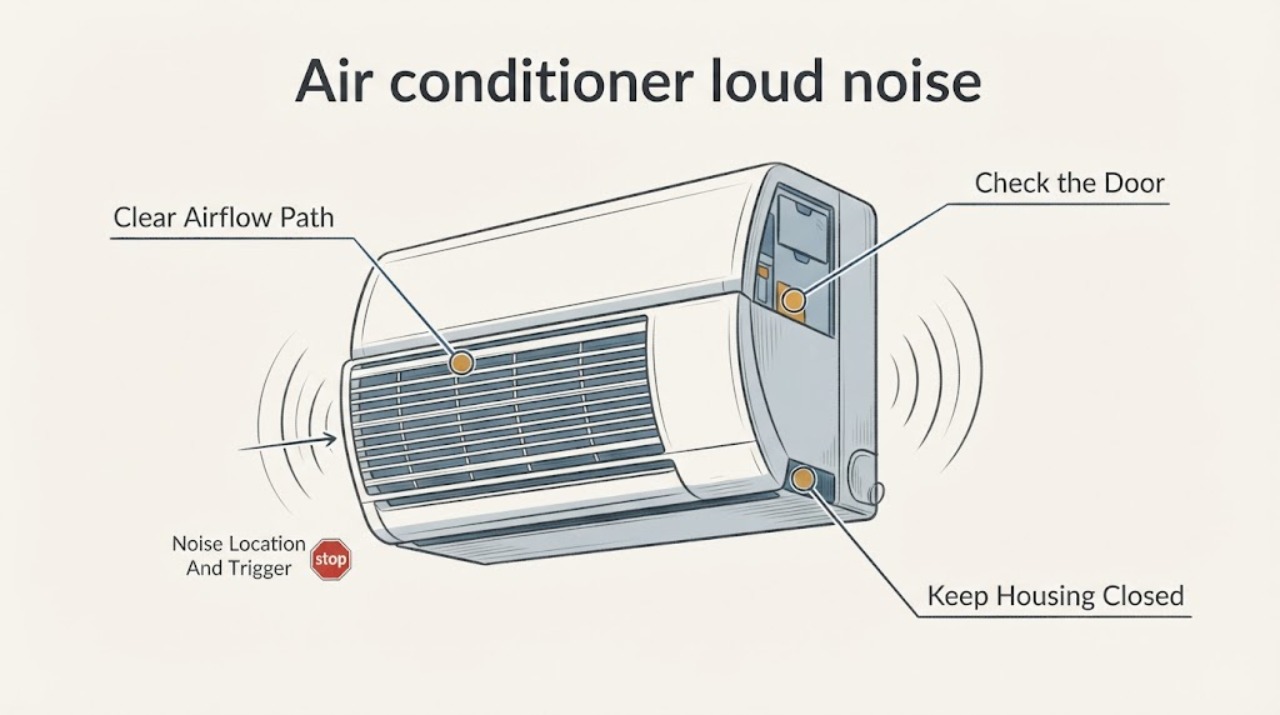
A new or intrusive air-conditioner noise is a symptom to classify, not a part to guess. Turn cooling off before inspecting anything. Note whether the sound comes from the indoor or outdoor unit and whether it is a rattle, scrape, bang, hum, hiss, or intermittent bubbling. From safe, ordinary access, check the filter and look for visible outdoor obstructions or a damaged fan blade without reaching through a guard or opening a cabinet. A sudden loud, grinding, scraping, banging, electrical, or burning-related noise should remain off while you arrange HVAC service. A brief startup or shutdown click may be a normal operating sound, but a noise that is new, persistent, worsening, or accompanied by weak airflow or poor cooling needs professional diagnosis.
Before you begin
Safety first
- The reader-level scope is thermostat control, ordinary filter access, and non-contact observation only. A qualified HVAC professional must handle electrical compartments, capacitors, moving fan parts, refrigerant circuits, live tests, disassembly, and component replacement.
Work through in order
Diagnostic checks
Use only checks that match the exact appliance or system and its official guide.
-
Check 1
Turn the cooling call off at the thermostat before inspecting, then record the sound location and timing from a safe position; do not place hands near a fan or open a panel.
Expected result: Note indoor versus outdoor origin, startup or shutdown versus continuous operation, and whether the sound is a brief click, rattle, scrape, bang, hum, hiss, or bubbling; also record weak airflow, poor cooling, smoke, or odor.
Next step: Keep the system off for a sudden, worsening, scraping, banging, electrical, or burning-related noise. For a brief, familiar transition sound with no other symptom, consult the model manual and monitor whether it changes; arrange service if it persists or becomes louder.
Stop if: Stop immediately for smoke, burning odor, sparks, exposed wiring, refrigerant-like hissing with other symptoms, a moving or damaged blade, or any need to open the cabinet.
Why this matters
Why: A brief click or flap-related rattle at a transition can be an operating sound, while a sudden intrusive noise, metal-on-metal sound, sustained hum, or noise paired with another symptom points to a fault that needs service. The description narrows the professional diagnosis but does not prove a part failure.
-
Check 2
With the unit stopped, inspect only the user-accessible air filter as described in the owner manual; replace or clean it only by the manual's method and do not remove indoor panels.
Expected result: Record whether the filter is visibly loaded with dust, wet, damaged, or correctly seated, and whether airflow was weak before the system was stopped.
Next step: Install only the correct filter type if the manual calls for replacement, then arrange HVAC service if the loud noise, weak airflow, ice, water, or poor cooling remains. Do not run the system with a missing filter as a test.
Stop if: Stop for water near electrical equipment, ice that requires handling, a damaged filter compartment, unusual heat or odor, or any access beyond the ordinary filter door.
Why this matters
Why: A dirty, wet, damaged, or mis-seated filter can restrict airflow and change operating noise, but a clean filter does not clear the blower, coil, duct, refrigerant, or electrical system.
-
Check 3
With cooling off, observe the outdoor unit from a stable position through the guard and around the cabinet; look for loose leaves or debris near the airflow path, a visibly cracked or bent blade, or abnormal cabinet vibration without reaching inside.
Expected result: Record clear airflow space versus visible obstruction, and an intact stationary fan blade versus a damaged blade, blade strike marks, or vibration when the unit is operating; do not restart a unit with a damaged blade.
Next step: Keep the system off and request HVAC service if a blade is cracked, loose, bent, striking anything, or not operating normally. If only loose debris is visible outside the cabinet, keep clear of the guard and follow the owner's cleaning instructions or have service perform the cleaning.
Stop if: Do not remove the guard, lift the cabinet top, touch the fan, wiring, capacitor, refrigerant lines, or any component that may still be energized or moving.
Why this matters
Why: Debris can reduce outdoor airflow, while a damaged or out-of-balance fan blade can make unusual noise and damage other components. A quiet or intact-looking exterior does not rule out a concealed motor, compressor, capacitor, mounting, or duct problem.
-
Check 4
If the sound is specifically intermittent bubbling or thumping from a split-system indoor unit, note whether a room is tightly closed, an exhaust or ventilation fan is running, or strong wind is present; make only a safe change such as opening a room vent or window if conditions permit.
Expected result: The sound may lessen when a safe vent or window is opened or the exhaust fan is stopped, or it may remain unchanged; record whether water leakage or another symptom appears.
Next step: If the sound improves, ask the installer or HVAC professional to assess the drain-hose routing and any needed check-valve solution. If it persists, leaks, or is not truly bubbling, keep the system off as appropriate and request inspection.
Stop if: Do not access the drain hose at height, remove a cover, add a valve, pour chemicals, or continue if water is leaking or the room cannot be ventilated safely.
Why this matters
Why: A sound that changes with room pressure or wind is consistent with air entering the drain hose, whereas no change suggests another cause. This observation does not justify installing a valve or altering the drain line.
-
Check 5
Prepare a service record from safe observations: sound sample only if recording does not require standing near moving equipment, exact location, timing, filter condition, visible outdoor condition, cooling performance, and recent installation or repair history.
Expected result: The record may show a repeatable trigger, a new change from the normal sound, a symptom that occurs only indoors or outdoors, or no safe pattern.
Next step: Send the record and safe photos to a qualified HVAC professional and ask for diagnosis before ordering a component. Keep the system off whenever the noise is severe, worsening, or associated with a safety sign.
Stop if: Stop testing when the noise worsens, cooling stops, the breaker trips, water appears, or inspection would require live electrical measurements, refrigerant work, disassembly, height access, or entering an unsafe area.
Why this matters
Why: Timing and location help the technician distinguish airflow, fan, mounting, compressor, drain, or control-system paths; no safe pattern is still useful and does not justify invasive testing.
Use your observations
Decision map
Find the observation that best matches what you see, then follow the next safe action.
-
PATH 01Next step
What you see
The noise is new, sudden, worsening, grinding, scraping, banging, electrical, or accompanied by smoke, burning odor, sparks, or another unsafe symptom.
Do this next
Leave the system off and arrange urgent HVAC service; use emergency assistance for smoke or fire. Do not reset a repeatedly tripping breaker or restart the unit to reproduce the sound.
Why this path and its safety boundary
Why it matters: A normally quiet system that suddenly becomes loud should not be operated while a concealed mechanical, electrical, or refrigerant-related cause is unresolved.
-
PATH 02Next step
What you see
The sound comes from the outdoor unit and a blade is visibly cracked, loose, bent, striking another part, or vibrating abnormally.
Do this next
Keep cooling off, do not reach through the guard, and request qualified HVAC diagnosis of the fan, motor, mounting, and related controls.
Why this path and its safety boundary
Why it matters: An out-of-balance or damaged fan can create unusual noise and may damage the outdoor assembly if operated.
-
PATH 03Next step
What you see
The filter is dirty, wet, damaged, or mis-seated and the system also has weak airflow or a changed air sound.
Do this next
Use the owner manual to clean or replace the user-accessible filter, then arrange service if the noise or airflow problem remains or if ice, water, or poor cooling is present.
Why this path and its safety boundary
Why it matters: Restricted or abnormal filter condition can contribute to airflow noise, but it does not prove the filter is the only cause.
-
PATH 04Next step
What you see
The sound is indoor bubbling or thumping and it changes when a safe room vent or window is opened or an exhaust fan is stopped.
Do this next
Ask the installer or HVAC professional to evaluate drain-hose routing and any suitable check-valve remedy; do not alter the drain line yourself.
Why this path and its safety boundary
Why it matters: The pattern is consistent with air entering the drain hose under room-pressure or wind conditions, not proof of a failed air-conditioning part.
-
PATH 05Next step
What you see
The sound is brief, familiar, and limited to startup, shutdown, or a flap transition, with normal airflow and cooling and no safety sign.
Do this next
Consult the owner manual, keep a timing note, and schedule service if the sound becomes intrusive, continuous, or different from the established normal behavior.
Why this path and its safety boundary
Why it matters: Some systems produce short transition sounds, but a change in loudness, duration, or frequency makes the symptom worth reassessing.
-
PATH 06Next step
What you see
Safe observations do not identify a harmless transition sound or visible filter/outdoor condition, or the required view is concealed or inaccessible.
Do this next
Keep the unit off if the sound is severe or worsening and request qualified HVAC inspection before selecting or replacing a part.
Why this path and its safety boundary
Why it matters: Fan, blower, motor, compressor, capacitor, mounting, duct, drain, or control causes cannot be separated safely from external observation.
Helpful context
Understand the symptom
Classify the sound before deciding what it means
Write down where the sound starts, when it occurs, and whether it changes with startup, shutdown, fan speed, or a cooling call. Daikin lists some brief clicking, flap movement, and bubbling sounds as possible operating or airflow conditions, while Trane advises shutting off a normally quiet system that suddenly becomes loud. The sound label alone does not identify a failed component.
Keep checks outside the cabinet
The useful user-level checks are visual and non-contact: a filter that is dirty or wet, leaves around the outdoor unit, or a fan blade that is visibly cracked, loose, or broken. Do not remove a grille, open the electrical compartment, touch wiring or a capacitor, or reach into the outdoor fan area. Those observations can help a technician choose the next test without making a high-voltage or moving-part repair a DIY task.
A bubbling indoor sound is a separate branch
If the noise is an intermittent bubbling or thumping from a split-system indoor unit, note whether the room is tightly closed, an exhaust fan is running, or strong wind is present. Daikin says those conditions can let outdoor air enter the drain hose; opening a safe room vent or window and turning off the exhaust fan may change the sound. If it does not improve, or the noise is something else, arrange an inspection rather than fitting a drain component yourself.
Safety boundary
Stop conditions
- Keep the air conditioner off for a sudden, severe, worsening, grinding, scraping, banging, electrical, or burning-related noise.
- Do not open the cabinet, remove a guard, touch wiring or a capacitor, reach near a fan, handle refrigerant, or perform live electrical or pressure testing.
- Stop for smoke, sparks, burning odor, refrigerant-like hissing with other symptoms, water near electrical equipment, ice, a damaged blade, a tripped breaker, or unsafe access.
- Do not choose or install a replacement part from the sound alone; concealed mechanical and electrical faults require qualified HVAC diagnosis.
Only after diagnosis
Potential parts
- condenser fan blade
Consider only if qualified inspection confirms a cracked, bent, loose, or out-of-balance outdoor fan blade as the source of the noise.
Match the exact unit model, blade dimensions, rotation, and manufacturer fit information before ordering. - condenser fan motor
Consider only after a technician confirms that the outdoor motor is noisy, vibrating, overheating, or not operating and that the motor is the failed component.
Confirm model, voltage, speed, mounting, rotation, and manufacturer fit information; do not infer compatibility from noise alone. - indoor blower motor or wheel
Consider only when professional diagnosis links an indoor hum, rattle, or airflow symptom to the blower assembly after the filter and accessible airflow path are checked.
Confirm the air-handler or furnace model and the exact motor or wheel specification before ordering.
When checks do not resolve it
Need a professional?
Arrange qualified HVAC service for any new or persistent loud noise, and keep the unit off for sudden, severe, worsening, grinding, scraping, banging, electrical, or burning-related sounds. Request urgent attention for a damaged or non-operating outdoor fan, smoke or sparks, water near electrical equipment, a repeatedly tripping breaker, or loss of cooling. Provide the technician the sound location, timing, safe photos, filter condition, outdoor observations, and any change in airflow or cooling.
Safety scope: The reader-level scope is thermostat control, ordinary filter access, and non-contact observation only. A qualified HVAC professional must handle electrical compartments, capacitors, moving fan parts, refrigerant circuits, live tests, disassembly, and component replacement.
Common questions
FAQ
Should I keep running an air conditioner that suddenly becomes loud?
No. Turn it off and arrange HVAC service when the noise is sudden, severe, worsening, grinding, scraping, banging, electrical, or paired with an odor, smoke, water, weak airflow, or poor cooling.
Can a dirty filter cause a loud air conditioner?
A dirty, wet, damaged, or mis-seated filter can restrict airflow and change the sound, but it does not prove the filter is the only cause. Check it through the normal filter access and arrange service if the symptom remains.
What does an outdoor rattling or scraping sound mean?
A visibly damaged or out-of-balance fan blade can make unusual noise, but a loose mounting, motor, compressor, or concealed component can sound similar. Keep the unit off, do not reach through the guard, and have HVAC service diagnose it.
Is bubbling from an indoor split air conditioner always a failure?
Not always. In a tightly closed room, wind or an exhaust fan can let air enter the drain hose and cause bubbling. A safe vent or window may change that sound; persistent bubbling, thumping, or any leak needs installer or HVAC inspection.
Can I replace the capacitor or fan motor myself?
No. Capacitors can retain electrical charge, and fan components can move unexpectedly. Do not open the cabinet or handle those parts; a qualified HVAC professional should confirm the failed component and its fit.
Read the exact guide
Official sources
- Measure Guideline: Air Conditioner Diagnostics, Maintenance, and ReplacementU.S. Department of Energy · Department of Energy technical maintenance guidance; used only for the visible outdoor obstruction and professional-access distinction.
- Is This Normal? HVAC Smells and Sounds, ExplainedTrane · Manufacturer educational guidance for residential HVAC sounds; it is not a diagnosis for a specific air-conditioner model.
- TroubleshootingDaikin · Manufacturer troubleshooting guidance for Daikin residential air conditioners; sound-specific behavior can vary by model.
- Why is My Air Conditioner Fan Not Working?Carrier · Manufacturer troubleshooting guidance for residential air-conditioner fan symptoms; exact repair depends on the model and diagnosis.
Community feedback
Share a repair observation
Share a plain-text repair observation. Accepted observations are published automatically; this page may take a moment to update.