
On this page
Start here
Quick answer
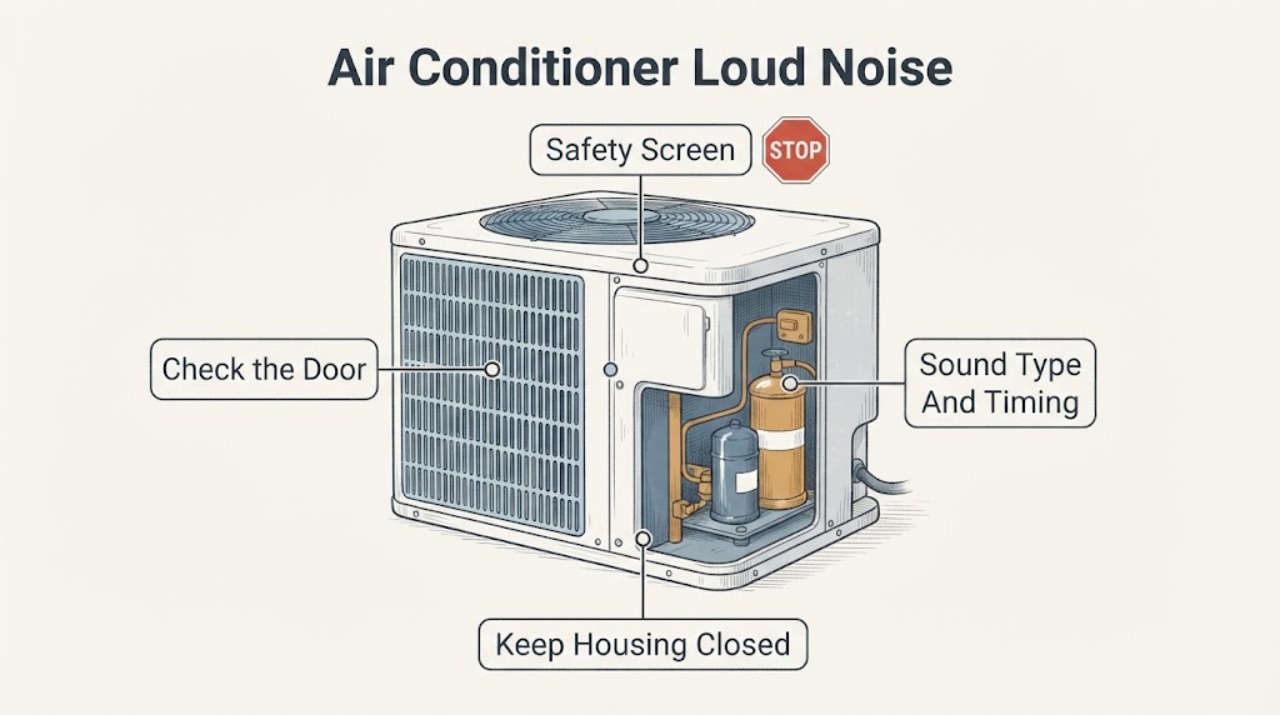
A loud air-conditioner noise should be classified by location, sound, and timing before anyone guesses a part. Turn cooling off at the thermostat and listen from a safe position: an indoor blower sound points to a different path from an outdoor hum, click, rattle, grind, bang, or squeal. A new outdoor noise that starts with the compressor, is followed by startup-and-stop behavior, or comes with weak cooling can involve a capacitor, compressor, fan motor, contactor, or another high-voltage component; those are HVAC service clues, not homeowner repairs. Check only the thermostat, accessible filter, registers, and visible outdoor obstructions without opening equipment. Stop for smoke, burning odor, arcing, a hot disconnect or cord, repeated breaker trips, ice, water near electricity, refrigerant-like hissing, severe vibration, or a rapidly worsening metal-on-metal sound. Do not remove guards, discharge or measure a capacitor, touch a contactor, open the refrigerant circuit, or run the system repeatedly to reproduce the noise.
Work through in order
Diagnostic checks
Use only checks that match the exact appliance or system and its official guide.
-
Check 1
Turn cooling off at the thermostat and observe the system from a dry, stable position without touching the cabinet, disconnect, guards, wiring, or wet equipment.
Expected result: Record smoke, burning odor, sparks, arcing, unusual heat, a hot or damaged cord or disconnect, repeated breaker trips, ice, water near electricity, refrigerant-like hissing, severe vibration, or a metal-on-metal sound.
Next step: Keep the system off, move away from the hazard, isolate power only from a dry safe position when appropriate, and arrange qualified HVAC or electrical service.
Stop if: Do not restart the air conditioner, touch wet electrical parts, open guards, or use a repeated cycle to see whether the sound worsens.
Why this matters
Why: These signs indicate a fire, shock, refrigerant, water, or mechanical hazard beyond ordinary noise diagnosis.
-
Check 2
From safe access, identify whether the loud noise comes from the indoor air handler, a supply or return grille, the outdoor condenser, or the line between them.
Expected result: Indoor noise supports a blower, filter, return, or indoor control path; outdoor noise supports a condenser fan, capacitor, compressor, contactor, or outdoor cabinet path; a line or wall sound changes the service assessment.
Next step: Keep cooling off and record the location, room, unit, and whether airflow or cooling changed.
Stop if: Do not enter a crawlspace or roof area, climb near the outdoor unit, or open either cabinet to locate the sound.
Why this matters
Why: Location narrows the responsible equipment without requiring a panel or guard to be removed.
-
Check 3
Record whether the sound is a hum, click, rattle, grind, squeal, bang, scrape, hiss, or vibration, and whether it occurs at startup, while running, shutdown, or continuously; do not intentionally restart the system.
Expected result: A brief documented start or stop click may be normal; a new hum with failed starting, a rattle, grind, squeal, bang, or persistent hiss changes the next step to service.
Next step: Preserve the first safe observation and provide the sound description to an HVAC technician.
Stop if: Do not run multiple start cycles, hold a fan blade, or use a tool to probe the sound source.
Why this matters
Why: Manufacturers use sound type and timing as diagnostic clues, but no sound alone proves a capacitor or compressor failure.
-
Check 4
After the system is quiet and safe, record the thermostat mode, fan setting, set point, display, and whether the noise began after a schedule or control change.
Expected result: Fan On can make the indoor blower run continuously; an incorrect mode or schedule can make normal transitions appear unusual; the same loud noise with cooling disabled points to equipment or a non-thermostat source.
Next step: Use the thermostat manual to select the intended normal mode once, then keep cooling off if the noise returns or is new and loud.
Stop if: Do not jumper thermostat terminals, remove the thermostat, or repeatedly cycle the call for cooling.
Why this matters
Why: A control setting can explain operation timing but cannot make a grinding, arcing, or failing outdoor motor safe.
-
Check 5
With cooling off, inspect the accessible air filter, return grille, and supply registers without opening the air handler or reaching toward a blower.
Expected result: A clogged filter or blocked grille can restrict airflow and change blower sound or system performance; a clean filter with a loud mechanical or outdoor sound leaves an equipment branch possible.
Next step: Replace a dirty filter with the correct model-approved type and keep the system off if the noise is severe, new, or accompanied by ice or weak airflow.
Stop if: Do not run the system without a required filter, remove blower panels, or reach into a fan assembly.
Why this matters
Why: Airflow maintenance is a low-risk check, not a test of the capacitor, compressor, motor, or refrigerant circuit.
-
Check 6
From ground level and a safe distance, look around the outdoor unit for leaves, branches, loose visible debris, a leaning cabinet, damaged grille, or an obvious obstruction without touching the fan or cabinet.
Expected result: A visible external obstruction or loose panel may explain a rattle; ice, oil-like residue, a damaged fan blade, severe vibration, or a blocked guard requires service rather than removal by hand.
Next step: Keep the unit off and arrange HVAC service for anything inside the guard, any damage, or any recurring noise.
Stop if: Do not remove the grille, insert tools, touch a fan blade, move the unit, or reach into the condenser.
Why this matters
Why: An outside visual clue can identify a safe maintenance boundary but cannot clear the capacitor, compressor, motor, or electrical controls.
-
Check 7
Look from outside for ice on refrigerant lines or the unit and for water around the indoor equipment, while keeping away from wet electrical components.
Expected result: Ice with weak cooling or excess water suggests an airflow, refrigerant, or coil problem; water near an outlet or electrical cabinet adds a shock hazard; neither is explained by a normal noise.
Next step: Turn cooling off, keep the system isolated, and arrange qualified HVAC service; do not chip ice or handle refrigerant.
Stop if: Do not run the AC to melt ice, open the coil cabinet, add refrigerant, or touch water and electricity together.
Why this matters
Why: Continuing to run a frozen system can damage the coil or compressor and requires professional assessment.
-
Check 8
Record whether the outdoor unit starts, hums without starting, starts and immediately stops, or produces the loud sound only when the compressor or fan engages; do not repeat the call for cooling.
Expected result: Humming with failed starting or rapid start-and-stop keeps capacitor, compressor, fan motor, contactor, or control faults possible; a hard bang, grind, or squeal points to urgent mechanical service.
Next step: Keep the unit off and provide the exact sequence to an HVAC professional.
Stop if: Do not remove the access panel, discharge a capacitor, touch a contactor, or measure voltage or capacitance.
Why this matters
Why: Capacitor and compressor clues overlap with other high-voltage or mechanical faults and cannot be confirmed by listening alone.
-
Check 9
Only when the unit is dry, cool, stable, and free of smoke, odor, ice, water, arcing, and repeated trips, follow the exact equipment manual's single authorized reset or thermostat-off wait.
Expected result: A normal quiet restart under the manual may indicate a temporary control state; a returning loud noise, no start, immediate stop, or breaker trip means the fault remains.
Next step: Stop after one safe documented attempt and arrange HVAC service if the noise returns or operation remains abnormal.
Stop if: Do not restore power to wet equipment, repeatedly reset, or restart after a safety symptom.
Why this matters
Why: A reset cannot validate a capacitor, compressor, fan motor, contactor, wiring, or refrigerant condition.
-
Check 10
Prepare a service record with system type and model, indoor or outdoor source, sound type, start or stop timing, thermostat state, filter condition, cooling result, ice or water, visible obstruction, breaker behavior, and all safety symptoms.
Expected result: The sequence distinguishes a normal transition, airflow restriction, external rattle, fan or motor issue, capacitor or compressor clue, refrigerant problem, or electrical fault.
Next step: Keep the air conditioner off until the noise is explained when it is new, loud, worsening, or accompanied by any warning sign.
Stop if: Do not order or replace a capacitor, compressor, fan motor, contactor, control, or refrigerant component from the noise alone.
Why this matters
Why: An HVAC technician can target the correct system without unsafe panel access or repeated operation.
Use your observations
Decision map
Find the observation that best matches what you see, then follow the next safe action.
-
PATH 01Safety boundary
What you see
Smoke, burning odor, arcing, sparks, a hot or damaged disconnect or cord, repeated breaker trips, severe vibration, ice, water near electricity, or a rapidly worsening metal-on-metal noise is present.
Do this next
Keep the system off, move clear of the hazard, isolate power only from a dry safe position when appropriate, and arrange qualified HVAC or electrical service.
Why this path and its safety boundary
Why it matters: The system presents electrical, fire, water, refrigerant, or mechanical risk.
Safety stop: Do not restart, open guards, touch wet equipment, or perform another test.
-
PATH 02Safety boundary
What you see
The sound is a brief documented click or normal airflow event at startup or shutdown, with normal cooling and no worsening or safety symptom.
Do this next
Monitor normal use without deliberate repeat testing and arrange service if the sound becomes loud, persistent, or changes character.
Why this path and its safety boundary
Why it matters: Some systems make normal transition sounds, but a new or increasing sound is not cleared by that possibility.
Safety stop: Stop if the system begins humming without starting, grinding, banging, overheating, or tripping protection.
-
PATH 03Safety boundary
What you see
The sound is indoors and changes with the blower, filter, return grille, or supply airflow.
Do this next
Check only the accessible filter and grilles with cooling off; arrange HVAC service for a persistent loud, grinding, or electrical noise.
Why this path and its safety boundary
Why it matters: A filter, grille, blower wheel, motor, or indoor control path may be involved.
Safety stop: Do not remove an air-handler panel or reach toward the blower.
-
PATH 04Safety boundary
What you see
The outdoor unit rattles and a visible loose external object or panel is present without ice, damage, heat, or electrical symptoms.
Do this next
Keep the unit off and have HVAC service secure or inspect it; do not reach through the guard or remove the panel.
Why this path and its safety boundary
Why it matters: An external obstruction or loose cover may be contributing, but internal fan and compressor faults remain possible.
Safety stop: Stop for severe vibration, scraping, a damaged blade, smoke, or a recurring rattle.
-
PATH 05Safety boundary
What you see
A new outdoor hum, loud startup or shutdown sound, start-and-stop pattern, or failed start occurs near compressor engagement.
Do this next
Keep cooling off and arrange qualified HVAC diagnosis.
Why this path and its safety boundary
Why it matters: A capacitor, compressor, fan motor, contactor, or control issue is possible; no single component is proven.
Safety stop: Do not discharge or measure a capacitor, touch a contactor, open the condenser, or continue starting the system.
-
PATH 06Safety boundary
What you see
The sound is grinding, scraping, squealing, hard banging, or accompanied by severe vibration from either unit.
Do this next
Leave the system off and arrange HVAC service before further operation.
Why this path and its safety boundary
Why it matters: A fan, blower, motor, compressor, mounting, or other mechanical part may be damaged.
Safety stop: Do not hold a fan, remove guards, or run it to locate the contact point.
-
PATH 07Safety boundary
What you see
Ice, excess indoor water, or hissing near the coil or refrigerant tubing accompanies the noise.
Do this next
Turn cooling off, keep clear of wet electrical equipment, and arrange qualified HVAC service.
Why this path and its safety boundary
Why it matters: Airflow, coil, refrigerant, compressor, or condensate problems may be present.
Safety stop: Do not chip ice, open the coil cabinet, add refrigerant, or run the system to thaw it.
-
PATH 08Safety boundary
What you see
The breaker trips when the system starts or trips again after a reset.
Do this next
Leave the breaker and AC off and arrange qualified electrician and HVAC diagnosis.
Why this path and its safety boundary
Why it matters: An overload, short, compressor, capacitor, wiring, or other electrical fault may be present.
Safety stop: Do not reset repeatedly, hold the breaker on, or open the panel.
-
PATH 09Safety boundary
What you see
The filter and visible airflow or obstruction checks are normal, but the loud noise remains or returns.
Do this next
Keep cooling off and arrange qualified HVAC service with the sound record.
Why this path and its safety boundary
Why it matters: An internal fan, motor, capacitor, compressor, contactor, control, mounting, or refrigerant fault remains possible.
Safety stop: Do not substitute parts or open the system based only on the sound.
Helpful context
Understand the symptom
Classify the sound before opening anything
A brief click or a normal airflow sound can occur as a system starts or stops, but a sudden or worsening noise from a normally quiet system is a service clue. Record whether it comes from the indoor air handler or outdoor condenser, whether it occurs at startup, steady operation, shutdown, or all the time, and whether cooling or airflow changed. Humming, rattling, grinding, squealing, banging, and hissing do not identify the same part.
Use only the safe external checks
Switch the thermostat to a non-cooling state before checking the filter, supply registers, return grille, and visible space around the outdoor unit. Replace a dirty filter only with the correct type and according to the system instructions. Remove no panels, guards, or covers. Do not reach through an outdoor fan guard, move the unit, or treat a clear filter as proof that the blower, compressor, capacitor, or control is healthy.
Capacitor and compressor clues are not DIY tests
An outdoor hum with difficulty starting, rapid cycling, or a start-and-stop pattern can be consistent with a capacitor or compressor problem, but the same sound can come from a fan motor, contactor, wiring, or another fault. Capacitors store electrical energy even after power is off, and compressor diagnosis may involve refrigerant and high-voltage systems. Give the technician the sound and timing; do not test or replace the component yourself.
Ice, water, and hissing change the decision
Ice on refrigerant lines or the outdoor unit, water around the indoor equipment, or hissing near the coil or refrigerant tubing is not a normal loud-noise branch. Turn cooling off, keep clear of wet electrical equipment, and arrange HVAC service. Do not chip ice, open the coil case, add refrigerant, or search for a leak.
Safety boundary
Stop conditions
- Stop for smoke, burning odor, arcing, sparks, hot or damaged electrical equipment, repeated trips, severe vibration, ice, water near electricity, refrigerant-like hissing, or rapidly worsening grinding or banging.
- Do not remove guards or panels, reach toward a fan or blower, touch a contactor, discharge or measure a capacitor, or perform live electrical tests.
- Do not open the refrigerant circuit, add refrigerant, chip ice, run the system to provoke or clear the noise, or move the equipment.
- Do not repeatedly restart, reset, or hold a breaker on; one model-authorized reset is the limit and only applies when the system is dry and free of safety symptoms.
- Do not choose a capacitor, compressor, motor, contactor, control, or refrigerant repair from a sound alone; persistent or new loud noise needs qualified HVAC diagnosis.
Only after diagnosis
Potential parts
- air-conditioner capacitor
Only relevant when a qualified HVAC diagnosis links the startup hum, failed start, or rapid cycling to the capacitor rather than the compressor, fan motor, contactor, or control.
Capacitance, voltage, physical configuration, system model, and safe discharge procedure must be confirmed by a qualified technician; capacitors can retain a dangerous charge after power is off. - air-conditioner compressor
Only relevant after professional testing confirms compressor mechanical or electrical failure; loud noise alone cannot justify compressor replacement.
Compressor selection depends on the complete system model, refrigerant circuit, electrical design, and professional compatibility assessment. - condenser or blower fan motor
Only relevant when service confirms a fan or blower motor, bearing, blade, or mounting fault as the source of the noise.
Motor type, speed, electrical rating, mounting, and system model must be confirmed by a qualified HVAC professional.
When checks do not resolve it
Need a professional?
Arrange qualified HVAC service for a new, loud, persistent, or worsening air-conditioner noise, especially a hum with failed starting, start-and-stop operation, grinding, squealing, banging, abnormal clicking, weak cooling, or a suspected capacitor or compressor issue. Stop immediately for smoke, odor, arcing, heat, repeated trips, ice, water near electricity, or refrigerant-like hissing; involve an electrician when the panel, wiring, disconnect, or breaker is implicated.
Common questions
FAQ
What does a loud humming air conditioner mean?
First identify whether the hum is indoors or outdoors and whether the system starts. An outdoor hum with failed starting or rapid cycling can be a capacitor, compressor, fan motor, contactor, or control clue, but listening cannot identify the part. Turn cooling off and arrange HVAC diagnosis.
Can I replace an air-conditioner capacitor myself?
No. A capacitor can retain dangerous electrical energy after power is disconnected. Do not remove a panel, discharge or measure it, or select a replacement from the noise; a qualified HVAC technician must diagnose and match the component.
Why does my AC make a loud noise when it starts?
Some systems make a brief normal start sound, but a new or worsening loud hum, bang, squeal, or start-and-stop pattern may involve the capacitor, compressor, fan motor, contactor, mounting, or controls. Keep it off and provide the timing and sound to an HVAC professional.
Should I run the AC if I see ice or water?
No. Turn cooling off and arrange HVAC service. Ice can indicate airflow, refrigerant, coil, or compressor trouble, and thawing water may reach electrical equipment. Do not chip ice, add refrigerant, open the coil, or run the system to clear it.
When is an air-conditioner noise an emergency?
Stop for smoke, burning odor, arcing, sparks, a hot or damaged disconnect, repeated breaker trips, severe vibration, metal grinding or banging, ice, water near electricity, or refrigerant-like hissing. Keep clear and arrange qualified HVAC or electrical help; use emergency assistance for fire or immediate danger.
Read the exact guide
Official sources
- AC Compressor | Air Conditioner CompressorCarrier · Air-conditioner compressor symptoms and professional diagnosis
- Troubleshoot an Air Conditioner: 6 Steps to Fix an AC Not WorkingCarrier · Air-conditioner safe troubleshooting, loud-noise, ice, electrical, capacitor, motor, and compressor service boundaries
- What is an AC Capacitor? | Cost, Signs of Failure & ReplacementCarrier · Air-conditioner capacitor operation, stored charge, symptoms, compatibility, and professional replacement
- Troubleshoot an Air Conditioner | AC TroubleshootingCarrier · Air-conditioner outdoor-unit, frozen-coil, refrigerant, electrical, and professional-service guidance
- Is This Normal? HVAC Smells and Sounds, ExplainedTrane · HVAC sound classification and capacitor, compressor, fan, contactor, and refrigerant service guidance
Community feedback
Share a repair observation
Share a plain-text repair observation. Accepted observations are published automatically; this page may take a moment to update.