
On this page
Start here
Quick answer
A loud air conditioner does not prove that the compressor has failed. First locate the sound from a safe distance and note whether it starts with the outdoor unit, only during compressor startup, or continues while the system runs. A loose panel, debris, fan problem, airflow or ice issue, electrical fault, or compressor mounting or internal fault can sound similar. Stop the system if the noise is grinding, violent, accompanied by smoke, burning odor, arcing, repeated breaker trips, refrigerant concerns, or loss of safe operation, and have a qualified HVAC technician diagnose the compressor and refrigerant circuit.
Before you begin
Safety first
- The homeowner scope ends at thermostat control, normal filter access, safe listening, and external visual observations. Electrical, capacitor, motor, compressor, refrigerant, and sealed-system work requires qualified service.
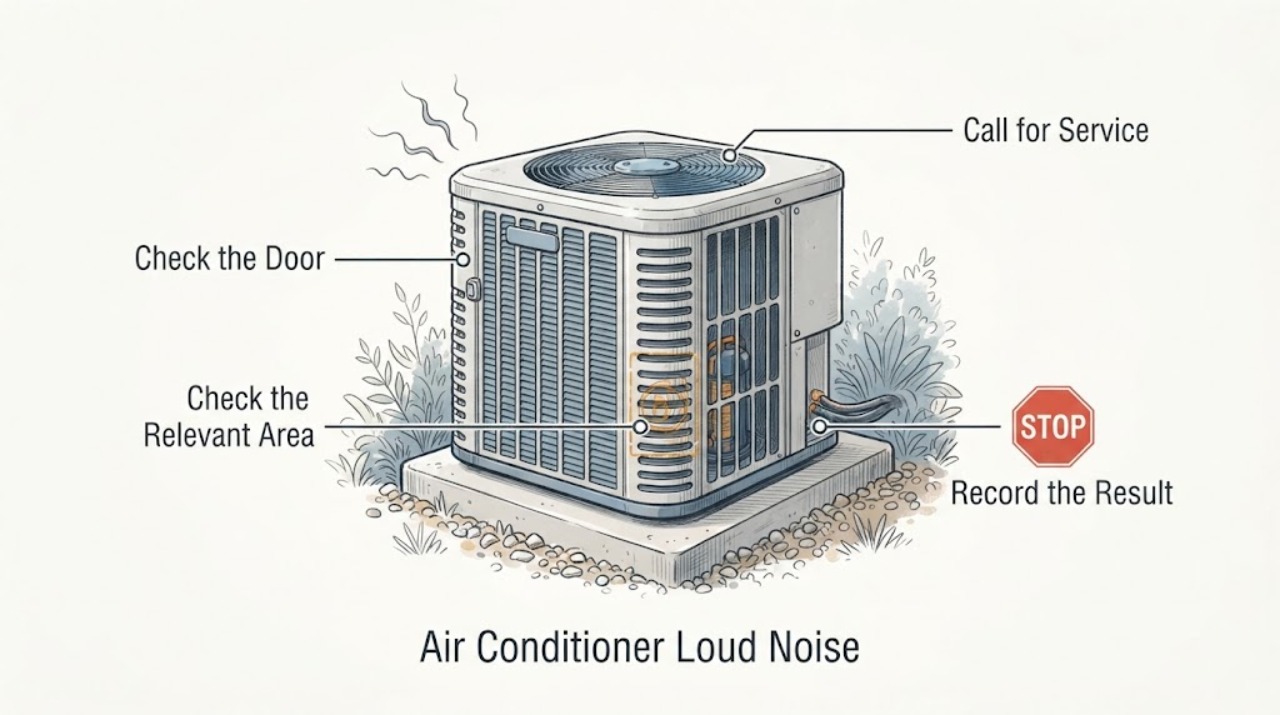
Work through in order
Diagnostic checks
Use only checks that match the exact appliance or system and its official guide.
-
Check 1
From indoors or from a clear dry position outside, determine whether the loud sound comes from the indoor air handler, the outdoor cabinet, the refrigerant-line area, or a nearby object; do not place hands or tools near a running unit.
Expected result: The sound is clearly indoors, clearly outdoors, present only at startup, or present continuously while cooling runs.
Next step: Record the location and phase of the sound, then use the matching branch below; do not remove a panel to improve the diagnosis.
Why this matters
Why: An outdoor startup or continuous sound keeps the compressor, condenser fan, mounting, and controls in scope, while an indoor or nearby sound may be unrelated to the compressor.
-
Check 2
With the system running only if there is no safety warning, describe the sound as humming, rattling, buzzing, grinding, scraping, thumping, clicking, or a sharp change in pitch, and note whether the outdoor fan is visibly turning from a safe distance.
Expected result: The sound changes with fan movement, comes from a loose-looking exterior panel or nearby object, or remains a harsh mechanical sound independent of visible fan motion.
Next step: If the sound is harsh, worsening, or accompanied by poor cooling, stop using the system and give the technician the sound type and timing.
Why this matters
Why: A fan, panel, debris, or vibration path may be involved; a persistent mechanical sound from the compressor area is a professional compressor or mounting diagnosis, not a homeowner parts replacement decision.
-
Check 3
Turn the thermostat to its normal off state when the noise is unsafe, very loud, or accompanied by poor operation; do not repeatedly cycle the breaker or outdoor disconnect to make the noise recur.
Expected result: The noise stops with the cooling call, returns on the next normal call, or continues after the thermostat is no longer calling for cooling.
Next step: Leave the system off when the noise returns or remains abnormal, and arrange qualified HVAC diagnosis.
Why this matters
Why: A call-linked repeat supports a system-side fault; a noise that continues after the call ends may be a fan, control, or nearby source and should not be chased by repeated restarts.
-
Check 4
Visually check the outdoor unit from a safe distance for leaves, branches, loose-looking exterior covers, blocked airflow, standing water, or visible ice; do not open the cabinet, reach through the grille, move heavy equipment, or spray water into it.
Expected result: There is visible debris or a displaced cover, the coil or airflow path appears obstructed, ice is visible, or the exterior looks clear.
Next step: Only remove loose debris that is safely outside the unit and cannot contact moving parts; otherwise leave the unit off and report the observation. If ice is visible, shut the system off and contact an HVAC professional.
Why this matters
Why: A visible external condition can explain rattling or strain but does not clear the compressor. Ice or excess water can indicate an airflow or refrigerant-related problem requiring expert evaluation.
-
Check 5
Check the filter only at its normal user access point and note whether airflow from the supply registers is weak or whether the system is failing to cool; do not treat a filter check as a compressor test.
Expected result: The filter is visibly loaded, airflow is weak, cooling is poor, or airflow and cooling appear normal.
Next step: Replace the filter only with the correct type and orientation if the owner's instructions permit it; if noise persists, ice returns, or cooling remains poor, stop and arrange HVAC service.
Why this matters
Why: Restricted airflow can contribute to icing and abnormal operation, while normal airflow does not rule out an outdoor mechanical or electrical fault.
-
Check 6
Record whether the compressor-area sound is paired with a blank thermostat, a tripped breaker, a repeated restart attempt, flickering, smoke, an odor, or a visible electrical or cabinet defect without touching the equipment.
Expected result: Any electrical or fire warning is present, or the only symptom is noise with otherwise normal visible operation.
Next step: For smoke, arcing, burning odor, hot parts, or repeated trips, stop using the system and keep clear. Otherwise provide the full symptom record to an HVAC technician.
Why this matters
Why: Warning symptoms raise an immediate electrical or fire concern; noise alone still requires professional differentiation between mounting, fan, controls, and compressor internals.
-
Check 7
Read the model and refrigerant information from the outdoor nameplate only if it is visible without opening or reaching into the unit, and give those details with the sound recording or written pattern to the service provider.
Expected result: The nameplate is readable, or the equipment identity cannot be safely confirmed.
Next step: Ask for a technician qualified for the installed equipment and refrigerant. Do not purchase refrigerant, attach gauges, cut lines, or open the sealed circuit.
Why this matters
Why: Model and refrigerant information helps the technician apply the correct service procedure; guessing a refrigerant or compressor part from a generic symptom can cause damage or unsafe work.
Use your observations
Decision map
Find the observation that best matches what you see, then follow the next safe action.
-
PATH 01Next step
What you see
The sound is a persistent grinding, scraping, violent thumping, or harsh mechanical noise from the outdoor compressor area.
Do this next
Turn the system off at the thermostat, do not restart it to compare sounds, and arrange HVAC service.
Why this path and its safety boundary
Why it matters: Compressor internals, mounting, fan interaction, or another mechanical component may be damaged.
-
PATH 02Next step
What you see
The unit hums or buzzes at startup but the outdoor fan does not visibly begin turning, or the unit starts and stops abnormally.
Do this next
Leave the system off and request qualified HVAC diagnosis. Do not touch the capacitor, contactor, wiring, or disconnect, and do not repeatedly attempt a start.
Why this path and its safety boundary
Why it matters: Carrier identifies the condensing unit as containing high-voltage components such as capacitors, motors, and the compressor; a start or control fault cannot be safely diagnosed by opening the unit.
-
PATH 03Next step
What you see
The noise changes when the visible outdoor fan changes, or a loose-looking cover or external debris is the only visible abnormality.
Do this next
Remove only loose debris that is clearly outside the moving equipment and safe to reach; otherwise leave it for the technician. Stop if the noise returns or cooling is affected.
Why this path and its safety boundary
Why it matters: The fan, debris, cabinet, or vibration isolation may be the source rather than the compressor.
-
PATH 04Next step
What you see
Ice is visible on the system or cooling is poor with abnormal operation.
Do this next
Shut the system off and contact an HVAC professional. Do not chip the ice, use heat, add refrigerant, or open the refrigerant circuit.
Why this path and its safety boundary
Why it matters: Carrier notes that ice can signal an airflow or refrigerant problem and can damage the compressor if the system continues running.
-
PATH 05Next step
What you see
Smoke, arcing, burning odor, a hot electrical part, repeated breaker trips, or a damaged power connection is present.
Do this next
Stop using the equipment and keep clear. If there is active smoke or fire, follow local emergency guidance; do not reset protection or touch wet or damaged equipment.
Why this path and its safety boundary
Why it matters: This is an electrical or fire safety condition, not an ordinary noise investigation.
-
PATH 06Next step
What you see
A hissing or unusual pressure-related sound is accompanied by an odor, poor cooling, or suspected refrigerant release.
Do this next
Leave the system off, ventilate only as appropriate for the space without operating a suspected ignition source, and use a qualified technician; never search for a leak, vent refrigerant, or recharge the system yourself.
Why this path and its safety boundary
Why it matters: The refrigerant circuit and its hazards cannot be confirmed safely from sound alone.
-
PATH 07Next step
What you see
The unit is quiet when off, cooling normally, and the only issue is a mild vibration or occasional cabinet rattle.
Do this next
Document when it occurs and schedule non-emergency HVAC inspection if it persists; stop sooner if it becomes metallic, loud, hot, odorous, or affects cooling.
Why this path and its safety boundary
Why it matters: A non-compressor vibration source is possible, but an intermittent sound can progress and cannot be cleared by a generic part guess.
Helpful context
Understand the symptom
Why a compressor may get blamed incorrectly
On a split system, the compressor is in the outdoor condensing unit, but the outdoor fan, cabinet, mounting, electrical controls, and nearby objects can all create noise. A noise that begins before the compressor starts, changes with the fan, or occurs only when a loose panel vibrates points to a different inspection path. A compressor that hums without starting, starts and stops, or makes a persistent internal mechanical noise needs professional testing; it is not safe to confirm the diagnosis by opening the unit or probing its electrical parts.
Safe homeowner scope
Use the thermostat and ordinary user controls, listen and look from a dry safe position, and record the pattern. Do not remove the outdoor-unit panels, touch the disconnect or capacitor, perform live measurements, open the refrigerant circuit, add refrigerant, or reach through a grille while the equipment can start. If the sound is severe or the unit is unsafe, leave it off and arrange HVAC service.
Safety boundary
Stop conditions
- Stop immediately for smoke, arcing, burning odor, a hot or damaged electrical connection, repeated breaker trips, or a noise that becomes violent or metallic.
- Stop the cooling call if ice is visible, water is entering electrical equipment, the unit is not starting normally, or cooling is rapidly deteriorating.
- Do not remove outdoor-unit covers, touch capacitors or contactors, reach through grilles, perform live electrical measurements, or bypass protective devices.
- Do not open the refrigerant circuit, attach gauges, add or vent refrigerant, or use a guessed compressor or electrical part.
- Keep clear of equipment that is wet, flooded, unstable, or inaccessible without climbing, moving heavy equipment, or entering an unsafe area.
When checks do not resolve it
Need a professional?
Call a qualified HVAC technician for persistent or worsening compressor-area noise, startup humming or repeated cycling, poor cooling with noise, visible ice, or any suspected sealed-system, motor, control, or compressor fault.
Safety scope: The homeowner scope ends at thermostat control, normal filter access, safe listening, and external visual observations. Electrical, capacitor, motor, compressor, refrigerant, and sealed-system work requires qualified service.
Common questions
FAQ
Does a loud air conditioner always need a compressor replacement?
No. A fan, loose cabinet, debris, mounting, control, airflow, or ice problem can sound similar. A technician should confirm the source before any compressor decision.
Can I open the outdoor unit to listen to the compressor more closely?
No. The condensing unit contains high-voltage components and moving equipment. Keep the covers in place and use safe-distance observations for the service handoff.
Should I add refrigerant if the compressor is noisy?
No. Noise alone does not establish a refrigerant problem, and opening or charging the refrigerant circuit requires qualified, appropriately certified service.
Read the exact guide
Official sources
- Refrigerant SafetyU.S. Environmental Protection Agency · Refrigerant toxicity, flammability, exposure and professional handling safety
- Homeowners and Consumers: Frequently Asked QuestionsU.S. Environmental Protection Agency · Residential air-conditioner refrigerant identification, certified service, leak repair, and restrictions on opening or charging refrigerant circuits
- Troubleshoot an AC Not WorkingCarrier · Residential air conditioner troubleshooting, outdoor condensing unit, compressor and condenser fan symptoms, ice, electrical and professional-service boundaries
- INSTALLATION, OPERATION AND MAINTENANCE INSTRUCTIONSCarrier · Carrier air-conditioning equipment operating and troubleshooting instructions, compressor noise and mounting symptoms
Community feedback
Share a repair observation
Share a plain-text repair observation. Accepted observations are published automatically; this page may take a moment to update.