
On this page
Start here
Quick answer
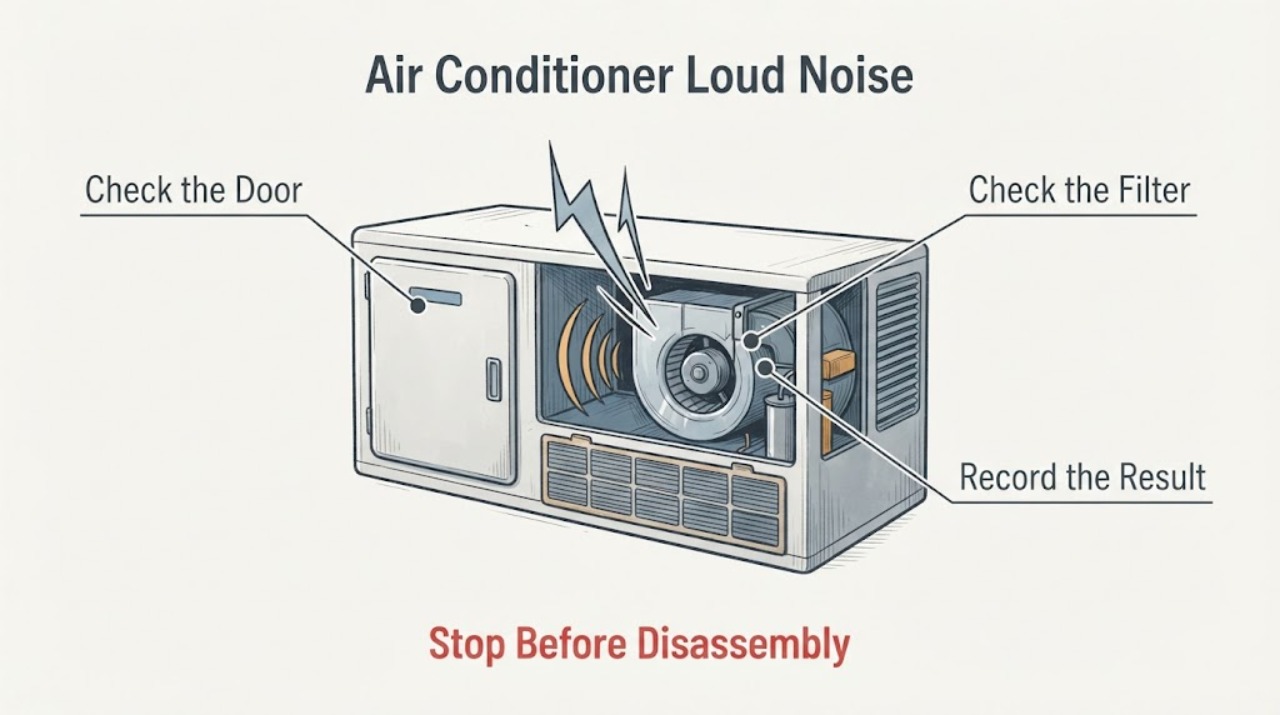
A new loud sound should be treated as a fault until its location and timing are clear. Turn cooling off, note whether the sound comes from the indoor blower or outdoor unit, and do only external, power-off checks. A loud indoor hum can involve the blower motor; a loud outdoor start-up hum can involve a run capacitor, fan motor, or compressor. A run capacitor can retain an electrical charge, so do not open a panel, test, discharge, or replace it yourself. If the sound is accompanied by smoke, a burning smell, sparks, a hot connection, repeated breaker operation, or a refrigerant leak, leave the system off and arrange qualified HVAC service.
Work through in order
Diagnostic checks
Use only checks that match the exact appliance or system and its official guide.
-
Check 1
Set the thermostat to stop cooling, stay clear of moving equipment, and listen from a safe distance to identify whether the sound is at an indoor register or air handler, or at the outdoor cabinet. Note when it starts and whether it is a hum, rattle, scrape, squeal, bang, or hiss.
Expected result: The sound is loudest indoors, loudest outdoors, present only at start or stop, or continuous while the system runs.
Next step: If the sound is sudden, harsh, or accompanied by an odor, vibration, smoke, or poor cooling, keep cooling off and arrange HVAC service. If it is a brief familiar switching sound, continue only with the external checks below.
Why this matters
Why: Indoor continuous humming or scraping makes the blower path more relevant; outdoor start-up humming or a changed start sound makes the outdoor fan, capacitor, or compressor path more relevant. A new loud sound is not a normal operating change just because the unit still cools.
-
Check 2
With the system off, check the return-air filter and supply registers that are accessible without tools. Replace a loaded filter only with the size and orientation specified for the system, and make sure furniture or covers are not blocking the registers.
Expected result: The filter is visibly loaded, airflow is weak at several registers, or the airflow is normal and the noise remains.
Next step: Run no further test if the filter is wet, the indoor coil is visibly iced, water is present near electrical equipment, or the blower sound is a scrape or grind; keep the system off and request service. Otherwise proceed to an external indoor inspection.
Why this matters
Why: A restricted filter or blocked air path can raise blower effort and airflow noise. If airflow is normal or the sound remains after the permitted filter change, the noise is less likely to be solved by a filter alone.
-
Check 3
Leave electrical covers closed and inspect only the accessible area around the indoor air handler for a loose external grille, visible water, ice, or an object at a return or supply opening. Do not reach into the blower compartment or move wiring.
Expected result: There is ice, water, a displaced grille, a visible obstruction, or no visible issue while the indoor noise persists.
Next step: Keep the system off for ice, water near electrical parts, a burning smell, or a persistent mechanical noise. A qualified technician should inspect the blower wheel, motor, mount, and controls rather than the homeowner opening the compartment.
Why this matters
Why: Ice or water can accompany an airflow or coil problem, while an accessible grille or register issue can create vibration without proving a motor fault. No visible issue does not clear the blower motor or its electrical controls.
-
Check 4
From outside the safety boundary and with the system commanded off, look through the outdoor unit grille for an obviously damaged fan blade, heavy debris, or a cabinet that is vibrating or shifting. Do not remove the grille, touch the blade, or enter the electrical compartment.
Expected result: A blade appears damaged, an object is contacting the fan area, the cabinet vibrates heavily, or the visible fan area looks clear.
Next step: Keep the system off for blade damage, contact marks, heavy vibration, smoke, or any electrical odor. Arrange HVAC service; do not restart it to see whether the sound gets worse.
Why this matters
Why: A damaged or unbalanced blade can create rattling or contact noise. A clear view does not rule out a fan motor, capacitor, compressor, or internal mounting fault.
-
Check 5
Record whether the unit starts with a loud hum, fails to start, starts and stops, or has reduced airflow, then provide that record and the model label to a qualified HVAC technician. Do not remove a panel or handle the blower motor, wiring, contactor, or capacitor.
Expected result: The technician receives a location, sound type, timing, airflow result, and any breaker or odor event.
Next step: Use professional service for any capacitor or motor diagnosis, electrical test, part selection, or repair. A capacitor may retain charge after the system is switched off.
Why this matters
Why: That pattern helps separate an airflow restriction from a blower motor, fan motor, capacitor, compressor, control, or mounting issue without exposing the reader to energized equipment.
Use your observations
Decision map
Find the observation that best matches what you see, then follow the next safe action.
-
PATH 01Next step
What you see
The sound is a brief familiar click, airflow change, or temperature-related tick and does not persist or worsen.
Do this next
Monitor it and compare with the normal start and stop pattern. If it becomes loud, continuous, or changes suddenly, stop cooling and schedule service.
-
PATH 02Next step
What you see
The indoor unit has a loud hum, scrape, squeal, weak airflow, ice, or water.
Do this next
Keep cooling off. Do not reach into the blower compartment; request inspection of the filter, blower wheel, blower motor, coil, drain, and related controls.
-
PATH 03Next step
What you see
The outdoor unit has a changed start-up hum, slow or absent fan movement, damaged blade, or heavy vibration.
Do this next
Keep the outdoor unit off and request HVAC service. The symptom can involve the fan motor, run capacitor, compressor, blade, or mounting; do not infer one part from sound alone.
-
PATH 04Next step
What you see
The noise is a hiss near refrigerant lines or the indoor coil, or cooling is accompanied by a visible refrigerant leak.
Do this next
Turn the system off and arrange qualified HVAC service. Do not touch or release refrigerant and do not open the sealed circuit.
-
PATH 05Next step
What you see
There is smoke, a burning electrical or plastic smell, a spark, an arcing sound, a hot or discolored connection, repeated breaker operation, or an exposed conductor.
Do this next
Stop using the system. If safe without touching wet surfaces or energized equipment, shut off the relevant disconnect; otherwise leave it alone and obtain urgent qualified electrical/HVAC help. Do not reset the breaker repeatedly or restart the unit.
Helpful context
Understand the symptom
Start with the sound location
A split system has an indoor blower that moves air through the registers and an outdoor fan that moves air across the condenser. The same complaint can therefore describe two different fault paths. Record whether the noise begins at start-up, continues during cooling, changes at shutdown, or occurs only briefly as the system changes state. A familiar soft airflow or short switching sound is different from a new rattle, grinding sound, squeal, or loud hum.
What the capacitor clue does and does not prove
A capacitor is only one possible cause of a start-up hum or a motor that struggles to start. The sound alone cannot identify it, and the part may be in the indoor or outdoor section depending on the system. Do not remove a service panel or attempt electrical testing. Give the technician the sound, location, start-up behavior, model information, and any loss of airflow or cooling.
Safety boundary
Stop conditions
- Stop immediately for smoke, fire, sparks, arcing, a burning electrical or plastic smell, a hot or discolored plug or disconnect, or repeated breaker operation.
- Stop and keep the unit off for heavy grinding, blade contact, severe vibration, a fan that does not stop, visible water near electrical equipment, or a refrigerant leak.
- Do not open an HVAC electrical panel, handle a capacitor, discharge a capacitor, take electrical readings, bypass a control, or work on energized equipment.
- If water is on the floor near electrical equipment, do not step into it to reach a switch; obtain qualified help from a dry location.
Only after diagnosis
Potential parts
- blower motor assembly
Consider this only if a qualified technician confirms a blower motor, motor mount, or related assembly fault after checking airflow and the blower wheel.
Use the exact equipment model and manufacturer documentation to confirm fit; do not infer compatibility from appearance. - run capacitor
Consider this only if a qualified technician identifies the capacitor as the cause of a start-up hum, slow motor start, or related motor symptom.
Capacitor ratings and application vary by equipment. A qualified technician must identify and install the correct part; the capacitor can retain an electrical charge.
When checks do not resolve it
Need a professional?
Arrange qualified HVAC service when the loud noise is new, persistent, worsening, or paired with weak airflow, poor cooling, ice, water, vibration, or a start-up hum. Treat smoke, fire, arcing, or a strong electrical odor as urgent and leave the equipment off.
Common questions
FAQ
Can a capacitor cause a loud air conditioner noise?
It can be one possible cause of a changed start-up hum or a motor that struggles to start, but sound alone cannot confirm it. Keep the system off and have a qualified technician diagnose it because the capacitor can retain electrical charge.
Is a loud indoor hum more likely to be the blower motor?
A loud indoor hum can involve the blower motor, but a restricted filter, blower wheel, mounting issue, or control fault can sound similar. Check only the accessible filter and registers, then arrange service if the sound persists.
Should I run the air conditioner again to identify the noise?
Do not restart it when the noise is new or harsh, or when there is smoke, an odor, vibration, poor airflow, a damaged blade, water near electrical equipment, or a breaker event. Give the technician the location and timing you already observed.
Read the exact guide
Official sources
- HomeCooling101U.S. Department of Energy · General residential cooling-system explanation of the blower, condenser fan, filter, airflow restriction, and basic maintenance; equipment instructions take precedence.
- Is This Normal? HVAC Smells and Sounds, ExplainedTrane · General residential HVAC sound triage, blower motor, fan, capacitor, compressor, vibration, and stop-service guidance; exact model behavior can differ.
- AC Fan Not Working? Reasons Why It Stopped SpinningTrane · Residential split-system distinction between indoor blower and outdoor fan, run capacitor warning, fan blade observation, and professional service boundary.
Community feedback
Share a repair observation
Share a plain-text repair observation. Accepted observations are published automatically; this page may take a moment to update.