
On this page
Start here
Quick answer
A suddenly loud air conditioner should be diagnosed by location, sound, and timing, not by opening the unit. From a safe position, note whether the noise is indoors or outdoors and whether it is a hum at startup, repeated clicking, rattling, scraping, grinding, or a fan that is not turning. Check only accessible thermostat settings, airflow, and visible damage with the system off; never remove a guard, hand-spin a powered fan, discharge or measure a capacitor, or open a refrigerant circuit. A capacitor or fan motor can make an outdoor unit hum, fail to start, or run intermittently, but those are professional service clues. Shut the system off for smoke, burning odor, arcing, abnormal heat, a tripped breaker, ice or water near electrical parts, or a fan that is stopped while cooling is called for, then call an HVAC technician.
Work through in order
Diagnostic checks
Use only checks that match the exact appliance or system and its official guide.
-
Check 1
From a safe position, identify whether the loud noise comes from an indoor air handler or an outdoor condenser. Note whether it starts at startup, continues while running, occurs at shutdown, or remains when the thermostat is not calling for cooling.
Expected result: The sound may be confined indoors, outdoors, or both; it may be a brief start/stop event, a steady hum, a repeated click, or a continuous mechanical sound.
Next step: Record the location and timing without opening either unit. Stop for smoke, burning odor, arcing, abnormal heat, or a breaker trip and call for urgent help.
Why this matters
Why: Location and timing separate blower, condenser fan, compressor, control, and normal operating sounds. Trane notes that some start and stop sounds can be normal, but a newly loud system needs service attention.
-
Check 2
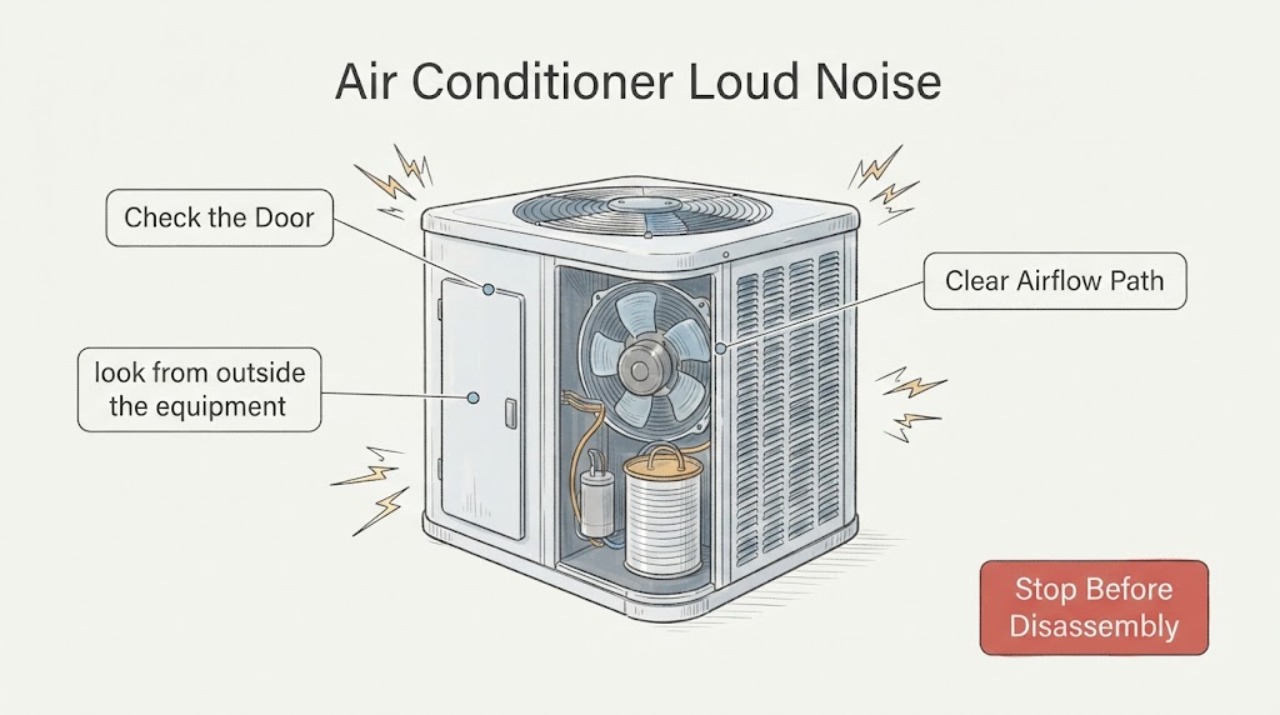
With the unit not running and without removing a guard, look from outside the equipment for visible leaves, loose external panels, a broken blade visible through a safe opening, ice, water, or an object contacting the cabinet. Do not reach through the grille or try to move the blade.
Expected result: The exterior may be clear, an object or loose panel may be visible, a blade may appear damaged, or ice and water may be present.
Next step: Remove only a loose object that is fully outside the equipment and safe to reach. Keep the system off and call an HVAC technician for a damaged blade, ice, water, or anything behind the guard.
Why this matters
Why: A loose panel, obstruction, or damaged blade can create rattling or vibration, while ice or water can indicate an airflow, refrigerant, drain, or electrical safety issue. A visual clue does not authorize guard removal.
-
Check 3
Check the thermostat from the user interface and note the mode, fan setting, temperature demand, and whether the indoor airflow is normal. Inspect or replace a user-accessible filter only as the equipment manual allows, without opening the air handler or touching a motor.
Expected result: The thermostat may be calling for cooling with normal airflow, the fan may be set to run continuously, airflow may be weak, or the filter may be visibly loaded.
Next step: Correct only a clearly incorrect user setting or filter condition, then stop if noise remains, airflow is weak, or the coil is iced. Arrange HVAC service for the indoor unit.
Why this matters
Why: A fan setting or restricted airflow can change operating sound and performance, but weak airflow with loud noise can also indicate a blower or coil issue. A filter observation cannot confirm a capacitor or motor fault.
-
Check 4
When the thermostat calls for cooling, observe the outdoor unit only from outside the guard: note whether the fan starts, turns normally, turns slowly, stops, or produces a hum or repeated click without rotation. Do not push the blade, remove the guard, or run the unit as a repeated test.
Expected result: The fan may run normally, fail to start, stop intermittently, rotate slowly, or remain still while the compressor or a hum is audible.
Next step: Turn the system off at the thermostat if the fan is stopped, the sound is abnormal, or the unit is overheating, and call an HVAC technician. Do not hand-start the fan or touch the capacitor.
Why this matters
Why: Trane links a stopped or abnormal fan with possible fan motor or capacitor problems, and Carrier identifies capacitors, motors, and compressors as high-voltage service components. A stopped fan with cooling demand can overheat the system.
-
Check 5
From a safe distance, classify the sound as hum, click, rattle, scrape, grind, bang, hiss, or high-pitched tone and record whether it changes with the fan, cooling call, startup, shutdown, or outdoor temperature. Do not remove panels or attempt to isolate the sound by touching the cabinet.
Expected result: A startup hum may accompany a failed start, a rattle may follow vibration, scraping may follow a fan or foreign object, and a hiss may accompany refrigerant or another hazardous condition.
Next step: Keep the system off for grinding, banging, persistent clicking, hissing, or a sudden new high-pitched sound. Request HVAC service and report the exact sound and stage.
Why this matters
Why: Trane uses sound type and timing to separate possible motor, capacitor, compressor, loose hardware, fan, or coil conditions; the sound is a service clue, not a part diagnosis.
-
Check 6
Record any companion symptom without repeating the event: weak or absent airflow, no cooling, short cycling, ice on lines or coils, water near the indoor unit, breaker operation, smoke, heat, or odor. Include the model, recent maintenance, and whether the noise is new.
Expected result: The noise may be isolated, or it may occur with no cooling, a stopped fan, ice, water, electrical symptoms, or a motor that starts and stops.
Next step: Shut the system off and call HVAC service for ice, water near electrical parts, burning odor, smoke, arcing, overheating, or repeat breaker operation. Do not open the refrigerant or electrical sections.
Why this matters
Why: Companion symptoms help an HVAC technician distinguish an airflow or mechanical issue from capacitor, motor, compressor, refrigerant, or electrical service work. Ice, water, odor, and heat change the safety decision.
Use your observations
Decision map
Find the observation that best matches what you see, then follow the next safe action.
-
PATH 01Next step
What you see
The outdoor fan hums, clicks, turns slowly, or does not turn while cooling is called for.
Do this next
Turn cooling off and call an HVAC technician; treat capacitor and fan motor work as professional service and do not hand-start the blade.
-
PATH 02Next step
What you see
The noise is a new rattle, scrape, grind, bang, or severe vibration.
Do this next
Keep the system off and arrange HVAC service because a blade, fan, motor, compressor, loose hardware, or unlevel unit may be involved.
-
PATH 03Next step
What you see
The noise is indoors with weak airflow or a filter issue but no electrical or burning warning sign.
Do this next
Check only the thermostat setting and user-accessible filter as the manual allows; if noise or weak airflow remains, call HVAC service.
-
PATH 04Next step
What you see
Ice, water near electrical parts, smoke, burning odor, arcing, abnormal heat, or a breaker trip is present.
Do this next
Stop the system from a safe control if possible, keep clear, and obtain urgent HVAC or electrical help; do not open the equipment.
-
PATH 05Next step
What you see
The sound occurs only briefly at normal startup or shutdown and no other symptom is present.
Do this next
Record the sound and monitor without opening the system; if it is new, becomes louder, or returns with poor cooling, arrange HVAC service.
-
PATH 06Next step
What you see
A hiss is heard near refrigerant lines or the unit has persistent no-cooling or short-cycling symptoms.
Do this next
Turn the system off and call an HVAC professional; do not open the refrigerant circuit or attempt a leak repair.
Helpful context
Understand the symptom
Start by locating the sound. An indoor blower and an outdoor condenser fan do different work, so “loud” has different implications at each unit. A brief sound at a normal start or stop can be different from a new continuous hum, scraping, grinding, or repeated click. Record the sound without placing hands near a fan or opening a cabinet.
The capacitor and fan motor are not ordinary homeowner checks. Carrier explains that a capacitor stores electrical energy, and Trane warns that fan motors and capacitors require professional assistance. A stopped outdoor fan can overheat the system even when the thermostat still calls for cooling.
Safe checks are limited to the thermostat, a user-accessible filter, visible exterior obstructions, and observations made with the system off when a manual or technician directs it. Do not remove a guard, reach into the unit, hand-spin a blade, discharge a capacitor, measure electrical parts, or open the refrigerant circuit.
Safety boundary
Stop conditions
- Stop immediately for smoke, burning odor, visible arcing, a hot cabinet or connection, a tripped breaker, water near electrical parts, or exposed damage; keep clear and obtain urgent professional help.
- Do not remove a fan guard or access panel, hand-spin or push a fan blade, discharge or measure a capacitor, test live wiring, or touch electrical terminals.
- Do not open the refrigerant circuit, release refrigerant, add refrigerant, or attempt a gas or electrical repair.
- Turn cooling off when the outdoor fan is stopped, the unit is overheating, ice is present, or a new grinding or banging sound continues.
- Use an HVAC technician for capacitor, fan motor, compressor, wiring, contactor, refrigerant, or concealed coil work; do not select a part from sound alone.
Only after diagnosis
Potential parts
- air conditioner capacitor
Consider only after an HVAC technician confirms the capacitor is the failed component behind a startup hum, motor difficulty, or related symptom.
Capacitor type and ratings depend on the complete equipment model; do not choose one from appearance or sound. - condenser fan motor
Consider only after professional diagnosis confirms the outdoor fan motor is defective rather than the capacitor, control, blade, or another cause.
Confirm the complete equipment model and manufacturer fit information before any replacement is considered.
When checks do not resolve it
Need a professional?
Call an HVAC technician for a new or persistent loud noise, outdoor fan failure, humming without rotation, rattling, scraping, grinding, weak airflow, short cycling, ice, or no cooling. Shut the system off and seek urgent help for smoke, burning odor, arcing, abnormal heat, water near electrical parts, or a breaker trip. Capacitor, fan motor, compressor, wiring, and refrigerant work is professional service.
Have this ready
- Provide the model, indoor or outdoor location, sound type, startup or shutdown timing, fan motion, thermostat demand, airflow, cooling result, ice or water, breaker behavior, heat, odor, smoke, arcing, recent work, and whether the noise is new.
Common questions
FAQ
What does a loud humming air conditioner mean?
The location and timing matter. Indoor hum can involve the blower; outdoor hum can involve a capacitor, contactor, fan motor, compressor, or another fault. Keep the system off if the sound is new or the fan is not turning and arrange HVAC service.
Can I spin the outdoor AC fan to get it started?
No. Do not reach through the guard or hand-spin a fan. A stopped fan can involve a capacitor or motor, and both require professional diagnosis. Turn cooling off and call an HVAC technician.
Is a brief AC noise at startup always a failure?
Not always. Some systems can be louder at normal start or stop, but a new, worsening, continuous, scraping, grinding, or rattling sound is not something to diagnose by opening the unit. Record the timing and arrange service if it persists.
Should I replace the capacitor myself?
No. A capacitor can store electrical energy even when the system is off. Do not discharge, measure, remove, or replace it; have a licensed HVAC technician diagnose the component.
When should I shut the air conditioner off?
Shut it off for a stopped outdoor fan, persistent grinding or banging, ice, water near electrical parts, smoke, burning odor, arcing, abnormal heat, or a breaker trip. Keep clear and request HVAC or electrical help as appropriate.
Read the exact guide
Official sources
- AC CapacitorCarrier · Air-conditioner capacitor role, motor starting, humming symptoms, stored electrical energy, and professional diagnosis
- AC Fan Not Working? Reasons Why It Stopped SpinningTrane · Residential indoor and outdoor AC fan location, stopped fan, broken blade, capacitor, fan motor, and professional service boundaries
- Troubleshoot an Air Conditioner: 6 Steps to Fix an AC Not WorkingCarrier · Residential air-conditioner thermostat, airflow, electrical, ice, outdoor fan, loud-noise, capacitor, motor, compressor, and refrigerant service boundaries
- Is This Normal? HVAC Smells and Sounds, ExplainedTrane · Residential HVAC sound timing, hum, rattle, high-pitched noise, clicking, fan motor, capacitor, compressor, and service guidance
- Electric-Arc Flash HazardsOccupational Safety and Health Administration · Electrical arc hazards, low-voltage arc risk, and qualified-person boundaries for energized equipment
Community feedback
Share a repair observation
Share a plain-text repair observation. Accepted observations are published automatically; this page may take a moment to update.