
On this page
Start here
Quick answer
If an air conditioner begins making a loud noise after a buzzing sound, stop treating the buzz as a harmless startup sound until the source is identified. From a safe distance, note whether the sound starts at the outdoor unit, whether the outdoor fan turns, and whether cooling or electrical behavior changes. A loose panel or debris can rattle, but a buzz followed by hard starting, repeated cycling, grinding, smoke, burning odor, or breaker trips can involve the contactor, motor, capacitor, compressor, or another high-voltage fault. Use the thermostat to stop the cooling call when the sound is abnormal and arrange qualified HVAC service rather than opening the unit or repeatedly restarting it.
Before you begin
Safety first
- The homeowner scope ends at thermostat control, normal filter access, safe listening, and external visual observations. Capacitor, contactor, motor, compressor, electrical, refrigerant, and sealed-system work require qualified service.
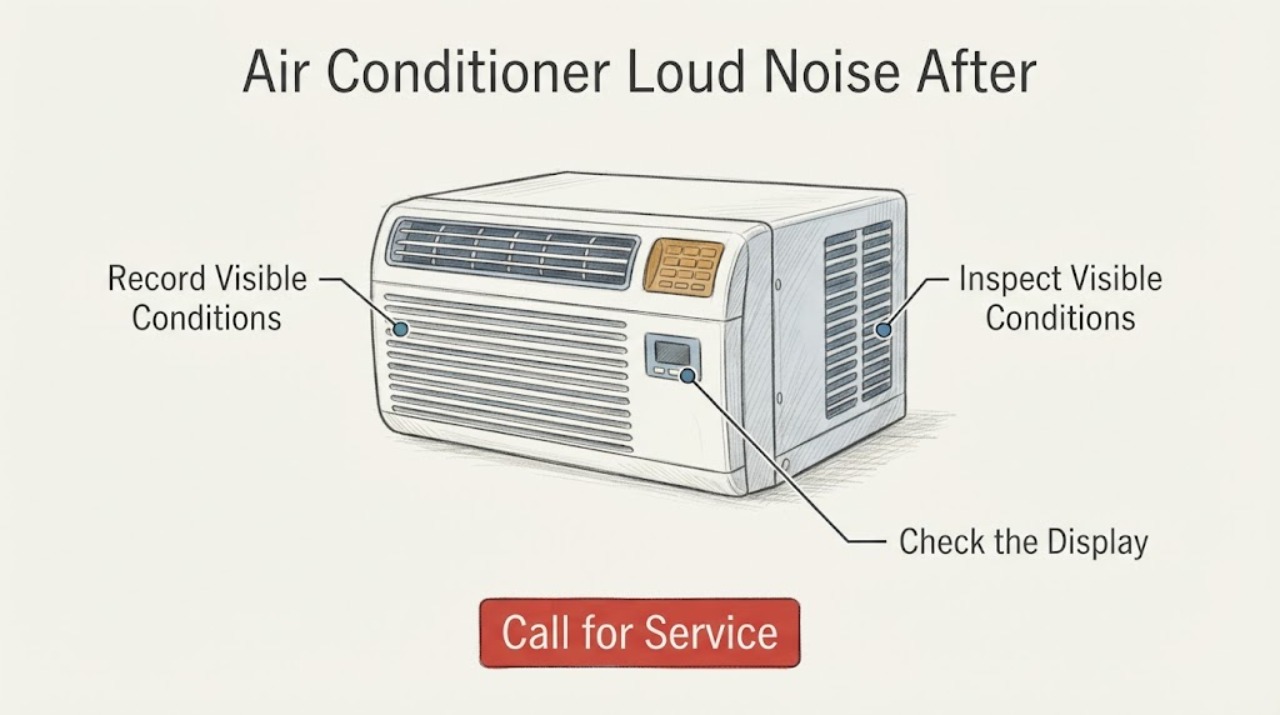
Work through in order
Diagnostic checks
Use only checks that match the exact appliance or system and its official guide.
-
Check 1
From indoors or a dry clear position outside, record whether the buzz occurs before the outdoor fan moves, during compressor startup, after the unit stops, or continuously; do not stand over the unit or place hands near the grille.
Expected result: The buzz is a brief startup event, continues while the unit struggles, returns in repeated starts, or occurs even after the cooling call ends.
Next step: Write down the sequence and use the matching branch below. Do not restart the unit just to reproduce the sound.
Why this matters
Why: A short event may be a control sequence, while a buzz followed by failed or repeated starting keeps the motor, capacitor, contactor, and compressor in scope; a noise after shutdown may come from a fan or another source.
-
Check 2
Observe the outdoor fan from a safe distance only if the system is operating without any warning sign, and note whether it turns normally, hesitates, stops, or never starts after the buzz.
Expected result: The fan turns normally, the fan is stationary while buzzing continues, or the fan starts and stops abnormally.
Next step: If the fan does not start normally or the sound is harsh, turn off the cooling call and arrange HVAC diagnosis; do not reach through the grille or touch the fan.
Why this matters
Why: Fan behavior helps separate an airflow or fan-side symptom from a compressor-start or control symptom, but it does not authorize access to high-voltage parts.
-
Check 3
Use the thermostat's normal off control when the noise is loud, worsening, or associated with poor cooling; do not cycle the breaker or outdoor disconnect repeatedly to compare attempts.
Expected result: The sound stops when the cooling call ends, returns on the next call, or continues after the call has ended.
Next step: Leave the system off if the abnormal sound returns or remains, and give the technician the exact timing rather than performing another test.
Why this matters
Why: A call-linked repeat supports an equipment-side fault; a continuing sound may be a fan, control, or nearby source and should not be chased by repeated starts.
-
Check 4
Visually check the outdoor cabinet from a safe distance for leaves, branches, a loose-looking panel, blocked airflow, ice, standing water, or an object touching the housing; do not open the cabinet or spray into it.
Expected result: Debris or an exterior panel appears to move, the airflow path is obstructed, ice or water is visible, or the outside looks clear.
Next step: Remove only loose debris that is clearly outside the equipment and safe to reach. Leave the system off for ice, water, a damaged cover, or any uncertain condition and call HVAC service.
Why this matters
Why: A loose panel or external object can create a rattle after buzzing, while ice or water may signal an airflow, refrigerant, or electrical concern that a visual check cannot clear.
-
Check 5
Note whether cooling is weak, the system runs continuously, the thermostat is blank, lights flicker, or the breaker changes state after the buzzing; do not reset a breaker that trips immediately or repeatedly.
Expected result: Cooling is normal, cooling is poor or short-cycles, the breaker trips, or the electrical symptoms appear without a visible cause.
Next step: For a trip or electrical warning, leave the circuit off and obtain qualified HVAC or electrical service. For normal cooling with persistent noise, schedule HVAC diagnosis rather than guessing a part.
Why this matters
Why: Poor cooling or cycling can accompany airflow, refrigerant, or mechanical problems; a breaker trip or electrical symptom raises a separate high-voltage safety concern.
-
Check 6
Check the air filter only at its normal user access point and record whether airflow is weak or ice is visible without touching the coil or refrigerant lines.
Expected result: The filter is loaded, airflow is weak, ice is visible, or airflow and visible conditions are normal.
Next step: Replace the filter only as the equipment instructions permit. If ice, persistent noise, or poor cooling remains, shut the system off and arrange professional service.
Why this matters
Why: Restricted airflow can contribute to abnormal cooling and ice, while normal airflow does not rule out a compressor, fan, control, or electrical fault.
-
Check 7
Read the outdoor nameplate only if it is visible without reaching into the unit and record the model, refrigerant information, sound location, and startup sequence for the technician; do not attach gauges or alter the refrigerant system.
Expected result: The equipment identity is readable, or the nameplate cannot be safely accessed.
Next step: Ask for an appropriately qualified HVAC technician and provide the observation record. Do not purchase or add refrigerant or open sealed lines yourself.
Why this matters
Why: Model and refrigerant information helps the professional apply the correct service procedure; a generic noise symptom cannot establish compressor failure or refrigerant type.
Use your observations
Decision map
Find the observation that best matches what you see, then follow the next safe action.
-
PATH 01Next step
What you see
The buzz is followed by a harsh mechanical sound, grinding, scraping, violent thumping, or rapidly worsening noise from the compressor area.
Do this next
Turn off the cooling call, do not restart the unit to compare sounds, and arrange HVAC service.
Why this path and its safety boundary
Why it matters: Compressor internals, mounting, fan interaction, or another mechanical component may be damaged.
-
PATH 02Next step
What you see
The unit buzzes but the outdoor fan does not start normally, or it starts and stops repeatedly.
Do this next
Leave the system off and request qualified diagnosis. Do not touch the capacitor, contactor, wiring, disconnect, or fan.
Why this path and its safety boundary
Why it matters: Carrier lists capacitors, motors, and compressors among possible high-voltage condensing-unit issues.
-
PATH 03Next step
What you see
The noise changes with airflow or a loose exterior panel or debris is visibly vibrating.
Do this next
Remove only loose debris that is safely outside the unit; otherwise leave it for the technician. Stop if the sound returns, worsens, or affects cooling.
Why this path and its safety boundary
Why it matters: A fan-side, cabinet, or external vibration source may be responsible rather than the compressor itself.
-
PATH 04Next step
What you see
Ice, abnormal water, weak cooling, continuous running, or repeated short cycling accompanies the buzzing.
Do this next
Shut the system off and contact HVAC service. Do not chip ice, add refrigerant, attach gauges, or open the sealed circuit.
Why this path and its safety boundary
Why it matters: Carrier notes that ice and poor cooling can indicate an airflow or refrigerant problem and can damage the compressor if operation continues.
-
PATH 05Next step
What you see
Smoke, arcing, burning odor, hot electrical parts, water near electrical equipment, or a breaker trip occurs.
Do this next
Stop using the equipment and keep clear. Do not reset protection or touch wet or damaged parts; use local emergency guidance for active smoke or fire.
Why this path and its safety boundary
Why it matters: This is an electrical or fire-safety condition, not an ordinary noise diagnosis.
-
PATH 06Next step
What you see
A hissing or pressure-like sound is accompanied by poor cooling, an odor, or suspected refrigerant release.
Do this next
Leave the system off and use a qualified technician; do not search for a leak, vent refrigerant, or recharge the system.
Why this path and its safety boundary
Why it matters: The refrigerant circuit and its exposure hazards cannot be confirmed from sound alone.
-
PATH 07Next step
What you see
The buzz was brief, the unit now runs quietly with normal cooling, and no warning sign is present.
Do this next
Record the event and arrange service if it repeats. Stop sooner for loudness, mechanical change, poor cooling, heat, odor, smoke, or electrical symptoms.
Why this path and its safety boundary
Why it matters: A transient control or cabinet sound is possible, but recurrence can indicate a developing fault.
Helpful context
Understand the symptom
What “buzzing, then loud” can mean
The timing is more useful than the word loud. A brief electrical click can accompany a normal start, but a sustained buzz followed by a hard start, no fan movement, repeated attempts, or a metallic sound can indicate that the system is not starting normally. A loose cabinet, debris, fan, contactor, capacitor, motor, compressor, or refrigerant-related condition can overlap in sound. The homeowner can document the sequence; a technician must confirm the component.
Keep the inspection outside the cabinet
Use the thermostat and visible, user-accessible observations only. Do not remove the outdoor cover, touch a disconnect, capacitor, contactor, wiring, or moving fan, and do not perform live electrical measurements. Do not open the refrigerant circuit or add refrigerant. If the unit is wet, smoking, hot, arcing, or repeatedly tripping protection, keep clear and obtain urgent professional help.
Safety boundary
Stop conditions
- Stop immediately for smoke, arcing, burning odor, hot or damaged electrical connections, water near electrical parts, or a breaker trip.
- Stop the cooling call for grinding, scraping, violent thumping, repeated failed starts, persistent buzzing, visible ice, or rapidly worsening noise.
- Do not remove cabinet covers, touch a capacitor, contactor, disconnect, wiring, or moving fan, and do not perform live electrical measurements.
- Do not open the refrigerant circuit, attach gauges, add or vent refrigerant, or use a guessed compressor or electrical part.
- Keep clear of wet, flooded, unstable, or inaccessible equipment and arrange qualified HVAC service.
When checks do not resolve it
Need a professional?
Call a qualified HVAC technician for a loud noise after buzzing, startup humming, repeated cycling, no fan movement, poor cooling, ice, suspected compressor or control trouble, or any electrical warning.
Safety scope: The homeowner scope ends at thermostat control, normal filter access, safe listening, and external visual observations. Capacitor, contactor, motor, compressor, electrical, refrigerant, and sealed-system work require qualified service.
Common questions
FAQ
Is a buzzing sound from an air conditioner always normal?
A brief control sound can occur, but buzzing followed by loud noise, failed starting, no fan movement, poor cooling, or repeated cycling should be treated as abnormal and assessed by an HVAC professional.
Can I replace the capacitor or contactor myself?
No. These are electrical components in the condensing unit, and Carrier identifies capacitor, motor, and compressor issues as high-voltage work. Keep the cabinet closed and arrange qualified service.
Should I add refrigerant when the air conditioner gets loud?
No. Noise does not establish a refrigerant problem. Do not open or charge the circuit; have an appropriately qualified technician diagnose and repair any refrigerant issue.
Read the exact guide
Official sources
- Troubleshoot an AC Not WorkingCarrier · Residential air conditioner troubleshooting, outdoor condensing unit, compressor and condenser fan symptoms, ice, electrical and professional-service boundaries
- INSTALLATION, OPERATION AND MAINTENANCE INSTRUCTIONSCarrier · Carrier air-conditioning equipment operating and troubleshooting instructions for compressor noise and mounting
- Refrigerant SafetyU.S. Environmental Protection Agency · Refrigerant toxicity, flammability, exposure and professional handling safety
- Homeowners and Consumers: Frequently Asked QuestionsU.S. Environmental Protection Agency · Residential air-conditioner refrigerant identification, certified service, leak repair and restrictions on opening or charging refrigerant circuits
Community feedback
Share a repair observation
Share a plain-text repair observation. Accepted observations are published automatically; this page may take a moment to update.