
On this page
Start here
Quick answer
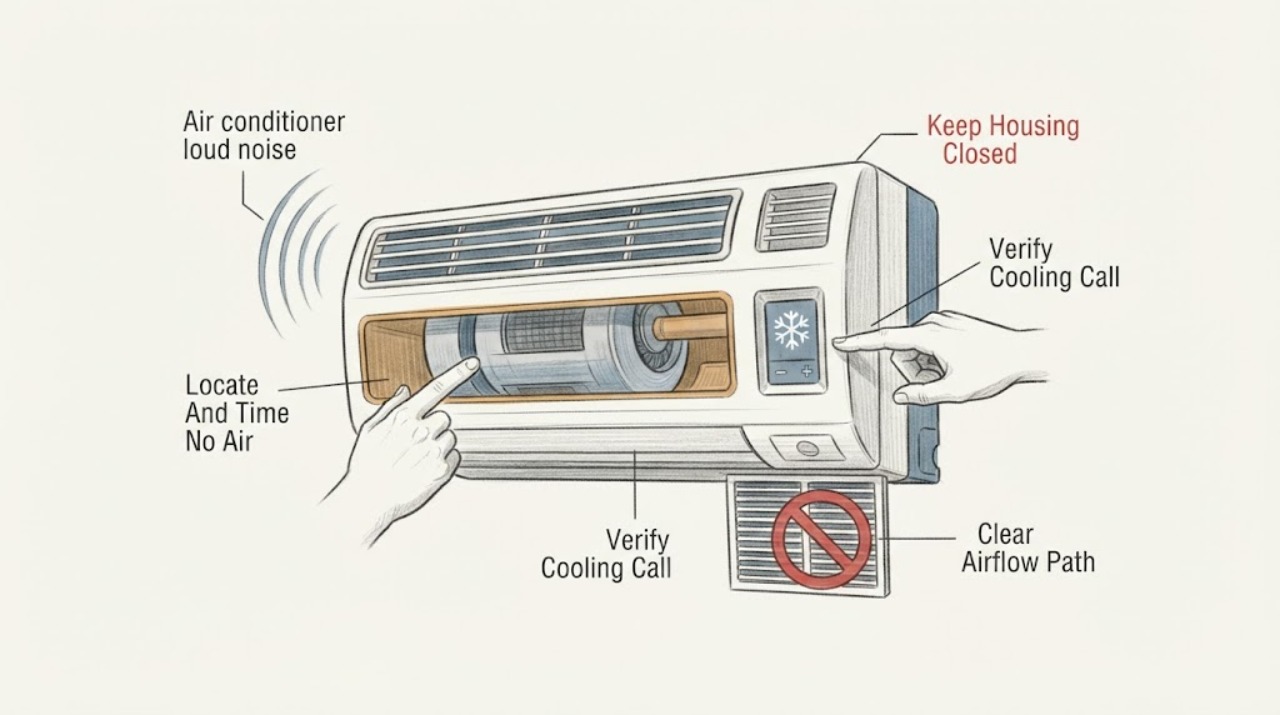
If an air conditioner makes a loud noise when turned on but no air comes from the vents, first confirm that the thermostat is actually calling for cooling and identify whether the sound is at the indoor air handler or the outdoor unit. A loud indoor hum with no airflow can involve the blower motor, blower wheel, a restricted filter or frozen coil, a control or safety shutdown, or another electrical fault; an outdoor sound is a different diagnostic path. Check only the thermostat, accessible filter, open supply and return vents, and visible ice or water from a safe position. Do not reach into a grille, remove the blower cabinet, spin the wheel, or work on wiring. Turn cooling off for a new loud sound, ice, water, burning odor, smoke, arcing, or a hot enclosure, and arrange qualified HVAC service if the blower does not start or airflow does not return.
Work through in order
Diagnostic checks
Use only checks that match the exact appliance or system and its official guide.
-
Check 1
From a dry, stable position, set the system to its normal cooling setting only when safe and listen briefly at the thermostat, supply and return grilles, indoor air handler exterior, and outdoor unit without touching any equipment; record where the loud sound is strongest and when it occurs.
Expected result: Record whether the sound is an indoor hum, buzz, rattle, grind, squeal, or click; whether any supply air moves; whether the outdoor unit runs; and whether the sound begins at start, continues during the call, or persists after shutdown.
Next step: Write down the timing and location for service and use the matching branch below. Stop the system for a sudden or harsh sound, smoke, burning smell, arcing, gas odor, water near electrical equipment, or a hot enclosure.
Stop if: Do not reach through a grille, touch a fan or wheel, remove an equipment cover, or repeat a hazardous start attempt to make the sound occur.
Why this matters
Why: A loud indoor sound with no airflow makes the blower motor, blower wheel, control, safety, filter, or frozen-coil path relevant. A sound strongest outdoors points to the condenser side instead, while a single brief control click may only mark the cooling call. The sound location does not prove a failed part.
-
Check 2
Read the thermostat without removing it and verify that the system is in Cool, the setpoint is below room temperature when cooling is wanted, and the fan setting is understood; note any startup-delay message, error, blank display, or schedule override.
Expected result: Record an active call with no airflow, a mode or setpoint that does not request cooling, a normal delay message, a blank or unstable display, or a call that starts and stops rapidly.
Next step: Correct only an obvious user setting and allow the documented startup delay once. If the call remains active with no airflow or the loud noise continues, turn cooling off and arrange HVAC service.
Stop if: Do not remove the thermostat wallplate, bridge terminals, enter undocumented installer settings, or continue if the control is hot, damaged, wet, or smells burned.
Why this matters
Why: An incorrect setting or normal compressor delay can prevent an immediate start, while an active call with no indoor airflow leaves the indoor blower and airflow path for further safe observation. Rapid cycling or an unstable control can reflect a filter, safety, control, or equipment issue rather than a blower motor alone.
-
Check 3
With the system stopped, confirm that supply and return grilles are open and not covered by furniture or fabric, then inspect the air filter only through its normal user access without opening the air-handler cabinet.
Expected result: Record open vents and a clean, dry filter; blocked vents; a visibly loaded or wet filter; or an access point that is stuck, damaged, or requires tools.
Next step: Open an accidentally closed register and replace a filter only with the exact type specified for the system, then stop if the noise or no-air symptom remains. Request HVAC service for a wet filter, stuck access, or any need to enter the cabinet.
Stop if: Do not operate the system with a wet filter, reach into the return, remove the blower cover, or use a hand or tool to move the blower wheel.
Why this matters
Why: Blocked registers or a heavily loaded filter can reduce airflow and may contribute to protective shutdown or coil icing. A clean filter with a loud indoor hum and no air makes the blower, control, wheel, or another internal fault more likely, but still does not identify which part failed.
-
Check 4
From a safe exterior position, look for visible ice on accessible refrigerant lines or coil surfaces, water around the indoor unit, unusual vibration, a loose exterior panel, or an airflow change; do not remove a panel or touch a line, fan, or wet electrical area.
Expected result: Record no visible hazard, ice, abnormal water, a panel or cabinet vibrating, or a loud hum with no visible airflow while the outdoor unit appears to run.
Next step: Turn cooling off for ice, abnormal water, significant vibration, or a persistent no-air condition and request HVAC service. Do not chip ice, spray water, add refrigerant, or try to stabilize a moving panel while the unit runs.
Stop if: Stop immediately for water near electrical equipment, smoke, burning odor, arcing, exposed wiring, or an enclosure that is hot to the touch from a safe non-contact assessment.
Why this matters
Why: Carrier links ice and excess water with airflow or refrigerant problems and advises shutting the system off for ice. Vibration or a loose panel can create noise independently of the blower motor. A loud hum with no air and no visible external cause remains an internal service diagnosis.
-
Check 5
From a dry, unobstructed position, record whether the known HVAC circuit appears tripped and whether the no-air event began after a power interruption; do not open a panel, handle wiring, or repeatedly reset a protective device.
Expected result: Record a normal circuit, a single known trip without damage, or a repeated trip, buzzing enclosure, scorch mark, warmth, moisture, smoke, or burning odor.
Next step: Leave a repeatedly tripping circuit off and request qualified HVAC or electrical service as appropriate; provide the noise and airflow timeline instead of attempting another restart.
Stop if: Do not open electrical covers, touch exposed conductors, perform live circuit checks, bypass protection, or reset a circuit again after an immediate repeat trip.
Why this matters
Why: A power or safety interruption can stop the blower while the thermostat still appears active. A repeated trip or any heat, odor, buzzing, moisture, or damage indicates an unresolved electrical or equipment fault, not a safe reason to test or replace a motor.
-
Check 6
Prepare the HVAC service request with the equipment model if visible from ordinary access, thermostat display and settings, sound location and description, start and stop timing, airflow result, filter and vent observations, ice or water notes, outdoor-unit response, and breaker history.
Expected result: Confirm that the record contains only external observations and that no cabinet, blower wheel, motor, wiring, refrigerant line, or safety device was disturbed.
Next step: Request qualified HVAC diagnosis and state that the assigned symptom is a loud air conditioner with the blower motor apparently turning on but no air from the vents. Let the technician verify the motor, wheel, controls, stored energy, and exact replacement compatibility.
Stop if: Stop all user troubleshooting when the next step requires cabinet access, electrical measurements, motor or wheel handling, refrigerant work, or operation near a moving fan.
Why this matters
Why: A clear handoff helps the technician distinguish a blower motor or wheel issue from airflow restriction, coil icing, control or safety shutdown, outdoor equipment noise, or a power fault without asking the owner to make an unsafe diagnosis.
Use your observations
Decision map
Find the observation that best matches what you see, then follow the next safe action.
-
PATH 01Next step
What you see
The thermostat is not calling for cooling, the fan setting is misunderstood, or a normal startup-delay message is present and there is no harsh equipment noise or hazard.
Do this next
Correct the documented setting and allow the model's normal delay once. If the blower still makes noise without airflow, arrange HVAC service.
-
PATH 02Next step
What you see
Vents are blocked or the user-accessible filter is visibly loaded, dry, and replaceable without opening the cabinet.
Do this next
Open the register or install the exact specified filter, then stop if airflow and noise do not normalize. Request service for a wet filter, icing, or a blocked internal path.
-
PATH 03Next step
What you see
The cooling call is active, the indoor unit makes a loud hum, buzz, grind, or rubbing sound, and no air comes from the vents after safe setting and airflow checks.
Do this next
Leave cooling off and request HVAC service. A blower motor, wheel, control, safety, or electrical fault is possible; do not choose a motor or capacitor from the sound alone.
-
PATH 04Next step
What you see
Ice, abnormal water, significant vibration, a loose cabinet panel, or weak airflow accompanies the no-air complaint.
Do this next
Turn the system off and arrange HVAC service. Do not chip ice, spray water, reach into the unit, or stabilize a panel while it is energized.
-
PATH 05Next step
What you see
The loud sound is strongest outdoors, the outdoor fan does not start, or the indoor no-air symptom is secondary to an outdoor-unit failure.
Do this next
Keep the system off and request HVAC service for the condenser-side diagnosis; do not assume the indoor blower motor is the failed component.
-
PATH 06Next step
What you see
There is smoke, burning odor, arcing, a hot enclosure, exposed wiring, water near electrical equipment, gas odor, or a repeated breaker trip.
Do this next
Stop using the system, keep clear, and use the appropriate emergency, electrical, or HVAC response from a safe location. Do not restart it to reproduce the noise.
Helpful context
Understand the symptom
No vent airflow changes the diagnosis
A thermostat call does not guarantee that the indoor blower has started. Trane distinguishes loud indoor humming, which can involve the blower motor or inducer motor, from outdoor-unit sounds involving other components. A loud indoor sound with no airflow can therefore be a blower-start, wheel, control, airflow, frozen-coil, or electrical issue rather than proof that one motor needs replacement. First locate the noise and record what the vents and outdoor unit do; avoid opening the air handler.
Check airflow before assuming a motor failure
Carrier recommends checking thermostat settings and the air filter as basic AC troubleshooting. A wrong mode or fan setting can look like a failed blower, while a heavily restricted filter can reduce airflow and contribute to protective shutdown or a frozen coil. A visible ice buildup, water, or continuing lack of air after a normal filter check is not a reason to remove the cabinet or force the blower; turn cooling off and arrange professional diagnosis.
The blower motor is an electrical service boundary
The blower motor and its controls are inside the air handler on many systems. A hum without rotation, a loud start, a rubbing or grinding sound, or a motor that stops can overlap with a wheel obstruction, capacitor or control problem, a safety shutdown, or a motor fault. Only a qualified HVAC technician should open the cabinet, isolate power at the equipment, inspect the motor and wheel, or select a replacement. Repeated start attempts can worsen a fault and do not safely identify the part.
Safety boundary
Stop conditions
- Stop immediately for smoke, fire, burning odor, arcing, a hot enclosure, exposed wiring, gas odor, water near electrical equipment, or a repeated breaker trip.
- Stop and leave cooling off for ice, abnormal water, severe vibration, a grinding or rubbing sound, a stationary fan, or persistent no-air output.
- Never open the air-handler cabinet, reach into a grille, touch or spin the blower wheel, change wiring, perform live electrical checks, handle refrigerant, or bypass a safety device as a homeowner.
Only after diagnosis
Potential parts
- blower motor
Consider a blower motor only if a qualified technician confirms that the motor is the failed component after separating the filter, wheel, control, safety, and power causes; loud noise with no air does not identify the motor.
Confirm the exact HVAC model, motor type, electrical specification, mounting, and manufacturer-approved fit before selecting a replacement.
When checks do not resolve it
Need a professional?
Call a qualified HVAC technician when the blower makes a loud noise and no air comes from the vents after safe thermostat, vent, and filter checks; when there is ice, water, vibration, rapid cycling, a stationary fan, or persistent no-air output; or whenever diagnosis requires opening the air handler. Use electrical or emergency help for smoke, burning odor, arcing, a hot enclosure, exposed wiring, gas odor, water at electrical equipment, or repeated breaker trips.
Have this ready
- Give the technician the equipment model if safely visible, thermostat display and settings, sound location and timing, airflow result, filter and vent observations, ice or water notes, outdoor response, and breaker history.
Common questions
FAQ
Why does my air conditioner make a loud noise but no air comes from the vents?
A loud indoor hum can involve the blower motor or wheel, a control or safety shutdown, a restricted filter, or a frozen coil. Confirm the thermostat call and safe airflow observations, then leave cooling off and request HVAC service if the blower does not start or the noise persists.
Can I spin the air-conditioner blower wheel to see if the motor is stuck?
No. Do not open the air-handler cabinet or touch the blower wheel. The motor and controls can present electrical and moving-part hazards, and a qualified HVAC technician should isolate power and diagnose the assembly.
Should I keep running the AC when there is no airflow and the indoor unit is humming?
No. Turn cooling off for a new or loud indoor hum with no airflow, especially if there is ice, water, vibration, burning odor, or a breaker event. Arrange HVAC service rather than repeatedly restarting the blower.
Read the exact guide
Official sources
- Is This Normal? HVAC Smells and Sounds, ExplainedTrane · Trane residential HVAC sound guidance used for general symptom location and escalation, not a model-specific blower repair procedure.
- Troubleshoot an Air Conditioner: 6 Steps to Fix an AC Not WorkingCarrier · Carrier residential AC troubleshooting guidance used for general external checks and safety escalation, not model-specific blower diagnosis.
- Common Thermostat Issues and How to TroubleshootCarrier · Carrier residential thermostat guidance used for user-control checks; exact thermostat and HVAC model instructions govern access and reset behavior.
Community feedback
Share a repair observation
Share a plain-text repair observation. Accepted observations are published automatically; this page may take a moment to update.