
On this page
Start here
Quick answer
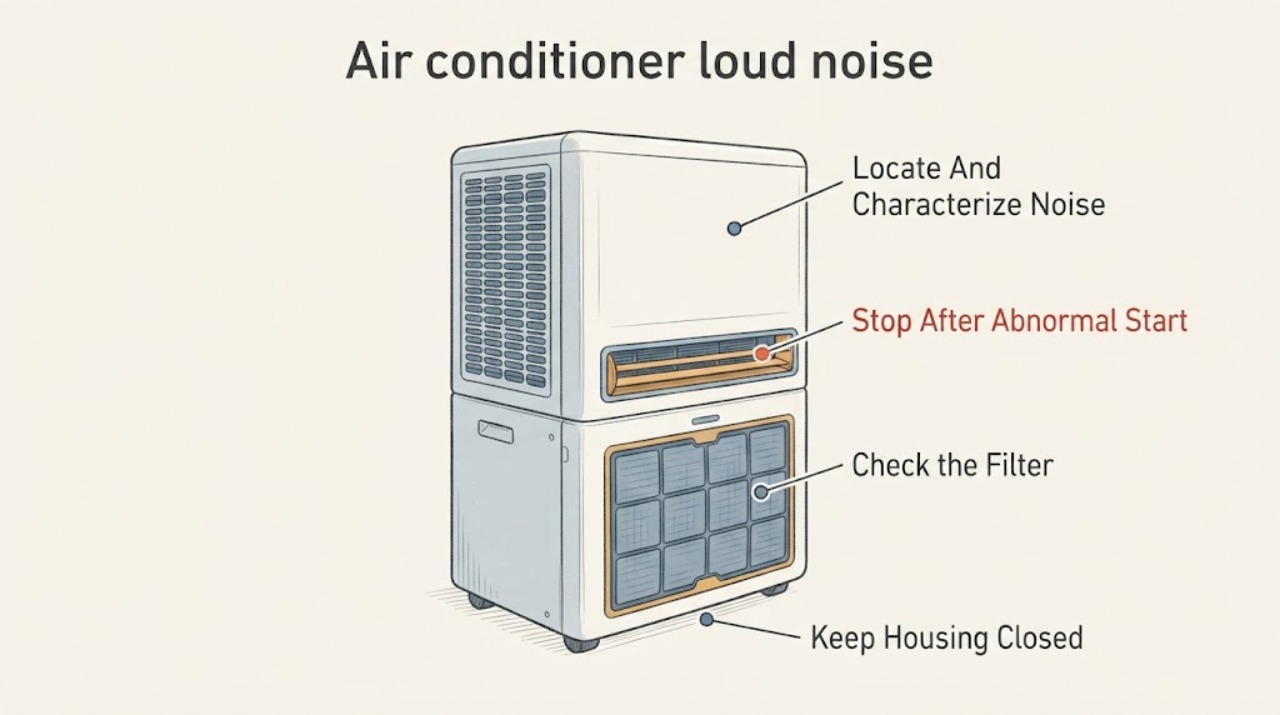
A loud air conditioner does not prove that the capacitor has failed. Note whether the sound comes from the indoor or outdoor unit and whether it occurs at startup, during cooling, or at shutdown, then stop the system if the sound is sudden, harsh, or accompanied by poor cooling. You may check the thermostat, a readily accessible filter, and visible airflow or ice without opening equipment. Do not remove an access panel, touch or test a capacitor, measure voltage or capacitance, or try to discharge it: an AC capacitor stores electrical energy even when the system is off. A startup hum with an outdoor fan that does not start can be consistent with a capacitor, motor, contactor, or compressor problem, but a qualified HVAC technician must identify the failed part.
Work through in order
Diagnostic checks
Use only checks that match the exact appliance or system and its official guide.
-
Check 1
From a dry, stable position and without opening either unit, listen briefly and record whether the loud noise is at the indoor air handler, the outdoor condenser, the thermostat, or the connecting line area; note whether it begins at startup, continues while cooling, changes during shutdown, and whether it sounds like a hum, buzz, rattle, grind, squeal, click, or hiss.
Expected result: Record the location, timing, sound character, whether the outdoor fan turns, whether air still comes from the indoor vents, and whether cooling changed. Do not move close to a hot, vibrating, wet, or electrically damaged enclosure.
Next step: Keep the recording or written description for the HVAC technician and use the relevant branch below; stop immediately for smoke, burning smell, sparks, gas odor, a hot panel, or a strong refrigerant-like hiss.
Stop if: Do not touch a grille, fan, line, panel, capacitor, or wiring while listening, and do not deliberately reproduce a dangerous sound.
Why this matters
Why: A startup hum with no outdoor fan or a unit that fails to start makes a capacitor, motor, contactor, or compressor a possible professional diagnostic path, not a confirmed capacitor failure. Indoor blower noise, loose exterior material, refrigerant-line noise, and mechanical contact point to different paths.
-
Check 2
If the noise is sudden or unusually loud, turn the thermostat to Off once from the normal control and observe from a safe distance whether the sound stops, whether the indoor blower or outdoor fan coasts normally, and whether the system remains off; do not use repeated cycling as a test.
Expected result: Note whether the noise stops with the call for cooling, continues after shutdown, or is accompanied by no airflow, warm air, repeated clicking, or a breaker trip.
Next step: Leave the system off and arrange HVAC service when the abnormal noise returns, cooling is poor, the fan does not start, or the system cycles abnormally; do not reset a repeatedly tripping breaker.
Stop if: If there is smoke, an electrical arc, burning odor, gas odor, visible water at electrical equipment, or a hot enclosure, stay clear, isolate power only from a safe accessible control if possible, and use emergency or electrical help as appropriate.
Why this matters
Why: A sound that disappears when the equipment stops still does not identify the component, but leaving an abnormal system off avoids repeated starting stress. A sound that continues, a fan that does not start, or a protective trip increases the need for prompt professional assessment.
-
Check 3
With the equipment stopped, confirm the thermostat is calling for Cool only when you intend to test it, check that the fan is set as intended, and inspect the air filter only if it is reachable through its normal user access without removing an equipment panel.
Expected result: Record whether the thermostat is in the wrong mode, the fan is set to run continuously, the filter is visibly loaded with dust, or the settings and filter look normal; note weak airflow or short cycling.
Next step: Correct only the thermostat setting or replace the filter with the exact type specified for the equipment, then stop if the noise remains. Never use a filter check as a reason to open the electrical compartment.
Stop if: Stop if the filter access is stuck, the filter is wet, there is ice or water inside, or accessing it requires tools, leaning into moving equipment, or opening a service panel.
Why this matters
Why: A wrong fan setting or restricted filter can create airflow and performance symptoms that are separate from a capacitor. Normal settings and airflow with a new loud outdoor startup sound leave electrical, motor, compressor, or mechanical causes for professional diagnosis.
-
Check 4
From outside the equipment guards, observe the indoor supply and return airflow and the outdoor condenser area for visible leaves, ice, standing water, a shifted cover, or an obstruction; keep hands, tools, and loose clothing away from grilles and fans.
Expected result: Record whether airflow is weak, ice is present on a line or coil area, water is accumulating, the outdoor fan is stationary during a call, or the visible surroundings look clear.
Next step: Turn the system off for ice, abnormal water, or a stationary fan and arrange HVAC service; only remove loose debris that is completely outside the guard and can be lifted without reaching toward the unit, and do not restart to test a suspected fault.
Stop if: Do not chip ice, spray water, reach through the grille, remove panels, move a guard, or handle refrigerant lines or electrical parts.
Why this matters
Why: Ice, weak airflow, water, or a stationary outdoor fan can signal an airflow, refrigerant, fan, electrical, or compressor problem and should not be corrected by forcing the fan or opening the unit. A clear exterior does not rule out a capacitor or another internal fault.
-
Check 5
From a dry, unobstructed position, record whether the AC disconnect or breaker appears off and whether a trip coincided with the noise; do not open the disconnect or electrical panel and do not reset a breaker repeatedly.
Expected result: Note a normal status, a single known trip with no heat or damage, or a repeated trip, buzzing, scorch mark, smell, warmth, moisture, or visible damage.
Next step: Leave a repeatedly tripping circuit off and request a qualified electrician or HVAC technician as appropriate; provide the timing and sound record instead of attempting a live test.
Stop if: Do not touch exposed conductors, remove covers, measure voltage or capacitance, bridge protection, use an extension cord, or discharge a capacitor.
Why this matters
Why: A repeated protective trip or any heat, smell, buzzing, moisture, or damage indicates an unresolved electrical or equipment fault rather than a capacitor that can be safely confirmed by the homeowner. Carrier advises not trying again when a breaker trips immediately after reset.
-
Check 6
Prepare the HVAC service request with the equipment model if visible from ordinary access, the indoor or outdoor sound location, the sound recording or description, start and stop timing, thermostat mode, airflow and cooling change, ice or water observations, and any breaker event.
Expected result: Confirm that the technician will receive observations without a panel being opened, a capacitor being handled, or the system being repeatedly restarted; include photos only from a safe distance.
Next step: Request qualified HVAC diagnosis and tell the technician the assigned concern is a loud noise with a possible capacitor symptom; let the technician verify isolation, stored energy, component condition, and exact compatibility.
Stop if: Stop all user troubleshooting if diagnosis would require electrical measurements, access-panel removal, capacitor handling, refrigerant work, fan or compressor work, or any unsafe access.
Why this matters
Why: A precise symptom timeline helps the professional distinguish a possible capacitor or motor-start symptom from blower, fan, compressor, refrigerant, airflow, mounting, or control causes. It does not justify ordering a capacitor by appearance or a generic rating.
Use your observations
Decision map
Find the observation that best matches what you see, then follow the next safe action.
-
PATH 01Next step
What you see
The sound is brief at a normal startup or shutdown, there is no new harsh noise, cooling and airflow are normal, and no hazard is visible.
Do this next
Document the pattern and mention it during routine HVAC maintenance; arrange service sooner if the duration, loudness, cooling, or starting behavior changes.
-
PATH 02Next step
What you see
The outdoor unit hums or buzzes at startup, the fan does not start, the system fails to cool, or the noise returns after one normal call for cooling.
Do this next
Leave the system off and request HVAC service. A capacitor, fan motor, contactor, compressor, or another electrical fault is possible; do not choose or replace a capacitor from the sound alone.
-
PATH 03Next step
What you see
The noise is at the indoor blower or registers, airflow is weak, or the sound is rubbing, rattling, or vibrating while the outdoor unit appears normal.
Do this next
Use only the safe filter and thermostat observations, then request HVAC service if the noise persists. Do not reach into the blower, remove the cabinet, or assume the outdoor capacitor is responsible.
-
PATH 04Next step
What you see
Ice, abnormal water, a strong hiss near the coil or lines, or a sudden cooling loss accompanies the noise.
Do this next
Turn cooling off, keep clear of the equipment, and request HVAC service. Do not chip ice, handle refrigerant lines, add refrigerant, or attempt a leak test.
-
PATH 05Next step
What you see
There is smoke, a burning smell, arcing, a hot panel or plug, visible electrical damage, moisture at electrical equipment, or a breaker trips again.
Do this next
Do not restart or reset the circuit again. Stay clear and use the appropriate emergency, electrical, or HVAC professional response from a safe location.
Helpful context
Understand the symptom
The sound is a symptom, not a capacitor diagnosis
The same loud complaint can come from different parts depending on where and when it occurs. A short click or brief airflow change at a normal cycle boundary is different from a new buzz that continues while the outdoor fan remains still, a grinding sound, a high-pitched squeal, or a hiss. Carrier identifies loud or unusual outdoor-unit noise, a fan that is not spinning, and a unit that will not start as symptoms that can involve capacitors, motors, or compressors. Trane likewise advises professional HVAC repair for loud and unusual noises. Use the observations below to decide whether to stop the equipment and what to tell the technician; do not treat them as proof of a particular component.
Why the capacitor boundary matters
An AC capacitor stores and releases electrical energy to help a compressor, condenser fan, or other motor start and run. Humming or buzzing during an attempted start, failure to start, short cycling, or weak cooling may occur with a failing capacitor, but they overlap with motor, compressor, control, airflow, and power faults. Capacitors can retain a charge after the air conditioner is turned off. Leave the service panel closed and let an HVAC professional perform electrical isolation, testing, and replacement with the model-appropriate part.
Safe observations before service
Keep checks outside the equipment. Confirm the thermostat mode and fan setting, inspect a filter only where the installation provides ordinary access, and look from a safe position for ice, water, blocked airflow, or visible debris at the outdoor grille. Do not put fingers or tools through a grille, move a guard, remove a panel, or start and stop the system repeatedly to reproduce the noise. If the breaker trips again, there is smoke, a burning smell, arcing, a hot electrical enclosure, or water near electrical equipment, leave the equipment isolated and request appropriate professional help.
Safety boundary
Stop conditions
- Stop immediately for smoke, fire, burning odor, arcing, a hot enclosure, exposed wiring, or a repeatedly tripping breaker.
- Stop and keep the system off for gas odor, strong refrigerant-like hissing, ice, abnormal water, or a fan that does not start.
- Never open an AC service panel, touch or test a capacitor, measure live voltage, short or discharge a capacitor, reach through a grille, or handle refrigerant or compressor components.
Only after diagnosis
Potential parts
- AC capacitor
Consider this part only if a qualified technician's tests identify the capacitor as failed and the exact equipment specifications call for it; loud noise alone is not enough.
A technician must verify the model, electrical ratings, physical fit, and manufacturer-approved replacement before any part is selected.
When checks do not resolve it
Need a professional?
Call a qualified HVAC technician for any persistent, new, or loud noise; a startup hum with no fan; failed cooling or starting; short cycling; ice or abnormal water; or any diagnosis that requires opening the equipment. Use an electrician or emergency response for a hot or damaged electrical component, arcing, smoke, burning smell, or repeated breaker trip.
Have this ready
- Give the technician the model visible from safe access, sound location and timing, recording, thermostat and airflow observations, cooling change, ice or water notes, and breaker history.
Common questions
FAQ
Does a loud humming air conditioner always need a new capacitor?
No. A startup hum can occur with a capacitor, fan motor, contactor, compressor, or another fault. If the outdoor fan does not start or cooling is poor, leave the system off and have an HVAC technician diagnose it rather than ordering a part from the sound alone.
Can I test an air-conditioner capacitor after turning the unit off?
Do not test, touch, short, or discharge it as a homeowner. Capacitors can retain electrical energy after shutdown, and testing or replacement requires safe isolation and appropriate equipment by a qualified HVAC professional.
What should I do if the noise is accompanied by ice or water?
Turn cooling off and arrange HVAC service. Ice or abnormal water can accompany airflow, refrigerant, drain, or equipment faults; do not chip the ice, add refrigerant, reach into the unit, or open the panel.
Read the exact guide
Official sources
- Troubleshoot an Air Conditioner: 6 Steps to Fix an AC Not WorkingCarrier · Carrier residential air-conditioning troubleshooting guidance used for general symptom triage and safety boundaries, not a model-specific diagnosis.
- Is This Normal? HVAC Smells and Sounds, ExplainedTrane · Trane residential HVAC sound guidance used for general sound-timing and escalation context, not brand-specific repair instructions.
- Maintenance ChecklistENERGY STAR · ENERGY STAR home heating and cooling maintenance checklist used for safe external maintenance scope; exact equipment manual controls access.
- AC Capacitor | Air Conditioner Capacitor | CarrierCarrier · Carrier educational guidance on air-conditioner capacitors; use for general mechanism and safety, not a replacement-part match.
- 1926.967 - Special conditions.Occupational Safety and Health Administration · OSHA electrical safety requirements used to support the professional-only capacitor boundary; not a homeowner work procedure.
Community feedback
Share a repair observation
Share a plain-text repair observation. Accepted observations are published automatically; this page may take a moment to update.