
On this page
Start here
Quick answer
If an air conditioner is running but not cooling, first note whether the indoor airflow is absent, weak, or normal but warm. Check the thermostat's cooling call, the accessible filter and vents, and the outdoor unit from a safe distance. Frost or ice on the evaporator coil or refrigerant tubing, water near the indoor unit, long continuous cycles, short cycling, or a silent or abnormal outdoor unit points beyond a simple setting. The compressor and evaporator coil are sealed-system components: do not open cabinets, handle refrigerant, touch a capacitor or contactor, or make electrical measurements. Turn cooling off for ice, water, smoke, burning odor, arcing, or repeated trips and arrange qualified HVAC service.
Before you begin
Safety first
- A qualified HVAC technician can separate thermostat, airflow, evaporator coil, compressor, condenser, contactor, capacitor, control, and refrigerant faults using appropriate de-energization, diagnostic equipment, and certified refrigerant practices.
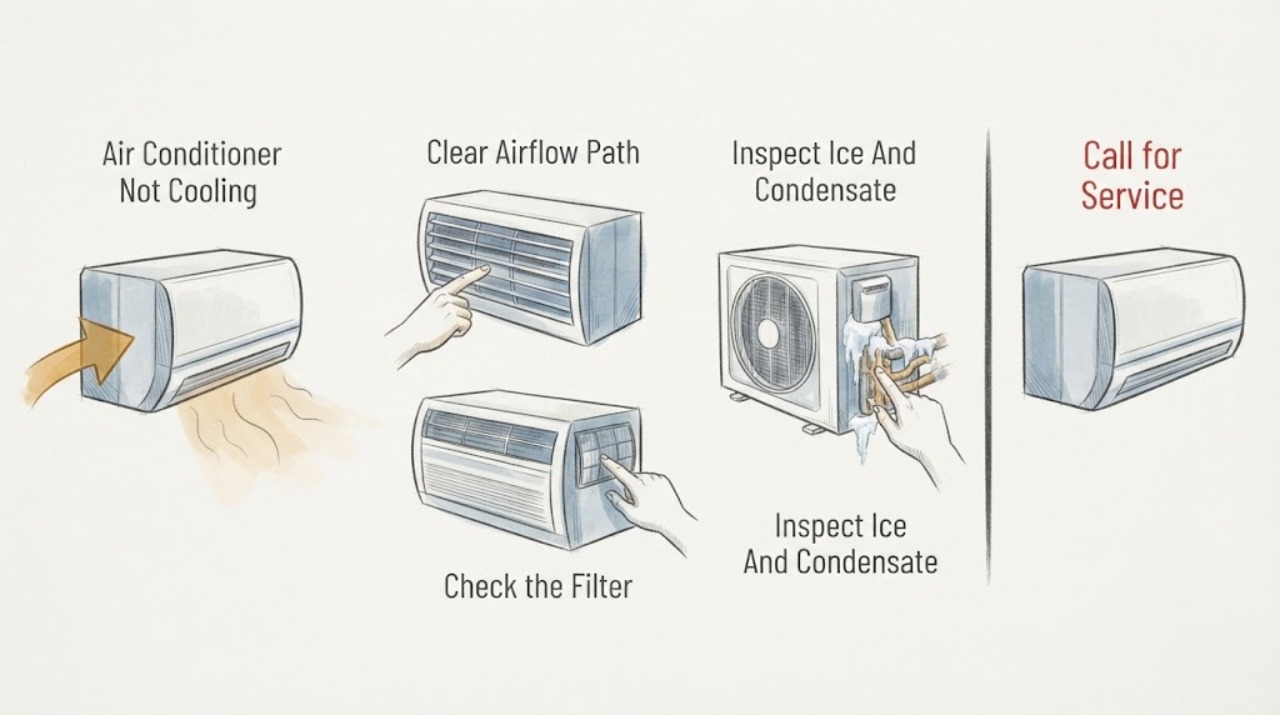
Work through in order
Diagnostic checks
Use only checks that match the exact appliance or system and its official guide.
-
Check 1
With cooling selected and no immediate hazard, observe one or more supply registers and the return. Note whether the indoor blower is silent, airflow is weak, or airflow is normal but the air remains warm; do not remove covers or reach into a grille.
Expected result: Airflow is absent, weak, or normal while the room remains warm.
Next step: Follow the matching branch and keep the system off if ice, water, odor, noise, or electrical symptoms are present.
Why this matters
Why: Absent or weak airflow shifts attention toward the filter, blower, duct path, drain safety, or frozen evaporator coil. Normal airflow with warm air shifts attention toward the outdoor unit, compressor, condenser, refrigerant circuit, or controls.
-
Check 2
Check that the thermostat is in cooling mode with a setpoint below the indoor temperature and that the fan setting is understood. From a safe, dry location, inspect the accessible filter and visible return or supply openings; replace the filter only if the exact equipment instructions allow it and the replacement has the correct size and airflow direction.
Expected result: The thermostat is not calling for cooling, the filter is dirty or blocked, or these visible items look normal.
Next step: Correct only a clear setting or accessible filter issue, then allow one normal cooling call. If cooling remains poor, stop repeating the check and arrange HVAC service.
Why this matters
Why: A setting or restricted filter can explain poor cooling and airflow. If the settings and filter are normal but the symptom continues, the cause is not confirmed by this check and may involve the coil, compressor, refrigerant, or controls.
-
Check 3
From outside the indoor cabinet, look for frost or ice on accessible refrigerant tubing, the cabinet exterior, or nearby surfaces, and look for unusual condensate or meltwater. Do not open the coil cabinet, chip ice, apply heat, or touch tubing.
Expected result: Ice or frost is visible, airflow is very low, condensate is excessive, or there is no ice or unusual water.
Next step: If ice or water is present, turn cooling off from the thermostat, protect the area from meltwater, and arrange HVAC service before restarting. If no ice is visible, continue with the safe outdoor observation.
Why this matters
Why: Ice can accompany restricted airflow, a dirty coil, low refrigerant, or another fault; water may appear as ice thaws. The absence of visible ice does not rule out a coil, compressor, or refrigerant issue.
-
Check 4
From a safe distance, observe whether the outdoor unit starts during a valid cooling call, whether its fan runs normally, and whether there is unusual noise, smoke, ice, or a short-cycle pattern. Do not touch the fan, grille, disconnect, wiring, capacitor, contactor, compressor, or refrigerant lines.
Expected result: The outdoor unit is silent, starts and stops quickly, runs continuously without cooling, makes abnormal noise, or appears to run normally while indoor air remains warm.
Next step: Keep the system off for abnormal noise, ice, smoke, odor, or repeated cycling and arrange qualified HVAC service. Do not reset or open the outdoor unit to compare behavior.
Why this matters
Why: A no-start or short-cycle pattern can involve power, controls, capacitor, contactor, fan, compressor, or refrigerant. Continuous operation with warm air can fit low refrigerant, coil, condenser, airflow, or compressor trouble; visual observation alone cannot identify the failed part.
-
Check 5
Record the equipment nameplate information, thermostat mode and setpoint, filter condition, indoor airflow, outdoor-unit behavior, runtime pattern, ice or water location, and any breaker or disconnect event. Note whether the problem is constant, intermittent, or tied to a hot period.
Expected result: The record points to weak airflow, ice or water, a normal-airflow warm-air pattern, outdoor no-start, short cycling, or an electrical symptom.
Next step: Provide the record to qualified HVAC service. Include refrigerant information only as shown on the nameplate or manual; do not open the circuit or add refrigerant.
Why this matters
Why: A clear symptom pattern helps a technician separate airflow and evaporator-coil concerns from compressor, condenser, refrigerant, control, or supply concerns without the user entering a hazardous area.
-
Check 6
After the safe external checks, decide whether the issue requires a sealed-system or electrical diagnosis: compressor, evaporator coil, refrigerant, contactor, capacitor, wiring, or control work. Do not remove the cabinet, attach gauges, or work on the sealed refrigeration circuit or electrical system.
Expected result: A professional component or sealed-system fault is suspected, or the thermostat, filter, and visible air path were normal but cooling did not recover.
Next step: Keep cooling off when the fault is persistent or unsafe and arrange qualified HVAC service; use certified refrigerant service for refrigerant work.
Why this matters
Why: These observations are a service trigger, not proof that a particular part has failed. A qualified technician must test the system and determine whether repair, leak correction, or another remedy is appropriate.
Use your observations
Decision map
Find the observation that best matches what you see, then follow the next safe action.
-
PATH 01Next step
What you see
There is smoke, burning odor, arcing, a hot disconnect, damaged wiring, water near electrical equipment, or a repeated breaker trip.
Do this next
Stop cooling and keep clear. Isolate power only from a dry, safe location if that can be done without touching damaged equipment; do not reset repeatedly or use water on an electrical hazard.
-
PATH 02Next step
What you see
Airflow is absent or weak and the filter or visible air path is dirty, blocked, wet, or otherwise abnormal.
Do this next
Turn cooling off and correct only an accessible filter or movable obstruction according to the equipment instructions.
-
PATH 03Next step
What you see
Frost or ice is visible, airflow has fallen sharply, or condensate is excessive near the indoor unit.
Do this next
Turn cooling off at the thermostat and protect the area from meltwater. Do not chip ice, use flame or heat, open the coil cabinet, or handle refrigerant.
-
PATH 04Next step
What you see
Indoor airflow is normal but the air remains warm after a valid cooling call.
Do this next
Keep the system off if it runs continuously, short cycles, makes abnormal noise, or shows ice or water; do not open the outdoor unit.
-
PATH 05Next step
What you see
The outdoor unit does not start, starts and stops quickly, or shows a compressor or fan noise pattern during a cooling call.
Do this next
Keep the system off and do not touch the disconnect, contactor, capacitor, compressor, fan, wiring, or refrigerant lines.
-
PATH 06Next step
What you see
The filter and thermostat are correct but ice, long runtimes, inadequate cooling, or a suspected refrigerant leak remains.
Do this next
Do not attach gauges, add refrigerant, cut tubing, or open the refrigeration circuit.
Helpful context
Understand the symptom
Start by separating airflow from refrigeration
An air conditioner that is not cooling may have no air movement, weak air movement, or normal airflow that is not cold. That distinction matters. No or weak airflow puts the indoor blower, filter, duct path, drain safety, or frozen coil higher on the list. Normal airflow with warm air keeps the thermostat, outdoor unit, compressor, condenser, refrigerant circuit, and controls in view. A homeowner can observe these patterns, but the sealed refrigeration and high-voltage sections require HVAC service.
What the evaporator coil and compressor tell you
The indoor evaporator coil absorbs heat from indoor air, while the outdoor condensing unit rejects that heat and contains the compressor. Ice on the indoor coil or copper tubing, excess condensate, long runtimes, or inadequate cooling can point to restricted airflow, a frozen coil, or low refrigerant. A compressor that hums, clicks, stops quickly, or fails to start cannot be diagnosed safely by touching the unit or opening a panel.
Keep checks external and low risk
Use the thermostat, visible vents, accessible filter, and a visual check around the outdoor unit as the homeowner boundary. Keep the area around the outdoor coil clear of loose debris without opening the cabinet or bending fins. Do not chip ice, apply heat, attach gauges, add refrigerant, or handle the compressor, capacitor, contactor, disconnect, wiring, or refrigerant lines.
Turn it off when the pattern is unsafe
Turn cooling off when ice, water near electrical equipment, smoke, burning odor, arcing, a hot disconnect, damaged wiring, or a repeated electrical trip appears. If ice is present, protect the area from meltwater and arrange service rather than running the system until it freezes again. Give the technician the symptom pattern, timing, ice or water location, and nameplate information.
Safety boundary
Stop conditions
- Stop immediately for smoke, burning odor, arcing, a hot disconnect or plug, damaged wiring, water near electrical equipment, or a repeated electrical trip.
- Turn cooling off when ice or frost is visible, airflow is nearly absent, condensate is excessive, or meltwater is reaching electrical equipment. Do not chip ice or apply flame, hot water, or a heat gun.
- Do not open indoor or outdoor cabinets, touch a compressor, capacitor, contactor, fan, wiring, or refrigerant line, attach gauges, add refrigerant, or make electrical measurements.
- Do not bypass a condensate safety switch, bridge a control, repeatedly reset a breaker or disconnect, or run the system again to compare a suspected fault.
- Stop if the access is wet, unstable, confined, at height, or otherwise unsafe; arrange qualified HVAC service.
Only after diagnosis
Potential parts
- compressor
Consider only when a qualified HVAC technician confirms a compressor fault after checking power, controls, airflow, condenser, coil, and refrigerant conditions.
Compressors are sealed-system, model-specific components; qualified service must confirm the system design, refrigerant, and approved fit before replacement. - evaporator coil
Consider only when service confirms a leaking, damaged, blocked, or otherwise failed evaporator coil rather than a filter, airflow, drain, or control issue.
Coil selection depends on the exact system, dimensions, refrigerant, and metering arrangement; do not open the circuit or assume a universal fit.
When checks do not resolve it
Need a professional?
Request qualified HVAC service when thermostat, filter, visible air path, ice, and external-unit observations do not restore cooling, or immediately for ice with water, suspected compressor or evaporator-coil fault, refrigerant symptoms, electrical signs, smoke, or odor.
Safety scope: A qualified HVAC technician can separate thermostat, airflow, evaporator coil, compressor, condenser, contactor, capacitor, control, and refrigerant faults using appropriate de-energization, diagnostic equipment, and certified refrigerant practices.
Have this ready
- Provide the equipment make and model, nameplate refrigerant information, thermostat mode and setpoint, filter condition, indoor airflow, outdoor-unit behavior, runtime or short-cycle pattern, ice or water location, sounds, odors, and breaker or disconnect events.
Common questions
FAQ
What should I check first when my air conditioner is not cooling?
Separate absent or weak airflow from normal airflow that feels warm. Then check the thermostat mode and setpoint, visible vents, and the accessible filter. Ice, water, abnormal outdoor behavior, or electrical symptoms move the issue to HVAC service.
Can a frozen evaporator coil stop an air conditioner from cooling?
Yes. Ice can restrict airflow and appear with inadequate cooling, excess condensate, or frost on tubing. Turn cooling off and arrange service; do not chip the ice or apply heat because the underlying cause may be airflow, coil, drain, or refrigerant related.
How do I know if the compressor is the problem?
A silent outdoor unit, humming, rapid cycling, long runtimes, or warm air with normal indoor airflow can involve the compressor, but these signs do not identify it by themselves. Keep clear of the outdoor unit and have a qualified technician diagnose it.
Can I add refrigerant to make the AC cold again?
Do not add refrigerant yourself or open the refrigeration circuit. A qualified and appropriately certified HVAC technician should check for a leak, repair it when possible, and service the system using the refrigerant specified for the equipment.
When is an AC not-cooling problem urgent?
Stop immediately for smoke, burning odor, arcing, a hot disconnect, damaged wiring, water near electrical equipment, repeated trips, severe ice, or meltwater. Keep the system off and use urgent electrical, fire, or HVAC service as appropriate.
Read the exact guide
Official sources
- AC Not Blowing Cold Air? Learn What to DoTrane · Air filter, thermostat, condensate drain, condenser, frozen evaporator coil, refrigerant, and HVAC service guidance
- Air Conditioner Not Cooling | AC Not Blowing Cold AirCarrier · AC not-cooling causes including thermostat, filter, condenser, compressor, evaporator coil, refrigerant, and service guidance
- Homeowners and Consumers: Frequently Asked QuestionsU.S. Environmental Protection Agency · Home air-conditioner refrigerant identification, leak repair, certified technicians, and refrigerant handling boundaries
- Troubleshoot an Air ConditionerCarrier · Thermostat, filter, refrigerant, evaporator coil, outdoor condenser, compressor, capacitor, electrical and professional HVAC boundaries
- Information for Stationary Refrigeration and Air-Conditioning Equipment OwnersU.S. Environmental Protection Agency · Stationary air-conditioning owner resources, refrigerant servicing, certification, leak repair, and venting requirements
Community feedback
Share a repair observation
Share a plain-text repair observation. Accepted observations are published automatically; this page may take a moment to update.