
On this page
Start here
Quick answer
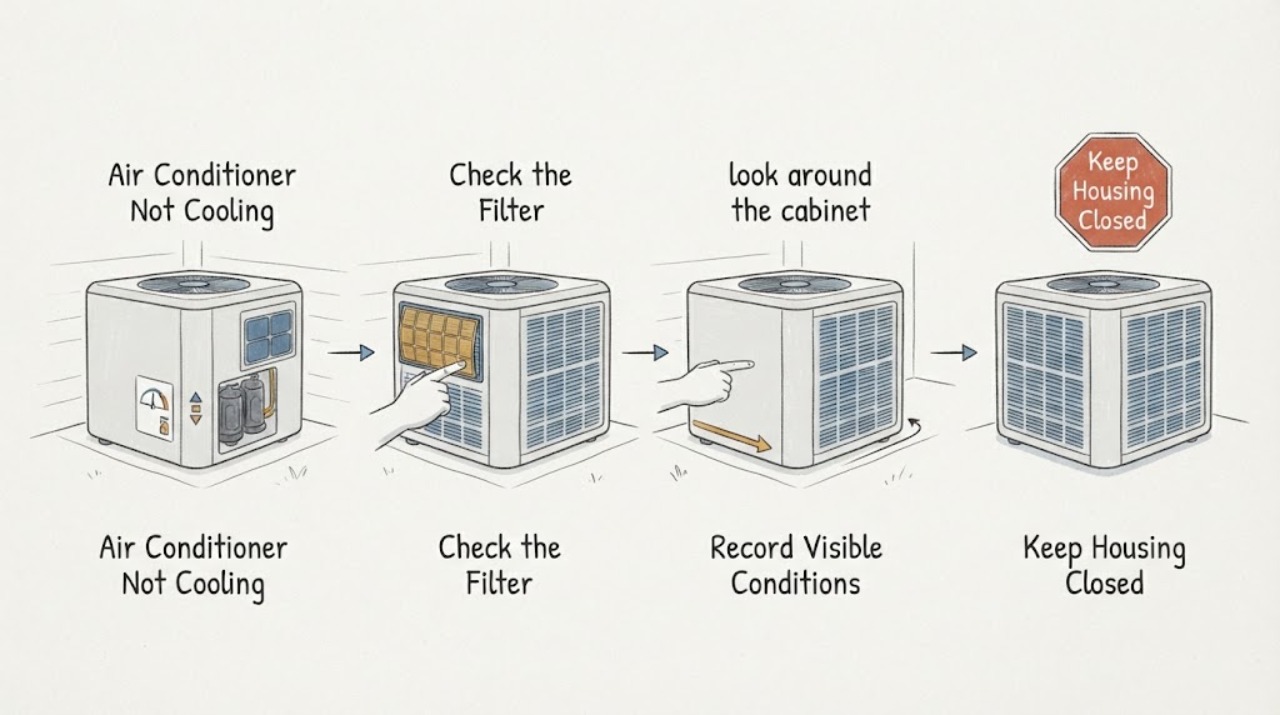
An air conditioner that is not cooling may have an airflow, thermostat, outdoor-coil, frozen-evaporator, refrigerant, electrical, or compressor problem. A compressor cannot be confirmed by sound alone, and its sealed refrigerant circuit and high-voltage starting components are not homeowner checks. First record the thermostat mode, indoor airflow, outdoor-unit behavior, frost or water, and any breaker, odor, or unusual noise. Replace or clean an accessible filter only as the equipment instructions allow and clear leaves or grass around the outdoor cabinet without opening it. Stop for a burning smell, smoke, arcing, a hot connection, repeated breaker trips, refrigerant release, or water near electrical equipment. If the outdoor unit hums, clicks off, trips, will not start, or runs without cooling after the safe airflow and setting checks, keep the system off and request qualified HVAC service for compressor, electrical, refrigerant, and coil testing.
Before you begin
Safety first
- Keep the air conditioner off for smoke, burning or electrical odor, visible arcing, hot connections, water near electrical equipment, severe noise, repeated short cycling, repeated breaker trips, or suspected refrigerant release. Do not open panels, perform energized checks, alter wiring, touch refrigerant fittings, add refrigerant, or vent the system.
Work through in order
Diagnostic checks
Use only checks that match the exact appliance or system and its official guide.
-
Check 1
From a safe position, record the thermostat mode, requested temperature, indoor room temperature trend, whether the indoor blower moves air, and whether the outdoor unit is silent, has a fan running, hums, clicks, or stops. Note the model and rating-plate information without removing covers.
Expected result: The thermostat is not calling for cooling, the blower is absent, or the outdoor unit never responds; or the outdoor unit starts and then clicks off or repeatedly restarts.
Next step: Correct only an obvious thermostat setting using the equipment instructions. For a missing blower, repeated clicking, short cycling, or a silent outdoor unit, stop repeated tests and give the recorded sequence to an HVAC technician.
Why this matters
Why: The symptom is not specific to the compressor. A control, indoor airflow, power, start, overload, fan, or safety condition may be preventing normal cooling.
-
Check 2
Turn the system off at the thermostat before inspecting the return filter and supply or return grilles. If the filter is accessible and the manual permits user replacement or cleaning, compare it with a clean filter and restore only the specified type and fit; do not reach into the blower cabinet.
Expected result: The filter is heavily loaded, grilles are blocked, or airflow is weak; alternatively, the filter and visible grilles are clear but airflow is still weak or absent.
Next step: Correct the accessible filter or grille issue once, then use the system only as the model instructions allow. If airflow remains weak, the coil, blower, duct, drain, or control needs professional diagnosis; do not blame the compressor yet.
Why this matters
Why: Restricted airflow can reduce cooling and contribute to coil freeze or excessive compressor run time. Persistent weak airflow points beyond a simple filter check.
-
Check 3
With cooling off and the outdoor unit stationary, look around the cabinet from outside for leaves, grass, or other obstructions and check whether the service access area appears damaged. Do not remove panels, bend fins, spray into the cabinet, or approach a fan that may start unexpectedly.
Expected result: Airflow around the outdoor coil is blocked by debris, or the cabinet, wiring cover, disconnect, or fan area shows damage, heat, or an unusual odor.
Next step: Clear only loose debris well away from the cabinet while power remains isolated by the normal controls; do not wash or open the unit unless the model instructions specifically permit that external task. For damage, heat, odor, or persistent poor cooling, leave it off and call HVAC service.
Why this matters
Why: A blocked condenser can reduce heat rejection and make the system run longer, which can stress the compressor. Damage, heat, or odor is an electrical or equipment-safety branch.
-
Check 4
Look from a safe position at accessible refrigerant tubing and the area around the indoor unit for frost, ice, unusual condensation, or a drain-pan overflow. Do not touch tubing, scrape ice, apply heat, open the coil cabinet, or handle an unknown liquid.
Expected result: Frost or ice is visible on tubing or the indoor unit, or water is collecting near the air handler; or there is no visible frost or water.
Next step: Turn cooling off and arrange HVAC service if frost, ice, or ongoing water is present. Protect nearby materials only from a dry, safe location and keep water away from electrical equipment; do not accelerate thawing or restart repeatedly.
Why this matters
Why: A frozen coil can follow restricted airflow, a refrigerant problem, or another fault; water can indicate condensate drainage trouble. Neither observation proves a compressor fault.
-
Check 5
If there is no smoke, burning odor, arcing, water hazard, or repeated trip, check only the normal thermostat indication and any plainly visible, labeled disconnect or breaker status. Follow the model instructions for a single ordinary reset only when the equipment and area are dry and safe; never remove a cover or perform an energized electrical check.
Expected result: The breaker or disconnect is off, the system resumes once but the breaker trips again, or the system still does not start after the safe control check.
Next step: Do not reset again after a trip. Keep the system off and request HVAC or electrical service as appropriate, especially if the connection is hot or damaged.
Why this matters
Why: An interrupted supply may explain a silent unit, but a returning trip indicates an unresolved electrical, motor, start, or compressor-load problem. A single reset does not establish that the compressor is bad or safe to run.
-
Check 6
Compare the outdoor-unit behavior with the cooling result after the safe setting, filter, and obstruction checks: note whether the fan runs, whether a steady compressor-like hum is heard, whether a click is followed by shutdown, and whether indoor air remains warm. Do not use sound, touch, or a restart test to decide that the compressor has failed.
Expected result: The outdoor fan runs but cooling is absent, the unit hums and clicks off, the unit repeatedly short-cycles, or the entire outdoor unit is quiet while the indoor blower runs.
Next step: Record the exact timing and pattern, stop operating the unit if it is short-cycling, overheating, noisy, or not cooling, and ask a qualified HVAC technician to evaluate the compressor and the other possible causes together.
Why this matters
Why: These patterns can involve the compressor, its starting or control path, refrigerant charge, outdoor fan, coil, airflow, or a protective shutdown. They require measurements and model-specific diagnosis.
-
Check 7
Check for a suspected refrigerant issue only by visible evidence and the system history: note a recurring loss of cooling, frost, oil-like residue reported by a technician, or a previous refrigerant top-off. Do not puncture tubing, loosen service fittings, add refrigerant, or vent any gas.
Expected result: A leak is suspected, the refrigerant type is unknown, or the system has been repeatedly topped off without a documented leak repair; alternatively, there is no such history.
Next step: Keep the system off if a leak or release is suspected and request an appropriately trained HVAC technician. Ask for the leak cause and refrigerant type to be identified rather than accepting an unsupported part or charge recommendation.
Why this matters
Why: A refrigerant or sealed-system fault can damage cooling performance and may overload the compressor, but the charge and leak location cannot be safely confirmed by a homeowner.
-
Check 8
Prepare a service note with the model, refrigerant label if visible without opening anything, thermostat setting, indoor and outdoor behavior, filter condition, visible frost or water, breaker events, sounds, odors, and when the cooling loss began. Photograph only from a safe, dry position.
Expected result: The same no-cooling symptom remains after the safe external checks, or the technician will need to distinguish compressor, start/control, airflow, coil, refrigerant, and drain paths.
Next step: Request qualified HVAC service and keep the system off for any stop condition. Provide the service professional the observations and ask for a system-level diagnosis before approving a compressor or other part.
Why this matters
Why: The remaining problem is beyond a reliable homeowner diagnosis, and the recorded sequence is more useful than repeated operation or a guessed compressor replacement.
Use your observations
Decision map
Find the observation that best matches what you see, then follow the next safe action.
-
PATH 01Next step
What you see
Smoke, a burning or electrical odor, visible arcing, a hot or damaged connection, water at electrical equipment, or repeated breaker trips is present.
Do this next
Stop using the air conditioner. Keep clear, isolate power only from a safe dry location if that can be done without touching the equipment, and obtain emergency help or qualified electrical/HVAC service as the hazard requires. Do not reset repeatedly or open the cabinet.
Why this path and its safety boundary
Why it matters: This is an immediate fire, shock, or water-safety event, not a compressor troubleshooting step.
-
PATH 02Next step
What you see
Frost or ice is visible, the indoor unit is overflowing, or water is approaching electrical equipment.
Do this next
Turn cooling off, protect people and property from a safe dry location, and arrange HVAC service. Do not scrape ice, apply heat, open the coil cabinet, or restart to see whether it clears.
Why this path and its safety boundary
Why it matters: Restricted airflow, condensate drainage, refrigerant, or another system fault may be involved, with added water and equipment risk.
-
PATH 03Next step
What you see
The filter or visible grille is restricted but there is no safety hazard.
Do this next
Correct the accessible filter or grille issue according to the model instructions, then reassess once. If cooling or airflow does not recover, request service rather than changing compressor parts.
Why this path and its safety boundary
Why it matters: The airflow branch is plausible and may be contributing to poor cooling or coil freeze; it does not identify the compressor.
-
PATH 04Next step
What you see
The outdoor coil area is visibly blocked by loose leaves or grass and there is no damage, heat, odor, or moving-fan hazard.
Do this next
Clear loose debris from the surrounding area without opening the unit or bending fins. If the problem remains, call an HVAC professional for coil, fan, compressor, and refrigerant evaluation.
Why this path and its safety boundary
Why it matters: Reduced outdoor heat rejection may be limiting cooling and adding to compressor stress.
-
PATH 05Next step
What you see
The outdoor unit hums, clicks off, short-cycles, or runs while the house remains warm after safe airflow and setting checks.
Do this next
Stop repeated operation and request qualified HVAC diagnosis. Do not order a compressor from the sound alone or open the sealed system.
Why this path and its safety boundary
Why it matters: A compressor or starting component is possible, but airflow, fan, control, overload, coil, and refrigerant faults can look similar.
-
PATH 06Next step
What you see
The unit is silent while cooling is requested, or a breaker has tripped once and will not stay on without a hazard.
Do this next
Do not repeatedly reset the breaker. Keep the system off and arrange HVAC or electrical service, supplying the model and the observed sequence.
Why this path and its safety boundary
Why it matters: The control, disconnect, supply, start circuit, motor, or compressor load may be involved; there is not enough evidence to identify one cause.
-
PATH 07Next step
What you see
A refrigerant leak or release is suspected, or the refrigerant type cannot be identified safely.
Do this next
Avoid the tubing and service fittings, ventilate only through ordinary safe occupancy practices, keep ignition sources away from any known flammable refrigerant release, and contact appropriately trained HVAC service. Do not vent or top off the system.
Why this path and its safety boundary
Why it matters: The system may have a sealed-circuit fault and refrigerant exposure or environmental risk; this is professional work.
Helpful context
Understand the symptom
Treat compressor as a suspected path, not a diagnosis
Cooling is a system result. The compressor circulates refrigerant, but the same warm-air symptom can come from a wrong thermostat state, restricted airflow, a blocked outdoor coil, a frozen indoor coil, a failed fan, a refrigerant leak, or an electrical control problem. A safe inspection can narrow the branch by recording what the indoor blower and outdoor unit do; it cannot prove a sealed-system or high-voltage fault. Keep the model and rating-plate information available because refrigerant type, controls, and service instructions vary by equipment.
What a compressor symptom can and cannot tell you
A quiet outdoor cabinet may mean that the cooling call is absent, power is interrupted, a control or safety device is open, or the compressor is unable to start. A hum followed by a click or shutdown can also involve a starting component, fan, overload, or supply issue. A running compressor does not prove that the refrigerant charge or heat transfer is correct. Use these observations to tell the technician what happened, not to select a compressor or open the cabinet.
Do not open the outdoor cabinet
The outdoor unit can contain stored electrical energy, moving parts, and a pressurized refrigerant circuit. Do not remove panels, bridge controls, touch terminals, add refrigerant, cut tubing, or use a meter on energized equipment. EPA describes toxicity, flammability, asphyxiation, and physical hazards associated with refrigerants, and its consumer guidance recommends appropriately trained technicians for air-conditioner refrigerant service.
Safety boundary
Stop conditions
- Stop immediately for smoke, burning or electrical odor, visible arcing, a hot or damaged connection, a carbon-monoxide or other safety alarm, or a repeated breaker trip. Keep clear and obtain emergency or qualified service help as appropriate.
- Stop cooling operation for frost or ice, ongoing water near electrical equipment, a damaged cabinet or disconnect, a fan or compressor that makes severe noise, or repeated short cycling.
- Do not open panels, touch terminals, bridge controls, use energized test equipment, puncture tubing, add refrigerant, vent refrigerant, scrape ice, or use heat to thaw a coil.
- Do not keep restarting an outdoor unit that hums, clicks off, overheats, or fails to cool. A sound pattern is not proof that the compressor is the failed part.
Only after diagnosis
Potential parts
- compressor assembly
Consider this only if a qualified HVAC diagnosis confirms that the compressor itself has failed after airflow, fan, control, start, electrical, and refrigerant causes have been evaluated.
Compressor selection depends on the exact equipment model, refrigerant, electrical rating, system design, and local service requirements. Do not select one from a sound or symptom alone. - compressor starting component
Consider this only when professional testing identifies a start or overload component as the cause of a hum, click, or failed compressor start rather than a failed compressor.
Starting components vary by model and electrical design. Confirm the exact equipment information and technician diagnosis before any replacement. - outdoor fan or control component
Consider this only when the outdoor fan or its control path is confirmed to be the reason heat is not rejected or the system shuts down, rather than assuming compressor failure.
Use model-specific service information and qualified installation; do not infer fit from a generic component description.
When checks do not resolve it
Need a professional?
Call after safe setting, filter, grille, and outdoor-clearance checks fail, or immediately for short cycling, a hum-and-click shutdown, no outdoor response, frost, water, suspected refrigerant release, odor, heat, arcing, or a breaker event.
Safety scope: Keep the air conditioner off for smoke, burning or electrical odor, visible arcing, hot connections, water near electrical equipment, severe noise, repeated short cycling, repeated breaker trips, or suspected refrigerant release. Do not open panels, perform energized checks, alter wiring, touch refrigerant fittings, add refrigerant, or vent the system.
Common questions
FAQ
How can I tell whether the compressor is the reason my air conditioner is not cooling?
You usually cannot confirm that safely from sound or outdoor-unit behavior alone. A quiet unit, a hum followed by a click, a running fan with warm air, and short cycling can involve controls, power, start components, airflow, coils, refrigerant, fan operation, overload protection, or the compressor. Record the pattern and have a qualified HVAC technician test the system as a whole.
What can I safely check before calling HVAC service?
Check the thermostat mode and requested temperature, the accessible filter and grilles, and loose debris around the outdoor cabinet after the system is off, provided the model instructions allow those tasks. Look from a safe position for frost, water, smoke, odor, heat, or damage. Do not open panels, touch terminals, handle refrigerant, or use energized test equipment.
Is a humming outdoor unit always a bad compressor?
No. Humming and clicking can also involve a start or control component, fan, overload, supply, or another system fault. Stop repeated restart attempts and arrange qualified HVAC diagnosis, especially if the unit overheats, short-cycles, trips a breaker, or does not cool.
Can I add refrigerant to make the air conditioner cool again?
Do not add refrigerant yourself. A loss of charge can indicate a leak, and the refrigerant type must match the equipment. EPA recommends trained technicians and leak repair rather than an unsupported top-off; do not loosen fittings, puncture tubing, or vent refrigerant.
When should I stop running the air conditioner immediately?
Stop for smoke, burning or electrical odor, visible arcing, a hot or damaged connection, repeated breaker trips, severe noise, repeated short cycling, frost or ice, water near electrical equipment, or a suspected refrigerant release. Keep clear and use emergency, electrical, or HVAC help as the situation requires.
Read the exact guide
Official sources
- Refrigerant SafetyU.S. Environmental Protection Agency · EPA refrigerant safety information; hazards depend on the refrigerant and equipment.
- Homeowners and Consumers: Frequently Asked QuestionsU.S. Environmental Protection Agency · EPA consumer guidance for home air conditioners; local rules and equipment manuals may add requirements.
- Air Conditioner Troubleshooting: 5 Common IssuesTrane · Trane residential guidance used for general system branches; exact model instructions take precedence.
- Room Air Conditioners Key Product CriteriaENERGY STAR · ENERGY STAR room-air-conditioner explanation; central-system designs and exact models vary.
- Air Conditioner Not Cooling | AC Not Blowing Cold AirCarrier · Carrier residential guidance; exact equipment and local installation instructions may differ.
- Maintenance ChecklistENERGY STAR · ENERGY STAR consumer maintenance checklist; manufacturer instructions and qualified service control equipment-specific work.
Community feedback
Share a repair observation
Share a plain-text repair observation. Accepted observations are published automatically; this page may take a moment to update.