
On this page
Start here
Quick answer
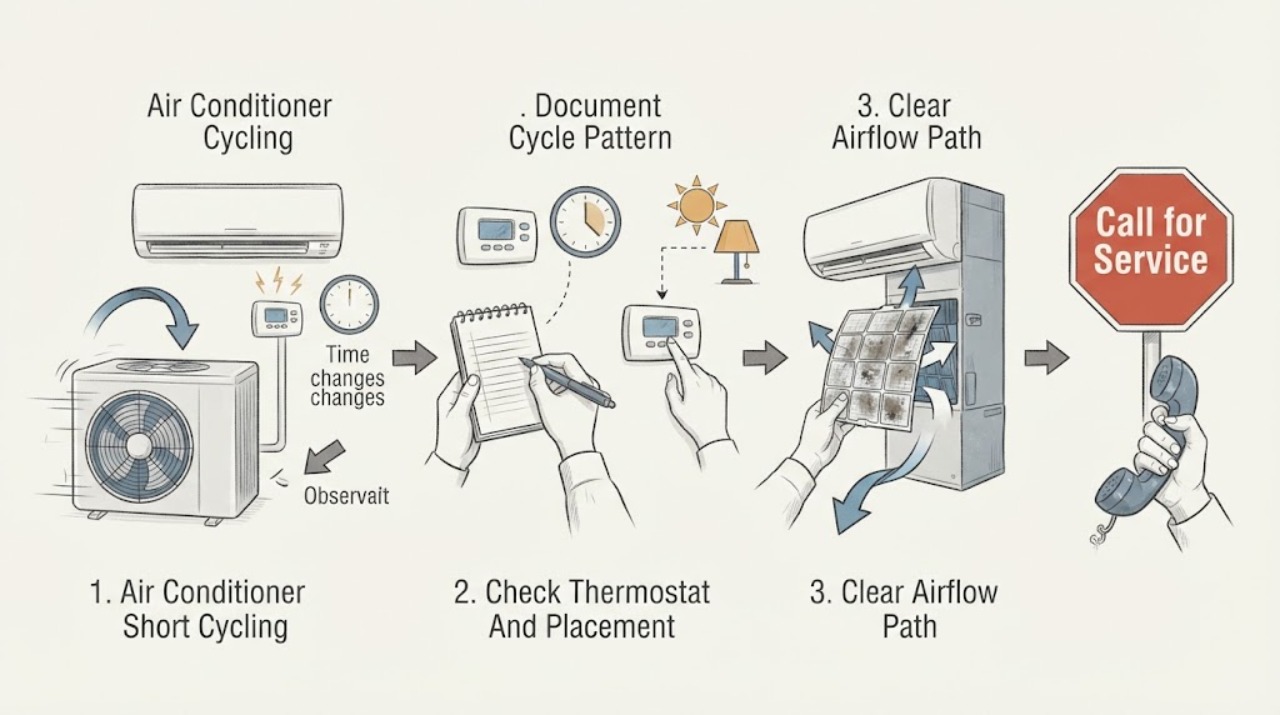
Air-conditioner short cycling means the system starts and stops repeatedly before completing a normal cooling cycle. First confirm the pattern by noting the run and off times and whether the thermostat reaches its setting. Then check the thermostat mode, schedule, fan setting, placement, accessible air filter, open registers, and visible outdoor-unit clearance. A dirty filter or restricted airflow can contribute, but low refrigerant, a frozen coil, an electrical fault, a thermostat fault, or an oversized system needs qualified HVAC diagnosis. Turn the system off for ice, burning odor, buzzing, exposed wiring, or a breaker that trips again, and do not keep forcing rapid restarts.
Work through in order
Diagnostic checks
Use only checks that match the exact appliance or system and its official guide.
-
Check 1
With the thermostat calling for cooling, note whether the indoor blower and outdoor unit start together, how long the system runs, how long it stays off, whether the thermostat reaches its setting, and whether the pattern occurs only on unusually mild conditions or all the time.
Expected result: Short cycling is repeated starting and stopping before the cooling cycle is complete. Uneven cooling, a clammy indoor feel, rising energy use, or a thermostat that never settles can accompany the pattern. A brief cycle under a changing load is not enough by itself to identify the cause.
Next step: Write down the cycle pattern and outdoor conditions, then check the thermostat and accessible airflow. Do not lower the thermostat repeatedly to force the system to run.
Stop if: Stop observing and switch the system off if you see ice, smell burning, hear loud electrical buzzing, see damaged wiring, or the breaker trips.
Why this matters
Why: A repeatable pattern gives the technician a useful symptom and separates a control signal problem from a system that is simply satisfying a small load. If the system has run this way since installation, improper sizing becomes more plausible; if it began suddenly, filter, thermostat, airflow, refrigerant, or component faults remain possible.
-
Check 2
Verify that the thermostat is in the intended cooling mode, the target temperature is reasonable, the fan is set as intended, and a schedule, hold, battery, or sensor setting is not changing the call. Look for direct sunlight, a nearby supply register, or a heat-generating appliance affecting the thermostat; do not remove its wiring.
Expected result: A thermostat in direct sun or near a register can read a local temperature that does not represent the rest of the home. A fan set to On can continue blowing after the compressor stops, which can make the cycling feel more confusing. A faulty thermostat may send start/stop signals at unexpected times.
Next step: Leave the thermostat in the correct mode and observe one complete call. If rapid restarts continue, continue with the filter and airflow checks and provide the recorded pattern to an HVAC technician.
Stop if: Do not jumper terminals, open the thermostat base, relocate wiring, or change installer configuration without model-specific professional guidance.
Why this matters
Why: Correcting an accessible setting or reducing an obvious local heat influence can stop a false short-cycle symptom. If the thermostat is correctly configured and the system still receives erratic calls, the control or wiring requires professional diagnosis.
-
Check 3
Inspect the accessible air filter and clean or replace it only according to the equipment manual if it is visibly dirty. Confirm that return and supply registers are open and not blocked. From outside the equipment, check that leaves, debris, or other obstructions are not blocking the outdoor unit's airflow.
Expected result: A clogged filter or blocked register can reduce airflow, make the system work harder, and contribute to short cycling or freezing. After an accessible filter or obstruction is corrected, airflow should improve; if it does not, the restriction may be deeper in the ductwork, coil, or blower.
Next step: Run one normal cooling call after the correction and compare it with the recorded pattern. If it still cycles rapidly, arrange HVAC service for airflow, refrigerant, control, and sizing checks.
Stop if: Do not reach into the outdoor unit, remove panels, bend coil fins, or continue running the system if ice is visible.
Why this matters
Why: An airflow correction can remove one common cause without touching refrigerant or electrical parts. If rapid cycling remains with a clean filter and clear registers/unit, do not assume the filter was the whole problem.
-
Check 4
Check for an obvious loss of power to the indoor air handler or outdoor unit and look at the labeled breaker only if you are comfortable and the panel is dry and undamaged. If a breaker is tripped, make one safe reset attempt; then watch whether the system starts normally or trips again.
Expected result: A system that is dead or whose outdoor unit drops out may have a power interruption. A breaker that trips again immediately, an overheated disconnect, buzzing, or a burning smell indicates an electrical fault rather than ordinary short cycling.
Next step: If the system operates normally after one reset and no hazard is present, continue monitoring without repeated resets. If it trips again or remains unreliable, switch it off and arrange qualified HVAC/electrical service.
Stop if: Never remove the disconnect cover or electrical panel, touch wiring, or reset a breaker repeatedly.
Why this matters
Why: A single power interruption may explain an abnormal start/stop event, but repeated trips can involve a capacitor, contactor, motor, compressor, or wiring. Those are high-voltage components outside the homeowner boundary.
-
Check 5
Look without dismantling for frost or ice on accessible refrigerant lines, the indoor coil area, or the outdoor unit, and note hissing, liquid pooling, unusual noises, or a unit that runs continuously between short starts. Do not try to measure refrigerant or melt ice with an unapproved heat source.
Expected result: Visible ice, inadequate cooling, excess condensate, hissing, liquid, or repeated rapid starts after the thermostat/filter checks can indicate a frozen coil, low refrigerant, dirty coil, failed outdoor component, or another technical fault. A brief normal control cycle should not leave persistent ice.
Next step: Turn the system off and arrange qualified HVAC service. Give the technician the cycle record, thermostat settings, filter condition, and exact location of any ice or noise.
Stop if: Stop immediately for ice, refrigerant symptoms, smoke, burning odor, arcing, exposed wiring, or a breaker trip.
Why this matters
Why: These observations identify a stop-and-service condition, not a part that a homeowner can safely replace. Continuing to run a frozen or refrigerant-compromised system can damage the equipment.
Use your observations
Decision map
Find the observation that best matches what you see, then follow the next safe action.
-
PATH 01Next step
What you see
The thermostat is in direct sun or near a register/heat source, has an incorrect mode or fan setting, or appears to send erratic calls.
Do this next
Correct only the accessible mode, schedule, fan, or obvious environmental issue using the thermostat manual.
-
PATH 02Next step
What you see
The filter is visibly dirty, registers are blocked, or the outdoor airflow path has accessible debris.
Do this next
Clean or replace the filter as directed and clear only accessible obstructions.
-
PATH 03Next step
What you see
The air conditioner has short cycled since it was installed and accessible thermostat and airflow checks do not change the pattern.
Do this next
Treat improper sizing or installation as a professional assessment rather than trying to force longer cycles with thermostat changes.
-
PATH 04Safety boundary
What you see
Ice remains visible, the coil is frozen, or hissing, liquid, or unusual outdoor-unit behavior accompanies the rapid cycling.
Do this next
Turn the system off and do not scrape ice, add refrigerant, or open the sealed system.
Why this path and its safety boundary
Safety stop: True
-
PATH 05Safety boundary
What you see
The breaker trips again, the disconnect is hot or damaged, or there is smoke, arcing, buzzing, or a burning odor.
Do this next
Leave the equipment off and stop electrical troubleshooting at the panel.
Why this path and its safety boundary
Safety stop: True
-
PATH 06Next step
What you see
The thermostat, filter, accessible airflow, and safe power checks are normal but the system still starts and stops abnormally.
Do this next
Treat the symptom as unresolved rather than replacing a guessed part or repeatedly resetting the system.
Helpful context
Understand the symptom
Confirm that the cycling is abnormal
An air conditioner can cycle differently as outdoor conditions and the indoor load change. Short cycling is the abnormal pattern: the system turns off before completing a cooling cycle, then starts again frequently. It can leave the home unevenly cooled or cold and clammy because the system has less opportunity to remove humidity. Record the behavior for one period instead of assuming that any single start and stop is a fault.
What the pattern can indicate
A thermostat that sends an incorrect signal, a thermostat exposed to direct sun or a nearby register, or a dirty filter can create a short-cycle symptom that has a safe accessible check. A system that was short cycling from its first installation may be oversized, which is not corrected by repeatedly changing the thermostat. Low refrigerant, a frozen coil, a failed capacitor or contactor, and other sealed-system or electrical faults require professional testing.
Protect the compressor and your safety
Frequent starts add wear and can increase energy use. Keep the homeowner checks to the thermostat, accessible filter, registers, visible debris, and a cautious power check. Do not open electrical panels, handle refrigerant, bypass controls, test capacitors, or continue operating a system with ice or an electrical odor. If the simple checks do not stop the pattern, the useful next step is an HVAC diagnosis rather than more resets.
When checks do not resolve it
Need a professional?
Arrange qualified HVAC service when short cycling persists after the thermostat, accessible filter, airflow, and safe single power checks, or when the pattern began after installation and never changed.
Common questions
FAQ
What does short cycling mean on an air conditioner?
It means the air conditioner starts and stops abnormally before completing a normal cooling cycle. Frequent restarts can reduce humidity removal, create uneven comfort, increase energy use, and add wear to the system.
Can a dirty air filter cause AC short cycling?
A dirty filter can restrict airflow and contribute to short cycling or a frozen coil. Inspect the accessible filter and clean or replace it according to the manual. If the pattern continues with a clean filter, the filter was not the complete diagnosis.
Is an air conditioner cycling every few minutes always a failure?
Frequent repeated starts before the system completes its cooling cycle are not normal short-cycle behavior, but a single short run does not identify the cause. Record the pattern and conditions, then check the thermostat and accessible airflow before arranging service if it persists.
Should I keep running an AC that is short cycling and icing up?
No. Turn it off when ice is visible or the coil is frozen. Do not scrape the ice or attempt refrigerant or electrical repairs; a frozen coil can indicate airflow or refrigerant trouble and needs professional diagnosis.
Read the exact guide
Official sources
- AC Short CyclingTrane · Residential air-conditioner short cycling symptoms, causes, and service boundaries
- Clean Heating and CoolingENERGY STAR · HVAC sizing, short-cycle effects, airflow, and maintenance guidance
- Troubleshooting an AC Not WorkingCarrier · Residential air-conditioner filter, power, ice, refrigerant, outdoor unit, and electrical safety checks
Community feedback
Share a repair observation
Share a plain-text repair observation. Accepted observations are published automatically; this page may take a moment to update.