
On this page
Start here
Quick answer
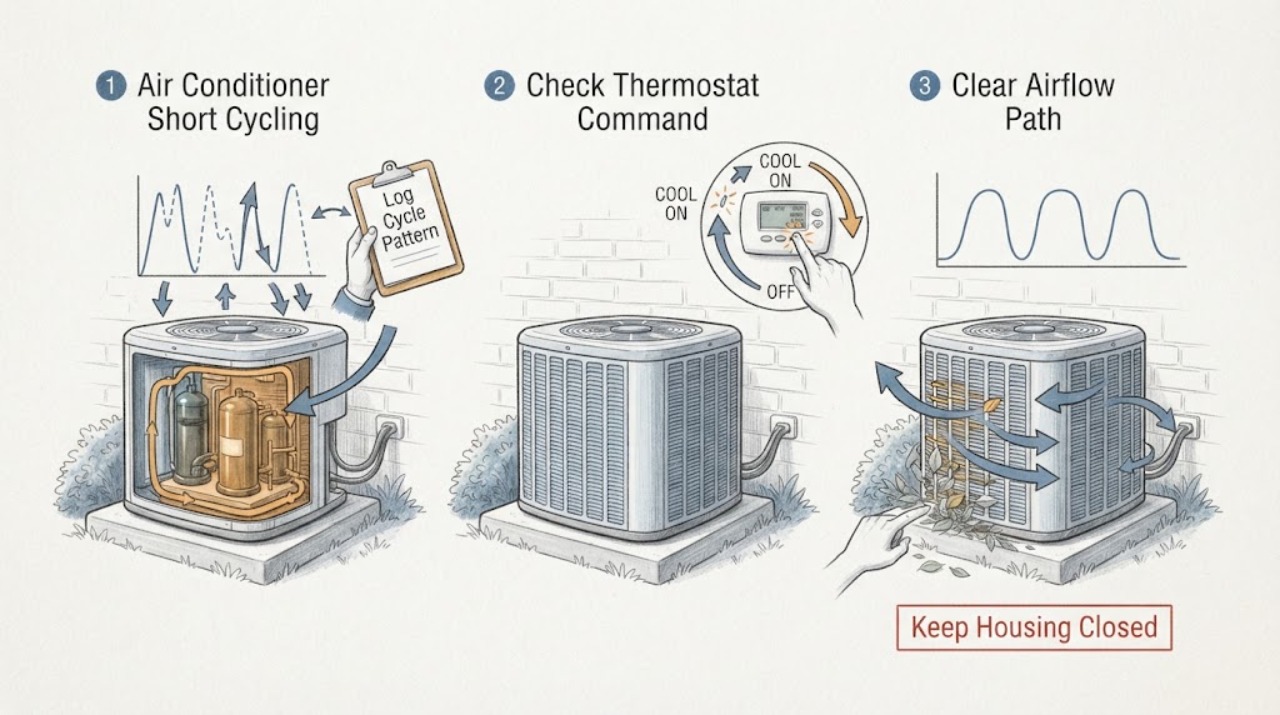
Short cycling means an air conditioner starts and stops repeatedly before completing a normal cooling call. Record each start and stop, the thermostat call, indoor airflow, outdoor-unit behavior, and any ice or water. Check only safe, visible thermostat settings and the accessible filter as the exact manual permits. A dirty filter or incorrect control can contribute, but persistent short cycling can also involve a frozen coil, condensate, blower, electrical control, equipment sizing, compressor, or refrigerant problem. Turn cooling off for ice, water near electrical equipment, burning odor, smoke, arcing, overheating, or a repeated breaker trip; do not open cabinets, handle refrigerant, or test the compressor. Arrange qualified HVAC service when the pattern continues after the permitted thermostat and filter checks.
Before you begin
Safety first
- This article supports only safe observation and thermostat or filter access explicitly allowed by the exact manual. It does not authorize cabinet opening, live electrical work, compressor or fan testing, refrigerant handling, high-pressure diagnosis, ice removal, drain chemicals, or repeated resets.
Work through in order
Diagnostic checks
Use only checks that match the exact appliance or system and its official guide.
-
Check 1
From a safe location, write down each cooling start and stop time for several ordinary calls, the thermostat mode and target, indoor temperature trend, indoor airflow, and whether the outdoor unit runs with the call.
Expected result: The system stops before the target is reached and restarts repeatedly, the indoor fan runs without outdoor operation, the target is reached normally, or the apparent event is only a brief fan or thermostat delay.
Next step: Keep the log and continue with the single visible thermostat and filter checks below. Do not change the set point repeatedly or force restarts to reproduce the pattern.
Stop if: Stop immediately for smoke, burning odor, arcing, a hot enclosure, exposed wiring, water near electrical equipment, or a breaker that trips again.
Why this matters
Why: Repeated incomplete cooling calls support short cycling. A normal completed call or a short equipment-protection delay points away from the assigned symptom; an indoor-only fan pattern points toward control or operating-mode investigation rather than assuming compressor failure.
-
Check 2
At the thermostat, confirm Cool is selected, the target is below the room reading, the fan is not unintentionally set to run continuously, and a schedule, hold, vacation mode, or delay is not ending the call. Check battery status only as the exact thermostat manual permits.
Expected result: A mode, target, fan, schedule, battery, blank display, or placement near sunlight, a register, or another heat source is incorrect; or the controls look normal but the unit still starts and stops.
Next step: Make one manual-authorized visible correction and allow the equipment's documented delay once. If the pattern persists, leave the thermostat in the intended safe state and arrange HVAC service; do not rewire or bypass it.
Stop if: Do not remove thermostat wiring or continue near a hot panel, smoke, odor, sparking, exposed conductors, water, or a repeated breaker trip.
Why this matters
Why: A visible setting or reading problem can imitate short cycling or create a false call. Normal commands with repeated equipment stops move the problem toward airflow, safety controls, outdoor equipment, electrical, sizing, compressor, or refrigerant diagnosis.
-
Check 3
With cooling safely off and only if the exact manual identifies the access, inspect the user-accessible filter and visible return and supply openings. Note loading, wetness, damage, missing or reversed installation, the filter direction, and whether airflow is weaker than normal.
Expected result: The filter is visibly loaded, wet, damaged, missing, or reversed; a grille is blocked; or the filter and visible airflow appear normal.
Next step: Clean a reusable filter or install the exact manual-specified replacement with the airflow arrow correct, only in a dry and safe area. If the filter is wet or airflow remains weak, leave cooling off and call HVAC service.
Stop if: Stop for ice, water near electrical equipment, a damaged cabinet, smoke, burning odor, arcing, or any need to open the air handler.
Why this matters
Why: Filter or visible airflow restriction can contribute to low cooling, coil ice, and short cycling. A normal filter does not rule out a blocked internal coil, blower, duct, control, compressor, or refrigerant issue.
-
Check 4
With panels closed, observe only from ordinary safe access for visible ice on accessible tubing or around the indoor unit, condensate or water on the floor, and whether the system continues to run without cooling. Do not touch the coil, tubing, water, or ice.
Expected result: Ice is visible, water is backing up or approaching electrical equipment, or the system has no ice or water but still short-cycles.
Next step: Turn cooling off when ice or water is present, keep away from wet electrical areas, and arrange HVAC service. Do not chip ice, pour chemicals into a drain, open panels, or restart to check whether it returns.
Stop if: Stop immediately for active leakage, water near wiring, smoke, burning odor, arcing, a hot enclosure, or a repeated breaker event.
Why this matters
Why: Ice can follow restricted airflow, low refrigerant, or another equipment fault; water can indicate a condensate problem. No ice or water does not clear the compressor, electrical, sizing, or control branches.
-
Check 5
During one ordinary thermostat call, observe the outdoor unit from a safe distance without opening it or touching the fan: note whether it starts, stops with the call, stays silent, restarts rapidly, makes an unusual sound, or has visible obstruction around its exterior.
Expected result: The outdoor unit follows the call normally, does not start, stops almost immediately, restarts repeatedly, or shows smoke, damage, ice, or an external obstruction.
Next step: Record the result for the HVAC technician. Keep the system off if it rapidly restarts, makes abnormal noise, has ice or damage, or fails to respond; never hand-spin a fan or reset repeatedly.
Stop if: Do not approach moving parts or continue for smoke, odor, arcing, a hot enclosure, exposed wiring, water, or repeated breaker trips.
Why this matters
Why: Normal outdoor response makes a simple outdoor-start failure less likely but does not prove the compressor is healthy. A silent or rapidly restarting unit can involve controls, power, safety shutdown, compressor, refrigerant, or another HVAC condition; visual obstruction does not justify opening the cabinet.
-
Check 6
If there is no ice, water, smoke, odor, or electrical warning, inspect only the visible thermostat display and labeled accessible power-control state described by the equipment manual. Note a blank display or a breaker or disconnect that is visibly off; do not remove covers or repeatedly reset anything.
Expected result: A safe visible control is off, the thermostat is blank, the same breaker trips again, or no visible power state explains the short cycling.
Next step: Follow the exact manual once only if it authorizes the visible correction. If the event returns or the symptom persists, leave the system off and call a qualified HVAC technician or licensed electrician for an electrical hazard.
Stop if: Do not open a panel, touch wiring, use test instruments, bypass protection, or reset a repeatedly tripping breaker.
Why this matters
Why: A single manual-authorized visible correction may restore a control state, but a returning trip or blank screen can indicate an electrical or equipment fault. A normal display with repeated starts and stops requires HVAC diagnosis rather than a guessed electrical repair.
-
Check 7
Give the HVAC technician the brand and model, cycle log, thermostat mode and schedule, filter condition, airflow, indoor temperature trend, outdoor-unit behavior, ice or water observations, error messages, and any single manual-authorized correction.
Expected result: The record separates a control or filter change from persistent short cycling, weak airflow, ice or water, an outdoor-unit response problem, or an electrical warning.
Next step: Keep cooling off when a stop condition or persistent rapid cycling is present and arrange qualified HVAC service. Ask the technician to verify the complete operating and safety condition before returning the system to service.
Stop if: Do not open cabinets, handle refrigerant, test the compressor, chip ice, touch moving equipment, bypass controls, or keep operating with abnormal heat, smell, water, smoke, sparking, or breaker behavior.
Why this matters
Why: A structured history helps the technician choose safe airflow, condensate, control, electrical, sizing, compressor, and refrigerant diagnostics without asking the homeowner to reproduce a hazardous condition.
Use your observations
Decision map
Find the observation that best matches what you see, then follow the next safe action.
-
PATH 01Safety boundary
What you see
The mode, target, fan setting, schedule, battery state, display, or thermostat placement is wrong, or the thermostat does not maintain a cooling call.
Do this next
Make one correction allowed by the exact thermostat manual, allow its documented delay, and call HVAC service if the pattern persists.
Why this path and its safety boundary
Why it matters: A visible control condition can imitate or trigger short cycling, but a normal command with repeated equipment stops is not proof of a bad thermostat.
Safety stop: Do not rewire, bridge terminals, bypass controls, or continue near smoke, odor, sparking, water, or a hot panel.
-
PATH 02Safety boundary
What you see
The filter is loaded, wet, damaged, reversed, or missing, visible grilles are blocked, or airflow is weaker than normal.
Do this next
With the system safely off, clean or replace the filter exactly as the manual permits. If airflow remains weak or the filter is wet, arrange HVAC service.
Why this path and its safety boundary
Why it matters: Restricted airflow can contribute to short cycling and ice, but a filter observation does not identify every airflow or equipment fault.
Safety stop: Stop for ice, water near electrical equipment, smoke, odor, arcing, a damaged cabinet, or any need to access internal parts.
-
PATH 03Safety boundary
What you see
Visible ice, condensate backup, or water appears around the indoor unit or electrical equipment.
Do this next
Turn cooling off and keep away from wet electrical areas. Arrange HVAC service to inspect the coil, airflow, drain, controls, and sealed system.
Why this path and its safety boundary
Why it matters: Ice may follow airflow restriction, low refrigerant, or another HVAC fault, while water may indicate a drain or pan problem. Continued cooling can worsen damage.
Safety stop: Do not chip ice, pour drain chemicals, open panels, touch wet equipment, or restart to see whether the symptom returns.
-
PATH 04Safety boundary
What you see
The outdoor unit is silent during a call, restarts rapidly, makes abnormal sounds, or the system short-cycles after thermostat and filter checks.
Do this next
Leave the system off when cycling is rapid or abnormal and provide the log to a qualified HVAC technician. Compressor, refrigerant, and high-pressure diagnosis are professional work.
Why this path and its safety boundary
Why it matters: Controls, power, safety shutdown, sizing, compressor, refrigerant, condenser, or another sealed-system problem may be involved; the observation cannot select a part safely.
Safety stop: Do not open the outdoor unit, touch a fan or wiring, handle refrigerant, hand-spin moving equipment, or repeatedly reset power.
-
PATH 05Safety boundary
What you see
The filter and visible thermostat settings are correct, but short cycling continues without a clear ice, water, or outdoor-unit explanation.
Do this next
Request qualified HVAC evaluation of the complete system and installation. Do not buy a compressor, refrigerant, or control part from the symptom alone.
Why this path and its safety boundary
Why it matters: Equipment sizing, duct or airflow design, condensate, electrical controls, compressor, refrigerant, or another model-specific condition remains possible.
Safety stop: Stop operation for smoke, burning odor, arcing, shock, water near electrical equipment, a hot enclosure, or repeated breaker trips.
Helpful context
Understand the symptom
Confirm that the symptom is short cycling
A brief fan delay, a thermostat's normal equipment-protection delay, or the outdoor fan continuing briefly after a call ends is not automatically a compressor fault. Short cycling is a repeated pattern: cooling starts, stops before the room reaches its target, and starts again. Log the timestamps, thermostat call, indoor airflow, outdoor-unit state, and room trend without repeatedly changing the set point to reproduce it.
Start with visible controls and airflow
Check that the thermostat is intentionally in Cool, the target is below the room temperature, the fan mode is appropriate, and no schedule or hold is cancelling the call. With the system safely off, inspect the user-accessible filter and visible return and supply openings if the manual allows access. A loaded filter can restrict airflow and contribute to coil ice or short cycling, but a clean filter does not rule out an HVAC fault.
Treat compressor and sealed-system causes as service work
A silent outdoor unit, rapid compressor restarts, persistent short cycling, low cooling output, or a frozen coil can result from controls, airflow, sizing, electrical equipment, refrigerant, or compressor conditions. These observations choose the service branch; they do not identify a part. Do not open the indoor or outdoor cabinet, touch moving equipment, handle refrigerant, bypass a control, or keep restarting the system to see what happens.
Safety boundary
Stop conditions
- Stop cooling immediately for smoke, fire, burning odor, arcing, shock, a hot panel or enclosure, exposed wiring, water near electrical equipment, active leakage, or a breaker that trips again.
- Do not open the air handler or outdoor-unit cabinet, handle refrigerant, test the compressor, touch wiring or moving fans, chip ice, use live test instruments, or bypass thermostat or safety controls.
- Do not repeatedly reset a breaker, repeatedly restart a rapidly cycling compressor, keep running with visible ice or water backup, or change the set point to force another cycle.
- Arrange qualified HVAC service when short cycling persists after the exact manual-authorized thermostat and filter checks, when airflow is weak, when the outdoor unit does not respond normally, or when compressor, refrigerant, high-pressure, electrical, sizing, coil, or drain diagnosis is needed.
When checks do not resolve it
Need a professional?
Arrange qualified HVAC service when the air conditioner repeatedly starts and stops before reaching the target, remains abnormal after one permitted thermostat and filter check, has weak airflow, shows ice or water, has an outdoor unit that is silent or rapidly restarting, or needs compressor, refrigerant, electrical, sizing, coil, or condensate diagnosis. Stop immediately for smoke, fire, burning odor, arcing, shock, water near electrical equipment, a hot enclosure, exposed wiring, or a repeated breaker trip; use emergency electrical or fire response when appropriate.
Safety scope: This article supports only safe observation and thermostat or filter access explicitly allowed by the exact manual. It does not authorize cabinet opening, live electrical work, compressor or fan testing, refrigerant handling, high-pressure diagnosis, ice removal, drain chemicals, or repeated resets.
Common questions
FAQ
How do I know whether my air conditioner is short cycling?
Record start and stop times during ordinary cooling calls. Short cycling is a repeated pattern of stopping before the target is reached and starting again, not simply a brief thermostat delay or a fan that continues for a short time. Do not repeatedly restart the equipment to reproduce it.
Can a dirty filter cause air-conditioner short cycling?
A loaded filter can restrict airflow and contribute to short cycling or a frozen coil, but it does not prove that the filter is the only cause. With cooling safely off, clean or replace it only as the exact equipment manual allows, then call HVAC service if the pattern or weak airflow remains.
Should I keep running the AC if I see ice?
No. Turn cooling off and stay clear of water near electrical equipment. Do not chip ice, open the cabinet, handle refrigerant, or restart the system to see if the ice returns; arrange qualified HVAC service.
Does short cycling prove that the compressor needs replacement?
No. Short cycling can overlap with thermostat, airflow, frozen-coil, condensate, control, electrical, equipment-sizing, compressor, and refrigerant conditions. Record the safe observations and have a qualified HVAC technician diagnose the system before any part is selected.
Read the exact guide
Official sources
- HVAC Quality InstallationENERGY STAR · ENERGY STAR guidance for residential HVAC installation quality; only qualified professionals should evaluate sealed-system, electrical, sizing, and refrigerant conditions.
- What Is AC Short Cycling? Causes & TroubleshootingCarrier · Carrier residential guidance used for general symptom branches; exact unit manuals and qualified technicians control equipment-specific diagnosis.
- AC Short CyclingTrane · Trane homeowner guidance used for general central-air symptom definition and visible checks; the exact equipment manual controls model-specific settings and access.
- Common Thermostat Issues and How to TroubleshootCarrier · Carrier thermostat guidance used for safe visible control checks; exact thermostat model and installation manual govern controls and reset behavior.
Community feedback
Share a repair observation
Share a plain-text repair observation. Accepted observations are published automatically; this page may take a moment to update.