
On this page
Start here
Quick answer
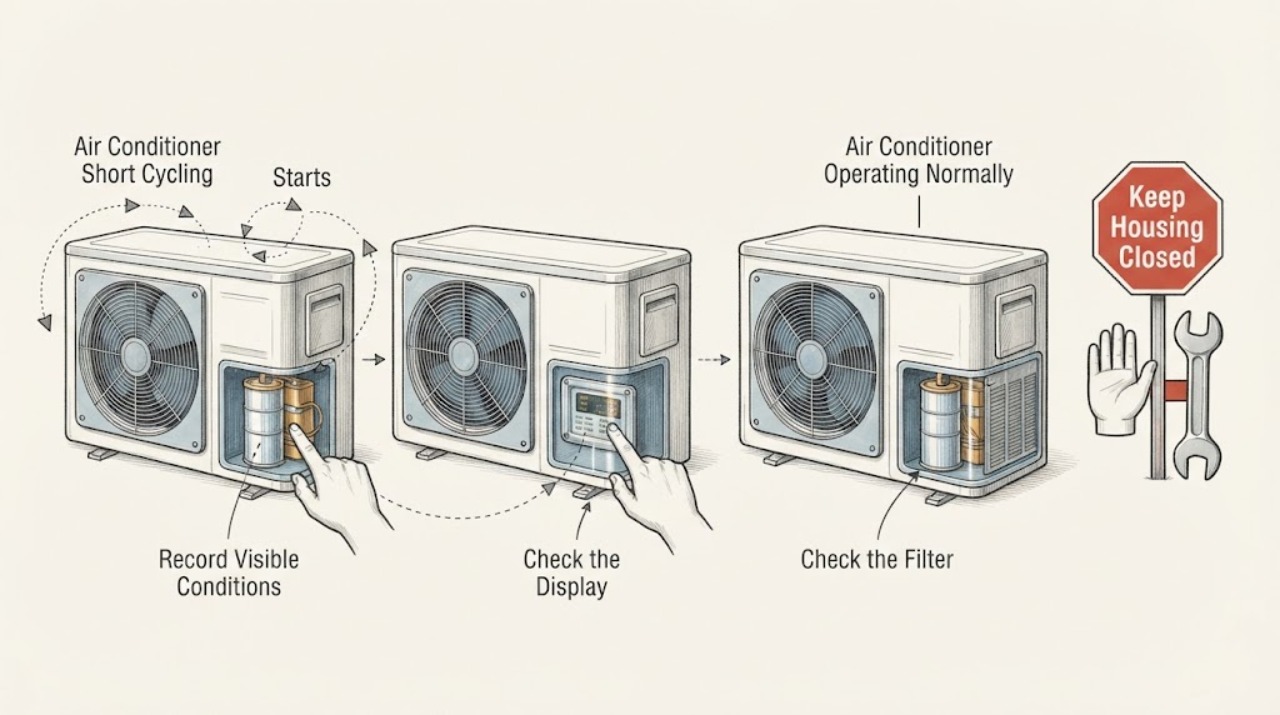
Short cycling means the air conditioner starts and stops repeatedly without completing a normal cooling cycle. A weak capacitor can make a motor or compressor struggle to start, but short cycling can also come from a thermostat or control delay, a dirty filter, frozen coil, low refrigerant, blocked outdoor coil, fan problem, oversized equipment, or an electrical fault. Record how long the system runs and rests, whether the indoor blower and outdoor fan operate, and whether cooling, frost, odor, noise, or breaker events accompany the stops. Check only the thermostat mode, accessible filter, open grilles, and visible outdoor clearance as the manual allows. Do not open the cabinet, touch or discharge the capacitor, test high-voltage parts, add refrigerant, or keep restarting the system. Stop for smoke, burning odor, arcing, a hot connection, water near electrics, severe noise, ice, or repeated breaker trips, and arrange qualified HVAC service.
Before you begin
Safety first
- Keep the system off for smoke, burning or electrical odor, arcing, hot connections, water near electrical equipment, severe noise, persistent ice, overheating, or repeated breaker trips. Do not open panels, touch or discharge the capacitor, perform energized tests, bypass protection, or handle refrigerant.
Work through in order
Diagnostic checks
Use only checks that match the exact appliance or system and its official guide.
-
Check 1
From a safe position, set the thermostat to the normal cooling mode and record the start time, stop time, rest time, and number of repeated starts without changing the system or opening any equipment. Also record the thermostat setpoint, room comfort, indoor blower status, outdoor fan status, and any display message.
Expected result: The system starts and stops rapidly, starts once and stays on, waits through a normal control delay, or the indoor blower and outdoor unit do not respond together.
Next step: Save the timing record and do not keep restarting the system to obtain more samples. Request HVAC service if rapid cycling repeats or the unit does not complete a normal cycle.
Why this matters
Why: The timing confirms a repeatable cycling symptom but does not identify a capacitor. A mismatch between blower and outdoor behavior can involve controls, power, fan, compressor, safety, or thermostat communication.
-
Check 2
Check the thermostat mode, requested temperature, fan setting, schedule, and any model-documented time-delay message from the thermostat controls only. Do not remove the thermostat faceplate or disturb wiring.
Expected result: The system is in the wrong mode, a schedule or fan setting is unexpected, a delay message is shown, or settings are correct but short cycling remains.
Next step: Correct only an obvious setting using the model instructions and observe one normal cycle. If rapid starts and stops continue, stop testing and provide the settings and display information to an HVAC technician.
Why this matters
Why: A setting or normal protective delay can resemble a fault. Correct settings do not rule out a filter, coil, refrigerant, capacitor, compressor, fan, or control problem.
-
Check 3
Turn the system off at the thermostat before inspecting an accessible return filter and the visible supply and return grilles. If the manual permits user filter cleaning or replacement, restore the correct filter type and fit; do not reach into a blower or coil cabinet.
Expected result: The filter is loaded, wet, or missing, grilles are blocked, or the filter and visible grilles are clear.
Next step: Correct the accessible filter or grille issue once as the manual permits, then reassess without repeated restart tests. If cycling continues or the filter is wet, arrange HVAC service.
Why this matters
Why: Restricted airflow can contribute to short cycling, frozen coils, and equipment stress. A clear filter does not rule out duct, blower, coil, refrigerant, or capacitor causes.
-
Check 4
With the outdoor unit off and stationary, look around the cabinet for leaves, grass, snow, or other loose obstructions and note any visible cabinet damage. Do not remove panels, bend fins, spray into the unit, or approach a fan that may start.
Expected result: Outdoor airflow is visibly blocked, the cabinet or disconnect appears damaged or hot, or the outdoor area looks clear.
Next step: Clear loose debris well away from the cabinet only if the model instructions permit it and no hazard is present. For damage, heat, odor, or continuing short cycling, keep the system off and call HVAC service.
Why this matters
Why: Blocked outdoor heat rejection can contribute to long operation, overheating, or cycling, while heat or damage creates an electrical-safety branch. A clear area does not prove the capacitor or compressor is faulty.
-
Check 5
Look from a safe position for frost or ice on accessible tubing or the outdoor unit and for unusual condensate or water near the indoor equipment. Do not touch tubing, scrape ice, apply heat, open the coil cabinet, or restart the system to force a thaw.
Expected result: Ice, frost, excess water, or a frozen coil is visible, or there is no visible ice or water.
Next step: Turn cooling off and arrange HVAC service for ice, ongoing water, or a returning freeze. Keep water away from electrical equipment and do not accelerate thawing.
Why this matters
Why: A frozen coil can follow restricted airflow, low refrigerant, blower trouble, or another fault and can make cooling cycle abnormally. The absence of ice does not clear the capacitor or other branches.
-
Check 6
From a safe distance, note whether the outdoor unit hums before a click, fails to start, starts and stops, or runs while the indoor air remains warm. Do not touch the cabinet, fan, capacitor, or refrigerant tubing and do not repeat a start attempt.
Expected result: A hum-and-click, failed start, short cycle, warm-air condition, or unusual outdoor sound accompanies the symptom.
Next step: Keep the system off if the pattern repeats, and give the technician the exact sound and timing sequence. Ask for capacitor, compressor, fan, control, airflow, and refrigerant causes to be separated before a part is selected.
Why this matters
Why: A capacitor is possible, but compressor, fan, control, overload, power, refrigerant, coil, and airflow faults can produce similar patterns. Sound alone cannot authorize a capacitor replacement.
-
Check 7
Check only a plainly visible, labeled breaker or disconnect status from a normal dry standing position if there is no smoke, odor, heat, water, or other hazard. Do not open the enclosure or reset a device to reproduce short cycling; do not perform an energized electrical test.
Expected result: The protective device is off, it trips again, or the visible supply status appears normal while the unit still cycles.
Next step: Leave the circuit off after a returning trip and arrange HVAC or qualified electrical service. Do not reset repeatedly, bypass protection, or open the panel.
Why this matters
Why: A power or protective-device event can stop a system, and a returning trip can involve the capacitor, compressor, fan, wiring, or another electrical fault. A normal visible status does not prove safe operation.
-
Check 8
Prepare a service note with the model and system type, thermostat settings, each run and rest interval, indoor airflow, filter condition, outdoor fan and compressor-like behavior, visible ice or water, debris, sounds, odors, heat, display messages, and breaker history. Photograph only closed equipment from a safe, dry position.
Expected result: The pattern persists after the safe external checks, or the suspected capacitor cannot be separated from other system causes.
Next step: Request qualified HVAC service and provide the complete record. Do not purchase or install a capacitor based on the symptom alone.
Why this matters
Why: The remaining diagnosis requires controlled HVAC inspection of the capacitor, motor and compressor starting, controls, airflow, coils, refrigerant, and protective systems.
Use your observations
Decision map
Find the observation that best matches what you see, then follow the next safe action.
-
PATH 01Next step
What you see
Smoke, burning or electrical odor, visible arcing, a hot connection, water near electrical equipment, severe noise, or repeated breaker trips is present.
Do this next
Stop the system, keep clear, and isolate power only from a safe dry location if possible. Use emergency help for smoke, fire, or active arcing and qualified HVAC or electrical service for other hazards.
Why this path and its safety boundary
Why it matters: This is an immediate electrical, fire, water, or mechanical safety event.
-
PATH 02Next step
What you see
The system cycles rapidly but thermostat settings, filter, grilles, and visible outdoor clearance are normal.
Do this next
Keep the system off or limit operation to what the manual permits and arrange HVAC diagnosis. Do not open the unit or replace the capacitor from the cycling pattern alone.
Why this path and its safety boundary
Why it matters: A capacitor, compressor, fan, control, refrigerant, coil, sizing, or protective shutdown remains possible.
-
PATH 03Next step
What you see
The outdoor unit hums, clicks, fails to start, or short-cycles while indoor airflow is present.
Do this next
Stop repeated starts and call HVAC service for controlled electrical and system testing. Do not touch or discharge the capacitor.
Why this path and its safety boundary
Why it matters: A compressor-start or capacitor path is plausible, but a fan, control, overload, power, or refrigerant fault can look the same.
-
PATH 04Next step
What you see
The filter is dirty or airflow is weak, or ice appears on the coil or tubing.
Do this next
Correct only an accessible filter issue as the manual permits. Turn cooling off and request HVAC service for weak airflow, ice, a wet filter, or persistent cycling.
Why this path and its safety boundary
Why it matters: Airflow restriction, blower trouble, coil condition, or refrigerant can be contributing to the cycling; the capacitor is not confirmed.
-
PATH 05Next step
What you see
The system is oversized, has a recent installation or thermostat change, or short cycling is present without a clear component symptom.
Do this next
Ask the HVAC professional to review sizing, control configuration, duct and airflow conditions, and component operation before authorizing a part.
Why this path and its safety boundary
Why it matters: Equipment sizing, control setup, installation, or a load calculation can be relevant; a capacitor replacement would not address every short-cycle cause.
-
PATH 06Next step
What you see
A breaker or disconnect trips again, or the system will not remain powered.
Do this next
Leave the circuit off and arrange qualified HVAC or electrical service. Do not reset repeatedly, change the protective rating, or open the enclosure.
Why this path and its safety boundary
Why it matters: An electrical fault, motor or compressor load, capacitor, wiring, or protective-device issue is possible.
Helpful context
Understand the symptom
Measure the pattern without opening the unit
Do not define short cycling by one start or by a universal number of minutes. Record the time from a call for cooling to shutdown, the rest period before the next start, and whether the pattern repeats. Also record whether the house is cooling, whether airflow is weak, and whether the outdoor fan runs. A pattern that changes with a clean filter or thermostat setting is different from a hum-and-click start failure or a safety shutdown.
Why the capacitor is only one branch
The capacitor supports motor and compressor starting and operation, so a weak one can accompany humming, failed starts, warm air, or frequent cycling. The same observations can follow low refrigerant, a frozen coil, a blocked condenser, a control or power fault, or an equipment-sizing problem. A visible bulge or leak would be a service clue, not a reason to touch the part.
Protect the compressor and the person
Repeated starts can add wear, and a system that is frozen, overheated, electrically abnormal, or low on refrigerant should not be forced to run. Keep the indoor and outdoor cabinets closed. Do not discharge a capacitor with a tool, bridge a control, use a meter on energized equipment, scrape ice, or add refrigerant. Give the technician the timing and symptom record instead.
Safety boundary
Stop conditions
- Stop immediately for smoke, burning or electrical odor, visible arcing, a hot connection, water near electrical equipment, severe noise, or repeated breaker trips. Keep clear and obtain emergency or qualified service help as appropriate.
- Stop cooling operation for persistent short cycling, frost or ice, unusual compressor or fan noise, a damaged cabinet or disconnect, or a system that hums and clicks off.
- Do not open the cabinet, touch, test, or discharge the capacitor; perform energized electrical tests; bypass a control or safety device; add refrigerant; scrape ice; or keep restarting the unit.
- Do not conclude that the capacitor is defective from a single hum, warm-air symptom, or short cycle. The complete system must be evaluated.
Only after diagnosis
Potential parts
- air-conditioner run or dual capacitor
Consider this only if a qualified HVAC technician tests the system and confirms a capacitor fault after separating airflow, controls, power, fan, compressor, refrigerant, and coil causes.
Capacitor type, capacitance, voltage, mounting, and equipment fit must match the exact model and service diagnosis. Do not touch or discharge the component. - thermostat or control component
Consider this only when controlled diagnosis finds that thermostat timing, control signaling, or a safety-control path is creating the repeated starts and stops rather than a capacitor or refrigerant fault.
Controls vary by system type, staging, wiring, and model. Confirm compatibility and configuration with the HVAC technician. - compressor or condenser-fan component
Consider this only if professional testing confirms a compressor or fan fault after the capacitor, supply, controls, airflow, coil, and refrigerant branches are evaluated.
Major HVAC components require exact model, refrigerant, electrical, and installation matching. Short cycling alone does not justify replacement.
When checks do not resolve it
Need a professional?
Call after safe setting, filter, grille, and visible outdoor-clearance checks fail, or immediately for a hum-and-click start, persistent ice, water, overheating, abnormal noise, odor, arcing, or a breaker event.
Safety scope: Keep the system off for smoke, burning or electrical odor, arcing, hot connections, water near electrical equipment, severe noise, persistent ice, overheating, or repeated breaker trips. Do not open panels, touch or discharge the capacitor, perform energized tests, bypass protection, or handle refrigerant.
Common questions
FAQ
Does short cycling prove the AC capacitor is bad?
No. A capacitor can be involved, especially with a hum, failed start, click-and-shutdown, or warm air, but filters, frozen coils, low refrigerant, controls, fans, compressor overload, electrical supply, and equipment sizing can cause similar cycling. Have the system tested before replacing a part.
What should I record during an AC short-cycle event?
Record the start and stop time of each cycle, the rest interval, thermostat mode and fan setting, indoor airflow, outdoor fan behavior, room comfort, filter condition, ice or water, sounds, odors, display messages, and breaker events. Do not keep restarting the unit solely to collect more samples.
Can a dirty filter cause short cycling?
Yes. Official HVAC guidance identifies a dirty or clogged filter as a possible airflow and short-cycling contributor. Check only an accessible filter and replace or clean it as the model instructions allow. If cycling continues, the filter is wet, or airflow is weak, arrange service.
Can I test or discharge the capacitor myself?
No. Do not touch, discharge, test, or replace the capacitor. It is inside HVAC equipment and can hold an electrical charge. A qualified HVAC technician should separate a capacitor fault from compressor, fan, control, power, airflow, coil, and refrigerant causes.
When should I stop running an AC that is short cycling?
Stop for smoke, burning or electrical odor, visible arcing, a hot connection, water near electrical equipment, severe noise, persistent ice, overheating, or a repeated breaker trip. Also stop repeated restart attempts when the unit hums and clicks off or short cycling continues after safe external checks.
Read the exact guide
Official sources
- AC Fan Not Working? Reasons Why It Stopped SpinningTrane · Trane residential guidance; exact fan, capacitor, and equipment configurations vary.
- AC Capacitor | Air Conditioner CapacitorCarrier · Carrier residential guidance; exact capacitor and equipment requirements vary by model.
- Troubleshoot an Air Conditioner | AC TroubleshootingCarrier · Carrier residential troubleshooting guidance; exact equipment and local instructions vary.
- Maintenance ChecklistENERGY STAR · ENERGY STAR consumer maintenance checklist; manufacturer instructions control user-accessible tasks.
- Common Thermostat Issues and How to TroubleshootCarrier · Carrier thermostat guidance used for general control branches; exact thermostat and HVAC model instructions take precedence.
- Clean Heating and CoolingENERGY STAR · ENERGY STAR consumer guidance for heating and cooling systems; sizing and installation require qualified professionals.
Community feedback
Share a repair observation
Share a plain-text repair observation. Accepted observations are published automatically; this page may take a moment to update.