
On this page
Start here
Quick answer
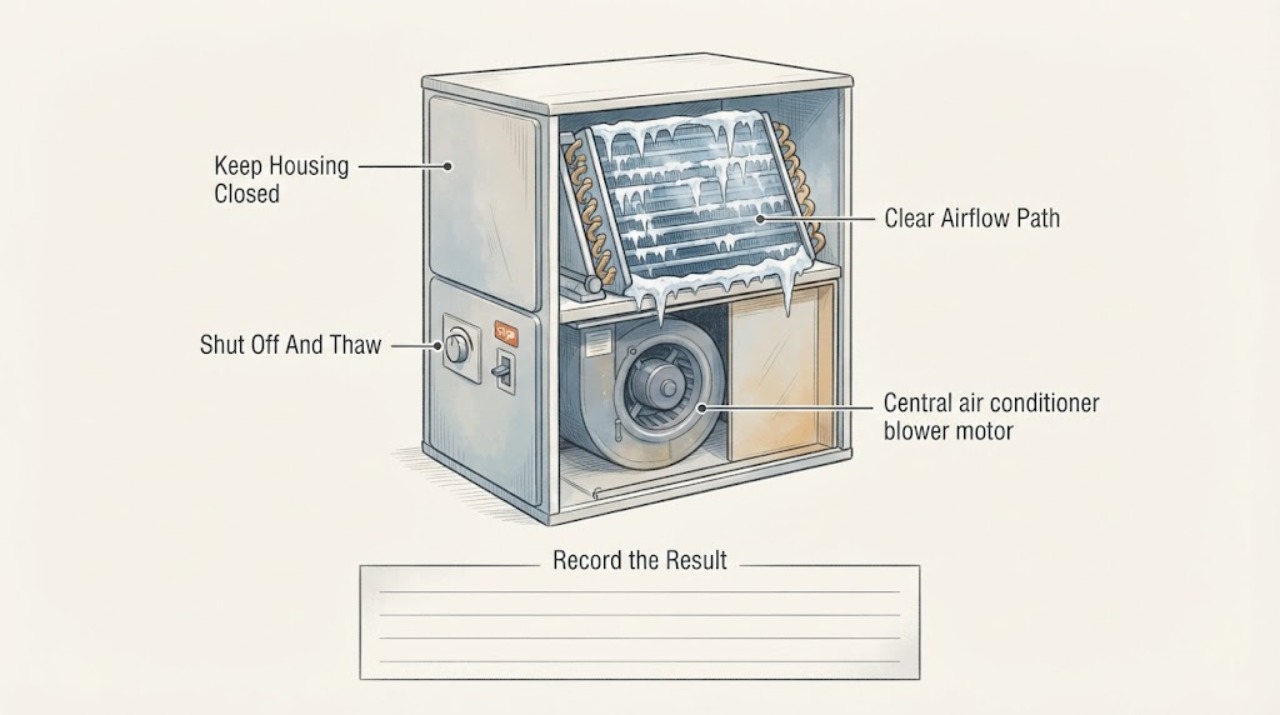
A frozen evaporator coil with weak or absent airflow can be caused by a blower motor problem, but a dirty filter, dirty coil, blocked return or supply path, thermostat issue, or low refrigerant can produce the same ice. Turn cooling off at the thermostat and do not keep running the AC while the coil is frozen. American Standard recommends setting the indoor fan to ON to help thaw the coil only when the blower is operating normally and there is no burning smell, grinding, or other electrical warning; if the blower is not moving air or is overheating, leave the system off. Change a dirty accessible filter and clear ordinary return grilles and supply registers without opening the air handler. Put down towels or a container for meltwater, then arrange qualified HVAC diagnosis before restarting cooling. A technician must assess the blower motor and electrical controls, airflow, coil cleanliness, drain, and refrigerant circuit.
Before you begin
Safety first
- This article covers thermostat control, food-free airflow observation, an accessible filter, ordinary registers, and safe water containment only. Do not open the air handler or electrical cabinet, touch a capacitor or live wiring, chip or heat the coil, handle refrigerant, bypass controls, or restart through a frozen or hazardous condition.
Work through in order
Diagnostic checks
Use only checks that match the exact appliance or system and its official guide.
-
Check 1
Without removing HVAC panels, note visible ice on the indoor coil cabinet or exposed refrigerant line, indoor supply airflow, air temperature, and any water puddle below the air handler as the ice begins to thaw.
Expected result: Record whether the coil or line is visibly iced, the AC is blowing warm air, airflow is weak or absent, water is collecting, and the blower or air handler is loud or silent.
Next step: Turn cooling off and continue to the safe thaw and filter checks. Treat absent airflow, an overheating motor, or electrical odor as a reason to leave the entire system off and request service.
Stop if: Stop immediately for burning smell, smoke, sparks, exposed wiring, a tripped breaker, refrigerant hissing or oily residue, or water reaching electrical components.
Why this matters
Why: American Standard lists visible coil or line ice, warm air, puddles near the drain pan, weak airflow, and air-handler noise among signs that can accompany a frozen coil or blower-motor problem. These signs overlap with refrigerant, filter, coil, thermostat, and duct faults.
-
Check 2
Set the thermostat from Cool to Off and place towels, a tray, or a bucket where thaw water can be contained; leave the indoor fan set to ON only if the blower is operating normally and safely.
Expected result: Confirm that compressor cooling has stopped, the blower moves a normal volume of air without abnormal noise or smell, and meltwater is controlled rather than reaching flooring, wiring, or controls.
Next step: Allow the coil to thaw fully and keep cooling off. Call for HVAC repair while it thaws so the technician can evaluate the coil and refrigerant lines after the ice is gone.
Stop if: Do not chip the ice, use a hair dryer, heat gun, open flame, space heater, or other direct heat, or continue running the compressor against a frozen coil.
Why this matters
Why: American Standard warns that running an AC with a frozen coil can cause major damage and recommends fan ON to help thaw. A fan that is not running, is noisy, or smells hot cannot safely be used as the thawing aid and points toward blower or electrical diagnosis.
-
Check 3
Once cooling is off, inspect the accessible return-air filter and replace it if visibly dirty; walk through the home to clear furniture, drapes, or stored items from return grilles and supply registers.
Expected result: Record whether the filter is clogged, several registers are closed or blocked, return airflow is restricted, or the coil is still encased in ice despite the filter and registers being accessible.
Next step: Keep the filter and air paths clear while the coil thaws, but do not restart cooling to test an unresolved ice condition. Request diagnosis if airflow does not normalize after thawing.
Stop if: Do not remove air-handler covers, reach into the blower, clean the coil with improvised chemicals, bypass a filter, or use the system if airflow is absent or the motor smells hot.
Why this matters
Why: American Standard identifies a clogged filter and blocked air ducts or registers as airflow restrictions that can freeze the evaporator coil. If airflow remains weak with a clean filter and open grilles, a blower motor, duct, coil, or control issue becomes more likely.
-
Check 4
From the thermostat and room registers only, observe whether the indoor fan starts, air comes from the registers, and the air-handler sound is a steady normal airflow rather than grinding, rattling, repeated starting, or silence.
Expected result: Classify the blower as delivering normal airflow, delivering weak airflow, not running, noisy, cycling unexpectedly, or producing a burning odor; note whether a breaker trips or the thermostat cannot command the fan.
Next step: Leave cooling off and arrange HVAC service for weak or absent airflow, abnormal sound, burning odor, repeated trips, or a blower that will not start. Do not infer that replacing the motor is appropriate until the motor, capacitor, controls, and wiring are tested.
Stop if: Do not open the electrical cabinet, touch the motor or capacitor, reset a repeatedly tripping breaker, or operate with smoke, burning smell, exposed wiring, or overheating.
Why this matters
Why: American Standard lists weak airflow, loud air-handler noise, frozen coil, overheating, burning smell, and electrical symptoms as possible blower-motor or related warning signs. A silent or overheating blower can leave the coil without enough airflow to prevent freezing.
-
Check 5
After the coil has fully thawed, document the model, filter condition, airflow result, thermostat setting, ice location, water amount or location, blower sounds, and whether the icing began overnight or returns after a previous thaw; keep cooling off until the service plan is clear.
Expected result: Record stable airflow with no recurring ice, fast re-freezing, continuous warm air, a hissing sound or oily residue, a dirty coil, a drain-pan overflow, or a blower that remains weak or inoperative.
Next step: Arrange qualified HVAC assessment and provide the observations. The technician should test airflow and blower operation, inspect the coil and drain, and evaluate refrigerant and controls before recommending a part.
Stop if: Do not restart cooling merely to reproduce the freeze, add refrigerant, open the sealed circuit, bypass controls, or continue if the home has unsafe heat or an electrical hazard.
Why this matters
Why: American Standard says recurring frozen coils can reflect dirty coil, thermostat, blower, blocked ducts, or refrigerant problems, and that refrigerant and coil work require a trained professional. Recurrence after a filter change is not a filter diagnosis by itself.
Use your observations
Decision map
Find the observation that best matches what you see, then follow the next safe action.
-
PATH 01Safety boundary
What you see
The coil is frozen, the blower runs with normal airflow and no smell or abnormal sound, and the accessible filter is visibly dirty or return and supply paths are blocked.
Do this next
Turn cooling off, allow full thawing, replace the filter and clear ordinary registers and grilles, then arrange service if ice returns rather than repeatedly restarting the AC.
Why this path and its safety boundary
Why it matters: A correctable airflow restriction is plausible; American Standard says a clogged filter or blocked ducts can restrict airflow and freeze the coil.
Safety stop: Do not run cooling while the coil is frozen or continue if airflow becomes weak, the motor overheats, or burning odor appears.
-
PATH 02Safety boundary
What you see
The coil is frozen and the indoor blower is silent, weak, intermittently starting, grinding, rattling, or accompanied by a burning smell or breaker trip.
Do this next
Leave cooling and the indoor unit off, isolate power only if safe, and arrange qualified HVAC diagnosis of the blower and electrical components.
Why this path and its safety boundary
Why it matters: A blower motor, capacitor, control, wiring, or other electrical fault is more likely than a filter-only problem, and continued cooling can damage the system.
Safety stop: Do not open the air handler, touch a capacitor or motor, reset a tripping breaker repeatedly, or use the fan as a thaw aid when it is not operating normally.
-
PATH 03Safety boundary
What you see
The filter is clean and accessible registers are open, but airflow remains poor or the coil is heavily coated or repeatedly freezes.
Do this next
Keep cooling off until thawed and arrange HVAC service to inspect airflow, the coil, duct path, and blower performance.
Why this path and its safety boundary
Why it matters: A dirty indoor coil, blocked duct, or hidden airflow restriction remains possible; American Standard recommends professional coil cleaning rather than a homeowner opening the system.
Safety stop: Do not spray or brush a hidden coil, remove the blower cabinet, force airflow through a blocked duct, or restart with visible ice.
-
PATH 04Safety boundary
What you see
The coil refreezes with adequate airflow, the thermostat appears to run cooling continuously or overnight, or there is hissing, bubbling, oily residue, or persistent warm air.
Do this next
Leave cooling off and arrange HVAC diagnosis. Give the technician the timing, frost pattern, airflow result, thermostat behavior, and any hissing or oily residue.
Why this path and its safety boundary
Why it matters: American Standard identifies thermostat faults and low refrigerant or leaks as possible frozen-coil causes; the refrigerant circuit must be tested by a qualified technician.
Safety stop: Do not add refrigerant, loosen fittings, use leak chemicals, bypass the thermostat, or restart the system to force a pressure reading.
-
PATH 05Safety boundary
What you see
The coil is thawing and water is pooling beneath the air handler, overflow pan, ceiling, wall, or other finished area, or the condensate path appears blocked.
Do this next
Keep cooling off, contain water without touching electrical parts, protect nearby finishes, and request HVAC service to inspect the drain and pan after the coil thaws.
Why this path and its safety boundary
Why it matters: American Standard notes that a thawing frozen coil can release water near the air handler or drain pan; property damage or a drain issue can accompany the freeze.
Safety stop: Do not pour chemicals into an unknown drain, open wet electrical panels, or leave the system energized when water reaches wiring, controls, ceilings, or flooring.
-
PATH 06Safety boundary
What you see
There is smoke, a strong burning odor, sparks, a hot or damaged electrical connection, repeated breaker trips, or unsafe indoor heat while cooling is unavailable.
Do this next
If safe, disconnect power at the normal disconnect or breaker without touching wet or damaged parts, keep people away from the hazard, and arrange qualified HVAC or electrical service; use local emergency procedures for smoke or fire.
Why this path and its safety boundary
Why it matters: This is an electrical, motor, fire, or immediate comfort-safety boundary, not a routine frozen-coil check.
Safety stop: Do not restart the system, handle live parts, open the air handler, reset the breaker repeatedly, or use improvised heating or cooling equipment unsafely.
Helpful context
Understand the symptom
Why a blower motor and frozen coil appear together
The indoor blower moves return air across the evaporator coil and back through the ductwork. When airflow is too low, the coil can become cold enough to freeze; a dirty filter, dirty coil, blocked ducts, thermostat fault, and low refrigerant can also freeze it. American Standard lists weak airflow, loud air-handler noise, a frozen evaporator coil, and overheating or a burning smell as blower-motor warning signs. Ice alone does not prove the motor is the failed part.
Shut off cooling and thaw without damaging the system
Switch the thermostat from Cool to Off as soon as the indoor coil or refrigerant line is visibly iced. American Standard says the system should not run with a frozen coil and recommends setting the fan to ON to help thaw it. That fan step is conditional: use it only when the blower is actually moving air and there is no burning smell, overheating, grinding, or electrical concern. Never chip ice or use a heat source near the coil, wiring, or refrigerant tubing, and catch the water as the ice melts.
Make only the low-risk airflow checks
With cooling off, check the accessible return filter and replace it if dirty, and make sure return grilles and supply registers are not blocked by furniture, drapes, or stored items. Do not open the air handler, reach into the blower, clean the evaporator coil with improvised chemicals, or change refrigerant charge. American Standard treats coil cleaning, blower diagnosis, refrigerant leaks, and advanced motor or electrical troubleshooting as professional work.
Use airflow, frost, and recurrence to guide the service call
After the coil has thawed, do not use a temporary thaw as proof that the problem is fixed. A technician needs to distinguish a filter or airflow restriction from a failed blower motor, dirty coil, thermostat control, drain issue, or low-refrigerant condition. Persistent weak airflow, frost returning quickly, warm air, water near the air handler, hissing or oily residue, a burning odor, or an outdoor unit that will not run all strengthen the case for prompt HVAC service.
Safety boundary
Stop conditions
- Turn cooling off at the thermostat when the evaporator coil or refrigerant line is frozen; do not keep running the compressor against visible ice.
- Use the indoor fan to assist thawing only when it operates normally with good airflow and no burning smell, overheating, abnormal noise, or electrical warning.
- Do not chip ice, use a hair dryer, heat gun, open flame, space heater, or other direct heat; do not open the sealed refrigerant circuit or add refrigerant.
- Do not open the air handler, reach into the blower, touch a capacitor or live wiring, bypass controls, or repeatedly reset a tripping breaker.
- Stop for smoke, sparks, burning odor, water at electrical parts, unsafe indoor heat, active refrigerant leak signs, or a damaged connection; arrange qualified service or emergency help as appropriate.
Only after diagnosis
Potential parts
- blower motor or motor module
Consider this category only when testing confirms the blower motor or motor module is weak, inoperative, noisy, or overheating after filter, airflow, control, and wiring checks.
Match the complete indoor-unit model, motor type, voltage, airflow requirements, and control configuration; do not infer motor failure from a frozen coil alone. - blower capacitor, relay, control board, or wiring component
Consider this category only when a qualified technician identifies an electrical starting, speed-control, relay, or wiring fault rather than a failed motor or airflow restriction.
Electrical ratings and control compatibility are model-specific; power must be isolated and live testing belongs to a qualified technician. - evaporator coil or coil-cleaning service
Consider this category only when a technician confirms a damaged, leaking, or persistently contaminated indoor coil after the system has thawed and airflow and refrigerant diagnosis are complete.
A replacement coil must match the indoor and outdoor system, refrigerant, cabinet, and model; cleaning and refrigerant work are not safe inference from ice alone. - air filter or condensate drain component
Consider this category only when the filter is confirmed dirty or a technician confirms a blocked, damaged, or overflowing condensate drain or pan.
Match the filter dimensions and equipment requirements; drain and pan parts are model-specific and should not be substituted without diagnosis.
When checks do not resolve it
Need a professional?
Arrange qualified HVAC service after any frozen evaporator coil, especially when airflow is weak or absent, the blower motor is noisy or overheats, the coil refreezes, the filter and registers are clear, water is pooling, or a thermostat, coil, drain, control, or refrigerant diagnosis is needed. Turn the system off immediately for burning odor, smoke, sparks, repeated breaker trips, exposed wiring, or water near electrical parts; follow local emergency procedures for fire or unsafe conditions.
Safety scope: This article covers thermostat control, food-free airflow observation, an accessible filter, ordinary registers, and safe water containment only. Do not open the air handler or electrical cabinet, touch a capacitor or live wiring, chip or heat the coil, handle refrigerant, bypass controls, or restart through a frozen or hazardous condition.
Common questions
FAQ
Can a blower motor problem freeze an American Standard evaporator coil?
Yes. American Standard lists weak airflow, air-handler noise, a frozen evaporator coil, and overheating or burning smell among possible blower-motor warning signs. A dirty filter, dirty coil, blocked duct, thermostat, or refrigerant problem can look similar, so diagnosis is needed.
Should I run the fan to thaw a frozen evaporator coil?
American Standard recommends turning cooling off and setting the fan to ON to help thaw the coil. Do this only when the blower is moving air normally and there is no burning smell, abnormal noise, overheating, or electrical warning. If the blower is weak or stopped, leave the system off and call for service.
Can I chip the ice off the American Standard coil?
No. American Standard explicitly says not to chip away at the ice. Turn cooling off, allow a safe thaw, contain the meltwater, and do not use a hair dryer, heat gun, open flame, or other direct heat around the coil and air handler.
Will changing the filter fix a frozen coil?
It may correct a clogged-filter airflow restriction, but it does not prove the blower, coil, thermostat, drain, ducts, or refrigerant circuit is healthy. Replace a dirty accessible filter, keep registers clear, let the coil thaw, and arrange service if airflow is weak or the ice returns.
When does a frozen American Standard coil need HVAC service?
Arrange service for every recurring freeze and immediately for weak or absent airflow, a blower that is noisy or overheating, warm air, water damage, hissing or oily residue, a suspected refrigerant leak, or any burning odor, smoke, sparks, or electrical warning.
Read the exact guide
Official sources
- Air Conditioner TroubleshootingAmerican Standard · American Standard general central-air troubleshooting guidance; model controls and safe disconnect procedures vary.
- Warning Signs: Replace Your AC SoonAmerican Standard · American Standard consumer warning-sign guidance; it does not diagnose a specific model.
- Got a Frozen Evaporator Coil? Don't Panic, Do ThisAmerican Standard · American Standard consumer guidance for air conditioners and heat pumps; exact equipment service procedures remain model-specific.
- 8 Common AC Repair Issues for Home SystemsAmerican Standard · American Standard consumer repair overview for central air systems; it is not a model-specific service manual.
- What Is an Evaporator Coil?American Standard · American Standard educational guidance for indoor evaporator coils in AC and heat-pump systems.
Community feedback
Share a repair observation
Share a plain-text repair observation. Accepted observations are published automatically; this page may take a moment to update.