
On this page
Start here
Quick answer
If a Carrier central air conditioner's evaporator coil is frozen, turn the cooling function off immediately and do not keep running the compressor against the ice. From a safe position, document where ice or frost appears, whether airflow is weak, whether the filter is dirty, whether the outdoor unit runs, and whether water collects as the ice melts. Restricted airflow from a filter, vents, blower, or dirty coil and low refrigerant are common possibilities, but a frozen coil can also involve a condensate or mechanical fault. Replace only an accessible filter as the exact manual permits and clear loose debris around—not inside—the outdoor unit. Do not scrape ice, pour water or heat on the coil, open refrigerant or electrical panels, handle a capacitor, or add refrigerant. Arrange qualified HVAC service, especially if ice returns, the blower or outdoor unit is silent, water overflows, a breaker trips, or there is a burning smell.
Before you begin
Safety first
- Evaporator and condenser coil access, refrigerant measurement or repair, blower and compressor work, capacitors, electrical controls, condensate safety devices, and system restart after recurring freezing should be handled by a qualified HVAC professional using the exact Carrier documentation.
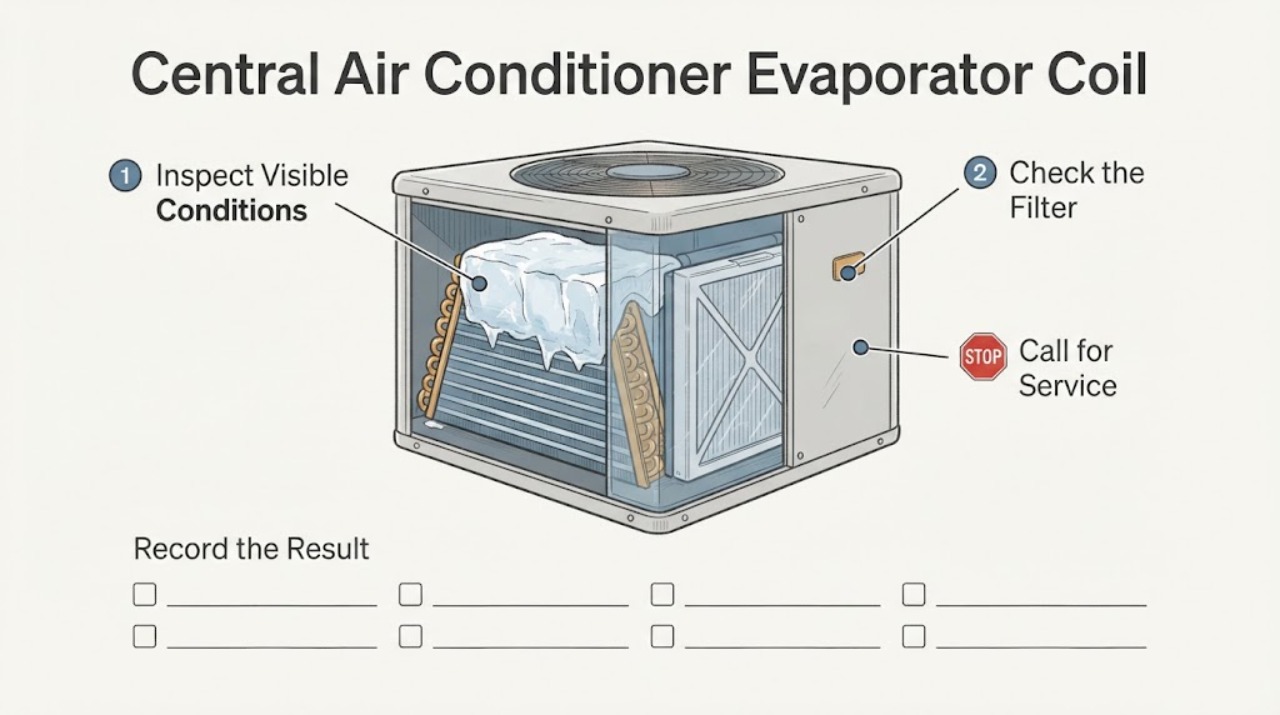
Work through in order
Diagnostic checks
Use only checks that match the exact appliance or system and its official guide.
-
Check 1
Set the thermostat's cooling mode to off as soon as you see frost or ice, and observe the system from outside the equipment. Note whether ice is on the indoor cabinet area, accessible refrigerant tubing, or outdoor unit, whether airflow has fallen, and whether water is collecting as the ice begins to thaw.
Expected result: Ice is visible, airflow is weak, water is forming near the indoor unit, or the system appears to be operating without effective cooling.
Next step: Keep cooling off and keep people away from the wet area. Record the symptoms and arrange qualified HVAC service; do not restart the compressor simply to see whether it clears.
Stop if: Stop immediately for water near electrical equipment, smoke, burning odor, arcing, a rapidly overflowing pan, or any exposed wiring.
Why this matters
Why: Visible ice with weak airflow or water supports a frozen-coil condition and possible airflow or refrigerant fault; the location of water helps identify thawing or condensate involvement. The appearance of ice does not identify which component caused it.
-
Check 2
With the cooling off, inspect the accessible return-air filter and reachable supply or return grilles. Replace or clean the filter only as the exact owner's manual directs, and make sure vents are not covered or closed; do not remove the air-handler panel or attempt to clean the evaporator coil.
Expected result: The filter is dirty, several grilles are blocked, airflow is weak throughout the home, or the filter and grilles are clear.
Next step: Restore a clean, correctly seated filter and open accessible grilles, but leave cooling off until the ice has thawed and the cause is addressed. Have a professional inspect recurring ice or any inaccessible coil or blower issue.
Stop if: Do not scrape ice, use a heat source, pour water on the coil, or remove an air-handler panel to reach the filter or coil.
Why this matters
Why: A loaded filter or blocked return can reduce warm-air flow across the coil and contribute to freezing. Clear external airflow with persistent ice makes a refrigerant, blower, dirty indoor coil, or control problem more likely.
-
Check 3
After confirming the thermostat call is off, observe the indoor blower's normal response from the registers and the outdoor unit's fan response only from a safe distance. Do not reach through a grille or open a cabinet; note whether either fan is silent, starts and stops, makes unusual noise, or operates normally while the coil is frozen.
Expected result: Indoor airflow is absent or weak, the outdoor fan is not spinning, a fan starts and stops, or both fans operate normally while ice remains.
Next step: Keep the system off for a silent, intermittent, noisy, or damaged fan and arrange qualified HVAC service. Do not handle a capacitor, motor, fan blade, wiring, or compressor.
Stop if: Stop for a broken or loose fan blade, burning smell, unusual electrical noise, exposed wiring, or any attempt to access the equipment while powered.
Why this matters
Why: A blower or outdoor-fan fault can cause or accompany coil freezing and may involve high-voltage components. Normal fan motion does not rule out low refrigerant, dirty coils, a control issue, or another refrigeration fault.
-
Check 4
From outside the equipment and with cooling off, inspect the outdoor unit's surrounding air path for leaves, grass, dirt, or other loose debris. Remove only loose material safely reachable around the cabinet; do not open the grille, brush the coil, spray the unit, or touch refrigerant tubing or electrical parts.
Expected result: The outdoor coil area is visibly obstructed, the cabinet is clear, or the unit has damage, oil-like residue, or abnormal noise.
Next step: Keep the outdoor unit off if it is damaged, noisy, or still blocked, and arrange service. If only loose debris was removed, document that fact and do not restart a still-frozen system until the ice has thawed and the cause is addressed.
Stop if: Do not open the outdoor cabinet, use tools or a hose inside the grille, touch the fan, or continue if smoke, oil-like residue, sharp damage, or electrical hazards are present.
Why this matters
Why: Outdoor airflow restriction can reduce heat rejection and contribute to poor cooling or abnormal operation. A clear exterior does not rule out an indoor coil restriction, low refrigerant, compressor, or control fault; residue or damage needs professional evaluation.
-
Check 5
Inspect only the visible condensate pan or drain area if the system provides a safe owner view, without removing panels. Note standing or overflowing water, wet insulation or flooring, a blocked-looking drain outlet, or water that appears only as the ice melts; keep water away from electrical equipment.
Expected result: The pan is rising or overflowing, water is near electrical parts, the drain appears blocked, or no visible condensate problem is present.
Next step: Leave cooling off, contain water only if safe, and arrange qualified service for an overflow, blocked drain, safety switch, frozen coil, or recurring leak. Do not bypass the switch, pour chemicals or hot water into an unknown drain, or open the air handler.
Stop if: Stop for active overflow, wet electrical equipment, a soaked ceiling or wall, a frozen coil hidden behind a panel, or any need to access wiring or the condensate pump.
Why this matters
Why: Meltwater can overflow a pan or expose a condensate restriction, and some systems use a safety switch that can stop operation. No visible water does not rule out an internal drain or coil problem, while a clear pan shifts attention toward airflow, refrigerant, fan, or controls.
Use your observations
Decision map
Find the observation that best matches what you see, then follow the next safe action.
-
PATH 01Next step
What you see
Do this next
Keep cooling off until the ice fully thaws, then have a professional evaluate the system before recurring freezing. Do not scrape or heat the coil.
Why this path and its safety boundary
Why it matters: Restricted airflow is a plausible contributor, but the evaporator coil, blower, and refrigerant condition are not proven healthy by a filter change alone.
-
PATH 02Next step
What you see
Do this next
Leave cooling off and arrange qualified HVAC diagnosis. Do not add refrigerant, open tubing, or clean the indoor coil yourself.
Why this path and its safety boundary
Why it matters: Low refrigerant, a leak, dirty or inaccessible coil, metering or control fault, or another refrigeration issue is more likely than a simple filter restriction.
-
PATH 03Next step
What you see
Do this next
Keep the system off and obtain qualified HVAC service. Do not handle capacitors, motors, blades, wiring, or refrigerant components.
Why this path and its safety boundary
Why it matters: A blower, condenser fan, motor, capacitor, compressor, or control fault may be causing or worsening the freeze; these are not safe homeowner repairs.
-
PATH 04Next step
What you see
Do this next
Turn the system off, keep clear of wet electrical equipment, and arrange qualified service for the condensate and cooling system. Do not bypass the safety switch.
Why this path and its safety boundary
Why it matters: A condensate restriction, pan, pump, or safety-switch condition is possible alongside the frozen coil, creating water and electrical risk.
-
PATH 05Next step
What you see
Do this next
Document the event and have a qualified professional check the system before returning to normal cooling if ice was extensive or the cause is uncertain.
Why this path and its safety boundary
Why it matters: The immediate ice event may have stopped, but a thermostat, control, airflow, low-temperature, or refrigerant cause can recur and cannot be cleared by thawing alone.
Helpful context
Understand the symptom
Ice is a stop signal, not a normal cooling stage
The indoor evaporator coil must absorb heat from moving indoor air. When airflow is restricted or refrigerant conditions are abnormal, the coil can fall below freezing and build ice, which further blocks airflow and reduces cooling. Carrier advises shutting the system down when ice is visible because continued operation can damage the compressor.
Use the thaw period to collect evidence
Do not scrape, pry, or rapidly heat the ice. Record the filter condition, register airflow, outdoor-unit response, thermostat call, and any condensate water while the system is off. A filter change may correct a simple airflow restriction, but recurring ice after thawing needs a professional check for airflow, coil cleanliness, refrigerant, blower, and control causes.
Safety boundary
Stop conditions
- Turn cooling off immediately for visible ice or frost and do not keep running the compressor; stop for water near electrical equipment, active overflow, smoke, burning odor, arcing, or exposed wiring.
- Do not scrape, pry, or rapidly heat ice; never pour hot water on the coil or use a hair dryer, heater, or open flame to thaw it.
- Do not open refrigerant or electrical panels, handle capacitors, test live wiring, add refrigerant, clean an inaccessible coil, or bypass a condensate safety switch.
- Do not repeatedly restart a system that refreezes, has weak or absent airflow, has a silent or intermittent fan, trips a breaker, leaks, or produces unusual noise.
- Arrange qualified HVAC service for recurring or unexplained freezing, low refrigerant or coil suspicion, blower or outdoor-unit faults, condensate overflow, or any uncertainty about safe thawing and restart.
Only after diagnosis
Potential parts
- central air conditioner air filter
Consider this only when the accessible filter is visibly loaded and the exact Carrier system documentation identifies the correct replacement or cleaning method.
Filter dimensions, type, and access vary by system; confirm the exact model and manual before ordering. - indoor blower or airflow component
Consider this only when a qualified technician confirms inadequate indoor airflow is caused by a failed blower motor, wheel, relay, or related component rather than a filter or duct restriction.
Motor, wheel, control, and wiring specifications are model-specific and involve electrical hazards; do not select a part from a frozen-coil symptom alone. - evaporator coil or refrigerant-system component
Consider this only after professional diagnosis confirms a leaking, blocked, or failed evaporator coil or another refrigerant-circuit component is responsible for recurring freezing.
Coil dimensions, refrigerant design, metering, and system match must be verified for the exact Carrier model by a qualified technician.
When checks do not resolve it
Need a professional?
Contact qualified HVAC service when a Carrier central AC evaporator coil freezes, especially if ice returns after a filter check, the blower or outdoor unit is abnormal, condensate overflows, a breaker trips, or the system runs without cooling. Escalate urgently for electrical, smoke, burning, major water, or refrigerant hazards.
Safety scope: Evaporator and condenser coil access, refrigerant measurement or repair, blower and compressor work, capacitors, electrical controls, condensate safety devices, and system restart after recurring freezing should be handled by a qualified HVAC professional using the exact Carrier documentation.
Have this ready
- Provide the exact Carrier model if safely visible, ice location and extent, thermostat call, indoor airflow, filter condition, outdoor fan response, visible debris, condensate or water symptoms, breaker behavior, sounds or odors, and what changed after cooling was switched off.
Common questions
FAQ
Why does a Carrier evaporator coil freeze?
The usual decision is airflow versus refrigeration or mechanical causes. A dirty filter, blocked vents, blower problem, dirty coil, low refrigerant, outdoor-unit issue, or control fault can reduce effective heat transfer and let the coil ice. The ice itself does not identify the failed part.
Can I keep running my Carrier AC if the evaporator coil is frozen?
No. Turn the cooling off immediately when you see ice and allow the system to be evaluated. Continued operation can worsen airflow loss and compressor damage; do not restart repeatedly to see whether the ice clears.
Will replacing the air filter fix a frozen Carrier AC coil?
It may correct one airflow restriction if the filter is loaded, but it does not rule out a blower, coil, condensate, refrigerant, or control problem. Replace or clean only the accessible filter as directed, keep cooling off while iced, and arrange service if freezing returns.
How should I thaw a frozen Carrier evaporator coil?
Switch cooling off and let the ice melt naturally; do not scrape it, pour hot water on it, or use a heater or hair dryer. Keep water away from electrical equipment and have a professional address the cause before normal cooling resumes.
When should I call for Carrier frozen-coil service?
Call when ice returns, remains after the filter and airflow check, the blower or outdoor fan is abnormal, the breaker trips, condensate overflows, warm air continues, or refrigerant or coil work may be needed. Stop immediately for burning odor, smoke, water near electrical parts, or exposed wiring.
Read the exact guide
Official sources
- Will Frozen AC Fix Itself? A Guide To Frozen AC CoilsCarrier · Carrier residential central air-conditioner guidance for visible frozen coils; exact equipment and manual determine the service procedure.
- Air Conditioner Not Cooling | AC Not Blowing Cold AirCarrier · Carrier residential troubleshooting page for central air conditioners not cooling; coil access and equipment design vary by model.
- Why is My Air Conditioner Fan Not Working?Carrier · Carrier residential fan troubleshooting page; fan and electrical access are professional work.
- Troubleshoot an Air Conditioner: 6 Steps to Fix an AC Not WorkingCarrier · Carrier residential troubleshooting overview for central AC systems; homeowner checks are external and model-dependent.
Community feedback
Share a repair observation
Share a plain-text repair observation. Accepted observations are published automatically; this page may take a moment to update.