
On this page
Start here
Quick answer
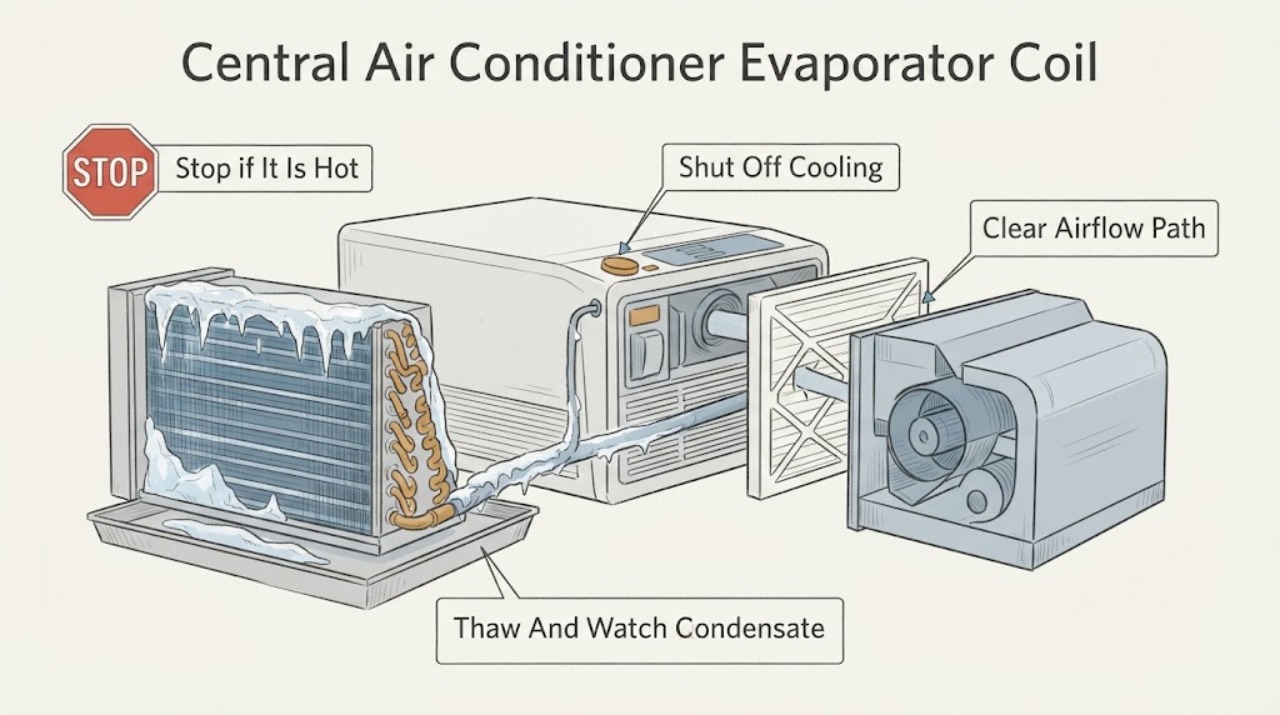
Visible ice on the indoor evaporator coil or on the refrigerant line coming from the coil cabinet means the central air conditioner is frozen. Switch the thermostat from COOL to OFF now and do not keep running the compressor to test it. Let the ice thaw naturally; never chip it or use a hair dryer, space heater, hot water, or another direct heat source. If your equipment instructions allow fan-only operation and the condensate system can safely handle meltwater, fan-only operation may help, but turn it off if water approaches electrical equipment or the drain overflows. Once the system is fully thawed, you may replace an obviously dirty, correctly sized air filter and confirm that return grilles and supply registers are open and unobstructed. Ice can result from restricted airflow, low refrigerant or a leak, a blower or other mechanical problem, a dirty coil, or thermostat conditions. Do not open the refrigerant circuit, add refrigerant, test electrical components, clean an inaccessible coil, or restart a system that refreezes, leaks water, has weak airflow, or is not cooling; arrange qualified HVAC service.
Before you begin
Safety first
- The technician should determine whether the root cause is restricted airflow, filter or coil contamination, blower or control failure, thermostat condition, refrigerant leak or charge, outdoor-unit airflow, condensate problem, or a combination before restarting or selecting parts.
Work through in order
Diagnostic checks
Use only checks that match the exact appliance or system and its official guide.
-
Check 1
At the thermostat, switch COOL to OFF as soon as ice is visible on the indoor evaporator coil, its cabinet, or the connected refrigerant line; do not keep calling for cooling to see whether the ice clears.
Expected result: The outdoor unit stops, the indoor blower continues under a fan-only setting, the system does not respond, or the thermostat and equipment behavior are unclear.
Next step: Leave COOL off, record the thermostat setting and equipment response, and use fan-only only if the exact equipment instructions allow it and meltwater is controlled safely.
Stop if: Do not reset breakers, open the electrical cabinet, or continue operating the compressor while ice remains visible.
Why this matters
Why: Stopping cooling removes the compressor demand while the ice thaws. A unit that does not stop, or a blower that behaves unexpectedly, adds a control or electrical question that should not be tested by repeated cycling.
-
Check 2
Let the ice thaw naturally and observe the accessible area below the indoor air handler or coil cabinet from a dry, stable position; do not chip ice or apply direct heat.
Expected result: Ice is melting without water escaping, the drain pan or floor is receiving water, water is pooling or overflowing, or the area is near electrical equipment or cannot be viewed safely.
Next step: Keep cooling off, protect nearby belongings only from a dry position, and arrange prompt HVAC service for pooling, overflow, a damaged pan, or an inaccessible wet area.
Stop if: Do not pour water into the unit, drill or chip ice, use a heat source, enter standing water, or touch wet electrical equipment.
Why this matters
Why: Meltwater can expose a blocked or undersized condensate path, a damaged pan, or a water-damage risk. Pooling or water near electrical equipment is a stop condition, not a reason to speed thawing with heat.
-
Check 3
Only after the coil and line are fully thawed, check the user-accessible air filter and confirm that return grilles and supply registers are open and not blocked; do not reach into the blower or coil cabinet.
Expected result: The filter is visibly dirty or collapsed, the filter is clean, returns or registers are blocked, airflow remains weak, or the filter and air handler cannot be accessed safely.
Next step: Replace a dirty filter only with the correct type and size for the equipment, clear only ordinary furniture or debris from grilles, and request HVAC service if airflow remains weak or access is uncertain.
Stop if: Do not run cooling while ice remains, remove cabinet panels, clean an inaccessible coil, alter blower wiring, or use a filter that does not match the equipment.
Why this matters
Why: A dirty filter or blocked airflow can reduce air across the evaporator coil and contribute to freezing. Persistent weak airflow with a clean filter keeps blower, duct, coil, control, or other mechanical causes in consideration.
-
Check 4
After thawing and without opening refrigerant or electrical compartments, note the cooling result, supply-air strength, ice location, any hissing sound, outdoor-unit operation, and whether water or high humidity was present.
Expected result: Cooling is normal with strong airflow, cooling is weak, ice is concentrated on the line or coil again, the indoor blower is not moving air, a hissing sound is present, or water continues to drain or pool.
Next step: Keep COOL off for recurrence, photograph the ice location and water pattern, and arrange qualified HVAC service for any recurring or unresolved symptom.
Stop if: Do not add refrigerant, puncture tubing, connect gauges, test capacitors, bypass controls, or operate a system that refreezes or leaks water.
Why this matters
Why: Normal operation after a correct filter and airflow check makes a temporary restriction more plausible but does not prove the fault is gone. Recurring ice, weak airflow, hissing, poor cooling, or water trouble supports refrigerant, leak, blower, coil, drain, or control diagnosis.
-
Check 5
From outside the outdoor condenser and without opening its cabinet, look for obvious leaves, grass, or debris blocking the airflow around the unit after the indoor ice has thawed; do not touch the fan or coil.
Expected result: The outdoor unit is visibly clear, loose debris is safely removable from around—not inside—the unit, the coil is blocked, or the fan and cabinet condition are uncertain.
Next step: Remove only loose debris that is safely outside the unit and away from moving parts; leave the system off and request service for blocked coils, fan problems, damage, or uncertain conditions.
Stop if: Do not reach through the grille, wash the coil, bend fins, remove panels, or work around a powered fan or damaged wiring.
Why this matters
Why: Restricted outdoor airflow can reduce system performance, but a clear exterior does not rule out a refrigerant, blower, indoor-coil, electrical, or control fault.
-
Check 6
Prepare a service record with the ice location, whether it was on the indoor coil, cabinet, or line, thermostat response, thaw and water behavior, filter condition, airflow, cooling result, outdoor-unit observations, equipment model, and photographs taken from safe access.
Expected result: The record shows a one-time event after a dirty filter, repeated icing, weak airflow, suspected water or refrigerant trouble, an unresponsive system, or an inaccessible component.
Next step: Give the record to a qualified HVAC technician and keep cooling off until the ice is gone and the cause has been assessed; do not restart if the issue recurs or water is uncontrolled.
Stop if: Do not keep running the system to gather more evidence, open sealed or powered compartments, or attempt refrigerant or electrical repair.
Why this matters
Why: The pattern helps a technician distinguish airflow restriction from refrigerant, leak, blower, drain, coil, thermostat, electrical, or outdoor-unit causes. It cannot establish refrigerant charge or identify a failed part without testing.
Use your observations
Decision map
Find the observation that best matches what you see, then follow the next safe action.
-
PATH 01Next step
What you see
Ice is visible on the indoor evaporator coil, its cabinet, or the connected line, with inadequate cooling or reduced airflow.
Do this next
Switch COOL off, thaw naturally, and do not run the compressor again until the ice has cleared and safe airflow and water conditions can be assessed.
Why this path and its safety boundary
Why it matters: The system is frozen regardless of whether the initiating fault is airflow, refrigerant, blower, coil, thermostat, or another issue.
-
PATH 02Next step
What you see
After complete thawing, the filter is visibly dirty or collapsed, returns or registers are blocked, and airflow improves after a correct filter change or clearing furniture from grilles.
Do this next
Keep the filter correct for the equipment, observe for recurrence, and request service if ice returns, airflow stays weak, or cooling remains inadequate.
Why this path and its safety boundary
Why it matters: Restricted airflow is more plausible, but one improved cycle does not prove the evaporator coil, blower, ductwork, refrigerant circuit, and drain are healthy.
-
PATH 03Next step
What you see
Ice returns after the filter is correct and accessible returns and registers are open, or ice persists with weak cooling, hissing, or a nonworking blower.
Do this next
Leave COOL off and arrange qualified HVAC diagnosis; do not add refrigerant, open the circuit, or repeatedly restart the system.
Why this path and its safety boundary
Why it matters: A refrigerant leak or low charge, blower or mechanical fault, dirty inaccessible coil, thermostat issue, or another system problem is more likely than a simple filter restriction.
-
PATH 04Next step
What you see
Meltwater pools, overflows, approaches electrical equipment, enters a ceiling or wall, or the indoor unit is wet and cannot be safely inspected.
Do this next
Keep cooling off, stay out of standing water, protect the area only from a dry position, and request prompt HVAC service; use appropriate emergency response for active electrical or structural danger.
Why this path and its safety boundary
Why it matters: The immediate concern is water damage or electrical exposure in addition to the frozen-coil cause.
-
PATH 05Next step
What you see
The ice melts and airflow appears normal, but the cause is unknown, the event repeats, or the equipment cannot be identified or safely observed.
Do this next
Document the event and arrange HVAC service before another freeze-up; do not use a normal cooling cycle as a substitute for diagnosis when icing recurs.
Why this path and its safety boundary
Why it matters: Temporary recovery does not establish that the refrigerant circuit, coil, blower, drain, thermostat, or electrical controls are sound.
Helpful context
Understand the symptom
Ice on the coil or line is a stop-cooling signal
A central split-system evaporator coil is commonly inside the air handler, and the connected refrigerant line can also frost or ice when the coil is frozen. Reduced cooling, weak airflow, and water near the indoor unit often accompany the condition. Turn cooling off before choosing a cause: continuing to run a frozen system can strain or damage the equipment.
Thaw naturally and protect the space from meltwater
Allow the ice to melt without chipping it or applying direct heat. Check from a safe, dry position for water in or below the indoor unit and keep water away from electrical equipment. If a filter is clearly dirty and the filter location is user-accessible, replacing it with the correct type and size is a limited airflow check; it does not diagnose refrigerant, blower, drain, or electrical faults.
Recurrence separates a simple airflow check from service work
After complete thawing, a clean filter and open, unobstructed registers may restore airflow when restriction was the cause. Ice that returns, ice accompanied by a hissing sound or weak cooling, water that cannot drain, or a blower that does not operate points beyond a basic filter check. Refrigerant leaks, charging, electrical work, blower repairs, and inaccessible coil cleaning require qualified HVAC service.
Safety boundary
Stop conditions
- Switch COOL off and do not run the compressor while ice remains visible; do not chip ice or use a hair dryer, space heater, hot water, or other direct heat source.
- Do not open sealed refrigerant tubing, add refrigerant, connect gauges, test electrical components, open powered cabinets, clean inaccessible coils, or bypass thermostat or safety controls.
- Stop immediately for meltwater near electrical equipment, overflowing drains, ceiling or wall water damage, smoke, burning odor, exposed wiring, or any standing water that makes access unsafe.
- Arrange qualified HVAC service for recurrent icing, weak airflow, hissing, low cooling, a nonworking blower, unclear equipment, or any condition not resolved by a safe filter and airflow check.
Only after diagnosis
Potential parts
- HVAC air filter
Consider a replacement filter only if the existing user-accessible filter is visibly dirty or collapsed and the equipment documentation confirms the correct filter type and size; a filter cannot repair recurrent icing caused by refrigerant, blower, coil, drain, thermostat, or electrical faults.
Confirm the exact filter dimensions, airflow direction, equipment requirements, and manufacturer guidance before replacing it; do not substitute a restrictive or incorrectly sized filter.
When checks do not resolve it
Need a professional?
Use prompt HVAC service for any visible evaporator-coil or line ice that recurs, for suspected low refrigerant or leakage, persistent weak airflow, inadequate cooling, blower or outdoor-unit failure, uncontrolled meltwater, or an inaccessible indoor unit. Escalate water near electrical equipment, smoke, burning odor, or exposed wiring as urgent.
Safety scope: The technician should determine whether the root cause is restricted airflow, filter or coil contamination, blower or control failure, thermostat condition, refrigerant leak or charge, outdoor-unit airflow, condensate problem, or a combination before restarting or selecting parts.
Have this ready
- Equipment make, model, and serial information if safely visible, plus photos of the ice location on the indoor coil, cabinet, or refrigerant line
- Whether COOL was switched off, how the system responded, and whether fan-only operation was used under the equipment instructions
- Filter type and condition, return and supply airflow observations, any blocked grille or outdoor-unit debris, and whether airflow changed after a correct filter replacement
- Thawing and condensate details, including pooling, overflow, ceiling or wall moisture, or water near electrical equipment
- Cooling performance, recurrence timing, hissing or unusual sounds, nonworking blower or outdoor unit, recent service, and any suspected refrigerant or electrical concern
Common questions
FAQ
What should I do when I see ice on my central AC coil or line?
Switch the thermostat from COOL to OFF and let the ice thaw naturally. Do not run the compressor, chip the ice, or apply direct heat. After it is fully thawed, check the accessible filter and airflow, then arrange service if the cause is unclear or the ice returns.
Can I run the fan while the evaporator coil is frozen?
Only use fan-only operation if the exact equipment instructions allow it and meltwater can be controlled safely. Keep COOL off, stop if water approaches electrical equipment or overflows, and never use a heat source to accelerate thawing.
Why does ice form on the indoor coil or refrigerant line?
Restricted airflow from a dirty filter, blocked returns or registers, a dirty coil, blower trouble, low refrigerant or a leak, thermostat conditions, and other mechanical faults can contribute. Visible ice does not identify which cause is present.
Is changing the air filter enough to fix a frozen AC coil?
It may help when a visibly dirty or collapsed filter caused restricted airflow, but it does not rule out a blower, coil, drain, thermostat, refrigerant, leak, or electrical problem. If icing returns or airflow remains weak, keep COOL off and call an HVAC professional.
When is a frozen evaporator coil urgent?
Request prompt HVAC service for recurring ice, weak airflow, poor cooling, hissing, a nonworking blower, or water that does not drain. Treat water near electrical equipment, active leaks into a wall or ceiling, exposed wiring, smoke, or burning odor as urgent and keep away from the equipment.
Read the exact guide
Official sources
- Air Handler Freezing Up: Causes and SolutionsTrane · Trane identifies visible indoor coil or line ice, recommends switching COOL off, forbids chipping ice, and lists airflow, refrigerant, thermostat, and maintenance checks.
- How to identify an AC Refrigerant leakLennox · Lennox connects refrigerant leaks with weak cooling, ice on coils, higher energy use, and the need for licensed professional testing and repair.
- Will Frozen AC Fix Itself? A Guide To Frozen AC CoilsCarrier · Carrier explains why coils freeze, recommends turning off a frozen system, natural thawing, safe airflow checks, and professional diagnosis for recurrence or refrigerant and mechanical faults.
- Troubleshoot an Air ConditionerCarrier · Carrier describes ice on the indoor coil or copper lines as a frozen-coil indicator and directs owners to shut down the system and use professional refrigerant and electrical service.
Community feedback
Share a repair observation
Share a plain-text repair observation. Accepted observations are published automatically; this page may take a moment to update.