
On this page
Start here
Quick answer
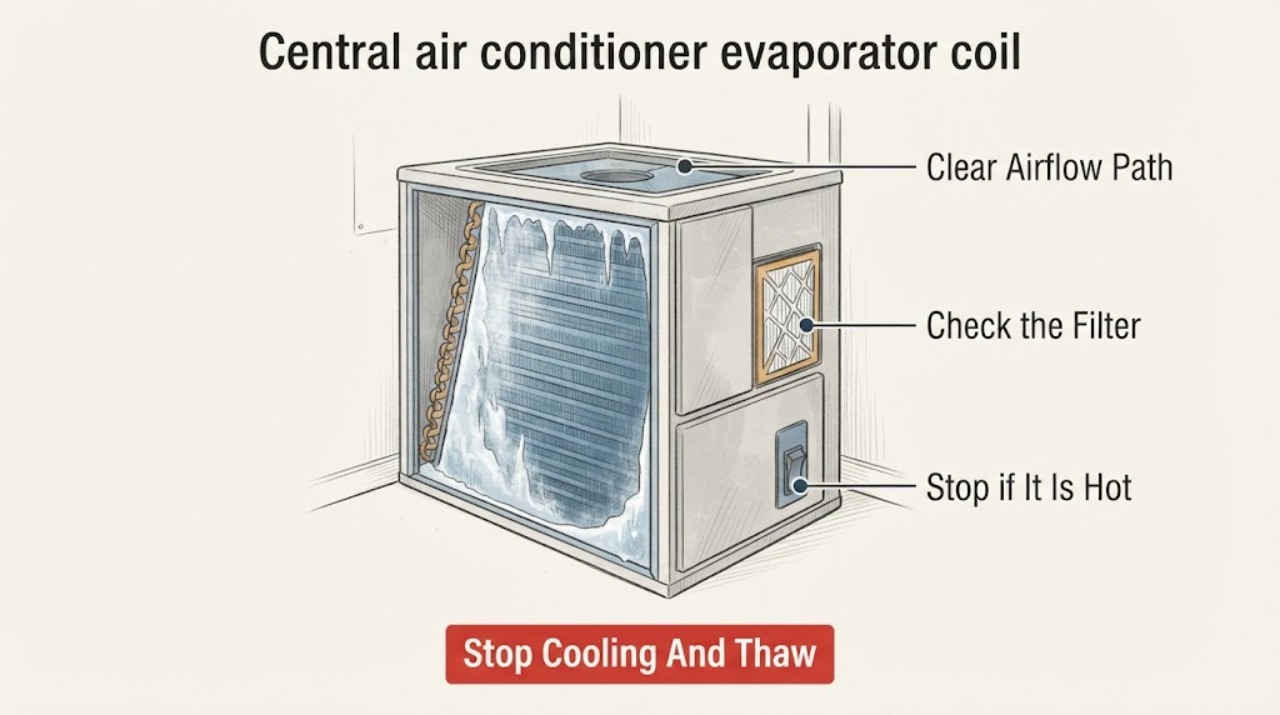
Ice on an American Standard central air conditioner's indoor evaporator coil means the cooling system needs to stop cooling until the coil thaws; continued operation can damage the system. The common first suspects are restricted airflow from a dirty filter or blocked return/supply, but a dirty coil, blower problem, thermostat behavior, condensate issue, or low refrigerant can look similar. Turn cooling off at the thermostat and use fan-only thawing only if the area is dry and the thermostat/manual supports it; never chip at the ice. Replace a dirty, correctly identified user-accessible filter and clear furniture from return grilles, but do not open the air handler, handle refrigerant, scrape the coil, or test electrical parts. Arrange HVAC service after the coil thaws, or sooner for water near electrical equipment, overflow, burning odor, a tripped breaker, oil residue, repeated freezing, or no airflow.
Work through in order
Diagnostic checks
Use only checks that match the exact appliance or system and its official guide.
-
Check 1
From a dry, safe position, look for frost or ice on the visible indoor coil cabinet and accessible refrigerant line, and note whether supply-airflow has weakened or the air feels warm; do not touch the coil, line, or blower.
Expected result: Record visible ice, frost only on a line, no visible ice but weak airflow, warm supply air, normal airflow, or no safe view of the indoor coil.
Next step: Photograph the visible condition and turn cooling off at the thermostat. Do not run repeated cooling cycles to confirm the ice.
Stop if: Stop immediately if water is near electrical equipment, the cabinet is hot, there is smoke/burning odor, a breaker trips, or the unit has no safe dry access.
Why this matters
Why: Visible ice supports a frozen-coil branch, but warm air and weak airflow can have other causes. The location and airflow pattern help separate restricted air from a refrigerant or control issue without proving either.
-
Check 2
At the thermostat, turn the cooling call off and use fan-only thawing only when the area is dry, the fan is an available normal mode, and the exact instructions permit it; keep the coil undisturbed while ice melts.
Expected result: Record ice gradually melting, increasing water in the pan or below the air handler, no indoor airflow, or water that approaches electrical components or overflows.
Next step: Keep cooling off and arrange HVAC assessment. Protect the area only with dry, stable measures that do not contact wiring or the appliance.
Stop if: Do not chip, scrape, pour hot water on, heat, or otherwise force the ice to melt. Stop fan use if water reaches electrical equipment or flooding begins.
Why this matters
Why: Thawing is necessary for a technician to inspect the coil and refrigerant lines, but meltwater can create damage. No airflow suggests a blower or control problem and requires more than a filter change.
-
Check 3
After identifying the correct user-accessible filter, inspect it with the system off and replace it only with the size/type specified for the unit; also check that return grilles and supply registers are not blocked by furniture, drapes, or stored items.
Expected result: Record a visibly loaded filter, a clean filter, blocked return/supply openings, clear openings, or a filter location/type that is uncertain.
Next step: Use the model-approved filter and restore clear grille access without opening the air handler. Keep cooling off until the ice has thawed and service guidance is available.
Stop if: Do not guess the filter size, remove a coil panel, wash the coil, or continue if the filter cabinet is wet or electrical parts are exposed.
Why this matters
Why: A loaded filter or blocked return can reduce airflow enough to freeze the coil and is a plausible first correction. A clean filter and clear grilles shift attention to the coil, blower, thermostat, refrigerant, or duct system.
-
Check 4
Once the ice has visibly thawed and the area is safe, inspect only the visible condensate pan, drain outlet, and floor for water, overflow, staining, or a drain path that appears blocked; do not remove the pan, add chemicals, or open the air handler.
Expected result: Record a dry pan, normal drainage, pooled water, overflow staining, a cracked-looking pan, or water near electrical components.
Next step: Keep the cooling call off and arrange HVAC service for standing water, overflow, a suspected drain blockage, or an inaccessible drain. Protect the area without moving the equipment.
Stop if: Do not pour liquid into the drain, use compressed air, remove panels, or work where water and electricity may meet.
Why this matters
Why: Meltwater should be managed by the condensate system; a blocked or damaged pan/drain can create water damage and may be a separate fault. Water near electrical components is a stop condition, not a cleaning opportunity.
-
Check 5
After full thaw, record whether the thermostat had been calling continuously, whether the system had weak airflow, and whether icing returns during a normal call; do not deliberately force a long cooling run if the coil begins to frost again.
Expected result: Record no recurrence with corrected filter/airflow, rapid recurrence with a clean filter, continuous thermostat demand, normal demand but icing, or a thermostat/display that behaves unexpectedly.
Next step: Keep the cooling system off at the first sign of renewed frost and provide the recurrence timing and thermostat behavior to the technician.
Stop if: Do not adjust sealed-system controls, lower the thermostat repeatedly, bypass a sensor, or continue operating with new ice.
Why this matters
Why: No recurrence after airflow correction supports an airflow-related cause but does not prove the coil is clean. Recurrence with clear airflow makes refrigerant, metering, blower, thermostat, or coil problems more likely and requires professional diagnosis.
-
Check 6
Prepare a service handoff with the American Standard model if safely visible, where ice appeared, filter and grille condition, airflow, thermostat call, thawing/water behavior, recurrence timing, refrigerant-line residue, and any error, odor, breaker, or noise symptom.
Expected result: Confirm that the record contains external observations and a model-approved filter change only, with no refrigerant, coil, blower, wiring, drain, or air-handler component disturbed.
Next step: Arrange qualified HVAC service after thawing or sooner for repeated freezing, weak/no airflow, water damage, or any sealed-system or electrical symptom.
Stop if: Stop all homeowner work when diagnosis requires opening panels, testing voltage, handling refrigerant, cleaning a cased coil, clearing an inaccessible drain, or accessing the blower.
Why this matters
Why: These details help the technician distinguish airflow restriction, condensate trouble, blower/control failure, thermostat behavior, refrigerant loss, metering restriction, and coil damage before choosing a repair.
Use your observations
Decision map
Find the observation that best matches what you see, then follow the next safe action.
-
PATH 01Next step
What you see
The indoor coil is iced, airflow is weak, and the filter is loaded or return/supply grilles are blocked; no water or electrical hazard is present.
Do this next
Replace the correctly identified filter and clear the grilles as the model guidance permits, keep cooling off until thawed, and arrange service if ice returns.
-
PATH 02Next step
What you see
The filter is clean, grilles are clear, airflow seems normal, and the coil or refrigerant line freezes again after thawing.
Do this next
Keep cooling off and arrange qualified HVAC diagnosis. Do not add refrigerant, open service ports, or select a coil from the ice symptom alone.
-
PATH 03Next step
What you see
Ice is present with little or no supply airflow, a blower noise, a control symptom, or a breaker trip even after the filter and grilles are clear.
Do this next
Leave cooling off and arrange qualified HVAC/electrical service. Do not open the air handler or test the blower live.
-
PATH 04Next step
What you see
The coil thaws but water remains in the pan, overflows below the indoor unit, stains the ceiling/floor, or reaches electrical equipment.
Do this next
Keep the system off, protect the area without touching wiring, and arrange HVAC service or appropriate water-damage response.
-
PATH 05Next step
What you see
The coil freezes mainly after an unusually long or overnight run, the thermostat does not appear to end a call, or the system runs despite a satisfied room.
Do this next
Record the thermostat and timing, keep cooling off when frost returns, and have a technician verify control operation and the refrigeration/airflow system.
-
PATH 06Next step
What you see
There is burning odor, smoke, arcing, a tripped breaker, water near electrical equipment, active overflow, no airflow, oil residue, or visible damage to the coil/air handler.
Do this next
Stop using the system and keep clear. Arrange qualified HVAC/electrical service; use emergency help for smoke, fire, shock, or uncontrolled water damage.
Helpful context
Understand the symptom
Ice is a symptom of a refrigeration or airflow problem
A frozen indoor coil can make the air conditioner blow warm air, reduce airflow, frost the refrigerant lines, and leave water beneath the air handler as the ice melts. American Standard says improper airflow is the most common cause, but lists a dirty coil, blocked return vents, thermostat behavior, and low refrigerant as other possibilities. The visible ice does not identify a single failed part, so shut down cooling and collect observations instead of restarting it repeatedly.
Thaw safely before diagnosis
American Standard recommends turning the cooling system off at the thermostat, using the indoor fan to help thaw when appropriate, and never chipping at the ice. As the coil thaws, water may collect below the air handler or coil cabinet. Keep people away from wet electrical areas and protect finishes only from a dry, stable position; the coil and refrigerant circuit cannot be assessed accurately while encased in ice.
Use airflow checks to narrow the branch
A dirty filter or blocked return grille reduces air crossing the cold coil, while a blower problem can produce weak or absent airflow. American Standard says homeowners can check or change the filter and keep return vents and supply registers clear. Cleaning a cased coil, opening the air handler, or testing a blower is different work and belongs to qualified HVAC service.
A clear filter does not rule out refrigerant service
If airflow is normal and the coil freezes again, low refrigerant, a refrigerant leak, a thermostat that runs too long, a metering component, or a coil restriction becomes more plausible. American Standard says leak testing and sealed-system work belong to a certified HVAC technician. Do not add refrigerant, open service ports, or order a coil because ice is visible; diagnosis must identify the cause first.
Safety boundary
Stop conditions
- Do not run cooling with an iced coil, chip or scrape ice, pour hot water on it, or force thawing with a heater or flame.
- Do not open the air handler, handle refrigerant, add refrigerant, test live electrical parts, clean a cased coil, bypass controls, or clear an inaccessible condensate drain as a homeowner.
- Stop immediately for burning odor, smoke, arcing, a breaker trip, shock, water near electrical equipment, active overflow, oil residue, no airflow, or visible equipment damage; keep clear and arrange qualified or emergency help.
Only after diagnosis
Potential parts
- HVAC air filter
Consider this only when the installed filter is visibly loaded or the exact model specifies a replacement filter; a clean filter does not justify changing other parts.
Confirm the exact filter dimensions, type, airflow rating, orientation, and system requirements before replacement. - condensate drain or drain-pan component
Consider this only when qualified inspection confirms a blocked, cracked, or failed pan/drain component contributing to thaw-water overflow.
Confirm the exact air-handler model, pan/drain configuration, float protection, materials, routing, and installation requirements before selection. - indoor blower motor or blower assembly
Consider this only when qualified electrical and airflow testing confirms the blower motor or assembly cannot provide the required airflow after filter, duct, and control checks.
Confirm the exact air-handler model, motor type, controls, wheel, mounting, electrical characteristics, and manufacturer-approved fit before installation. - evaporator coil
Consider this only when qualified leak/pressure and coil inspection confirms a leaking or damaged indoor coil; frozen ice alone does not establish coil failure.
Confirm the exact coil and air-handler model, refrigerant design, dimensions, metering arrangement, connections, and installation requirements before replacement.
When checks do not resolve it
Need a professional?
Arrange qualified HVAC service whenever an American Standard evaporator coil freezes, especially after the filter and visible airflow checks, because the root cause may be a dirty coil, blower/control fault, thermostat behavior, condensate restriction, metering issue, or refrigerant leak. Keep cooling off for recurrent ice, weak/no airflow, water overflow, oil residue, or a tripped breaker. Stop immediately for burning odor, smoke, arcing, shock, water near electrical equipment, or uncontrolled water damage.
Have this ready
- Provide the model if safely visible, icing location, filter and grille condition, airflow, thermostat call, thawing and water behavior, recurrence timing, line residue, and any error, odor, breaker, noise, or water-damage symptom.
Common questions
FAQ
What should I do first when an American Standard evaporator coil is frozen?
Turn cooling off at the thermostat and allow the coil to thaw; fan-only thawing is appropriate only when the area is dry and the exact instructions support it. Do not chip the ice. Check the user-accessible filter and clear blocked return/supply grilles, then arrange HVAC assessment.
Can a dirty filter freeze the evaporator coil?
Yes. American Standard says a clogged filter restricts airflow and can freeze the coil. A dirty coil, blocked return, blower issue, thermostat behavior, or refrigerant problem can produce the same symptom, so recurrence after a filter change needs professional diagnosis.
Why is water under the indoor unit after the coil thaws?
Melted ice can drip into the pan, but a blocked or damaged condensate pan or drain can also cause pooling or overflow. Keep cooling off and have the drain system assessed if water persists, reaches electrical equipment, or damages the area.
Does a frozen coil prove the system needs refrigerant?
No. American Standard lists airflow restriction, dirty coil, blocked returns, thermostat behavior, and refrigerant leaks as different possible causes. Refrigerant measurement and leak work require a qualified HVAC technician.
Can I scrape the ice or open the air handler?
No. Do not chip or scrape ice, open the air handler, handle refrigerant, or test electrical parts. Keep cooling off, perform only the model-authorized filter/register check, and arrange qualified HVAC service.
Read the exact guide
Official sources
- Got a Frozen Evaporator Coil? Don’t Panic, Do This.American Standard · American Standard consumer HVAC guidance used for the assigned brand and general central-AC frozen-coil triage; exact model instructions govern.
- Air Conditioner TroubleshootingAmerican Standard · American Standard central-air troubleshooting guidance used for user-accessible filter and register reasoning; exact model and installation instructions govern.
- 8 Common AC Repair Issues for Home SystemsAmerican Standard · American Standard consumer guidance used to separate frozen-coil causes and service boundaries; exact system diagnosis requires a qualified technician.
- Coil TroubleshootingTrane · Trane manufacturer guidance used as corroborating HVAC coil evidence; American Standard model instructions and qualified service govern the assigned equipment.
Community feedback
Share a repair observation
Share a plain-text repair observation. Accepted observations are published automatically; this page may take a moment to update.