
On this page
Start here
Quick answer
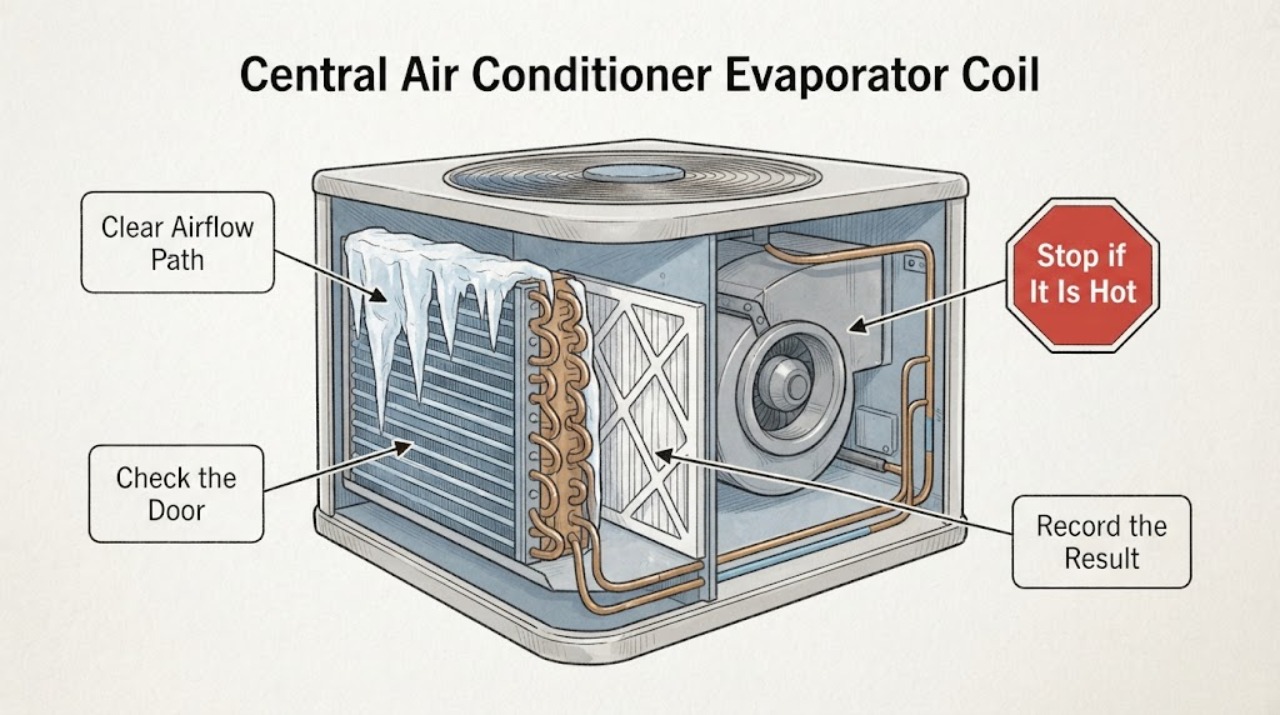
A frozen indoor evaporator coil can block the air path and make the registers feel weak or warm. Turn the thermostat's cooling function off and let the ice melt; use the indoor fan only if the system manual allows it and watch for meltwater. Do not chip ice, pour hot water on the coil, use a heat gun, or keep running cooling against the ice. Once the system is off, replace an obviously dirty, correctly sized filter and clear furniture or debris from return grilles and supply registers. If airflow remains weak after the coil is fully thawed, the filter is clean, or ice returns, stop using cooling and arrange HVAC service: low refrigerant, a dirty or inaccessible coil, a blower fault, duct restriction, or another control problem requires measurements and qualified repair.
Work through in order
Diagnostic checks
Use only checks that match the exact appliance or system and its official guide.
-
Check 1
Turn the thermostat's cooling mode to Off and keep the air conditioner from starting while ice is visible. Look from a dry, safe position for frost on the indoor cabinet or refrigerant lines, weak or absent register airflow, water collecting below the air handler, smoke, a burning smell, or an electrical problem; do not open the cabinet.
Expected result: Ice is visible, the system is still calling for cooling, meltwater is approaching electrical equipment, or there is smoke, burning odor, arcing, a hot connection, or repeated breaker operation.
Next step: Keep cooling Off and arrange HVAC service. For smoke, arcing, a hot connection, or an immediate electrical hazard, keep clear and use local emergency guidance; isolate power only from a safe, dry location if that can be done without approaching the hazard.
Stop if: Stop immediately for smoke, burning odor, arcing, a hot or damaged disconnect, repeated breaker trips, or water reaching electrical components.
Why this matters
Why: Continuing to run cooling against a frozen coil can damage the system, while water near electrics or an electrical symptom adds a separate shock or fire hazard.
-
Check 2
Allow the indoor coil to defrost naturally with cooling Off. If the exact system instructions permit the indoor fan to run, select Fan On only while cooling remains Off; place a pan or towels where safe for meltwater and never chip the ice, pour hot water, or apply a heat gun, torch, space heater, or hair dryer.
Expected result: Ice gradually disappears and the drain area remains controlled, or water overflows, the coil does not thaw, the blower does not move air, or ice remains trapped inside the cabinet.
Next step: Leave cooling Off. If water is overflowing, the drain is blocked, the blower is not operating, or ice cannot be safely observed and allowed to thaw, stop and request HVAC service rather than opening the coil cabinet or forcing drainage.
Stop if: Stop the fan or any inspection for water near electrics, leaking from the cabinet, unusual motor noise, exposed wiring, or any need to use heat or a tool on the ice.
Why this matters
Why: A full thaw is needed before airflow and cooling behavior can be interpreted. Overflow, failure to thaw, or a nonworking blower points beyond a simple visible restriction.
-
Check 3
After the system is off and the coil is fully thawed, inspect the accessible air filter and its airflow arrow. Replace it only with the type and size specified by the equipment instructions if it is visibly dirty, collapsed, wet, or obstructed; also move furniture, boxes, curtains, or other obstructions away from return grilles and supply registers.
Expected result: The filter is clogged or damaged, a return grille or supply register is blocked, or the filter and visible grilles are clear but airflow is still weak.
Next step: Correct only the accessible filter or room-obstruction issue documented for the system, keep cooling Off until all water is gone, and make one supervised test only after the coil is fully thawed. If airflow is still weak, stop and schedule HVAC diagnosis.
Stop if: Stop if the filter location, size, orientation, or replacement procedure is uncertain, the filter is wet from a leak, or access would require removing a panel or reaching into the blower or coil.
Why this matters
Why: A clogged filter or blocked air path can reduce heat flow across the evaporator coil and contribute to icing. A clear accessible path with weak airflow shifts suspicion to the blower, ductwork, coil, control, or another system fault.
-
Check 4
With cooling still Off, compare airflow at several registers and listen from outside the cabinet for the indoor blower. Check only visible, accessible duct sections for a crushed flex duct, disconnected joint, closed register, or return grille obstruction; do not remove access panels or test electrical components.
Expected result: All registers are weak, only one branch is weak, the blower is silent or making abnormal noise, a visible duct is crushed or disconnected, or airflow is normal after thawing.
Next step: Clear only an obvious room-level obstruction or restore a visibly displaced duct connection if it can be done without tools, panels, or contact with wiring. If the blower is abnormal, the duct is inaccessible, or airflow remains weak, leave cooling Off and arrange HVAC service.
Stop if: Stop for a motor hum without airflow, scraping, burning smell, exposed wiring, a wet cabinet, or any requirement to enter the air handler or blower compartment.
Why this matters
Why: System-wide weak airflow is more consistent with a filter, return, blower, coil, or control issue; one weak branch suggests a local register or duct restriction. A silent or abnormal blower needs professional diagnosis.
-
Check 5
After a complete thaw and an accessible filter/return check, make no more than one brief supervised cooling test only if the area is dry, the system manual permits it, and airflow has returned. Watch for new frost, falling airflow, water, abnormal noise, or a cycle that runs continuously without cooling.
Expected result: Cooling works with steady airflow and no new ice, or frost returns, airflow falls again, water appears, the outdoor unit behaves abnormally, or the system cannot maintain the set temperature.
Next step: Turn cooling Off again at the first sign of renewed icing, weak airflow, water, or abnormal operation. Leave the system Off and request qualified HVAC service; do not check refrigerant pressure, add refrigerant, open the sealed circuit, or troubleshoot live electrical parts.
Stop if: Stop the test for any new ice, warm air with weak flow, water overflow, loud or burning equipment noise, repeated short cycling, or electrical symptom.
Why this matters
Why: A single clean test with stable airflow makes a temporary restriction more plausible but does not prove the underlying cause is fixed. Rapid recurrence or persistent poor cooling points to low refrigerant, a dirty or inaccessible coil, blower/duct failure, or controls.
Use your observations
Decision map
Find the observation that best matches what you see, then follow the next safe action.
-
PATH 01Safety boundary
What you see
Is there visible ice or frost and weak airflow, with no emergency electrical or water hazard?
Do this next
Turn cooling Off, allow a natural thaw, and perform only the accessible filter and return/register checks after thawing. Do not run cooling while ice remains.
Why this path and its safety boundary
Why it matters: Ice plus weak flow is a consistent frozen-coil pattern, but the pattern does not by itself identify whether airflow restriction, refrigerant, or mechanical failure started it.
Safety stop: If no ice is visible, do not assume the coil is clear; weak airflow may be a filter, register, duct, blower, or control problem. If an electrical or water emergency is present, use the stop boundary first.
-
PATH 02Next step
What you see
After a full thaw, the filter is dirty or a return/register is visibly blocked and airflow improves when that accessible restriction is corrected.
Do this next
Keep the filter type and installation direction correct, keep returns and registers open, and make at most one dry, supervised cooling test. Turn cooling Off and call HVAC service if ice or weak airflow returns.
Why this path and its safety boundary
Why it matters: The result makes an airflow restriction more likely, but a recurrence still requires investigation because the coil, blower, ductwork, and refrigerant condition have not been fully tested.
-
PATH 03Next step
What you see
The coil is thawed and the accessible filter, returns, and registers are clear, but airflow remains weak or the blower is silent or abnormal.
Do this next
Leave cooling Off and arrange qualified HVAC diagnosis. Do not remove the air-handler panel, probe wiring, clean an enclosed coil, or replace a motor or capacitor as a homeowner check.
Why this path and its safety boundary
Why it matters: A blower, duct, dirty indoor coil, control, or other mechanical problem is more likely than the corrected room-level obstruction. A user cannot distinguish those causes safely by listening or looking through a grille.
-
PATH 04Next step
What you see
Ice returns quickly after thawing, especially with a clean filter and open airflow path, or frost appears on refrigerant tubing and the system runs continuously without cooling.
Do this next
Turn cooling Off and arrange qualified HVAC service for airflow and refrigerant-system measurements. Do not add refrigerant, use gauges, search for a leak with an open system, or keep restarting the unit.
Why this path and its safety boundary
Why it matters: Recurrence makes low refrigerant, a leak, a dirty or inaccessible coil, a blower problem, or another mechanical fault more likely. The symptom cannot establish which one is responsible.
Helpful context
Understand the symptom
Why a frozen coil makes the airflow weaker
In a split central air conditioner, the indoor evaporator coil is in or beside the indoor air handler. Ice narrows the passages that air must cross, so the system can blow less air while cooling poorly. Restricted airflow can also be the reason the coil froze in the first place; low refrigerant or a mechanical fault can produce a similar pattern. Weak airflow by itself does not identify one failed part.
Thaw first, then separate an airflow restriction from a deeper fault
Leave cooling off until all visible ice has melted. Meltwater can overflow or collect below the indoor unit, so protect the area and watch for a leak. A filter and blocked-return check are reasonable homeowner checks when the equipment is off and the parts are accessible. The indoor coil, blower assembly, refrigerant charge, wiring, and electrical controls are not ordinary user-serviceable checks.
A recurrence is a diagnosis signal, not a reason to keep resetting the system
If ice forms again after the filter and visible airflow path are corrected, the system still has an unresolved condition. Low refrigerant can reduce coil pressure and create ice; a dirty coil, failing blower, duct restriction, thermostat problem, or other mechanical issue can also reduce heat reaching the coil. Do not add refrigerant, open the sealed circuit, probe live electrical parts, or clean an enclosed coil without the exact equipment procedure and appropriate training.
Safety boundary
Stop conditions
- Do not run cooling while the evaporator coil or refrigerant lines are frozen; turn cooling Off and allow a safe natural thaw.
- Do not chip ice, pour hot water, use a heat gun, torch, space heater, hair dryer, or other direct heat on the coil or refrigerant tubing.
- Stop for smoke, burning odor, arcing, a hot connection, repeated breaker trips, a wet electrical cabinet, or water reaching electrical components; keep clear and use local emergency guidance as appropriate.
- Do not open panels, probe live wiring, remove the blower or coil, check refrigerant with gauges, add refrigerant, or attempt sealed-system repair as a homeowner check.
Common questions
FAQ
What should I do first when the central AC evaporator coil is frozen and airflow is weak?
Turn the thermostat's cooling Off and allow the coil to thaw naturally. If the manual permits, the indoor fan may run with cooling Off to help circulate air. Do not keep running cooling, chip ice, apply direct heat, or open the air-handler cabinet. Watch for meltwater and arrange service if the coil cannot thaw or airflow remains weak.
Can a dirty filter cause a frozen evaporator coil?
Yes. Carrier identifies a dirty or clogged filter and blocked vents as airflow restrictions that can contribute to freezing. After cooling is Off and the coil is fully thawed, replace an obviously dirty filter only with the documented type and size and clear accessible return grilles. If ice returns, the filter was not the whole diagnosis.
How can I tell whether low refrigerant is causing the ice?
You cannot confirm low refrigerant from ice or weak airflow alone. Recurring frost after a clean filter and clear airflow path can make a refrigerant problem more likely, but a dirty coil, blower, duct, or control fault can look similar. Leave cooling Off and have qualified HVAC service test the system; do not add refrigerant or use gauges yourself.
Is it safe to pour hot water on a frozen AC coil?
No. Let the ice melt naturally with cooling Off, using the system fan only if the exact instructions permit it. Do not chip the ice or apply hot water, a heat gun, a torch, a space heater, or a hair dryer; direct or rapid heat can damage equipment and create a separate hazard.
When does weak airflow after thawing require HVAC service?
Arrange service if airflow remains weak after a fully thawed coil, a correctly installed clean filter, and clear accessible returns and registers; if the blower is silent or abnormal; if water leaks; or if ice returns. Those results can involve the blower, ductwork, indoor coil, controls, or refrigerant circuit and require qualified measurements or repair.
Read the exact guide
Official sources
- Air Conditioning Service | Expert AC Maintenance & Tune-UpsCarrier · Carrier residential AC service guidance on weak airflow, filters, blocked registers, recurring frozen coils, and professional coil/refrigerant service
- Coil TroubleshootingTrane · Trane residential HVAC coil troubleshooting for dirty or frozen evaporator coils, thawing, water leakage, and refrigerant-related frost
- Troubleshoot an Air Conditioner | AC TroubleshootingCarrier · Carrier residential central air-conditioner troubleshooting for filters, airflow, refrigerant, electrical limits, and frozen evaporator coils
- Will Frozen AC Fix Itself? | Guide to Frozen AC CoilsCarrier · Carrier residential air-conditioner guidance on frozen evaporator coil causes, airflow, safe thawing, and professional service boundaries
Community feedback
Share a repair observation
Share a plain-text repair observation. Accepted observations are published automatically; this page may take a moment to update.