
On this page
Start here
Quick answer
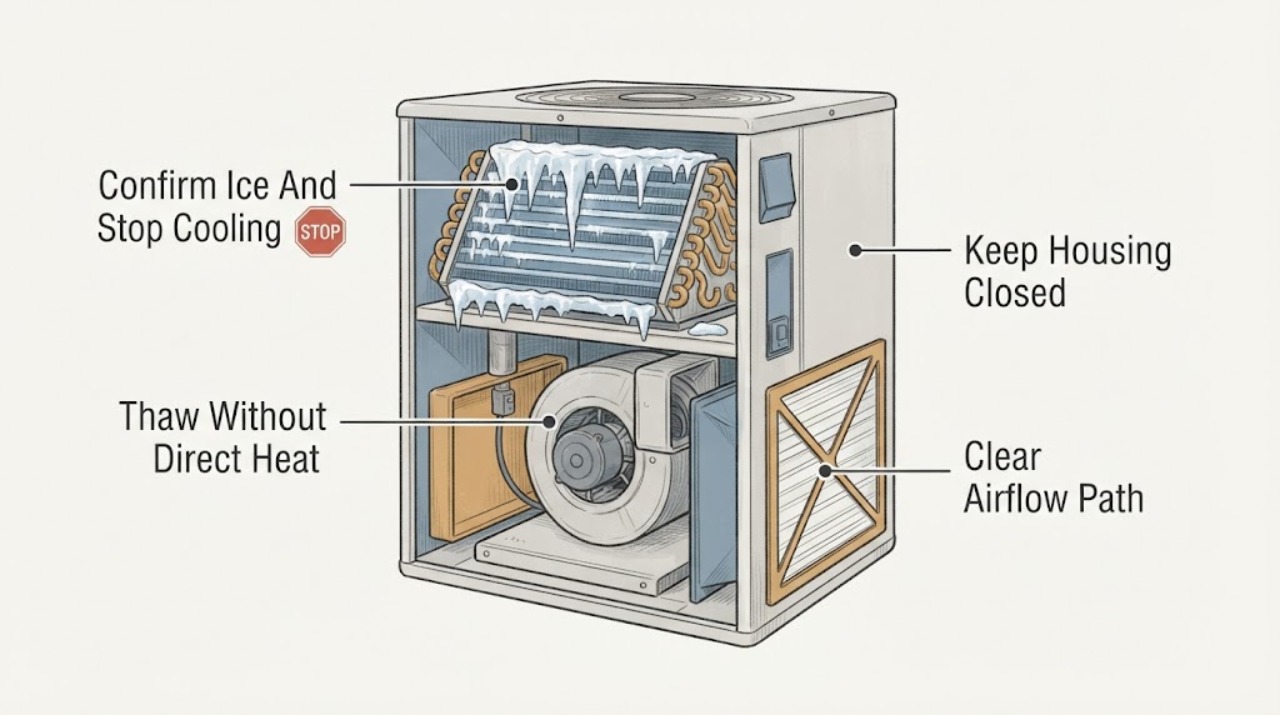
Turn the cooling function off as soon as you see ice on the evaporator coil or refrigerant line. A frozen coil can block airflow, and Carrier warns that continuing to run the system can damage the compressor and may allow a blower motor to be blocked or seized by ice. Set the thermostat to Off; if your system and thermostat safely allow it, the indoor fan may be set to On to help natural thawing, but do not use a hair dryer, space heater, hot water, or another direct heat source. Check the accessible air filter and replace a dirty disposable filter with the exact approved size, keep supply and return vents open, and look for a blower that is not moving air or is making an abnormal sound without reaching into the air handler. Once all ice has melted and the area is dry, a single cautious restart is only a comparison, not a repair. If the coil refreezes, airflow stays weak, the blower motor does not run, cooling is poor, or a refrigerant leak is suspected, shut the system down and arrange qualified Carrier HVAC service. Do not open the cabinet, test capacitors or wiring, handle refrigerant, or attempt to force the blower to turn.
Before you begin
Safety first
- This article supports turning cooling Off, natural thawing, ordinary-access filter and vent checks, visible airflow observation, and safe thermostat review only. Do not open the air handler, reach into the blower, handle capacitors or wiring, touch refrigerant, add refrigerant, use direct heat, or continue operation with ice, water near electrical parts, smoke, burning odor, sparks, severe heat, or a failed fan.
Work through in order
Diagnostic checks
Use only checks that match the exact appliance or system and its official guide.
-
Check 1
From a safe position, confirm whether ice or frost is visible on the indoor coil area or refrigerant line and whether the vents are blowing weak or warm air; turn the thermostat's cooling function Off immediately and do not keep running the compressor.
Expected result: Record visible ice, water beginning to collect, weak airflow, warm airflow, no visible ice but a suspected blower stop, or an unrelated outdoor-unit symptom.
Next step: Leave cooling Off and continue with the filter, vent, and blower observations only after the system is safe to approach; arrange Carrier service if the coil is inaccessible or the cause is unclear.
Stop if: Stop for smoke, burning odor, sparks, electrical damage, water near wiring, refrigerant hissing, or a blower or outdoor unit that is dangerously hot or damaged.
Why this matters
Why: Ice plus weak or warm airflow supports a frozen evaporator coil. Continuing cooling can increase compressor strain, while no ice shifts attention toward a blower, thermostat, power, or other fault that still requires safe diagnosis.
-
Check 2
With cooling Off, allow the ice to thaw naturally; if the thermostat and system instructions permit, set the indoor fan to On while cooling remains Off, and place protection around the area where meltwater may appear.
Expected result: Record whether ice melts, water drains normally, water overflows or pools, airflow returns as the ice clears, or the blower remains silent or weak.
Next step: Keep cooling Off for any drainage problem or persistent blower symptom and arrange HVAC service; do not restart while ice remains or water is near electrical parts.
Stop if: Never use a hair dryer, space heater, open flame, hot water, or another direct heat source to thaw the coil; stop if water reaches wiring or the air handler.
Why this matters
Why: A returning airflow after thaw suggests ice was blocking the air path, but it does not identify the root cause. Overflowing water points to a drain or pan concern, and a blower that remains weak suggests a motor, capacitor, control, or wiring problem.
-
Check 3
Once the system is off and the filter is accessible without opening the air handler, inspect the filter, return grille, and supply registers; replace a dirty disposable filter with the exact approved size and orient its airflow arrow toward the blower.
Expected result: Record a caked or visibly restricted filter, a reusable filter that needs the model-approved cleaning method, blocked return or supply openings, or a clear filter and open air path.
Next step: After the coil has fully thawed and the area is dry, use the filter result as one input for a single cautious comparison; arrange service if airflow stays weak or the coil refreezes.
Stop if: Do not wash a disposable filter, use an incorrect size, remove the coil or blower cover, or continue if the filter housing is wet or damaged.
Why this matters
Why: Restricted airflow can make the evaporator coil freeze and can overwork or shut down the blower. A clear filter and air path make low refrigerant, coil dirt, blower, control, or another fault more likely.
-
Check 4
After the coil has thawed and the filter and vents are clear, observe from the registers and the ordinary exterior of the air handler whether the indoor blower starts, moves normal air, stops intermittently, hums, grinds, or remains silent; do not reach into the blower or remove a panel.
Expected result: Record strong airflow, weak airflow, no airflow with a call for fan, an intermittent motor, abnormal noise, or ice that prevents a meaningful observation.
Next step: Keep cooling Off for absent, noisy, or intermittent blower operation and arrange qualified Carrier service; do not test a capacitor, spin the wheel, or bypass a motor control.
Stop if: Stop for burning odor, sparks, a hot motor, exposed wiring, damaged fan components, or any need to open the air-handler cabinet.
Why this matters
Why: Weak or absent airflow with a clear filter points toward a blower motor, capacitor, control, duct, or power issue. A motor that is blocked by remaining ice must not be forced, and a coil that refreezes despite normal airflow points toward refrigerant or another mechanical cause.
-
Check 5
From ordinary safe access, verify the thermostat is in the intended cooling mode and inspect the outdoor condenser through its grille for obvious debris or a damaged fan blade, without touching the unit or resetting repeatedly tripped breakers.
Expected result: Record an incorrect mode or schedule, open airflow path and normal outdoor fan, heavy debris, damaged or nonmoving fan, a tripped breaker, or no obvious external issue.
Next step: Correct only an obvious user setting or ordinary loose debris without opening equipment; keep the system off and call service for a damaged fan, breaker issue, or persistent freezing.
Stop if: Do not touch capacitors, wiring, fan blades, refrigerant lines, or a running unit; stop for sparks, burning odor, damaged conductors, or a repeatedly tripping breaker.
Why this matters
Why: A thermostat setting or outdoor airflow obstruction can alter cooling performance, but a frozen indoor coil with a blower problem may remain. A damaged or nonmoving fan, repeated breaker trip, or abnormal heat needs professional electrical and mechanical diagnosis.
-
Check 6
Only after all ice has melted, meltwater has drained, the filter and vents are clear, and the blower operates normally, make one cautious restart with the thermostat at a moderate approved setting while staying present; stop at the first sign of renewed ice or abnormal airflow.
Expected result: Record normal cooling and airflow, weak airflow, ice returning, water leakage, short cycling, unusual noise, or an electrical or burning symptom.
Next step: Turn cooling Off again and arrange qualified Carrier HVAC service for any recurrence; provide the technician the thaw, filter, airflow, and restart observations.
Stop if: Stop immediately for renewed ice, water overflow, smoke, burning odor, sparks, severe heat, damaged wiring, or a blower that stops.
Why this matters
Why: Normal operation after a dirty-filter or blocked-vent correction supports an airflow contributor but does not prove the coil, blower, or refrigerant circuit is healthy. Any recurrence indicates an unresolved restriction, leak, motor, control, or other fault.
Use your observations
Decision map
Find the observation that best matches what you see, then follow the next safe action.
-
PATH 01Safety boundary
What you see
Ice is visible, airflow is weak or warm, and the blower does not operate normally after the coil begins to thaw.
Do this next
Keep cooling Off, allow natural thawing, and arrange Carrier service for the blower and indoor airflow system; do not force the fan or test electrical parts.
Why this path and its safety boundary
Why it matters: A blower motor, capacitor, control, power, or airflow problem may be causing the freeze, and remaining ice can itself block the fan.
Safety stop: Stop for burning odor, sparks, exposed wiring, a hot motor, or water near electrical components.
-
PATH 02Safety boundary
What you see
The coil thaws, the filter is visibly restricted or vents are blocked, and airflow improves after the exact filter is replaced and openings are cleared.
Do this next
Use one supervised restart only after the area is dry and the coil is fully thawed; turn cooling Off and call service if ice returns or airflow weakens.
Why this path and its safety boundary
Why it matters: Restricted airflow is a plausible contributor to freezing, but the system should still be watched for recurrence.
Safety stop: Do not run cooling with residual ice, use an incorrect or washed disposable filter, or block returns and supplies with furniture.
-
PATH 03Safety boundary
What you see
The filter and vents are clear, the blower appears to move normal air, but the evaporator coil freezes again after a complete thaw.
Do this next
Keep the cooling Off and arrange qualified Carrier HVAC diagnosis; do not add refrigerant, open the coil cabinet, or attempt a sealed-system repair.
Why this path and its safety boundary
Why it matters: Low refrigerant, a leak, an inaccessible dirty coil, a metering or control issue, or another mechanical fault is more likely than a simple filter problem.
Safety stop: Do not keep restarting a refreezing system or handle refrigerant, electrical components, or hidden coil surfaces.
-
PATH 04Safety boundary
What you see
After thawing, the filter is clear but the indoor blower remains silent, intermittent, noisy, or weak, and airflow at the registers is absent or poor.
Do this next
Leave cooling Off and arrange qualified Carrier service for blower and electrical diagnosis.
Why this path and its safety boundary
Why it matters: A blower motor, capacitor, control, wiring, duct, or power problem may be present; running cooling can freeze the coil again and stress the compressor.
Safety stop: Do not reach into the blower, spin the wheel, test a capacitor, remove a panel, or operate with burning odor, sparks, or a hot motor.
-
PATH 05Safety boundary
What you see
Ice melts but water overflows, pools around the indoor unit, or the drain pan or line appears unable to carry the meltwater safely.
Do this next
Keep cooling Off, protect the area from water, and arrange HVAC service to assess the drain, pan, coil, and original freeze cause.
Why this path and its safety boundary
Why it matters: A condensate drain or pan issue may coexist with the frozen coil and can cause property or electrical damage.
Safety stop: Do not pour chemicals into an unknown drain, open the air handler, or allow water to reach wiring or electrical equipment.
-
PATH 06Safety boundary
What you see
The breaker trips, the outdoor fan is damaged or does not run, burning odor or sparks appear, or the system shuts down while the coil is frozen.
Do this next
Leave the system off and arrange qualified HVAC or electrical service; use urgent help for smoke, fire, or dangerous electrical signs.
Why this path and its safety boundary
Why it matters: An electrical, condenser, fan, or control fault may be involved and is not safe to isolate by repeated resets.
Safety stop: Do not reset a repeatedly tripping breaker, touch a capacitor or disconnect, or run the compressor with a failed fan or frozen coil.
Helpful context
Understand the symptom
A frozen coil and a blower-motor failure can cause each other
Ice on the evaporator coil restricts the air path, while a failed or seized blower motor stops warm indoor air from reaching the coil. Carrier notes that the blower can be physically blocked by ice or can be the reason the coil freezes. That is why the safe first move is to stop cooling and let the ice thaw, not to keep running the compressor while listening for the motor.
Start with airflow that is accessible without opening the air handler
A dirty filter, closed supply register, blocked return grille, or obstructed indoor airflow can make the evaporator too cold. Replace a disposable filter only with the exact approved size and put it back with the airflow arrow pointing toward the blower. Keep vents open and clear. Do not remove an air-handler panel to reach the coil or blower, and do not wash an electronic motor or cabinet.
Refreezing after a filter change needs professional diagnosis
If the coil freezes again after a complete thaw and an airflow correction, the cause may be low refrigerant, a leak, a dirty inaccessible coil, a blower motor or capacitor problem, a thermostat or control issue, or another mechanical fault. Carrier says refrigerant and electrical troubleshooting should be handled by a qualified contractor. A frozen coil is a symptom, not proof that the blower motor or coil itself should be replaced.
Protect the drain, compressor, and indoor equipment
Meltwater can overflow a drain pan or damage nearby materials when ice thaws. Keep the cooling off, monitor for water around the indoor unit, and do not pour hot water onto the coil or use direct heat. Record airflow, filter condition, ice location, blower sound, thermostat mode, and whether the coil refreezes so the technician can separate airflow, refrigerant, and motor causes.
Safety boundary
Stop conditions
- Turn cooling Off immediately when ice is visible and do not continue running the compressor with a frozen evaporator coil.
- Never use a hair dryer, space heater, open flame, hot water, or another direct heat source to thaw the coil; allow natural thawing and protect against meltwater.
- Do not open the air-handler cabinet, reach into the blower, test capacitors or wiring, handle refrigerant, add refrigerant, or perform sealed-system work.
- Stop for smoke, burning odor, sparks, exposed or damaged wiring, a repeatedly tripping breaker, water near electrical parts, severe heat, refrigerant hissing, or fire signs; arrange urgent qualified help.
- Keep cooling Off and arrange Carrier HVAC service when the coil refreezes, airflow remains weak, the blower is silent or intermittent, drainage overflows, or the cause is not resolved by an exact filter and clear vents.
Only after diagnosis
Potential parts
- blower motor
Consider this category only when airflow remains weak or absent after complete thawing and an exact clean filter, and a qualified technician confirms the motor is failed, seized, or intermittently operating.
Confirm the complete Carrier indoor-unit model, motor type, speed, voltage, connector, and manufacturer fit information; do not replace a motor based on ice alone. - blower motor capacitor
Consider this category only when a qualified technician confirms a capacitor fault in a blower circuit after the coil is thawed and airflow, wiring, and control causes are assessed.
Confirm the exact indoor-unit model and capacitor specification with the technician; capacitors can retain hazardous charge and are not an ordinary user repair. - evaporator coil assembly
Consider this category only when a qualified technician confirms coil leakage, severe corrosion, inaccessible contamination, or damage after airflow and refrigerant diagnosis.
Confirm the complete Carrier system match, coil orientation, refrigerant and metering configuration, and manufacturer fit information; a frozen coil alone does not prove replacement is needed. - thermostat or indoor control
Consider this category only when a technician confirms an incorrect cooling demand, sensor, control, or wiring fault after airflow and coil causes are ruled out.
Confirm the exact Carrier equipment, thermostat type, wiring, staging, and approved compatibility before ordering; do not bypass safety or control circuits.
When checks do not resolve it
Need a professional?
Arrange qualified Carrier HVAC service when the evaporator coil refreezes after a complete thaw and exact filter replacement, airflow stays weak, the blower motor is silent, intermittent, noisy, or blocked, cooling is poor, water overflows, a refrigerant leak is suspected, or diagnosis requires opening the air handler or handling electrical or refrigerant components. Seek urgent help for smoke, burning odor, sparks, exposed wiring, severe heat, fire signs, or water near electrical equipment.
Safety scope: This article supports turning cooling Off, natural thawing, ordinary-access filter and vent checks, visible airflow observation, and safe thermostat review only. Do not open the air handler, reach into the blower, handle capacitors or wiring, touch refrigerant, add refrigerant, use direct heat, or continue operation with ice, water near electrical parts, smoke, burning odor, sparks, severe heat, or a failed fan.
Common questions
FAQ
Can I run my Carrier AC with a frozen evaporator coil?
No. Carrier recommends turning cooling off immediately because continued operation can stress the compressor, block airflow, and worsen damage. Allow the coil to thaw naturally and address the cause before a cautious restart.
Can a Carrier blower motor cause the evaporator coil to freeze?
Yes. A failed, intermittent, or blocked blower reduces airflow across the coil, and ice can then physically block or seize the blower. After thawing, observe airflow from safe access; do not reach into the blower or test electrical parts.
Will changing the Carrier AC filter fix a frozen coil?
It may help when the filter is visibly restricted, but it is not a complete diagnosis. Use the exact approved filter with the airflow arrow toward the blower, let the coil thaw fully, and call service if freezing returns or airflow remains weak.
How should I thaw a frozen Carrier evaporator coil?
Turn cooling Off and allow natural thawing; if the thermostat and system instructions permit, the indoor fan may run with cooling Off. Do not use a hair dryer, space heater, flame, hot water, or other direct heat, and monitor for meltwater near the indoor unit.
Does low refrigerant cause a Carrier evaporator coil to freeze?
Carrier identifies low refrigerant or a leak as possible causes of a frozen coil, but a dirty filter, blocked airflow, blower problem, dirty coil, or another fault can look similar. Refrigerant diagnosis and repair require a qualified HVAC technician.
When does a Carrier frozen-coil and blower problem need service?
Arrange service when the blower is silent, weak, noisy, or intermittent, the coil refreezes after a complete thaw and filter check, water overflows, cooling remains poor, a leak is suspected, or electrical or refrigerant access is needed. Stop urgently for smoke, sparks, burning odor, severe heat, fire signs, or water near wiring.
Read the exact guide
Official sources
- Will Frozen AC Fix Itself? A Guide To Frozen AC CoilsCarrier · Carrier residential air-conditioning guidance for frozen coils; exact equipment controls and access depend on the installed model.
- AC Fan Not Spinning? 8 Causes & How to Fix ThemCarrier · Carrier residential air-conditioner fan guidance; indoor and outdoor equipment details vary by model.
- AC Filter Replacement Guide | How to Replace AC FilterCarrier · Carrier residential air-conditioner filter guidance; the installed filter and equipment manual control the exact size and service interval.
- Troubleshoot an Air ConditionerCarrier · Carrier split-system central AC troubleshooting guidance; model-specific procedures and local service requirements control.
Community feedback
Share a repair observation
Share a plain-text repair observation. Accepted observations are published automatically; this page may take a moment to update.