
On this page
Start here
Quick answer
A blower motor does not create cooling by itself: it circulates air through the indoor coil and supply ducts, so a failed or overheating blower can cause little or no airflow, while normal airflow with warm air points to the thermostat, outdoor unit, coil, refrigerant, or another system problem. Confirm whether airflow is absent, weak, or normal, check only the thermostat and accessible filter, and look for visible ice or water; stop before opening the air handler, touching wiring or a capacitor, handling refrigerant, or forcing the blower, and arrange qualified HVAC service when the motor or cooling circuit is suspected.
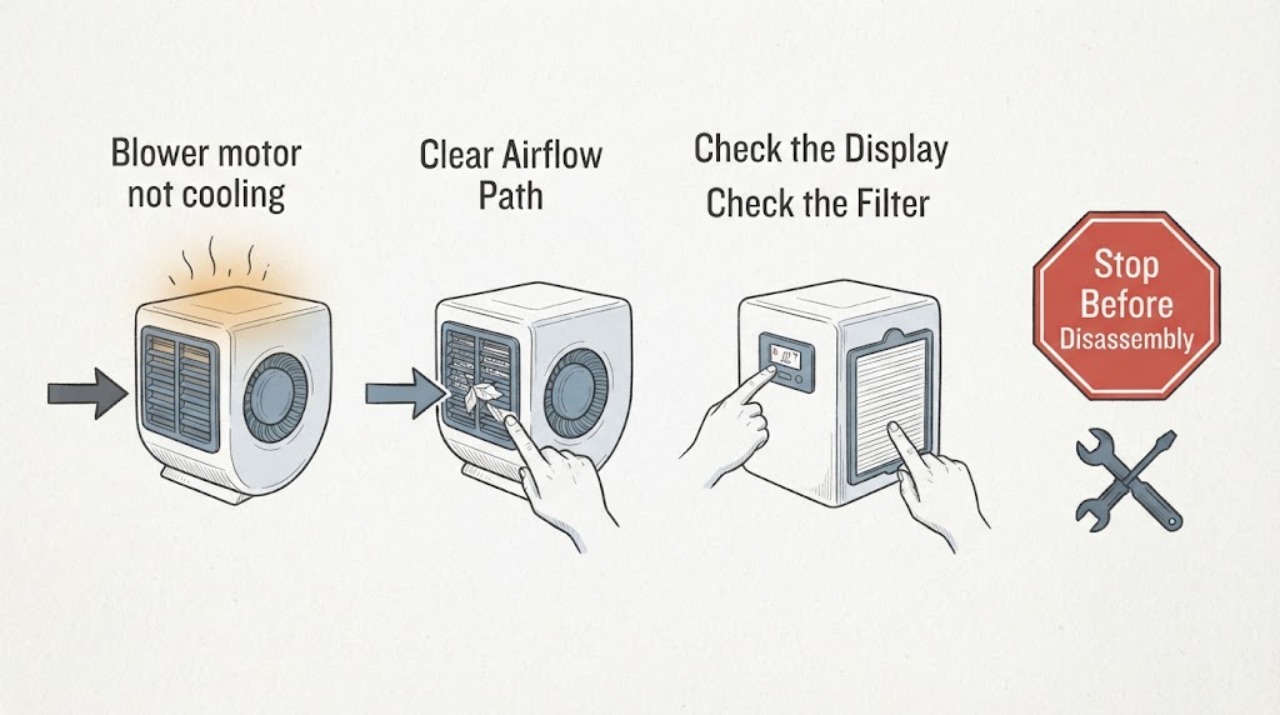
Work through in order
Diagnostic checks
Use only checks that match the exact appliance or system and its official guide.
-
Check 1
With the thermostat calling for cooling and the air handler closed, stand at several supply registers and the return. Note whether there is no airflow, weak airflow, or normal airflow, and listen from outside the cabinet for the blower starting, stopping, humming, grinding, or repeatedly restarting.
Expected result: Airflow is absent or weak while the system calls, airflow is normal but warm, or the blower makes an abnormal sound or cycles without maintaining airflow.
Next step: Record the pattern and continue only with external thermostat, filter, and visible-condition checks. Do not repeat starts to force a noisy, overheating, or stalled blower to run.
Stop if: Stop immediately for burning odor, smoke, grinding, a tripped breaker, exposed wiring, water near electrical equipment, or uncontrolled repeated starting and stopping.
Why this matters
Why: Absent or weak airflow supports a blower, filter, duct, coil, or control path; normal airflow with warm air moves attention toward the cooling circuit, outdoor unit, thermostat, or coil rather than assuming a motor failure.
-
Check 2
Check the thermostat display and user settings without removing the cover: confirm cooling mode, a suitable temperature request, and the intended fan mode. Review a programmed schedule or remote sensor and note whether the blower runs when there is no active cooling call.
Expected result: The thermostat is in the wrong mode, fan mode or schedule is overriding the call, the display is blank or abnormal, or the settings appear correct while the airflow symptom remains.
Next step: Correct only an obvious user setting and observe one controlled cooling call. If the thermostat is blank, damaged, or correctly calling without the expected blower response, arrange HVAC service rather than changing wiring or installer parameters.
Stop if: Stop for exposed thermostat wiring, a hot or wet thermostat, repeated breaker trips, or any need to remove the cover to change terminals.
Why this matters
Why: An incorrect user setting can mimic a blower or cooling failure; correct settings with no airflow or warm air move the diagnosis to the air handler or connected equipment.
-
Check 3
Turn the system off at the normal thermostat control and inspect only the filter location identified by the equipment instructions. Look for a visibly loaded, wet, collapsed, or incorrectly oriented filter, and make sure accessible supply and return grilles are not blocked by furniture or coverings.
Expected result: The filter is dirty, wet, damaged, or restrictive-looking, a grille is blocked, or the filter and visible grilles look clear while airflow remains weak.
Next step: If the instructions specify a user-replaceable filter, install the correct type and orientation, then make one controlled observation. If the filter is wet, airflow stays weak, or the system still fails to cool, leave it off as needed and arrange service.
Stop if: Stop for water at the air handler, a filter frozen in place, damaged insulation, a secured panel that must be removed, or anything requiring access to the blower compartment.
Why this matters
Why: A restricted filter or blocked grille can reduce airflow and make the system cool poorly or stress the blower; clear external airflow with continued weakness points toward ducts, coil, blower, or controls.
-
Check 4
From the floor or another stable location, look at accessible refrigerant tubing and the area around the air handler without touching lines or opening panels. Note frost or ice, excessive condensate, a wet filter, water near the unit, or a blocked-looking external drain outlet.
Expected result: Ice or frost is visible, airflow is reduced, condensate is excessive, or water is collecting at or around the air handler.
Next step: Turn off the cooling call and arrange qualified HVAC service for ice or water. Do not scrape ice, apply heat, add refrigerant, open the coil compartment, or bypass a drain or freeze safety.
Stop if: Stop for active water near electrical parts, a leaking drain pan, a refrigerant hiss or odor, a fully iced coil, or any need to access the coil or drain inside the cabinet.
Why this matters
Why: A frozen coil can restrict airflow and contribute to blower overheating or shutdown; ice and water can also reflect airflow, coil, drain, or refrigerant problems that cannot be distinguished by a visual check alone.
-
Check 5
Without approaching moving equipment or touching the outdoor unit, note whether it starts when the thermostat calls for cooling and whether the indoor blower response matches. Compare supply air after the system has had one controlled opportunity to operate, and stop if the outdoor unit is silent, repeatedly starting, or visibly damaged.
Expected result: The blower runs but the outdoor unit does not, both sections run but the supply air stays warm, the outdoor fan or compressor cycles rapidly, or the whole system stops together.
Next step: Give the sequence to the technician and do not reset breakers repeatedly or alter disconnects. Refrigerant, compressor, condenser, capacitor, and control faults require qualified service.
Stop if: Stop for a damaged outdoor fan blade, burning odor, unusual electrical sound, ice, exposed conductors, a tripped breaker, or any need to open the disconnect or equipment cabinet.
Why this matters
Why: A blower-only response can indicate a thermostat, control, or outdoor-equipment issue; normal airflow with warm supply air points away from the motor; rapid cycling or no outdoor response needs system-level diagnosis.
-
Check 6
Prepare a service record with thermostat mode and fan setting, no/weak/normal airflow, the blower sound and start-stop pattern, filter condition, register obstructions, ice or water, outdoor-unit response, and any recent work. Read the model label only from an accessible exterior location; do not remove panels to inspect the motor.
Expected result: The record separates visible observations from suspected motor, capacitor, coil, refrigerant, duct, or control causes and identifies any cabinet or electrical area not inspected.
Next step: Arrange qualified HVAC service when airflow remains absent or weak, warm air persists, or any stop condition is present. Ask for blower, airflow, coil, condensate, thermostat/control, outdoor equipment, and refrigerant evaluation as applicable.
Stop if: Do not continue when diagnosis requires live voltage, a capacitor, motor wiring, a control board, coil access, refrigerant handling, or bypassing a safety device.
Why this matters
Why: A bounded record helps the technician test the complete system and avoids replacing a blower motor when the cooling fault is elsewhere.
Use your observations
Decision map
Find the observation that best matches what you see, then follow the next safe action.
-
PATH 01Next step
What you see
There is no airflow while cooling is called, or the blower never starts from the normal thermostat command.
Do this next
Check the thermostat setting and accessible filter only. If the call is correct and the blower remains off, shut the system down and arrange HVAC service for power, controls, capacitor, motor, and safety-circuit diagnosis.
-
PATH 02Next step
What you see
Airflow is weak at several registers, the filter is loaded, or there is visible ice or condensate.
Do this next
Replace only an identified user-serviceable filter and remove accessible grille obstructions. If weakness, ice, or water remains, turn off cooling and request professional airflow, coil, drain, and refrigerant diagnosis.
-
PATH 03Next step
What you see
The blower delivers normal airflow but the supply air is not cool or the home does not cool.
Do this next
Do not replace the blower motor from that symptom alone. Confirm thermostat settings and observe the outdoor-unit response, then arrange system-level service for coil, refrigerant, outdoor equipment, controls, or sizing issues.
-
PATH 04Next step
What you see
The blower hums, grinds, overheats, starts and stops, or airflow drops after a brief run.
Do this next
Turn the system off and keep the cabinet closed. Arrange qualified service for the motor, capacitor, wheel, wiring, controls, filter, and coil; do not spin, oil, bypass, or electrically test the motor yourself.
-
PATH 05Next step
What you see
The blower runs but the outdoor cooling section does not start, starts and stops rapidly, or the two sections do not respond together.
Do this next
Stop repeated calls and arrange professional HVAC diagnosis. The symptom can involve controls, power, compressor, condenser fan, capacitor, or refrigerant and is not proof of a blower motor failure.
-
PATH 06Next step
What you see
There is burning odor, smoke, exposed wiring, water near electrical parts, a repeated breaker trip, active refrigerant leak evidence, or a secured cabinet that must be opened.
Do this next
Leave the system off if it can be done from the normal control, keep clear, and arrange urgent qualified HVAC or electrical assessment as appropriate. Do not reset protection repeatedly or open the cabinet.
Helpful context
Understand the symptom
What a blower symptom actually tells you
An air handler circulates air for a connected air conditioner or heat pump. If the blower does not run, airflow may disappear even though the outdoor section is operating; if the blower runs with normal airflow but the air is warm, the fault may be outside the blower path. Weak airflow can also be caused by a dirty filter, a frozen coil, or an obstruction, so the sound of the motor alone is not a diagnosis.
Start with external airflow and control checks
Check the thermostat mode and fan setting, then inspect the accessible filter and compare airflow at several registers. ENERGY STAR includes filters, condensate drainage, controls, coils, refrigerant, and blower components in a proper maintenance check, but those checks are not all homeowner tasks. A filter change can remove one restriction; it cannot prove the blower motor, coil, refrigerant charge, or control sequence is healthy.
The air-handler cabinet is a professional boundary
The motor, capacitor, relay, control board, wiring, coil, and safety devices are inside or connected to the air handler. Trane advises shutting the system off and calling for HVAC repair when the fan or motor is not working, and Carrier advises professional handling of frozen coils, refrigerant, and electrical issues. Do not remove panels, jump controls, spin the wheel by hand, or test live voltage to prove a motor fault.
Only after diagnosis
Potential parts
- air filter
Consider this category only when the equipment instructions identify a user-replaceable filter that is visibly loaded or damaged.
Confirm the exact filter dimensions, type, airflow direction, and equipment instructions; a filter change does not establish a blower motor or cooling-circuit fault. - blower motor or motor control
Consider this category only after a qualified professional confirms the motor or its control is defective rather than the filter, coil, duct, thermostat, or outdoor cooling equipment.
Confirm the exact air-handler model, motor technology, electrical ratings, airflow requirements, and control compatibility before selection or installation. - blower run capacitor
Consider this category only when professional testing identifies a failed capacitor in a motor system that uses one.
Confirm the exact capacitance, voltage, physical fit, motor requirements, and discharge procedure; capacitors can retain dangerous electrical energy.
When checks do not resolve it
Need a professional?
Airflow is absent or weak after the thermostat and accessible filter checks., The blower hums, grinds, overheats, stops and restarts, or makes an abnormal sound., The blower runs with warm air, the outdoor unit does not respond normally, or cooling remains inadequate., Ice, water, a wet filter, a blocked condensate path, or suspected refrigerant trouble is visible., Diagnosis would require opening the air handler, testing voltage or a capacitor, handling refrigerant, or changing controls.
Common questions
FAQ
Can a blower motor be the reason an air conditioner is not cooling?
Yes, if the motor fails or airflow is severely reduced, conditioned air may not circulate and the coil can be affected. But normal airflow with warm air points toward the thermostat, outdoor equipment, coil, refrigerant, or another system issue, so the motor should not be blamed from temperature alone.
What should I check before calling about a blower motor?
Confirm the thermostat is calling for cooling, inspect the accessible filter, make sure registers and the return are not blocked, and note whether airflow is absent, weak, or normal. Keep the cabinet closed and stop for ice, water, unusual noise, or electrical symptoms.
Why is my blower running but the air is warm?
The blower may be operating normally while the outdoor cooling unit, thermostat command, coil, refrigerant circuit, or another control is not producing cooling. Observe whether the outdoor section responds and arrange system-level HVAC diagnosis if the filter and settings are correct.
What if the air handler blower hums or stops after starting?
Turn the system off and keep the cabinet closed. A motor, capacitor, control, filter, coil, or overheating condition may be involved, and Trane advises HVAC repair for a blower that is not working; do not try to spin or electrically test it.
Should I replace the blower motor or capacitor myself?
No. Motor and capacitor selection and testing depend on the air-handler model and system airflow, and the cabinet contains electrical hazards. Have a qualified professional confirm the failed component before any part is selected.
Read the exact guide
Official sources
- Troubleshooting an AC Not WorkingCarrier · Carrier residential air-conditioning troubleshooting covering thermostat settings, indoor air-handler filters, short cycling, refrigerant, electrical issues, frozen evaporator coils, and outdoor-unit response
- Air Handler Fan Not Working: Causes and SolutionsTrane · Trane residential air-handler troubleshooting covering filters, thermostat settings, power, controls, wiring, capacitors, blower motors, overheating, and frozen coils
- Maintenance ChecklistENERGY STAR · ENERGY STAR guidance from the U.S. Environmental Protection Agency and U.S. Department of Energy on HVAC maintenance, filters, drains, coils, refrigerant, controls, and blower airflow
Community feedback
Share a repair observation
Share a plain-text repair observation. Accepted observations are published automatically; this page may take a moment to update.