
On this page
Start here
Quick answer
If an air conditioner stopped cooling after the blower motor was changed, first separate an airflow failure from a refrigeration failure. From the thermostat and registers, check whether the system is calling for cooling and whether air is moving. If the indoor blower is silent, the airflow is absent, a breaker trips, a motor hums, or the new motor runs abnormally, stop the system and have the installing HVAC technician verify the motor match, wiring, control signal, capacitor or module, and safety controls. If air moves but is warm, check only the thermostat setting, a dirty filter, visible ice, and whether the outdoor unit responds; do not open panels, touch wiring or a capacitor, measure live voltage, or handle refrigerant. A frozen coil, water at the indoor unit, repeated shutdown, burning smell, or electrical fault is a stop-and-service condition.
Before you begin
Safety first
- Do not open the air handler or panel, touch motor wiring or a capacitor, measure live voltage, bypass a safety switch, run the system with ice or water, or work on refrigerant.
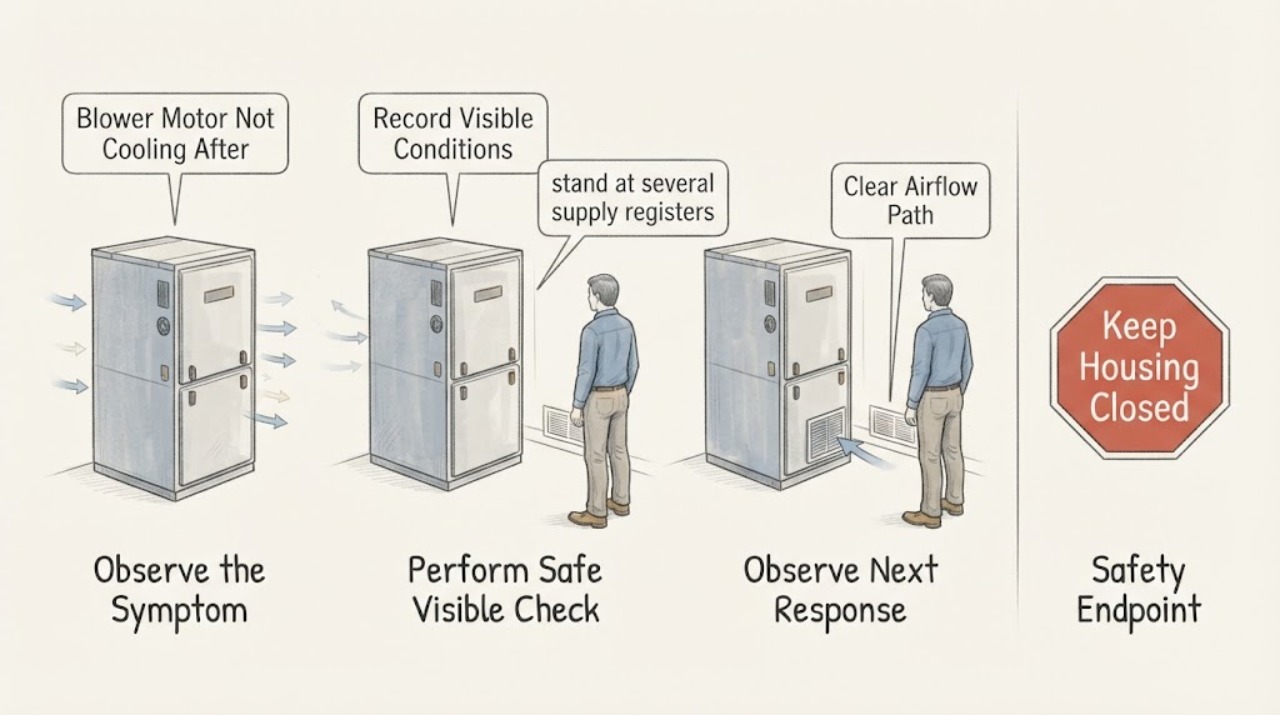
Work through in order
Diagnostic checks
Use only checks that match the exact appliance or system and its official guide.
-
Check 1
At the thermostat, record the current mode, setpoint, room temperature, fan setting, schedule/hold state, and any displayed alert. Set only the user controls as directed by the equipment instructions: cooling mode, a temperature below the room temperature, and fan AUTO unless the manual says otherwise.
Expected result: The thermostat calls for cooling, does not call, has a blank or fault display, or calls while the indoor unit gives no response.
Next step: If the call is correct and the indoor unit remains silent, stop normal operation and contact the installer. Do not open the thermostat or air handler to test the call.
Stop if: Stop if the thermostat or nearby equipment smells burned, feels hot, shows smoke, or the system trips a protective device.
Why this matters
Why: A control setting or thermostat power problem can look like a blower or cooling failure. If there is a valid cooling call but no indoor response immediately after motor work, the post-repair installation/control branch becomes more likely.
-
Check 2
With the system requested to cool only long enough for a safe observation, stand at several supply registers and listen from outside the air-handler cabinet. Do not open the cabinet or place fingers or tools near a grille or fan.
Expected result: There is no airflow, weak airflow, normal airflow that is warm, a hum/click followed by silence, grinding/squealing, or a blower that starts and stops.
Next step: Record the exact sound and register response, then stop if airflow is absent or abnormal. Give the observation to the HVAC technician instead of repeating start attempts.
Stop if: Stop immediately for grinding, scraping, electrical buzzing, burning odor, smoke, heat, a trip, or any need to reach inside the air handler.
Why this matters
Why: No or newly abnormal airflow keeps the blower change, motor selection, wiring, control signal, capacitor/module, or safety interlock in the service branch. Normal airflow means the blower is at least circulating air and the no-cooling diagnosis must move to thermostat, filter/coil, outdoor unit, condensate, or refrigerant possibilities.
-
Check 3
Inspect only the normally accessible air filter and return/supply grilles. Follow the filter's airflow arrow and the equipment manual; replace a visibly loaded filter only if it can be done without opening an energized cabinet or contacting wet, hot, or damaged equipment.
Expected result: The filter is clean, visibly clogged, missing, wet, collapsed, or the grilles are blocked; the blower has no airflow despite a clean accessible filter.
Next step: Correct only the accessible filter/grille issue permitted by the manual. If airflow remains absent, weak, or the filter is wet, turn cooling off and call the installer/HVAC technician.
Stop if: Stop for water, ice, a hot or damaged filter compartment, electrical odor, or any requirement to remove an air-handler panel.
Why this matters
Why: A blocked filter or grille can reduce airflow and contribute to a frozen coil, but it does not explain a blower that is silent immediately after replacement. A wet or damaged filter can indicate condensate or equipment trouble.
-
Check 4
Look from a safe distance at the visible indoor equipment area and the accessible condensate drain/pan location, if your system exposes one without removing a cover. Do not touch the pan, drain, pump, float switch, or wet wiring.
Expected result: There is no visible water, standing water or overflow, ice/frost on accessible tubing or the coil housing, or an equipment safety indication.
Next step: If water or ice is visible, turn the thermostat to OFF and arrange HVAC service. Do not chip ice, pour chemicals into a drain, bypass a float switch, or restart to see whether it clears.
Stop if: Stop for any water near electrical equipment, active overflow, ice, moldy drain conditions, or a need to open the cabinet or handle a drain component.
Why this matters
Why: A rising condensate level can stop an indoor unit through a safety switch, and a frozen coil can result from poor airflow or a refrigeration problem. Ice and water are evidence to stop rather than a reason to keep running the system.
-
Check 5
From outside the equipment enclosure, observe whether the outdoor condenser responds during a valid cooling call and whether its visible airflow/noise is normal. Keep clear of the fan, grille, refrigerant lines, disconnect, and electrical cabinet; do not remove covers or touch the unit.
Expected result: The outdoor unit is silent, starts and stops, runs while the indoor blower is absent, or runs with unusual noise, heat, odor, ice, or visible damage.
Next step: Record the response and shut cooling off if the unit is abnormal. If the outdoor unit runs while there is no indoor airflow, contact the installer promptly to prevent continued coil-freezing or equipment stress.
Stop if: Stop for exposed wiring, smoke, burning odor, arcing, a hot enclosure, damaged fan parts, refrigerant hissing/oily residue, or any need to approach moving parts.
Why this matters
Why: A mismatch between indoor airflow and outdoor operation helps the technician separate a post-repair blower/control issue from an outdoor-unit or refrigeration issue, but it cannot identify a failed component by itself.
-
Check 6
Make a post-repair handoff record: blower motor change date, old and new motor labels only if already visible without opening anything, thermostat call, register airflow, outdoor-unit response, filter/ice/water observations, trips or noises, and whether the no-cooling symptom began immediately or later.
Expected result: The symptom is consistently no airflow, warm air with airflow, intermittent operation, or a safety shutdown after the motor change.
Next step: Leave the system off when an unsafe or abnormal symptom is present and request a professional post-installation diagnosis. Do not buy or install another motor based only on the symptom.
Stop if: Stop all troubleshooting for repeated trips, smoke, burning odor, hot components, exposed wiring, refrigerant release, water near electrical equipment, or persistent no-airflow/ice.
Why this matters
Why: The repair context lets the HVAC technician verify motor type/control compatibility, wiring and connectors, capacitor or ECM module, blower rotation/speed, airflow, coil condition, condensate safety, and the refrigeration circuit in the correct order.
Use your observations
Decision map
Find the observation that best matches what you see, then follow the next safe action.
-
PATH 01Safety boundary
What you see
There is no indoor airflow, the blower is silent or newly noisy, the motor cycles abnormally, or the symptom began immediately after the motor change.
Do this next
Turn the thermostat to OFF and have the installing HVAC technician verify the replacement motor's application, wiring, control signal, capacitor or electronic module, rotation/speed setup, and safety interlocks. Do not open the air handler or make a wiring change.
Why this path and its safety boundary
Safety stop: No further start attempts when a motor hums, scrapes, overheats, smells burned, or a protective device trips.
-
PATH 02Safety boundary
What you see
Airflow is normal but the air is warm after the motor change.
Do this next
Check thermostat demand, the accessible filter, visible ice/water, and the outdoor unit's response. If those observations do not identify a safe surface-level cause, call an HVAC professional for coil, condensate, electrical, and refrigerant diagnosis.
Why this path and its safety boundary
Safety stop: Do not open panels, test capacitors, handle refrigerant, or keep running with ice, water, burning odor, or repeated shutdown.
-
PATH 03Safety boundary
What you see
The outdoor unit runs while the indoor blower has no airflow, or the indoor coil/tubing is visibly icing.
Do this next
Turn cooling OFF and arrange prompt HVAC service. The system may be operating with inadequate airflow or another fault that can worsen if it continues to run.
Why this path and its safety boundary
Safety stop: No repeated cycling to melt ice, no fan-stick test, no panel removal, and no refrigerant work.
-
PATH 04Safety boundary
What you see
Water is rising at the condensate area, the unit shuts down on a safety control, or water is near electrical equipment.
Do this next
Turn cooling OFF, keep away from wet equipment, and call an HVAC technician. Do not bypass the condensate safety switch or pour cleaner into an inaccessible drain.
Why this path and its safety boundary
Safety stop: Stop for active overflow, wet wiring, standing water, or any shock/tingle.
-
PATH 05Safety boundary
What you see
The thermostat or HVAC equipment shows an electrical fault, a breaker trips, or there is smoke, burning odor, heat, arcing, or repeated start/stop behavior.
Do this next
Stop operation and leave the equipment off. From a safe location, contact the installing HVAC technician; involve a qualified electrician when the branch circuit or building wiring is implicated.
Why this path and its safety boundary
Safety stop: Do not reset repeatedly, open a panel, touch wiring or a capacitor, or run the system to reproduce the symptom.
Helpful context
Understand the symptom
The timing matters: a problem that begins immediately after a blower motor change should be treated as a post-repair symptom first, not as proof that the refrigerant charge or compressor suddenly failed. A blower that does not run cannot deliver air across the indoor coil, and a restricted or frozen coil can then make the cooling complaint look worse. The replacement motor, its control method, wiring, and the system's safety controls are model-specific and belong to the installing HVAC professional.
Use the symptom at the registers to choose the safe branch. No airflow or a newly abnormal motor sound points back toward the blower installation and its electrical controls. Normal airflow that is warm points toward thermostat demand, filter or coil airflow, condensate protection, the outdoor unit, or refrigerant-side diagnosis. Do not run the system repeatedly to reproduce a fault.
Only surface-level observations are appropriate for a homeowner here. Do not remove the air-handler panel, touch the motor, capacitor, terminals, control board, refrigerant lines, or disconnect, and do not use a meter or jumper wire. If the work was recently performed, give the same technician the exact time of the change and the first new symptom so the repair can be checked without guessing at parts.
Safety boundary
Stop conditions
- Smoke, burning odor, arcing, hot equipment, a circuit trip, exposed wiring, or a shock/tingle.
- No indoor airflow after the motor change, a motor hum/grind/squeal, repeated cycling, or abnormal vibration.
- Visible ice, water near electrical equipment, condensate overflow, or a safety shutdown.
- Any need to remove an air-handler or electrical-panel cover, touch wiring, test live voltage, handle a capacitor, bypass a safety control, move a fan blade, or handle refrigerant.
When checks do not resolve it
Need a professional?
Contact the installing HVAC technician when cooling stopped immediately after the blower motor change, especially if the indoor blower is silent, weak, noisy, or intermittent., Call HVAC service when airflow is present but the air remains warm after the thermostat and accessible filter checks, or when the outdoor unit and indoor blower do not respond together., Request prompt service for ice, condensate water, repeated shutdowns, circuit trips, burning odor, smoke, abnormal heat, exposed wiring, or any refrigerant concern.
Safety scope: Do not open the air handler or panel, touch motor wiring or a capacitor, measure live voltage, bypass a safety switch, run the system with ice or water, or work on refrigerant.
Common questions
FAQ
Why did cooling stop right after the blower motor was changed?
The timing keeps the replacement motor, its application, wiring, control method, capacitor or module, and safety controls in the first service branch. A blower that does not circulate air can also lead to coil icing. Do not open the air handler; have the installer verify the work.
What if air is blowing but it is not cold?
Check the thermostat's cooling demand and the accessible filter, then look for visible ice or condensate water and observe whether the outdoor unit responds. Persistent warm air with normal airflow needs professional diagnosis of coils, condensate protection, controls, and refrigerant; do not handle refrigerant.
Can I check or wire the replacement blower motor myself?
Do not. Blower replacement involves high-voltage wiring and model-specific connections. Leave the panel, motor terminals, capacitor or electronic module untouched and ask the installing HVAC professional to verify the replacement.
Should I keep running the AC to see if it starts cooling?
No when airflow is absent or abnormal, the coil is icing, water is present, the system cycles repeatedly, or there is an electrical or burning sign. Turn cooling OFF and arrange service; continued operation can worsen an airflow or refrigeration fault.
Read the exact guide
Official sources
- Furnace Blower Motor Repair & Replacement GuideCarrier · Carrier's general blower-motor guidance; not a model-specific installation procedure for this task.
- Why Is My AC Not Blowing Cold Air? 7 Common CausesCarrier · General residential AC guidance; does not establish a specific motor or wiring diagnosis.
- AC Not Blowing Cold Air? Learn What to DoTrane · General central-AC troubleshooting and service escalation.
- HomeCooling101U.S. Department of Energy · General residential cooling guidance across common system types.
- AC Fan Not Working? Reasons Why It Stopped SpinningTrane · General split-system AC troubleshooting; exact equipment controls remain model-specific.
- Electrical Safety: ChecklistNational Fire Protection Association · General home electrical safety when HVAC equipment shows an electrical hazard.
Community feedback
Share a repair observation
Share a plain-text repair observation. Accepted observations are published automatically; this page may take a moment to update.