
On this page
Start here
Quick answer
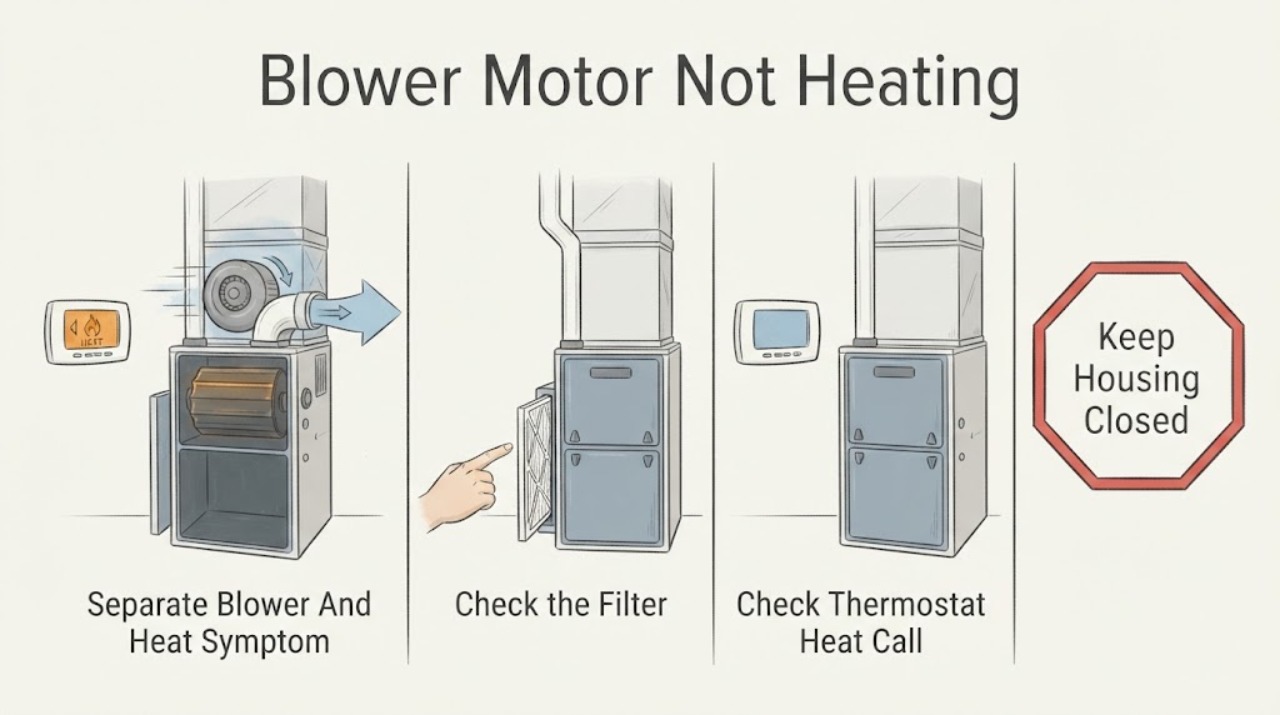
A blower motor does not create heat; it moves return air across the furnace heat exchanger and into the rooms. First determine whether the blower is running but the air is cold, or whether the blower is not running at all. Set the thermostat to Heat with the fan on Auto, confirm the requested temperature is above the room temperature, and replace a dirty user-accessible furnace filter while the furnace is off. Check only the external power switch or breaker if it is safely accessible, and do not repeatedly reset a tripped breaker. If the blower runs but the furnace does not ignite, or if the blower will not start, the likely causes include ignition, limit or safety controls, a capacitor, motor, control board, or another electrical/HVAC fault. Do not open the furnace, work on gas or combustion parts, or bypass a safety control; arrange qualified HVAC service. If a carbon-monoxide alarm sounds or anyone has CO symptoms, leave immediately for fresh air and call emergency services.
Before you begin
Safety first
- User checks are limited to thermostat settings, user-accessible filter replacement with the furnace off, clear room-side returns, and external observation of controls and status. Do not open panels, handle gas or combustion parts, touch capacitors or wiring, measure live circuits, replace a motor, bypass safety controls, repeatedly reset a breaker, or operate an appliance after a CO alarm until trained personnel clear it.
Work through in order
Diagnostic checks
Use only checks that match the exact appliance or system and its official guide.
-
Check 1
During a normal request for heat, observe from the registers and thermostat without opening the furnace: is there airflow, is the airflow cool or warm after the normal startup delay for the model, and does the blower run continuously, cycle, or stay off? Do not keep calling for heat if the furnace makes an unusual sound or a safety alarm is active.
Expected result: The blower is off, the blower runs but air stays cool, warm air starts and then stops, or the blower runs continuously with the thermostat fan set to On.
Next step: Use the thermostat branch for a fan-setting or heat-call issue, the filter/airflow branch for restricted airflow, and the professional branch when the blower is absent, the air stays cold after startup, or the symptom is intermittent.
Stop if: Stop and seek urgent help for a carbon-monoxide alarm, smoke, fuel odor, burning smell, sparking, exposed wiring, or rapidly overheating equipment. Do not open the furnace to identify the motor.
Why this matters
Why: A blower that runs with no heat is not proof of a failed motor; the heat-producing sequence may not be operating. A blower that never starts points toward power, thermostat, door interlock, motor, capacitor, control, or another furnace fault. Continuous fan operation can simply circulate unheated air when Fan is set to On.
-
Check 2
At the thermostat, verify that Mode is Heat, the requested temperature is above the current room temperature, and Fan is Auto rather than On. If the thermostat uses batteries and its display is weak or blank, follow its user instructions for battery replacement. Do not remove or move wiring to test the call.
Expected result: The mode was Cool or Off, the fan was On, the setpoint was not calling for heat, the display was blank, or the settings were already correct but the furnace symptom remains.
Next step: Correct only the user settings or batteries and allow the normal heat cycle to respond. If the blower remains off or the air remains cold with correct settings, continue with the filter check and arrange HVAC service if it persists.
Stop if: Do not jumper thermostat terminals, change wiring, open the furnace control compartment, or repeatedly cycle power to force a start.
Why this matters
Why: Cool/Off mode, a fan forced On, an unmet temperature request, or a weak thermostat display can make a healthy blower circulate cool air or prevent a heat call. Correct settings that produce no change shift the concern toward the furnace, blower, or heating controls.
-
Check 3
Turn the furnace off using its normal user control before checking the filter. Inspect only the filter location described by the owner information, and replace it if it is visibly dirty or clogged with the exact type and size specified for the system. From the room side, make sure return grilles and supply registers are not blocked by furniture or other objects; do not remove furnace panels.
Expected result: The filter is heavily loaded, return airflow is blocked, the filter is clean and grilles are clear, or a filter replacement does not change the blower/heat symptom.
Next step: Restore the approved filter and normal airflow, then make one normal heat call. If the symptom continues, leave the furnace off as appropriate and give an HVAC professional the filter condition and observed airflow; do not attempt to clean burners or controls.
Stop if: Stop if the filter is wet, there is water inside the furnace, the cabinet is hot, or the filter cannot be accessed without removing a panel. Never operate the furnace without the required filter.
Why this matters
Why: Restricted airflow can reduce warm-air circulation and can cause a furnace to overheat and shut down on a safety control. A clean filter and clear returns make a simple airflow restriction less likely, but they do not prove the blower motor, limit control, ignition, or heat exchanger is sound.
-
Check 4
Without opening the equipment, observe the furnace's external power switch, thermostat display, and any plainly visible status indicator or diagnostic message. If the external switch or a service-panel breaker is safely accessible and clearly identified, confirm it has not been switched off; do not touch wiring or repeatedly reset a breaker. Note whether the blower door or access panel is visibly ajar, but do not remove or force it.
Expected result: The external switch is off, a breaker has tripped, a door appears ajar, a diagnostic message is present, power returns but the fault recurs, or no external issue is visible.
Next step: Correct only an obviously switched-off external control or fully closed user-accessible door, then make one normal heat call. If a breaker trips again, the furnace remains unresponsive, or a code persists, leave it off and call qualified HVAC/electrical service.
Stop if: Do not remove panels, test voltage, touch capacitors or terminals, defeat a door switch, reset a breaker repeatedly, or bypass a limit, rollout, or other safety device.
Why this matters
Why: A switched-off furnace, an incomplete access-door interlock, or a single tripped breaker can prevent a blower or heat cycle. A recurring trip, persistent diagnostic indication, or no visible external cause can involve electrical, motor, control, ignition, or safety components and cannot be diagnosed safely from outside.
-
Check 5
Record the thermostat mode and fan setting, whether the blower ran, whether supply air was cool or warm, filter and return-air condition, external status indications, unusual noises or odors, and any recent service or installation change. Decide whether the furnace now produces normal heat and airflow after the safe checks.
Expected result: The blower still will not start, the blower runs but the furnace does not ignite or stays cold, the furnace short-cycles, a breaker trips, water is present, or the system works normally again.
Next step: Leave the furnace off if it is unsafe, repeatedly trips, leaks, or has no heat after the safe checks. Arrange qualified HVAC service; use qualified electrical help for recurring power trips. If a CO alarm sounds or CO symptoms occur, leave for fresh air, call emergency services, and do not re-enter or operate the furnace until cleared by responders and trained personnel.
Stop if: Do not open combustion or electrical compartments, relight or adjust gas components, clean burners or flame sensors, replace a motor or capacitor, measure live circuits, bypass safeties, or use the furnace as a temporary source of heat if it is malfunctioning.
Why this matters
Why: A no-blower symptom may involve the motor, capacitor, control board, thermostat signal, power, or a safety interlock. Blower operation without heat points more toward ignition, flame sensing, fuel/combustion, high-limit, condensate, or another furnace control issue. These observations narrow the service call but do not identify a part for replacement.
Use your observations
Decision map
Find the observation that best matches what you see, then follow the next safe action.
-
PATH 01Next step
What you see
The blower runs cool air with Fan set to On, or the thermostat is not actually calling for Heat.
Do this next
Set the thermostat to Heat, raise the setpoint appropriately, and use Fan Auto. If the system still does not heat, continue with filter and professional checks.
-
PATH 02Next step
What you see
The filter is visibly dirty or return airflow is obstructed.
Do this next
With the furnace off, replace the filter according to the exact owner instructions and clear room-side returns. If heating does not recover or the filter quickly loads again, call HVAC service.
-
PATH 03Next step
What you see
There is no airflow during a valid heat call, or the blower starts and stops abnormally.
Do this next
Do not open the furnace. Arrange HVAC service to diagnose power, door interlock, motor, capacitor, control, or safety causes; use electrical service for recurring breaker trips.
-
PATH 04Next step
What you see
The blower runs but the supply air stays cool after the model's normal startup period.
Do this next
After checking thermostat settings and filter, leave combustion and controls to a qualified HVAC professional. Possible areas include ignition, flame sensing, limit/safety controls, condensate protection, or another heating fault.
-
PATH 05Next step
What you see
A CO alarm sounds, anyone has possible CO symptoms, or there is smoke, fuel odor, burning odor, or an unsafe venting concern.
Do this next
Leave immediately for fresh air, call emergency services from outside, do not search for the source or re-enter until authorized, and do not operate the furnace until trained personnel service it.
Helpful context
Understand the symptom
The blower moves heat; it does not make heat
In a forced-air furnace, fuel or electricity produces heat at the heat exchanger, and the blower pulls return air across it before sending warmed air through the supply ducts. That means “blower motor not heating” can describe two different symptoms: the blower is not moving air, or it is moving room-temperature air because the heating sequence did not produce heat. Do not replace a motor based on cold air alone. Identify which symptom is present first.
Safe homeowner checks are limited
Thermostat settings, a user-accessible filter, clear return grilles, and external signs such as a display or diagnostic light are reasonable observations. Furnace doors, panels, wiring, capacitors, burners, flame sensors, gas valves, venting, condensate equipment, and limit controls are not casual user-service points. A dirty filter can restrict airflow and cause a safety shutdown, so a clean filter does not prove that the blower or furnace is healthy.
Combustion warning
Fuel-burning furnaces can produce carbon monoxide if equipment or venting malfunctions. A carbon-monoxide alarm is an evacuation signal, not a diagnostic invitation: move outside, call emergency services, and do not re-enter or operate the appliance until responders and trained personnel say it is safe.
Only after diagnosis
Potential parts
- furnace air filter
Consider this only when the existing user-accessible filter is visibly dirty or clogged and the exact system instructions identify a replacement filter.
Confirm the exact filter dimensions and type from the furnace or thermostat documentation; do not assume a generic filter is suitable. - blower motor assembly
Consider this only after a qualified HVAC technician confirms the blower motor is the failed component rather than the thermostat, capacitor, control, wiring, or a safety shutdown.
Fit and control type are model-specific. Do not order or install a motor from the symptom alone; the technician should identify the exact furnace model and required assembly.
When checks do not resolve it
Need a professional?
Arrange qualified HVAC service when the blower will not start, the blower runs but the furnace does not produce heat, the system short-cycles, a diagnostic indication persists, water is present, or a filter and thermostat check did not restore normal operation. Use qualified electrical service for repeated breaker trips. Treat a CO alarm, possible CO symptoms, smoke, fuel odor, burning odor, sparking, or exposed wiring as urgent; leave the area and call emergency services for a CO alarm or symptoms.
Safety scope: User checks are limited to thermostat settings, user-accessible filter replacement with the furnace off, clear room-side returns, and external observation of controls and status. Do not open panels, handle gas or combustion parts, touch capacitors or wiring, measure live circuits, replace a motor, bypass safety controls, repeatedly reset a breaker, or operate an appliance after a CO alarm until trained personnel clear it.
Have this ready
- Provide the furnace and thermostat make/model if visible without opening equipment, thermostat mode and fan setting, whether the blower runs, supply-air temperature description, filter condition, external status message, breaker behavior, unusual sounds or odors, water, and recent service or installation changes. Tell the technician about any CO alarm or suspected combustion issue.
Common questions
FAQ
Does the blower motor make the heat in a furnace?
No. The blower moves air across the furnace heat exchanger. If the blower runs but the air stays cool, the heating sequence may not be producing heat; if the blower does not run, the motor or another control may be involved.
Why does the furnace blow cold air when the blower is running?
Fan On can circulate room-temperature air when the furnace is not heating. Correct the thermostat mode and fan setting, check the user-accessible filter, and call HVAC service if the furnace still does not ignite or warm the air.
Can a dirty filter stop the furnace from heating?
A dirty filter restricts airflow and can cause overheating that triggers a safety shutdown. Replace it only through the normal user access and with the documented type; persistent no-heat symptoms require professional diagnosis.
What if the blower does not turn on at all?
After checking the thermostat and filter without opening the equipment, leave the furnace alone and arrange HVAC service. Causes can include power, an access-door interlock, motor, capacitor, control, ignition sequence, or a safety lockout.
What should I do if a CO alarm sounds while the furnace is not heating?
Move outside to fresh air immediately, call emergency services, do not search for the source or re-enter until responders authorize it, and do not operate the furnace until trained personnel have serviced it.
Read the exact guide
Official sources
- Furnace Not Blowing Hot Air? Learn Why and How to Fix ItTrane · Manufacturer guidance used to distinguish thermostat, filter, limit, condensate, ignition, burner, and flame-sensor causes; do not generalize model-specific controls to every furnace.
- Furnace Blower Not WorkingTrane · Manufacturer guidance used for the relationship between the blower and heat exchanger, symptom separation, filter/thermostat checks, and service boundaries; exact equipment controls vary by model.
- Carbon Monoxide Fact SheetU.S. Consumer Product Safety Commission · Government safety guidance for the combustion-hazard stop boundary, not a furnace repair procedure.
Community feedback
Share a repair observation
Share a plain-text repair observation. Accepted observations are published automatically; this page may take a moment to update.