
On this page
Start here
Quick answer
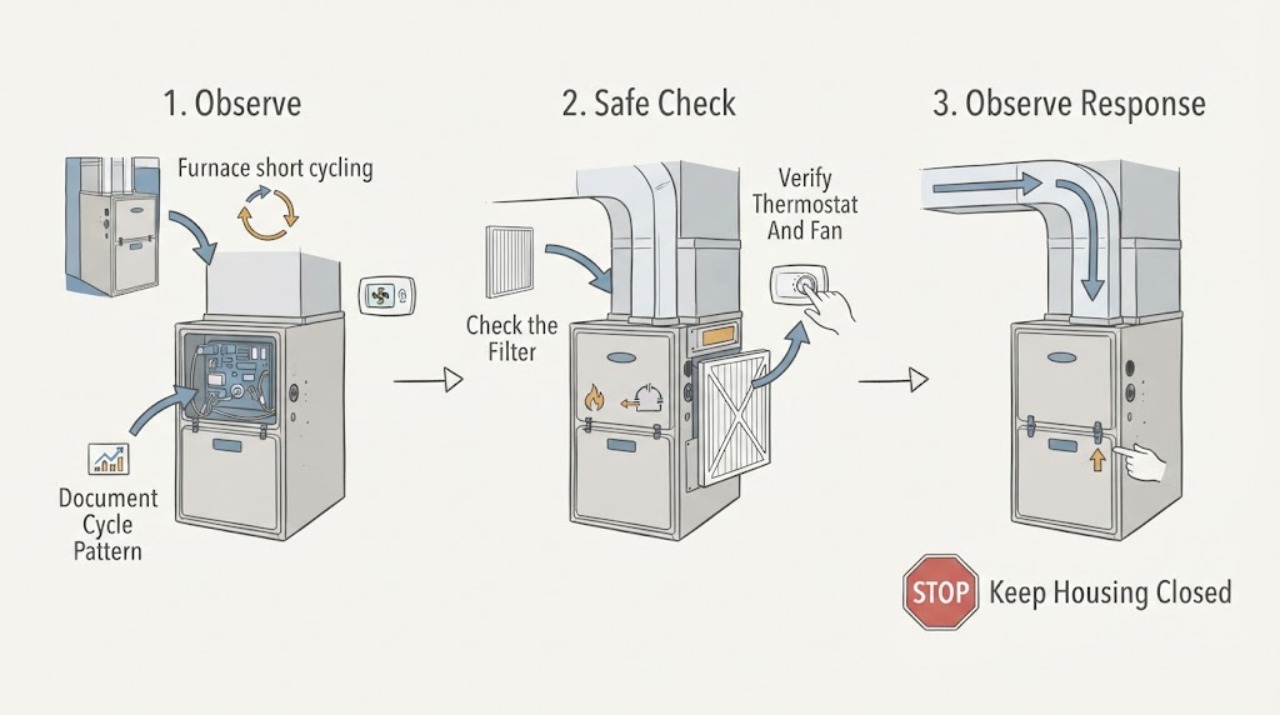
A Goodman furnace is short cycling when it starts and stops repeatedly before the home is comfortable or before a normal heating call completes. First confirm the thermostat is in Heat and the fan is not set to run continuously, then check the user-accessible filter and make sure return and supply vents are not blocked. A plugged filter or restricted ductwork can reduce airflow, overheat the furnace, and open a limit protection circuit; Goodman also notes that an oversized furnace can heat the thermostat area quickly and shut off before the rest of the home is warm. Watch one cycle from outside the closed furnace panels and record whether ignition occurs, warm air arrives, the blower continues, an alert appears, or the furnace stops and retries. Do not bypass a limit switch, alter gas pressure, open the burner compartment, test live voltage, or keep resetting a lockout. If short cycling continues after the thermostat, filter, and visible-airflow checks, or if there is gas odor, smoke, unusual flame, a CO concern, water damage, or a repeatedly tripping breaker, leave the furnace off and arrange licensed HVAC service.
Work through in order
Diagnostic checks
Use only checks that match the exact appliance or system and its official guide.
-
Check 1
During one ordinary heat request, observe from outside the closed furnace panels when the thermostat calls, whether warm air arrives, how soon the burner/heating sound stops, whether the blower continues, and whether the thermostat calls again; do not open the furnace to watch the burner.
Expected result: Record a normal completed heat call, a very brief heat call followed by blower-only air, repeated ignition attempts, a thermostat satisfied before other rooms warm, or a fault/alert after each stop.
Next step: Keep the sequence record and use the corresponding branch. Do not repeat cycles to force ignition or clear a lockout.
Stop if: Stop immediately for gas odor, smoke, unusual flame noise, burning odor, water damage, a hot electrical panel, or a repeatedly tripping breaker.
Why this matters
Why: A short heat call followed by blower-only operation makes airflow or limit protection more likely. Repeated ignition attempts make flame, ignition, gas, pressure, or control faults more likely. A thermostat satisfied quickly in one warm location makes sensing, sizing, or distribution more likely.
-
Check 2
At the thermostat, confirm Heat is selected, the setpoint is above room temperature, and the fan is set to Auto rather than continuous On when that option exists; note the thermostat location and any alert.
Expected result: Record a valid heat call with Fan Auto, Fan On, a display or sensor that seems wrong, a thermostat in a draft/sun/heat source, or a no-heat/service alert.
Next step: Correct only the mode or fan setting and observe one cycle. Do not move or rewire the thermostat as a diagnosis; arrange service if the call ends early, the display is abnormal, or the alert returns.
Stop if: Do not bridge thermostat terminals, remove wiring, or keep cycling the system when a control or electrical fault is suspected.
Why this matters
Why: Fan On can make the system seem to run continuously between heat calls. A thermostat exposed to a local warm or drafty condition can end the call before the home is evenly heated; an alert requires the model-specific service path.
-
Check 3
With the furnace not operating, inspect the user-accessible return-air filter and nearby return grille for heavy loading, collapse, wrong orientation, or an obstruction; confirm the filter is present and the access panel can close normally.
Expected result: Record a clean correctly seated filter, a plugged or collapsed filter, a missing/damaged filter, a return grille blocked by furnishings, or an inaccessible filter.
Next step: Replace the filter only with the exact model-approved size/type and restore the panel. Observe one heat call; if short cycling remains or returns, keep the furnace off and arrange HVAC service.
Stop if: Do not operate without a filter or secured access panel, stack filters, force a filter into place, or open the blower compartment.
Why this matters
Why: A plugged or overly restrictive filter can reduce airflow and contribute to a high-limit shutdown. Goodman says the filter should match the blower capacity; a clean filter does not rule out restricted ducts, blower, limit, or other faults.
-
Check 4
Check that supply registers and return grilles are open and unobstructed, and inspect visible duct connections for a detached section, crushed flexible duct, or obvious air escape without removing covers or entering the furnace.
Expected result: Record clear balanced openings, blocked registers/returns, a disconnected or crushed visible duct, one room much warmer than the thermostat room, or no safe access to the duct route.
Next step: Clear only movable items from registers and returns. Arrange licensed HVAC service for duct damage, balancing, sizing, airflow measurement, or any condition requiring duct or cabinet access.
Stop if: Do not seal a gas vent, alter duct design, cut into ductwork, move the furnace, or use the system if combustion exhaust or flue damage is suspected.
Why this matters
Why: Blocked returns or restricted supply/ductwork can change airflow and temperature around the heat exchanger. A warm thermostat area with cold rooms may also reflect sizing or distribution rather than a furnace control fault.
-
Check 5
Without removing panels, record any normal external status light or thermostat alert and inspect only the visible intake/exhaust termination and condensate area for an obvious blockage, water, icing, or damage when the model has those components.
Expected result: Record no alert and a clear dry termination, a recurring fault/lockout indication, blocked or damaged vent termination, condensate water/leak, or no safe external indication.
Next step: Write down the exact alert and keep the furnace off for a blockage, leak, or repeated lockout. Arrange licensed HVAC service for vent, condensate, combustion, or code diagnosis.
Stop if: Do not clear combustion vents with tools or heat, open the drain trap, reset a rollout/limit device, or open a panel to read a hidden code.
Why this matters
Why: A recurring code or visible vent/condensate problem can explain repeated shutdown, but status codes identify a circuit or symptom rather than proving a replaceable part. A clear exterior does not rule out an internal pressure, drain, flame, or control issue.
-
Check 6
Prepare a service handoff with the exact Goodman model and serial number, cycle pattern, thermostat mode/fan setting, filter condition and date, room temperature differences, visible airflow findings, alerts, fuel type, and any odor, noise, water, or breaker symptom.
Expected result: Confirm that only thermostat settings, filter replacement, unobstructed grille checks, and visible external observations were performed; no gas, burner, wiring, panel, limit, or live-voltage work was attempted.
Next step: Arrange licensed HVAC service for persistent short cycling, any lockout, blower-only sequence, ignition failure, airflow uncertainty, or a system that cannot heat evenly after safe checks.
Stop if: Stop all homeowner work when diagnosis requires opening the cabinet, testing energized circuits, handling gas, bypassing a safety switch, or changing duct or vent configuration.
Why this matters
Why: The pattern helps a technician separate thermostat/sizing, airflow-limit shutdown, ignition/flame proving, pressure/vent/condensate, gas supply, blower, and control problems before selecting a part.
Use your observations
Decision map
Find the observation that best matches what you see, then follow the next safe action.
-
PATH 01Next step
What you see
The blower runs between calls because Fan is On, or the thermostat reaches its setpoint in a warm/drafty location before other rooms are comfortable, with no limit or ignition alert.
Do this next
Set Fan Auto if available and record room temperatures. Arrange HVAC service for thermostat relocation, calibration, duct distribution, or sizing review rather than rewiring or replacing controls by guesswork.
-
PATH 02Next step
What you see
The furnace produces heat briefly, then stops with the blower continuing or a limit-related indication, and the filter, returns, registers, or visible ducts are restricted.
Do this next
Correct only an obvious filter or grille obstruction. Keep the furnace off and arrange licensed HVAC service if cycling persists, because blower, duct, limit, heat-exchanger, or control problems may remain.
-
PATH 03Next step
What you see
The inducer/blower sequence occurs but ignition is not sustained, the furnace retries or locks out, or the status pattern suggests flame, pressure, gas, or ignition trouble.
Do this next
Leave the furnace off and arrange licensed HVAC diagnosis. Do not relight, adjust gas pressure, clean internal burners, bypass a pressure/limit circuit, or repeatedly reset lockout.
-
PATH 04Next step
What you see
The furnace completes a short heat call, the thermostat area warms rapidly, other rooms remain cool, and no airflow restriction or safety alert is observed.
Do this next
Arrange a licensed HVAC assessment of sizing, temperature sensing, duct balance, and delivered airflow. Do not alter gas input or thermostat wiring to lengthen cycles.
-
PATH 05Next step
What you see
Short cycling is accompanied by gas odor, smoke, unusual flame/noise, CO concern or alarm, water/flood damage, burnt wiring, shock, or a breaker that trips again.
Do this next
Leave the area as appropriate, do not operate switches or the furnace, and obtain emergency or licensed professional help. Do not use a flood-damaged furnace.
Helpful context
Understand the symptom
First decide whether the cycling is actually abnormal
A furnace naturally starts and stops as the thermostat calls for heat, so the useful question is whether it stops unusually soon, fails to warm the home, or repeatedly retries. Goodman says an oversized furnace can heat the thermostat area very quickly and shut off before the whole home reaches the desired temperature. A thermostat in a draft, direct sun, or a warm spot can also end a call early. Record the thermostat and room pattern before assuming the furnace has a failed part.
Airflow restrictions are a common protection pattern
Goodman identifies the return filter and ductwork as important parts of furnace performance and notes that a restricted filter can contribute to a primary limit trip. A furnace that runs briefly, stops heating, and leaves the blower running may be protecting itself from excessive heat, but that pattern does not prove the filter is the only cause. Check the filter and visible vents without opening the unit; repeated trips need a professional diagnosis.
Ignition and combustion faults should not be reset repeatedly
If a Goodman furnace starts its draft or blower sequence but does not establish or maintain heat, the ignition, flame sensing, gas supply, pressure proving, burner, or control path may be involved. Goodman service material describes ignition lockout and limit-trip causes as technician checks. Observe the sequence and any status indication from the normal exterior viewing position, but do not open the burner compartment, adjust gas pressure, or bypass a safety circuit.
Short cycling can be an installation or sizing issue
Goodman distinguishes a furnace that is too large and shuts off quickly from one that is too small and runs continuously on cold days. Restricted or poorly sized ductwork can also change airflow and comfort. Those causes require system measurements and installation review, not a guessed thermostat or control-board replacement. Keep the service handoff focused on cycle behavior, room temperature, filter condition, airflow, and alerts.
Safety boundary
Stop conditions
- Do not operate the furnace for gas odor, smoke, unusual combustion, CO concern or alarm, water/flood damage, burning odor, sparks, shock, exposed wiring, or a repeatedly tripping breaker; leave and obtain emergency or licensed professional help as appropriate.
- Do not bypass a limit, rollout, pressure, or other safety switch; alter gas pressure; bridge thermostat terminals; open the burner/blower compartment; test live voltage; or repeatedly reset a lockout.
- Do not run without a filter or secured access panel, use tools/heat/chemicals in a vent or condensate path, alter duct or flue configuration, or select a control, flame, or gas part from short cycling alone.
Only after diagnosis
Potential parts
- furnace air filter
Consider this only when the installed filter is missing, damaged, incorrectly sized, or visibly restricted and the exact furnace instructions call for replacement; short cycling alone does not prove the filter is the sole cause.
Confirm the exact Goodman model, dimensions, orientation, filter type, and blower-airflow requirements before selection. - furnace thermostat
Consider this only after qualified diagnosis confirms inaccurate sensing, incompatible staging, or failed thermostat control after settings and airflow causes are excluded.
Confirm the exact Goodman furnace stages, heat type, wiring, control protocol, and thermostat compatibility before selection or installation. - furnace igniter or flame sensor
Consider this only when licensed HVAC diagnosis confirms failed ignition or flame proving during the observed short-cycle/lockout sequence.
Confirm the exact furnace model, ignition design, connector, mounting, and manufacturer-approved fit before selection or installation. - furnace limit switch, blower, or control board
Consider these only after qualified diagnosis identifies the component causing or failing to respond to a limit, airflow, blower, or control fault; never replace or bypass a safety device from cycling alone.
Confirm the exact model, switch rating/location, blower design, board revision, wiring, safety approvals, and manufacturer fit before replacement.
When checks do not resolve it
Need a professional?
Arrange licensed HVAC service when a Goodman furnace continues to short cycle after thermostat, filter, and visible airflow checks; when the blower continues after heat stops, a limit or lockout repeats, ignition is not sustained, the thermostat satisfies before other rooms warm, or diagnosis requires gas, burner, control, blower, vent, condensate, duct, or live-electrical access. Stop immediately for gas odor, smoke, unusual combustion, CO concern or alarm, water/flood damage, burning odor, shock, exposed wiring, or repeated breaker trips.
Have this ready
- Provide the exact Goodman model and serial number, cycle pattern, thermostat mode/fan setting and location, filter condition, room temperature differences, airflow/duct observations, alerts, fuel type, and any odor, noise, water, CO, or breaker symptom.
Common questions
FAQ
What does it mean when a Goodman furnace short cycles?
It starts and stops repeatedly before the home is evenly warm or before a normal heat call completes. Possible causes include a thermostat or fan setting, plugged filter or restricted ductwork, limit protection, ignition/flame or pressure trouble, sizing/distribution, or a control issue. Start with thermostat, filter, and visible airflow checks, then arrange service if it continues.
Can a dirty filter cause a Goodman furnace to short cycle?
Yes. Goodman identifies a plugged or restricted filter as a possible primary-limit-trip cause, and restricted airflow can make the furnace overheat and stop. Replace only the user-accessible filter with the exact approved type and secure the panel; recurring cycling needs professional diagnosis.
Could the thermostat cause a Goodman furnace to short cycle?
A fan set to On can circulate air between heating calls, and a thermostat in a warm, sunny, or drafty location can satisfy early. Set Heat and Fan Auto when available and observe one cycle. Do not rewire or relocate the thermostat as a guess; arrange service if the call still ends early.
Is an oversized Goodman furnace a cause of short cycling?
Goodman says an oversized furnace can heat the thermostat area quickly and shut off before the rest of the home reaches the desired temperature. This is an installation and distribution question that requires professional sizing and airflow review, not a gas-input adjustment by the homeowner.
When is Goodman furnace short cycling urgent?
Stop and get urgent help for gas odor, smoke, unusual combustion, CO symptoms or alarm, flood damage, burning odor, shock, exposed wiring, water near equipment, or repeated breaker trips. Keep the furnace off and do not bypass a safety control or reset a lockout repeatedly.
Read the exact guide
Official sources
- Service BulletinGoodman Manufacturing / Technical Services · Goodman service bulletin applies to the listed furnace control-board family and is used here only for general limit-trip interpretation and professional boundary; exact model documentation governs.
- HVAC Learning Center | Heating and Cooling | GoodmanGoodman Manufacturing · Goodman manufacturer education used for brand-specific short-cycle mechanisms and system-level interpretation; exact model documentation and licensed service govern.
- What type of filter should I use?Goodman Manufacturing · Goodman filter FAQ used for conditional filter and airflow interpretation; exact furnace model requirements govern.
- Seasonal HVAC MaintenanceGoodman Manufacturing · Goodman maintenance guidance used for service boundaries and component categories; exact furnace model instructions govern.
Community feedback
Share a repair observation
Share a plain-text repair observation. Accepted observations are published automatically; this page may take a moment to update.