
On this page
Start here
Quick answer
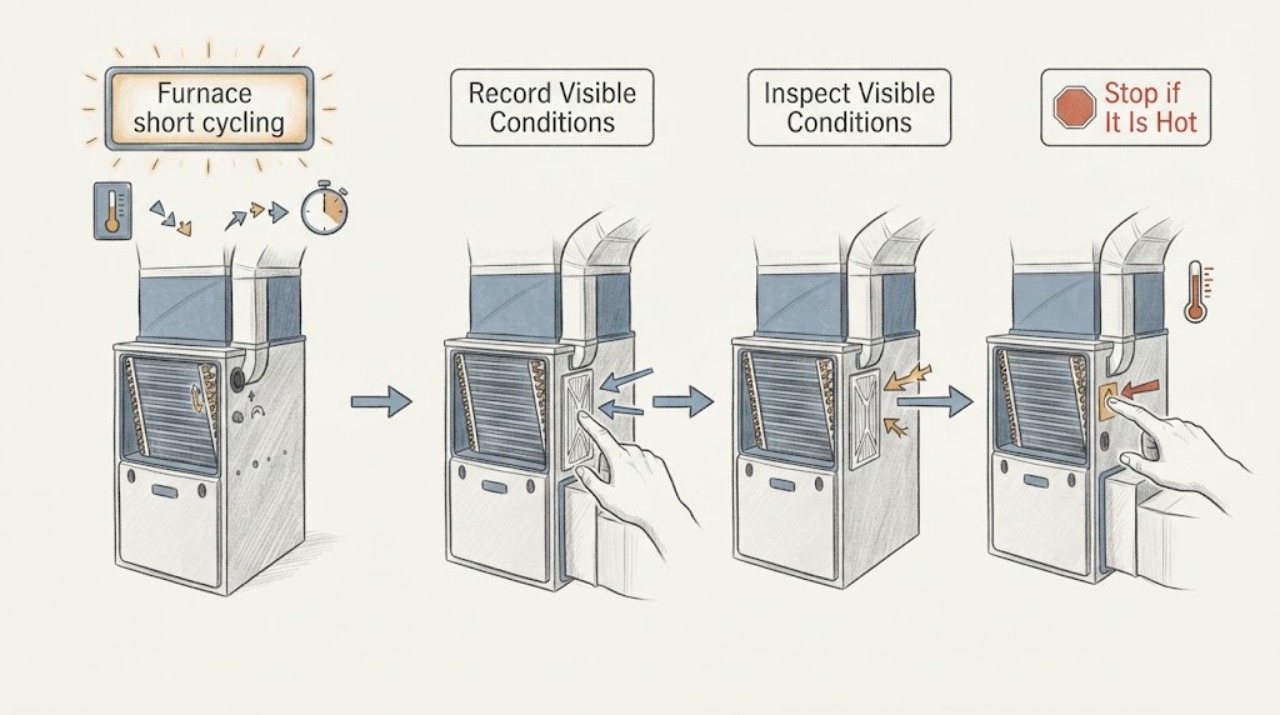
A Goodman furnace that starts and stops before the home is comfortable needs a pattern check, not a guessed coil replacement. The evaporator coil is normally part of the indoor air-handler or furnace-and-air-conditioner assembly, so a dirty filter, blocked return or supply path, restricted coil airflow, or a condensate problem can affect the furnace's heat cycle; a furnace that is simply oversized or a thermostat that is satisfied quickly is a different branch. First record the cycle pattern, thermostat call, airflow, and any visible ice or water, then inspect only the user-accessible filter and vents. Do not open the coil cabinet, handle refrigerant, force a condensate line, test high voltage, or bypass a limit or safety control. If ice is heavy or returns, the drain pan overflows, a control or gas alert appears, the breaker trips, there is a burning or gas odor, or short cycling continues after the safe airflow checks, leave the system off and arrange qualified HVAC service.
Work through in order
Diagnostic checks
Use only checks that match the exact appliance or system and its official guide.
-
Check 1
From a normal room position, record the thermostat call and the furnace sequence without opening the equipment: note when the burners or heat source stop, whether the blower continues, whether the room reaches the setpoint, and how often the pattern repeats.
Expected result: Classify the result as heat stops while the thermostat still calls, the thermostat is satisfied quickly, the blower stops unexpectedly, the unit never ignites, or an alert or safety indication appears.
Next step: Continue with the filter and visible-airflow checks only when there is no odor, smoke, alarm, or active water; keep the timing and alert information for service.
Stop if: Stop immediately for gas odor, burning smell, smoke, arcing, a carbon-monoxide alarm, or repeated safety lockout.
Why this matters
Why: Early heat shutdown with a continuing call supports an airflow, limit, ignition, control, or equipment issue. A thermostat that is satisfied quickly makes sizing, thermostat location, or normal control behavior more likely than a blocked evaporator coil.
-
Check 2
With the system off and safe to approach, inspect the user-accessible return-air filter and visible supply and return grilles; do not remove the coil cabinet or block or close additional vents.
Expected result: Record a filter that is loaded, wet, damaged, installed incorrectly, or reasonably clean, and note whether airflow is weak at several vents or only one room.
Next step: Replace a visibly dirty or damaged filter only with the size and type specified for the system, then observe one call for heat; if the furnace still short cycles or airflow remains weak, arrange service.
Stop if: Do not operate without the required filter, force a stuck filter, close more vents to change the symptom, or open the blower or coil cabinet.
Why this matters
Why: Goodman identifies clogged filters and duct or airflow problems as performance concerns. A restricted filter or broad weak airflow can contribute to overheating and early furnace shutdown; normal airflow shifts attention toward thermostat, sizing, ignition, control, or another fault.
-
Check 3
From ordinary safe access, look for visible ice on exposed tubing or the cabinet exterior, water in or under an accessible drain pan, a wet floor, or a condensate line that is visibly disconnected; do not remove panels or touch the coil.
Expected result: Classify the area as dry with no ice, light frost that is changing, heavy or returning ice, water in the pan or on the floor, or no safe view of the coil or drain.
Next step: Turn cooling off and leave the system for qualified service when ice, water, or an inaccessible coil or drain is present; do not use thawing or drain clearing as a substitute for diagnosis.
Stop if: Do not scrape ice, pour chemicals into a condensate line, open the coil cabinet, handle refrigerant tubing, or run the system with an overflowing pan or water near electrical parts.
Why this matters
Why: Heavy or returning ice can reflect inadequate airflow, a coil or refrigeration problem, or another system fault. Water or a blocked-looking condensate path can affect operation and property safety; a dry exterior does not prove the enclosed coil is clean or the drain is open.
-
Check 4
Check the thermostat mode, setpoint, fan setting, schedule, and any displayed alert without removing the thermostat or changing wiring; compare the setpoint with the room comfort and the timing of the furnace shutdown.
Expected result: Record whether the thermostat ends the call normally, calls continuously while the furnace stops, has an unusual schedule or mode, shows an alert, or changes state when the thermostat is moved by the user interface.
Next step: Correct only an obvious mode or schedule setting and observe one cycle; if the pattern remains or an alert returns, save the exact message and arrange HVAC service.
Stop if: Do not remove the thermostat, jumper terminals, change staging configuration, or bypass an alert or safety control.
Why this matters
Why: A normal end-of-call points away from a heat-limit fault and toward sizing, thermostat placement, or expected cycling. A continuing call with an early furnace stop supports an equipment, airflow, ignition, or safety branch; an alert should be interpreted from the exact model manual.
-
Check 5
After the safe checks, document the Goodman model from existing paperwork or a label accessible without opening equipment, the cycle timing, filter result, airflow pattern, ice or condensate evidence, thermostat setting, and any alert or noise.
Expected result: Confirm whether short cycling continues after the filter and visible-airflow check, whether the evaporator-coil area was inaccessible, and whether water, ice, or a safety indication returned.
Next step: Leave the system off when the fault persists or any ice, water, odor, alert, or safety trip is present and request qualified HVAC service with the recorded evidence.
Stop if: Stop testing after one failed safe check; do not keep cycling the furnace, force thawing, open equipment, or attempt refrigerant, gas, or high-voltage work.
Why this matters
Why: The record lets a technician separate sizing or thermostat behavior from airflow restriction, evaporator-coil or condensate faults, ignition or limit operation, and electrical or refrigerant diagnosis without unsafe homeowner testing.
Use your observations
Decision map
Find the observation that best matches what you see, then follow the next safe action.
-
PATH 01Safety boundary
What you see
The filter is visibly loaded or airflow is weak at several vents, and the thermostat still calls when the furnace stops.
Do this next
Install the specified filter and observe one cycle; request service if short cycling continues, airflow remains weak, or the filter becomes dirty unusually quickly.
Why this path and its safety boundary
Why it matters: Airflow restriction is plausible and can contribute to heat buildup or early shutdown, but the evaporator coil, blower, ductwork, and safety controls still need professional evaluation if the symptom remains.
Safety stop: Do not remove the coil cabinet, alter the filter type by guesswork, or close additional vents.
-
PATH 02Safety boundary
What you see
Heavy or returning ice is visible near the indoor evaporator coil or associated tubing, with weak airflow or poor comfort.
Do this next
Turn cooling off, protect the area from meltwater, and arrange licensed HVAC service to inspect airflow, coil, drain, and refrigerant circuit.
Why this path and its safety boundary
Why it matters: Airflow restriction, coil cleanliness, blower performance, condensate, or a refrigeration fault is possible; ice is not proof that refrigerant is low.
Safety stop: Do not scrape ice, add refrigerant, open the coil cabinet, or run the system repeatedly while iced.
-
PATH 03Safety boundary
What you see
Water is in the accessible condensate pan, on the floor, or the condensate drain path appears blocked or disconnected.
Do this next
Turn the system off and arrange qualified HVAC service to clear and inspect the drain and pan; protect nearby electrical equipment from water without entering the cabinet.
Why this path and its safety boundary
Why it matters: A condensate drainage or pan problem can affect the indoor coil system and cause property damage or a safety control response; it is distinct from furnace sizing.
Safety stop: Do not pour chemicals, force a pressurized drain clearing, open the pan cabinet, or run equipment with an overflowing pan.
-
PATH 04Safety boundary
What you see
The thermostat ends the call normally, the home warms quickly, airflow is normal, and no ice, water, alert, or odor is present.
Do this next
Record the pattern and ask a qualified technician to evaluate sizing, thermostat placement, staging, and temperature rise; do not alter gas input or controls.
Why this path and its safety boundary
Why it matters: Sizing, thermostat location or control behavior, or normal staging is more likely than an evaporator-coil restriction. Goodman says an oversized furnace can heat quickly and short cycle.
Safety stop: Do not adjust the gas valve, change blower wiring, or bypass a limit to lengthen a cycle.
-
PATH 05Safety boundary
What you see
The thermostat continues calling, the filter and visible airflow are reasonable, and the furnace stops heat early or shows a limit, ignition, or control alert.
Do this next
Leave the furnace off and arrange qualified HVAC diagnosis with the exact model, alert, sequence, and filter or airflow observations.
Why this path and its safety boundary
Why it matters: A furnace limit, ignition, flame-sensing, control, blower, gas, or other equipment fault is more likely than a simple accessible filter issue; the exact alert is model-specific.
Safety stop: Do not reset repeatedly, bypass a safety, open the burner or control compartment, adjust gas input, or test live wiring.
-
PATH 06Safety boundary
What you see
Gas odor, smoke, burning smell, arcing, a carbon-monoxide alarm, or possible CO symptoms occur during the short-cycling event.
Do this next
Leave for fresh air and call emergency services or the gas utility from outside or a safe neighbor location; do not reenter or operate the furnace until responders and trained personnel clear it.
Why this path and its safety boundary
Why it matters: This is a gas, combustion, electrical, or CO emergency, not a coil-cleaning or thermostat-adjustment problem.
Safety stop: Do not operate switches in a gas-odor situation, silence and ignore a CO alarm, relight burners, or search for the source inside.
Helpful context
Understand the symptom
Why an evaporator coil can matter to a furnace complaint
In a split HVAC system, the indoor evaporator coil sits in the air path with the furnace or air handler and is used for cooling. The coil itself is not a furnace burner, but a dirty or iced coil, restricted filter, blocked return, or condensate issue can reduce airflow through the shared cabinet. That can change heat delivery and safety-limit behavior. Goodman also describes furnace short cycling as a possible result of a unit that heats the home too quickly because it is oversized, so the coil should be a diagnostic branch, not an automatic parts diagnosis.
Define short cycling before changing anything
Write down whether the burners stop while the thermostat still calls for heat, whether the blower continues, whether the supply air becomes unusually hot, and whether the cycle repeats. A normal cycle ends when the thermostat is satisfied; an early shutdown with weak airflow, a visible limit or alert, or a cold return to ignition points elsewhere. A furnace that runs for a short period because the setpoint is met quickly can reflect sizing, thermostat location, or control behavior instead.
Ice and condensate change the urgency
Goodman says a clogged filter blocks airflow and that condensate drains from the indoor evaporator coil should be kept clear as part of system maintenance. Ice on an indoor coil, water in or around the pan, or a drain that backs up can indicate an airflow, coil, drain, or refrigeration problem. Turn the system off and let a qualified technician determine why ice or water formed; thawing alone does not establish a safe repair.
Refrigerant, electrical, and gas work stay professional
Goodman's maintenance list assigns refrigerant-line inspection, electrical-connection checks, drain and pan clearing, blower checks, and coil inspection to trained HVAC professionals. Do not open the evaporator-coil cabinet, recover or add refrigerant, test live circuits, adjust gas input, or defeat a furnace limit or rollout control. Stop for gas odor, burning smell, smoke, arcing, or a carbon-monoxide alarm and use the emergency boundary.
Safety boundary
Stop conditions
- Stop and leave for fresh air for gas odor, smoke, burning smell, arcing, a carbon-monoxide alarm, or possible CO symptoms; call emergency services or the gas utility from a safe location.
- Turn the system off for heavy or returning evaporator-coil ice, condensate overflow, water near electrical components, repeated lockout, or a breaker that trips again; arrange qualified HVAC service.
- Do not open the coil or burner cabinet, handle refrigerant, test high voltage, adjust gas input, bypass a limit or rollout control, or force a drain clearing.
- Do not keep cycling the furnace to reproduce short cycling after one safe observation, and do not use thawing or a filter change as proof that the underlying cause is fixed.
- Stop routine troubleshooting when the filter and visible-airflow checks do not restore a normal cycle, when the coil or drain is inaccessible, or when an alert returns.
Only after diagnosis
Potential parts
- Goodman air filter
Consider only when the installed filter is visibly dirty or damaged and the exact Goodman documentation specifies the required size and type.
Match the exact system requirements and airflow direction; a new filter does not prove the evaporator coil or furnace fault is repaired. - Goodman condensate drain or pan component
Consider only when a qualified technician confirms a damaged pan, drain component, or condensate safety issue after finding water or overflow.
Drain and pan fit are model-specific; do not force a line, drill a pan, or substitute a part without the equipment documentation. - Goodman evaporator coil or coil accessory
Consider only after licensed HVAC diagnosis confirms a coil defect or an unrepairable airflow or refrigerant-side fault; ice alone is not proof of coil failure.
Coil match, refrigerant circuit, metering device, and airflow configuration are model-specific and professional installation is required.
When checks do not resolve it
Need a professional?
Arrange qualified HVAC service when a Goodman furnace short cycles with a continuing thermostat call, heavy or returning evaporator-coil ice, condensate water, weak airflow after the specified filter change, a returning alert, a tripping breaker, abnormal blower or ignition behavior, or any need to inspect the coil, refrigerant circuit, electrical components, gas controls, or safety limits. Use emergency services or the gas utility for gas odor, smoke, a CO alarm, or possible CO symptoms.
Common questions
FAQ
Can an evaporator coil cause a Goodman furnace to short cycle?
The evaporator coil is part of the indoor air path in many split systems, so restricted airflow, icing, or condensate problems around it can affect system operation. But Goodman also identifies oversized-furnace behavior and thermostat or sizing issues as separate possibilities; coil replacement should follow a qualified diagnosis.
What should I check before calling for Goodman service?
Record the cycle pattern and thermostat call, inspect the user-accessible filter and visible vents, and look for visible ice or condensate water without opening the cabinet. Replace a dirty filter only with the specified type; persistent cycling, ice, water, alerts, or weak airflow needs qualified service.
Can I add refrigerant or open the evaporator-coil cabinet?
No. Goodman places refrigerant-line, coil, drain-pan, electrical, and blower inspection in professional maintenance work. Ice alone does not prove low refrigerant, and opening the cabinet or handling refrigerant can create electrical, pressure, and equipment hazards.
Read the exact guide
Official sources
- AC Maintenance Tips| Air Conditioner |GoodmanGoodman · Goodman filter, evaporator-coil airflow, condensate drain, and professional refrigerant or electrical inspection guidance
- HVAC Learning Center | Maintenance | GoodmanGoodman · Goodman HVAC maintenance, filter, coil, condensate, electrical, blower, and technician inspection guidance
- HVAC Learning Center | HVAC 101Goodman · Goodman furnace sizing and short-cycling explanation, evaporator-coil system function, airflow context, and professional service boundary
- Carbon Monoxide Fact SheetU.S. Consumer Product Safety Commission · Carbon-monoxide hazards from fuel-burning furnaces, alarm response, and trained-service boundary
Community feedback
Share a repair observation
Share a plain-text repair observation. Accepted observations are published automatically; this page may take a moment to update.