
On this page
Start here
Quick answer
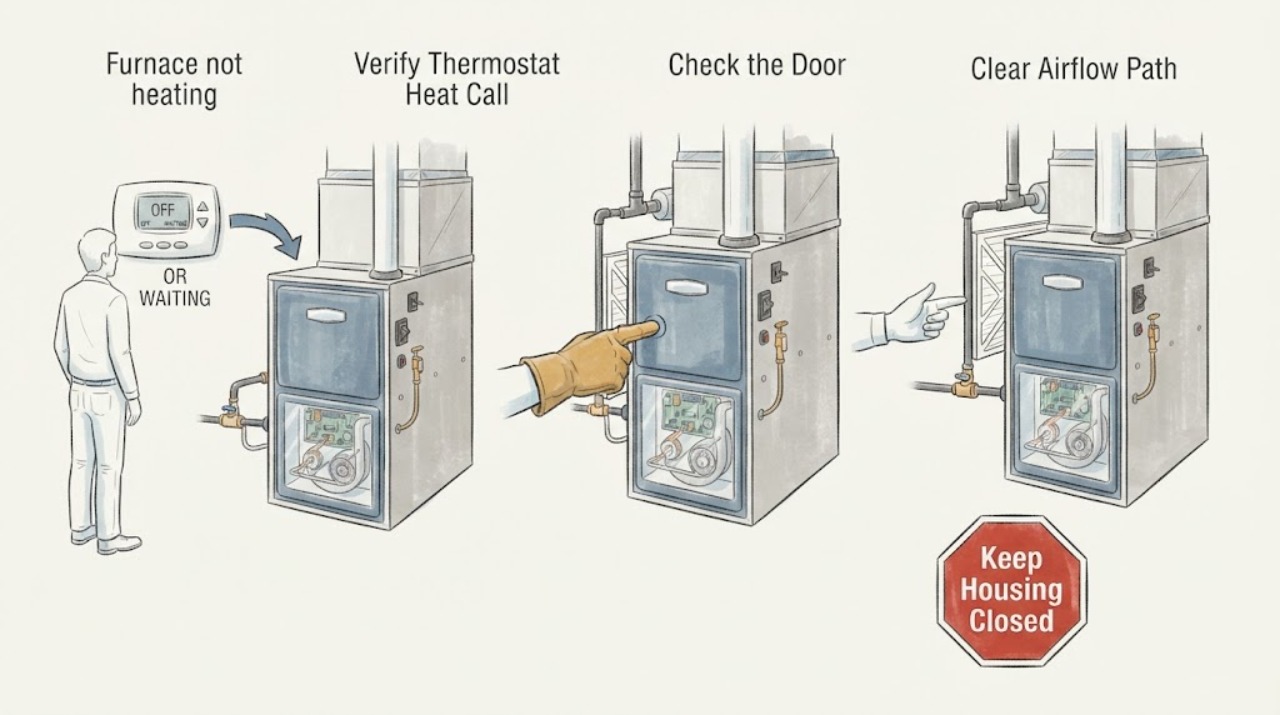
If a Lennox furnace is not heating, first confirm the thermostat is calling for heat and the fan is set to Auto, then check the furnace disconnect or breaker and the filter without opening the cabinet. A brief burst of cool air at startup can be normal while the ducts warm, but air that stays cool means the burners or electric heat are not producing or delivering heat. A plugged filter can restrict airflow and make a furnace overheat and shut off; a dirty flame sensor, ignition or gas-supply problem, blocked condensate drain on a high-efficiency unit, or control fault can also prevent heating. Observe the furnace from outside the access panels and record whether it starts, attempts ignition, runs the blower only, shows a thermostat alert, or stops again. Do not open the burner compartment, relight or adjust gas equipment without the exact Lennox instructions, test live voltage, bypass a safety switch, or repeatedly reset a lockout. If the furnace still does not heat after the thermostat, power, and filter checks, or if there is gas odor, smoke, a CO concern, water damage, unusual noise, or a recurring shutdown, leave it off and arrange licensed HVAC service.
Work through in order
Diagnostic checks
Use only checks that match the exact appliance or system and its official guide.
-
Check 1
At the thermostat, confirm the mode is Heat, raise the setpoint modestly above the room temperature, and set the fan to Auto when available; note whether the display is active and whether a heat or service alert appears.
Expected result: Record a clear heat call with fan Auto, fan On, an inactive or blank display, a no-heat alert, or a setting that will not stay selected.
Next step: Correct only the thermostat mode/fan setting or model-authorized battery issue. If the display is blank, an alert returns, or a valid heat call produces no heat, keep the system from repeated cycling and continue with the power and service branch.
Stop if: Do not remove thermostat wiring, bridge terminals, or open the furnace to force a heat call.
Why this matters
Why: Fan On can circulate cool duct air without a heating call. A blank display or thermostat alert makes controls or power more likely, while a clear heat call with no heat shifts attention to the furnace, airflow, ignition, condensate, fuel, or control path.
-
Check 2
Without opening the furnace, check that the labeled furnace disconnect is in its normal On position and that no furnace breaker is visibly tripped; observe whether the thermostat and furnace respond normally after one ordinary reset only if no hazard is present.
Expected result: Record normal thermostat power, a tripped breaker or off disconnect, a breaker that trips again, no display, or a furnace that powers up but still does not heat.
Next step: Restore a clearly off switch or breaker only once if it can be done safely and there is no odor, water, heat, or visible damage. If it trips again or heat does not return, leave it off and arrange licensed HVAC/electrical service.
Stop if: Do not remove panels, touch wiring, reset a repeatedly tripping breaker, or approach equipment with smoke, burning odor, water damage, or exposed conductors.
Why this matters
Why: An off disconnect or tripped breaker can prevent the heat sequence. A breaker that trips again, a hot or damaged disconnect, or no control power suggests an electrical or equipment fault rather than a simple setting issue.
-
Check 3
With the furnace not operating, inspect the user-accessible air filter and return-air path; note whether the filter is heavily loaded, the wrong size/orientation, missing, or seated so the access panel cannot close correctly.
Expected result: Record a clean correctly seated filter, a visibly plugged filter, an absent or damaged filter, or airflow blocked by an external obstruction.
Next step: Install or replace the filter only with the exact model-approved type and orientation, secure the access panel, and observe one normal heat call. If the furnace still does not heat or cycles off again, use the service branch.
Stop if: Do not operate without the filter or access panel, force a filter into place, change ductwork, or open the blower or burner compartment.
Why this matters
Why: A plugged filter can restrict airflow, cause overheating, and shut the furnace off. A missing or incorrectly seated filter can allow dirt into the furnace and is not a reason to run the unit without one.
-
Check 4
From outside the closed furnace panels, observe one normal heat request and record whether the inducer or blower starts, whether ignition is attempted, whether warm air arrives, and whether the furnace stops or a status/thermostat alert returns.
Expected result: Record no response, blower-only operation, repeated start attempts, heat that starts then stops, warm air followed by cool air, or a complete normal heat cycle that does not warm the home.
Next step: Record the pattern and stop repeated retries. Arrange licensed HVAC diagnosis for any failed ignition, short run, blower-only sequence, or recurring alert; do not remove an access panel to watch the burner.
Stop if: Stop immediately for gas odor, unusual flame noise, smoke, burning odor, water, unusual exhaust, or signs of unsafe combustion.
Why this matters
Why: No response suggests power, thermostat, or control issues; blower-only or repeated attempts make ignition, flame sensing, gas supply, condensate, venting, or a limit fault more likely. Heat that starts then stops points to flame proving, airflow, overheating, or safety control behavior. A normal furnace cycle with a cold room shifts attention to duct delivery or building heat loss.
-
Check 5
For a high-efficiency Lennox furnace, inspect only the visible condensate drain outlet, trap area, intake/exhaust termination, and surrounding floor for obvious blockage, standing water, a disconnected pipe, or damage; do not remove tubing or access panels.
Expected result: Record a dry clear termination and drain, visible water or leakage, a blocked or iced termination, a disconnected/cracked pipe, or no safe way to see the components.
Next step: Keep the furnace off and arrange licensed HVAC service for a blockage, leak, damage, or inaccessible drain/vent. Do not use a tool, heat source, chemical, or improvised tube to clear a combustion or condensate path.
Stop if: Do not enter a vent termination, open the combustion section, alter vent slope, work on gas piping, or continue if exhaust may be entering the home.
Why this matters
Why: Lennox says a blocked condensate line can deactivate burners, and its manual requires the venting and condensate system to be physically sound and free of obstruction. A visible blockage or leak can explain no heat, but a clear exterior does not rule out an internal drain or combustion fault.
-
Check 6
Prepare a service handoff with the exact Lennox model and serial number, thermostat setting and alert, breaker/disconnect result, filter condition, startup sequence, warm-air duration, condensate/vent observations, fuel type, and any odor, noise, leak, or CO concern.
Expected result: Confirm that only thermostat setting, safe external power observation, filter replacement, and visible external checks were performed; no gas, burner, wiring, access-panel, or live-voltage work was attempted.
Next step: Arrange licensed HVAC service for persistent no heat, an alert, repeated lockout, blower-only operation, failed ignition, or any internal diagnosis. Keep the furnace off when a hazard sign is present.
Stop if: Stop all homeowner troubleshooting when diagnosis requires opening the cabinet, testing live circuits, handling gas, bypassing a safety control, or entering a combustion/vent path.
Why this matters
Why: The sequence and timing help a technician distinguish thermostat/power loss, restricted airflow, ignition/flame proving, condensate or vent lockout, gas valve/fuel delivery, control, blower, or duct-delivery issues.
Use your observations
Decision map
Find the observation that best matches what you see, then follow the next safe action.
-
PATH 01Next step
What you see
The thermostat is set to Fan On or is not making a valid heat call, and the furnace is circulating room-temperature air without a heat sequence.
Do this next
Set Heat and Fan Auto if available and observe one normal call. If the display is blank, the setting will not hold, or the no-heat alert returns, arrange HVAC service without rewiring the thermostat.
-
PATH 02Next step
What you see
The heat call is valid but the furnace has no power, a breaker trips, the filter is plugged, or the furnace starts and stops before delivering sustained warm air.
Do this next
Correct only an obvious filter issue using the exact model guidance. Do not repeatedly reset a breaker or bypass a limit; arrange licensed HVAC/electrical service for recurrence.
-
PATH 03Next step
What you see
The blower or startup sequence occurs but there is no sustained heat, ignition is attempted repeatedly, the flame does not prove, or other gas appliances also lack fuel.
Do this next
Leave the furnace off and arrange licensed HVAC service. Do not relight, adjust, clean, or replace gas/combustion components based on sound or a guessed fault.
-
PATH 04Next step
What you see
A high-efficiency unit has visible condensate water, a blocked or damaged intake/exhaust termination, a disconnected drain, or a recurring no-heat alert after a wet-weather or freezing event.
Do this next
Keep the furnace off and arrange licensed HVAC service to inspect the full drain, trap, vent, and combustion system. Do not clear or alter a combustion path with tools or heat.
-
PATH 05Next step
What you see
There is gas odor, smoke, unusual combustion noise, CO concern, visible burnt or wet components, flood damage, a hot electrical panel, or a fault that cannot be safely observed with panels closed.
Do this next
Leave the area as appropriate, do not operate switches or the furnace, and contact emergency or licensed professional help. Do not use a flood-damaged furnace.
Helpful context
Understand the symptom
First separate normal startup air from a no-heat fault
A furnace can deliver cool air briefly when a heating cycle begins because the ductwork is cold. Lennox says that continuous cold air is not normal and recommends starting with thermostat settings, fan mode, and the filter. Set the thermostat to Heat and the fan to Auto if those controls are available; a fan set to On can circulate room-temperature air even when the furnace is not heating. If the air never becomes warm or the system stops before heat arrives, use the checks below rather than waiting through repeated cycles.
A clean filter is a useful check, not a diagnosis
Lennox explains that a dirty filter restricts airflow, can make the furnace overheat, and can cause it to shut off. Replace or clean only the user-accessible filter with the type and orientation specified for the exact unit; do not run a furnace without its filter or with an access panel unsecured. If a new filter does not restore heat, or the furnace repeatedly starts and stops, the airflow may be only one part of the fault and professional testing is needed.
Ignition, flame, condensate, and fuel faults need a service boundary
A Lennox furnace may fail to heat when an older pilot is out, an electronic igniter or flame detector fails, a gas valve does not open, or a high-efficiency condensate line is blocked. Lennox also notes that a furnace can shut down when gas supply is insufficient and that condensate blockage can deactivate burners. These clues can be observed from the thermostat and the outside of the equipment, but burner, gas-valve, combustion, electrical, and internal drain work belongs to a licensed HVAC professional.
Use alerts and timing to give the technician a useful pattern
A Lennox thermostat may display a Service Urgent alert for no heat, no cool, or no ventilation, and Lennox says that alert requires service by a licensed HVAC contractor. Note the exact alert or warning text, when the blower starts, whether ignition is attempted, whether warm air ever arrives, and how long the furnace runs before stopping. This separates a thermostat or power issue from a filter/airflow limit, ignition or flame-sensing failure, condensate/vent problem, or control fault without opening the furnace.
Safety boundary
Stop conditions
- Do not operate the furnace for gas odor, smoke, unusual combustion, CO concern or alarm, water/flood damage, burning odor, sparks, shock, exposed wiring, or a hot/damaged disconnect; leave and obtain emergency or licensed professional help as appropriate.
- Do not open access panels during operation, test live voltage, bridge thermostat terminals, relight or adjust gas equipment, bypass a limit or pressure switch, or clean/replace burner, flame-sensing, gas-valve, or combustion parts as a casual homeowner check.
- Do not run without a filter or secured access panel, repeatedly reset a breaker or lockout, use tools/chemicals/heat in a condensate or vent path, or use a furnace after flooding.
Only after diagnosis
Potential parts
- furnace air filter
Consider this only when the installed filter is missing, damaged, incorrectly sized, or visibly loaded and the exact unit instructions call for replacement; no-heat symptoms alone do not prove the filter is the only cause.
Confirm the exact Lennox model, filter dimensions, orientation, and manufacturer-approved filter type before selection. - furnace igniter or flame sensor
Consider this only after licensed HVAC diagnosis confirms failed ignition or flame proving with the thermostat, airflow, condensate, fuel, and safety paths checked.
Confirm the exact furnace model, ignition design, connector, mounting, and manufacturer-approved fit before selection or installation. - furnace condensate drain or trap component
Consider this only when qualified service confirms a cracked, blocked, or failed condensate component that is preventing safe heating operation.
Confirm the exact furnace model, drain/trap configuration, tubing connections, venting relationship, and manufacturer instructions before selection. - furnace gas valve or control board
Consider this only after licensed HVAC diagnosis confirms the valve or control is not delivering the required ignition/heating sequence; no heat alone does not identify either part.
Confirm the exact model, fuel type, electrical and gas specifications, control revision, safety approvals, and manufacturer fit before replacement.
When checks do not resolve it
Need a professional?
Arrange licensed HVAC service when a Lennox furnace remains cold after thermostat, power, and filter checks; when ignition is not sustained, the blower runs without heat, a no-heat alert or lockout returns, condensate/venting is blocked or inaccessible, or diagnosis requires a cabinet, burner, gas valve, wiring, combustion, or live-electrical test. Stop immediately for gas odor, smoke, unusual combustion, CO symptoms or alarm, water/flood damage, burning odor, sparks, shock, or a repeatedly tripping breaker. Do not bypass safety controls or keep resetting a failed furnace.
Have this ready
- Provide the exact Lennox model and serial number, thermostat mode/fan setting and alert text, breaker/disconnect result, filter condition, startup sequence, warm-air timing, condensate/vent observations, fuel type, and any odor, noise, leak, water, CO, or breaker symptom.
Common questions
FAQ
Why is my Lennox furnace not heating?
Possible causes include a thermostat or fan setting, loss of power, a plugged filter and airflow shutdown, ignition or flame-sensing failure, low fuel supply, a blocked condensate line on a high-efficiency model, duct damage, or a control fault. Start with thermostat, power, and filter checks, then arrange licensed HVAC service for persistent no heat.
Is cool air briefly normal when a Lennox furnace starts?
A short burst of cool air can be normal while cold duct air is displaced. If the air stays cool, the furnace stops before heating, or the blower runs continuously with Fan On, check Heat/Fan Auto and the filter; continuous cold air needs further diagnosis.
Can a dirty filter make a Lennox furnace stop heating?
Yes. Lennox says a dirty filter restricts airflow and can make the furnace overheat and shut off. Replace or clean only the user-accessible filter using the exact model instructions, keep the access panel secured, and arrange service if heating does not return or shutdown repeats.
What does it mean if my Lennox furnace blower runs but there is no heat?
Blower-only operation can occur when the thermostat fan is On, but with a valid heat call it can also point to ignition, flame sensing, gas supply, condensate, airflow-limit, or control problems. Record the sequence without opening panels and arrange licensed HVAC service rather than bypassing a safety device.
When is a Lennox no-heat problem urgent?
Treat gas odor, smoke, unusual combustion, CO symptoms or alarm, water or flood damage, burning odor, sparks, shock, exposed wiring, or a repeatedly tripping breaker as urgent. Do not operate switches or the furnace in a suspected gas or electrical hazard; clear the area as appropriate and get emergency or licensed professional help.
Read the exact guide
Official sources
- How to fix furnace blowing cold airLennox · Lennox consumer furnace guidance used for brand-specific no-heat triage; exact model manuals and licensed service govern.
- What are alerts and notifications and what do they mean?Lennox Support Center · Lennox support guidance used for alert interpretation; alert availability and display vary by thermostat model.
- What is a Furnace Gas Valve?Lennox · Lennox gas-valve guidance used for conditional internal-fault and safety boundaries; fuel and model-specific work requires licensed HVAC service.
- MaintenanceLennox · Lennox furnace manual used for model-family safety and service checks; the manual for the exact furnace controls.
Community feedback
Share a repair observation
Share a plain-text repair observation. Accepted observations are published automatically; this page may take a moment to update.