
On this page
Start here
Quick answer
If a deadbolt works with the door open but rubs, stops short, or only locks when the door is pushed, pulled, or lifted, the bolt and the strike opening are probably out of alignment. A lawful owner can compare the lock open and closed, note visible contact marks and door movement, and then give those observations to a locksmith. Do not force the key or thumbturn, leave a door that cannot be secured in service, or attempt any bypass or destructive entry.
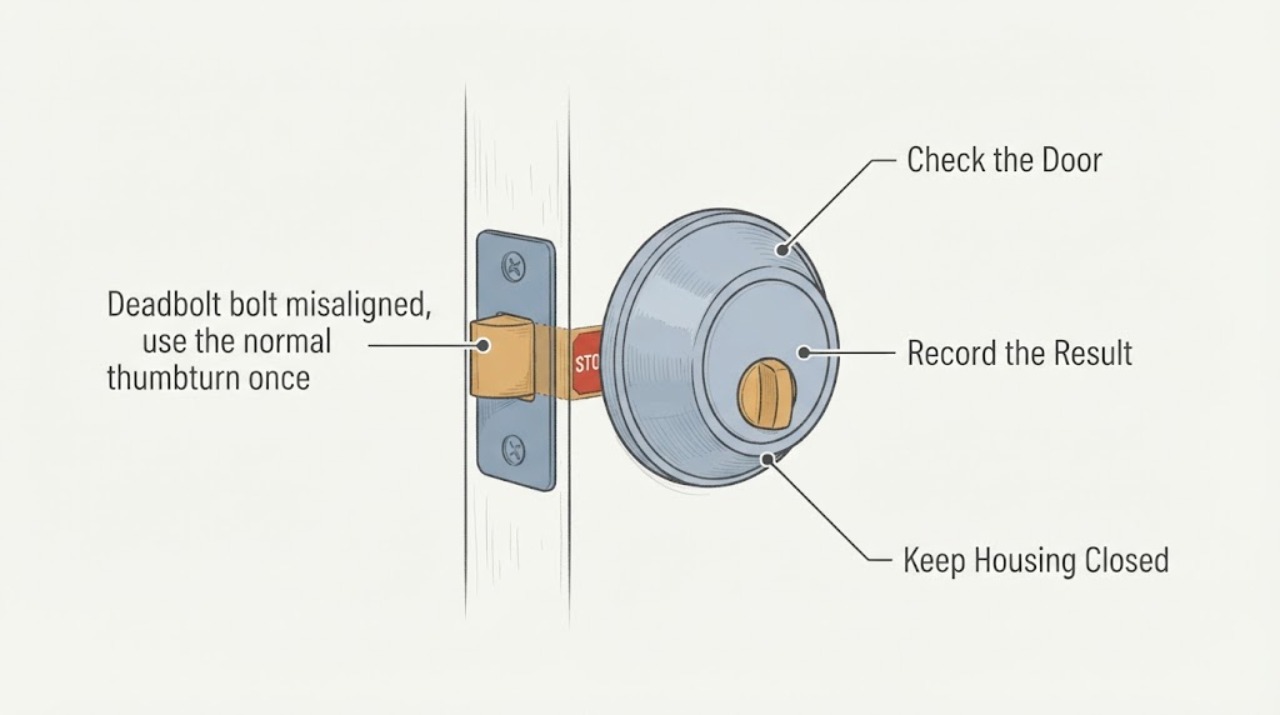
Work through in order
Diagnostic checks
Use only checks that match the exact appliance or system and its official guide.
-
Check 1
With the door open and while standing on the secure interior side, use the normal thumbturn once to extend and retract the deadbolt without force.
Expected result: Note whether the bolt travels smoothly through its full visible movement, stops partway, or makes the thumbturn or key feel unusually tight.
Next step: Leave the door open or unlocked and record which result occurred; arrange a locksmith assessment if movement is not smooth with the door open.
Stop if: Stop immediately if the thumbturn or key needs force, the bolt jams, or the door could become locked with no safe exit.
Why this matters
Why: Smooth movement with the door open but not when closed points toward door-to-frame or strike alignment. Binding with the door open points toward the lock body or its hardware and is not a reason to keep forcing it.
-
Check 2
Close the door normally and make one gentle inside lock-and-unlock attempt, without slamming, pushing, pulling, or lifting the door.
Expected result: Observe whether the bolt enters the strike opening cleanly, touches one side or the top or bottom, stops short, or retracts only after the door is moved.
Next step: Keep the door in the position that preserves safe egress, note the direction of contact, and give that observation to a locksmith rather than trying to enlarge or reshape the opening.
Stop if: Stop using the lock if it will not retract smoothly, the door cannot be opened from inside, or the bolt remains only partly engaged.
Why this matters
Why: Contact or a partial extension only with the door closed is consistent with an alignment issue, but it does not identify whether the door, frame, strike or hinges are responsible.
-
Check 3
From the room side, visually compare the bolt face, strike plate, door edge and frame; look only for visible offset, fresh rub marks, chipped finish, a shifted plate, or a loose-looking fastener.
Expected result: Record whether marks cluster on one edge and whether the door and frame still appear even when closed. Do not remove the plate, drill, chisel, pry, or probe the bolt pocket.
Next step: Take a photo from a safe, open-door position if useful and report the location and direction of the mark; do not make a hardware adjustment based only on the photo.
Stop if: Stop if the frame is split, the strike or bolt is loose, sharp damage is present, or the door no longer provides a dependable secure closure.
Why this matters
Why: A localized rub mark can show where contact occurs, while no visible mark does not rule out movement inside the frame. Visible frame damage or a plate that is no longer secure needs professional evaluation.
-
Check 4
Open and close the door gently while observing the hinge-side gap, latch-side gap, and any visible weather seal, and note whether the problem occurs only in particular weather or seasons.
Expected result: Note any need to lift, pull, or push the door, a changing gap, a swollen-looking edge, or weather stripping that visibly compresses the door against the frame.
Next step: Record when the symptom appears and ask a locksmith to assess the alignment and the condition of the door and frame together.
Stop if: Stop if the door drags badly, an exit path is compromised, the frame is visibly damaged, or repeated operation increases resistance.
Why this matters
Why: A changing gap or a problem tied to temperature or moisture can indicate door, hinge, or frame movement. A seal that obstructs closure can contribute to resistance, but these observations do not establish a repair method or a safe amount of adjustment.
-
Check 5
Confirm, without repeated cycling, whether the door can close and secure with normal light hand operation while a lawful occupant still has a safe way out.
Expected result: Answer yes if the bolt fully engages and retracts normally; answer no if it only partly engages, requires force, cannot be secured, or could leave someone locked in or out.
Next step: Keep the door unlocked only when that is safe for the property and occupants, use another lawful access route if available, and provide the locksmith with the prior observations.
Stop if: Stop all troubleshooting and seek urgent professional help if there is no safe egress, the door is stuck, or the lock cannot be left in a secure and predictable state.
Why this matters
Why: A no result is a security and access concern, not a cue to defeat the lock. The lock should be kept out of service until an authorized locksmith can inspect it.
Use your observations
Decision map
Find the observation that best matches what you see, then follow the next safe action.
-
PATH 01Next step
What you see
The bolt is smooth with the door open but binds only when the door is closed.
Do this next
Treat this as a door-to-frame, strike, hinge, or seal alignment symptom and arrange professional adjustment; do not reshape the opening yourself.
-
PATH 02Next step
What you see
The bolt binds or stops with the door open.
Do this next
Keep the lock out of service and have a locksmith assess the bolt, lock body, installation tension, and compatible hardware.
-
PATH 03Next step
What you see
The door must be pushed, pulled, or lifted, or the bolt enters only partly.
Do this next
Stop forcing the lock, preserve safe egress, and request a locksmith assessment of the door, hinges, frame and strike as a system.
-
PATH 04Next step
What you see
The door cannot be opened safely from the occupied side or cannot be secured reliably.
Do this next
Stop testing and contact an authorized locksmith or appropriate emergency service for the immediate access or safety risk.
-
PATH 05Next step
What you see
The symptom is seasonal or follows visible moisture, swelling, or frame movement.
Do this next
Document the timing and visible changes and have the door and frame assessed before selecting any replacement part.
Helpful context
Understand the symptom
Start with a safe comparison
Keep the door open for the first test so a binding bolt cannot trap anyone. A smooth open-door test followed by resistance only when the door is closed points toward the relationship between the door, frame, strike and weather seal, rather than proving that one part needs replacement. The checks below are observations for a lawful owner; they are not an entry or lock-defeat procedure.
What the pattern usually tells you
A door that needs a lift or a hard pull may be sagging or pressing the bolt against one edge of the strike. A problem that changes with season or moisture can involve the door or frame moving. If the bolt binds even while the door is open, the lock hardware itself needs professional assessment.
Only after diagnosis
Potential parts
- strike plate
Consider this only if a locksmith confirms that the existing strike is damaged, loose, or incompatible after the alignment cause is identified.
Match the lock brand and model, door/frame preparation, finish, and security requirements before ordering. - door hinge screws
Consider these only if a professional finds loose or damaged hinge hardware contributing to door sag; visible misalignment alone does not prove the screws are the cause.
Confirm the hinge type, screw dimensions, frame material, and load requirements with the installer or locksmith. - deadbolt replacement
Consider a replacement only if the bolt binds with the door open or the locksmith confirms internal wear, damage, or an incompatible lock body.
Verify door thickness, backset, handing, cylinder style, finish, and the exact manufacturer's fit information.
When checks do not resolve it
Need a professional?
Call an authorized locksmith when the bolt binds with the door open, remains partly extended, the door needs force to lock, the frame or strike is damaged, or reliable security and safe egress are uncertain.
Have this ready
- Provide the lock type, whether it moves smoothly with the door open, where contact appears when closed, whether the symptom changes with weather, and any safe interior-side photos.
Common questions
FAQ
Why does the deadbolt work with the door open but bind when the door is closed?
That pattern usually points to the relationship between the door, frame, strike, hinges, or weather seal. It does not by itself identify which item needs adjustment, so record the contact direction and have a locksmith assess the closed-door alignment.
Should I push or lift the door while turning the deadbolt?
No. Needing force is useful evidence of a possible alignment or sag symptom, but repeated force can damage the lock or leave the door unpredictable. Stop the test and arrange professional service.
Can I move the strike plate myself?
This workflow is limited to safe observation. Do not remove, drill, chisel, or reshape the strike or frame; have an authorized locksmith determine whether adjustment is appropriate and whether the door still meets the property's security needs.
When is a misaligned deadbolt urgent?
Treat it as urgent when the door cannot be secured, the bolt remains partly engaged, the key or thumbturn binds, the frame is damaged, or someone could be trapped without safe egress. Keep the lock out of service and contact an authorized locksmith or emergency service appropriate to the immediate risk.
Read the exact guide
Official sources
- How to install a deadbolt lockSchlage · Manufacturer guidance for checking smooth bolt movement and recognizing strike or doorjamb alignment symptoms.
- How to fix a door that won't latchSchlage · Manufacturer discussion of seasonal movement, weather stripping, strike contact, and door sag as possible alignment factors.
- Support for Latch IssuesKwikset · Manufacturer support examples distinguishing open-door operation from closed-door binding caused by latch and strike misalignment.
Community feedback
Share a repair observation
Share a plain-text repair observation. Accepted observations are published automatically; this page may take a moment to update.