
On this page
Start here
Quick answer
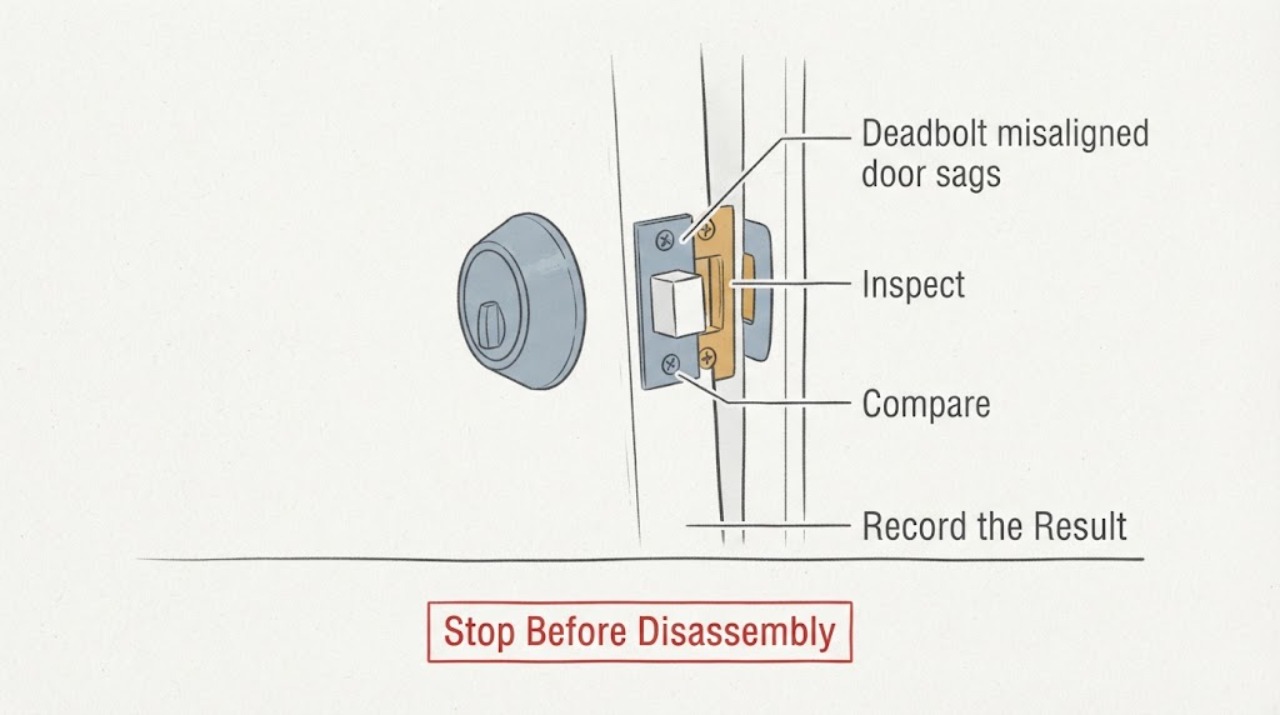
When a door sags and the deadbolt is misaligned, first check from the secure side whether the door must be lifted, pushed, or pulled for the bolt to meet the strike. Record where the bolt rubs and whether the door gap or hinge side has shifted, but do not force the lock or remove hardware. A qualified locksmith should confirm whether the cause is hinge or frame movement, strike alignment, or the deadbolt itself before any part is selected.
Work through in order
Diagnostic checks
Use only checks that match the exact appliance or system and its official guide.
-
Check 1
From the secure side of the closed door, observe whether the door sits low or shifts at the latch edge, and whether the deadbolt lines up with the strike without pushing, pulling, or lifting the door. Do not remove the lock or hardware.
Expected result: The door may close and lock smoothly, require lifting or pushing, rub at the top or bottom of the strike, or remain inaccessible for a safe comparison.
Next step: Photograph the door gap, latch edge, and strike area from safe positions, record whether force is needed, and continue only without forcing the bolt.
Stop if: Stop for instability, smoke, flames, gas odor, exposed electricity, active flooding, contamination, sharp or moving material, or unsafe access.
Why this matters
Why: If the door must be lifted or pushed to align the bolt, door sag or hinge movement may be driving the misalignment; if the door is level but the bolt still rubs, the strike or frame path needs a different assessment.
-
Check 2
Compare accessible adjacent surfaces, controls, or a nearby normal area without removing covers or changing settings. This check concerns the the deadbolt on the sagging door.
Expected result: The result may be normal, localized, intermittent, widespread, or accompanied by a second defect.
Next step: Photograph and record the result, then continue only while the area remains safe; otherwise arrange professional service.
Stop if: Stop for instability, smoke, flames, gas odor, exposed electricity, active flooding, contamination, sharp or moving material, or unsafe access.
Why this matters
Why: The result helps distinguish a misaligned deadbolt from a broader system, access, compatibility, or safety issue.
-
Check 3
Observe one normal use or environmental cycle from a clear position and note timing and response. This check concerns the the deadbolt on the sagging door.
Expected result: The result may be normal, localized, intermittent, widespread, or accompanied by a second defect.
Next step: Photograph and record the result, then continue only while the area remains safe; otherwise arrange professional service.
Stop if: Stop for instability, smoke, flames, gas odor, exposed electricity, active flooding, contamination, sharp or moving material, or unsafe access.
Why this matters
Why: The result helps distinguish a misaligned deadbolt from a broader system, access, compatibility, or safety issue.
-
Check 4
Find the accessible model, material, finish, installation, or prior-repair information without removing the item. This check concerns the the deadbolt on the sagging door.
Expected result: The result may be normal, localized, intermittent, widespread, or accompanied by a second defect.
Next step: Photograph and record the result, then continue only while the area remains safe; otherwise arrange professional service.
Stop if: Stop for instability, smoke, flames, gas odor, exposed electricity, active flooding, contamination, sharp or moving material, or unsafe access.
Why this matters
Why: The result helps distinguish a misaligned deadbolt from a broader system, access, compatibility, or safety issue.
-
Check 5
Look for recurrence, spread, related odor, staining, pests, discomfort, or loss of service without disturbing damaged material. This check concerns the the deadbolt on the sagging door.
Expected result: The result may be normal, localized, intermittent, widespread, or accompanied by a second defect.
Next step: Photograph and record the result, then continue only while the area remains safe; otherwise arrange professional service.
Stop if: Stop for instability, smoke, flames, gas odor, exposed electricity, active flooding, contamination, sharp or moving material, or unsafe access.
Why this matters
Why: The result helps distinguish a misaligned deadbolt from a broader system, access, compatibility, or safety issue.
-
Check 6
Combine the observations to choose monitoring, verified compatibility, or a professional service call. This check concerns the the deadbolt on the sagging door.
Expected result: The result may be normal, localized, intermittent, widespread, or accompanied by a second defect.
Next step: Photograph and record the result, then continue only while the area remains safe; otherwise arrange professional service.
Stop if: Stop for instability, smoke, flames, gas odor, exposed electricity, active flooding, contamination, sharp or moving material, or unsafe access.
Why this matters
Why: The result helps distinguish a misaligned deadbolt from a broader system, access, compatibility, or safety issue.
Use your observations
Decision map
Find the observation that best matches what you see, then follow the next safe action.
-
PATH 01Next step
What you see
The the deadbolt on the sagging door symptom is localized and no immediate hazard is visible.
Do this next
Document it and obtain a verified model- or material-appropriate repair assessment.
-
PATH 02Next step
What you see
The the deadbolt on the sagging door symptom repeats, spreads, or affects another system.
Do this next
Stop nonessential use and arrange qualified Locksmith service.
-
PATH 03Next step
What you see
The model, material, prior repair, or exact cause of the deadbolt on the sagging door is unknown.
Do this next
Use photos and accessible labels for professional diagnosis; do not force a generic replacement.
-
PATH 04Next step
What you see
The the deadbolt on the sagging door issue involves smoke, fire, gas, live electrical parts, flooding, falling material, contamination, or lost safety function.
Do this next
Leave or stop use and contact emergency or qualified service support.
Helpful context
Understand the symptom
Start with safe evidence
A deadbolt on a sagging door can have more than one cause. Record accessible visual evidence, timing, surrounding conditions, and identity; use a professional when the cause or safety boundary is uncertain.
Safety boundary
Stop conditions
- Do not perform work requiring live electrical, gas, pressurized, structural, contaminated, confined-space, elevated, or moving-system access.
- Do not open, disconnect, pry, cut, drill, mix chemicals, or force parts when cause or compatibility is unknown.
- Stop for smoke, flames, gas odor, sparking, active flooding, structural instability, severe contamination, or a failed safety function.
- Keep people and pets clear and use qualified service when the repair crosses the safety boundary.
Only after diagnosis
Potential parts
- strike-plate
Consider only after the a misaligned deadbolt cause and compatibility are confirmed.
Match exact model, dimensions, material, environment, and professional guidance. - door-hinge-screws
Consider only after the a misaligned deadbolt cause and compatibility are confirmed.
Match exact model, dimensions, material, environment, and professional guidance. - deadbolt-replacement
Consider only after the a misaligned deadbolt cause and compatibility are confirmed.
Match exact model, dimensions, material, environment, and professional guidance.
When checks do not resolve it
Need a professional?
Arrange normal Locksmith service when a sagging door requires lifting, pushing, or pulling for the deadbolt to lock, the bolt continues to rub, the door or frame has shifted, or the cause cannot be identified safely. Provide photos, alignment observations, timing, labels, and prior repair history.
Common questions
FAQ
What should I check first when a sagging door misaligns the deadbolt?
From the secure side, observe whether the door sits low or must be lifted, pushed, or pulled for the bolt to meet the strike. Photograph the alignment and do not force or disassemble the lock.
Can normal operation rule out the problem?
No. Hidden or intermittent faults can coexist with one normal observation; repeat symptoms or spread warrant professional diagnosis.
Should I buy a generic replacement part?
Only after exact model or material and cause are confirmed; verify fitment with the manufacturer or professional.
When should I stop using it?
Stop for smoke, fire, gas odor, sparking, flooding, structural movement, contamination, uncontrolled motion, or lost safety function.
What should I tell the technician?
Provide photos, timing, behavior, labels or material details, surrounding observations, prior repairs, and access or safety concerns.
Read the exact guide
Official sources
- How to fix a door that won’t latch.Schlage · Schlage’s general guidance identifies door sag, hinge movement, and strike alignment as possible causes of a deadbolt that does not latch; the exact lock and door condition control.
Community feedback
Share a repair observation
Share a plain-text repair observation. Accepted observations are published automatically; this page may take a moment to update.