
On this page
Start here
Quick answer
A deadbolt that binds as seasons change usually reflects door, frame, strike, hinge, or weatherstrip movement. Test only with the door open and the bolt unloaded, then observe whether the bolt is smooth; do not force the key, enlarge the pocket, or defeat a lock. If alignment remains difficult or the door must be pushed, lifted, or pulled, arrange locksmith service.
Before you begin
Safety first
- Observation-focused guidance; locksmiths handle alignment, strike, hinges, cylinder, and security repairs.
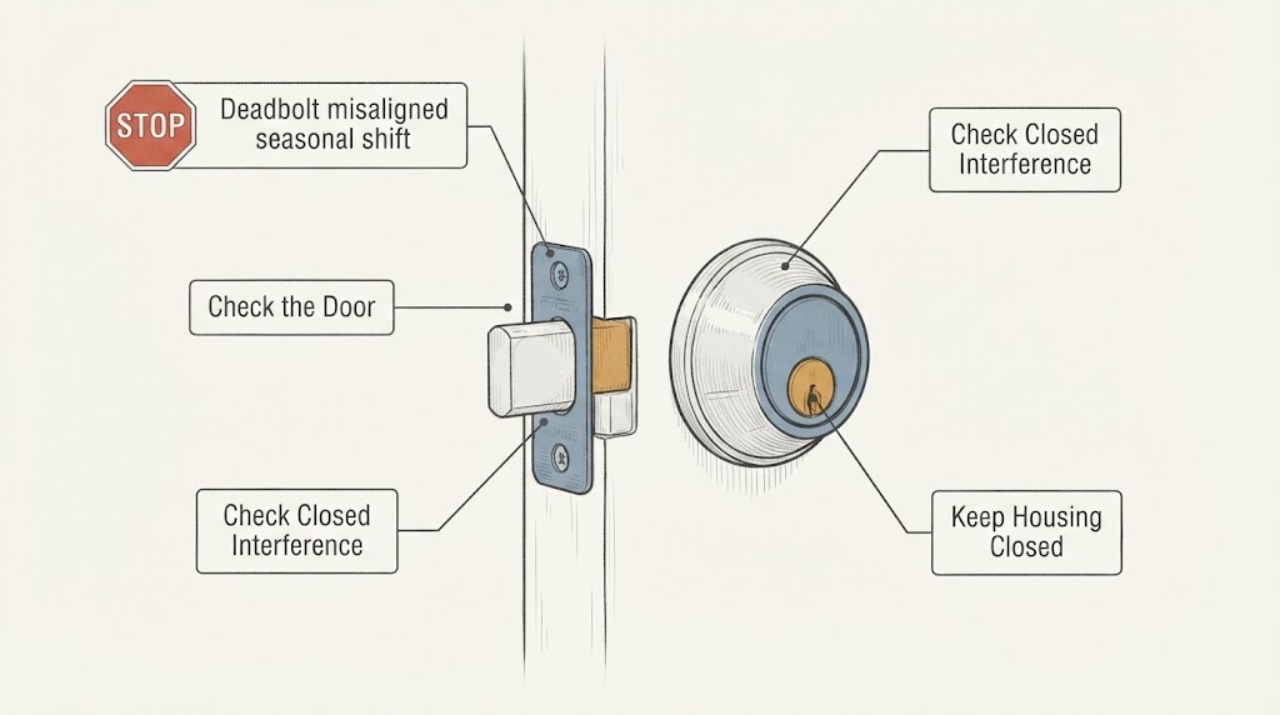
Work through in order
Diagnostic checks
Use only checks that match the exact appliance or system and its official guide.
-
Check 1
With the door fully open and hands clear of the latch edge, turn the key or thumbturn gently to observe the bolt; do not force it or test under pressure.
Expected result: The bolt extends and retracts smoothly; it binds with the door open; or the lock cannot be tested safely.
Next step: Keep the door usable only if safe and arrange locksmith assessment when binding persists.
Stop if: Stop for a seized key, broken hardware, or any force requirement.
Why this matters
Why: Smooth open-door movement points toward door/frame alignment, while binding with the door open suggests lock hardware or a separate mechanical fault.
-
Check 2
Close the door without locking and observe whether the latch and door fit evenly; do not push, pull, or lift the door while turning the bolt.
Expected result: The bolt meets the strike at the top, side, or bottom; the door must be moved; or alignment is normal.
Next step: Record the contact direction and have the strike, hinges, and frame assessed.
Stop if: Do not chisel, drill, or move strike hardware as a test.
Why this matters
Why: Contact at one edge or a need to move the door supports seasonal frame or hinge alignment, but it does not identify which adjustment is safe.
-
Check 3
Look at the visible weatherstrip and frame for compression, swelling, gaps, or rubbing without removing trim or seal material.
Expected result: Weatherstrip is compressed, newly installed, damaged, or appears unrelated to the interference.
Next step: Photograph the condition and provide it to a locksmith.
Stop if: Stop for damaged frame, loose hinges, or a need to remove trim.
Why this matters
Why: A thick or shifted weatherstrip can affect fit, while a normal seal leaves hinges, frame movement, and strike alignment in scope.
-
Check 4
Record when binding appears, including humid, dry, hot, or cold periods, and whether the door was recently painted, weatherstripped, or repaired; do not force operation.
Expected result: The issue is seasonal, sudden after work, gradually worsening, or unexplained.
Next step: Share the timeline and contact direction for service.
Stop if: Stop for a stuck key, damaged cylinder, or inability to secure the door safely.
Why this matters
Why: Seasonal recurrence supports movement-related alignment review, while a sudden change after work may indicate shifted hardware. Neither pattern justifies forcing the lock.
Use your observations
Decision map
Find the observation that best matches what you see, then follow the next safe action.
-
PATH 01Safety boundary
What you see
Does the bolt bind even with the door open?
Do this next
Stop forcing it and arrange locksmith service for the lock hardware.
Why this path and its safety boundary
Safety stop: Do not force or disassemble the cylinder.
-
PATH 02Safety boundary
What you see
Must the door be pushed, pulled, or lifted to lock?
Do this next
Arrange assessment of hinges, frame, strike, and seasonal movement.
Why this path and its safety boundary
Safety stop: Do not enlarge the pocket or move hardware as a test.
-
PATH 03Safety boundary
What you see
Does weatherstrip visibly compress or rub the door?
Do this next
Provide the finding for compatible adjustment or replacement.
Why this path and its safety boundary
Safety stop: Do not remove trim or seal material.
-
PATH 04Safety boundary
What you see
Can the door be secured without force?
Do this next
Avoid repeated testing and arrange service if recurrence continues.
Why this path and its safety boundary
Safety stop: Do not leave a forced or partially engaged lock as the security solution.
Helpful context
Understand the symptom
Seasonal alignment can change the lock geometry
Schlage notes that temperature or moisture can change door fit and that a bolt dragging on the strike or doorjamb indicates an alignment issue. The amount and direction of movement vary by door and frame, so do not assume one adjustment fits every season.
Use an unloaded observation
Keep the door open for a brief key or thumbturn observation only if the hardware is accessible and safe. Never force a key or bolt, and do not enlarge a strike pocket as a first diagnostic step.
Only after diagnosis
Potential parts
- deadbolt strike plate
Consider this only after a locksmith confirms the strike and frame are compatible and the correct contact point is known.
Match the lock, frame, and security requirements; do not enlarge the pocket or alter the frame without assessment. - door weatherstrip
Consider this only if weatherstrip interference is confirmed and the correct profile is known.
Match the door and frame and avoid a seal that prevents smooth bolt travel.
When checks do not resolve it
Need a professional?
Arrange locksmith service when the deadbolt binds open or closed, the door must be moved to lock, seasonal misalignment recurs, a key is stuck, hardware is damaged, or the door cannot be secured without force.
Safety scope: Observation-focused guidance; locksmiths handle alignment, strike, hinges, cylinder, and security repairs.
Have this ready
- Open-door versus closed-door behavior
- Bolt contact direction and whether pushing, pulling, or lifting is needed
- Weatherstrip, hinge, frame, and strike observations
- Seasonal and recent repair history
- Any stuck key or damaged-cylinder symptoms
Common questions
FAQ
Why does a deadbolt bind seasonally?
Temperature or moisture can change door and frame fit, and weatherstrip, hinges, strike, or lock hardware may also contribute. The contact pattern helps a locksmith assess it.
Should I force the key?
No. Test only gently with the door open if safe; stop for resistance, a seized key, or damaged hardware and arrange locksmith service.
What does pushing the door to lock mean?
It suggests alignment, hinge, frame, or seasonal movement rather than a simple key problem. Record the behavior and have the hardware assessed.
Can I chisel the strike pocket?
Do not alter the frame as a diagnostic step. A locksmith should confirm the interference and compatible repair.
Read the exact guide
Official sources
- How to fix a door that won’t latchSchlage · Supports the relationship between seasonal moisture or temperature changes, weatherstrip fit, and latch alignment.
- How to install a deadbolt lockSchlage · Supports testing with the door open and recognizing bolt drag at the strike as an alignment issue.
Community feedback
Share a repair observation
Share a plain-text repair observation. Accepted observations are published automatically; this page may take a moment to update.