
On this page
Start here
Quick answer
If a deadbolt bolt will not turn, keep the door in the safest lawful position available and do only external, gentle observations on a door and lock you own or are authorized to manage. Compare the key or interior thumbturn with the door open versus closed, look for visible strike or frame misalignment, and note whether the bolt is obstructed or the cylinder turns without moving it. Do not force the key, pick or bypass the lock, drill it, remove the lock while access is uncertain, or make a repair that could leave the door unsecured. If the bolt still will not turn or the door cannot be secured, contact the lock manufacturer or a qualified locksmith.
Before you begin
Safety first
- Use only external observations on an authorized lock. Do not force the key or thumbturn, bypass or pick the lock, drill or chisel, remove the lock while access is uncertain, open electronic covers, or modify the door or frame.
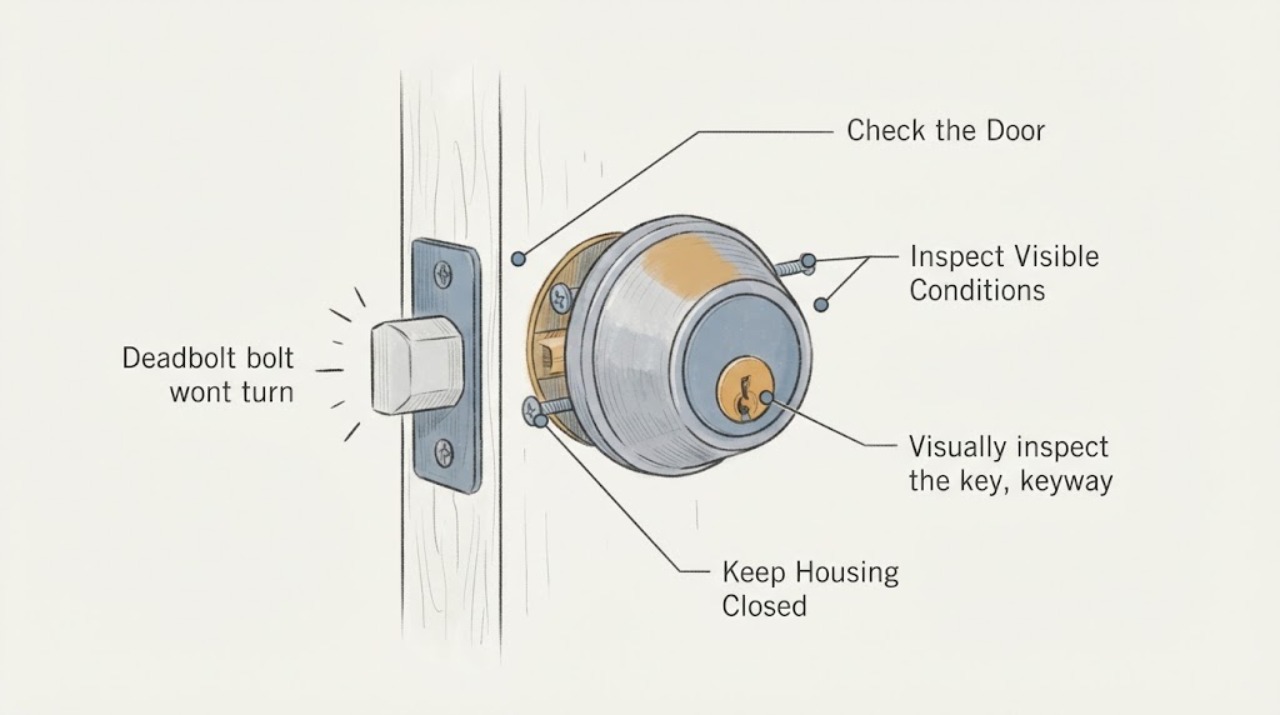
Work through in order
Diagnostic checks
Use only checks that match the exact appliance or system and its official guide.
-
Check 1
On an authorized lock, with the door open and a safe alternate exit available, gently try the key or interior thumbturn through its normal range without adding force or repeatedly cycling it.
Expected result: Note whether the bolt extends and retracts smoothly, moves only partway, or does not move while the key or thumbturn turns.
Next step: Stop the check, record the result, and use the manufacturer or qualified locksmith route; do not remove the cylinder, cover, or lock body.
Stop if: Stop immediately if the key bends, binds, requires force, the thumbturn jams, or the door cannot remain safely controlled.
Why this matters
Why: Smooth movement with the door open suggests the closed-door alignment may be loading the bolt; failure with the door open points more toward the lock, key, or internal mechanism.
-
Check 2
With the door closed only if it is already safely controlled, observe the gap between the door edge, bolt face, strike plate, and frame without pushing, pulling, lifting, or forcing the door.
Expected result: Look for the bolt touching the strike edge, an uneven door gap, a visibly shifted strike, sagging hinges, swelling, or weatherstrip pressure.
Next step: Photograph the visible alignment and provide it to a locksmith or hardware manufacturer; do not enlarge the strike pocket, chisel, drill, or remove the strike plate.
Stop if: Stop if the door needs pressure to close, the frame is cracked or moving, or the bolt or strike looks loose.
Why this matters
Why: A difference from the open-door result or visible contact supports an alignment or frame-load problem, but it does not establish which adjustment is safe for this door.
-
Check 3
Visually inspect the key, keyway opening, exposed bolt face, and strike area for obvious dirt, foreign material, damage, or a key that is not the correct authorized key; do not insert tools or liquids into the lock.
Expected result: Record whether the key is bent or damaged, the keyway is visibly obstructed, or the bolt face and strike show burrs, impact, paint, or corrosion.
Next step: Keep the lock in its current safe state and provide clear photos and the lock brand or model if visible to the manufacturer or locksmith.
Stop if: Stop if the key is stuck, breaks, the cylinder is damaged, or the lock appears tampered with.
Why this matters
Why: A visible condition may explain resistance, but probing, spraying, or scraping can worsen the lock or conceal a failure that needs a locksmith.
-
Check 4
For an electronic deadbolt, observe the exterior indicator, keypad response, app status, and any battery or bolt-jam message without removing the cover or battery pack.
Expected result: Note whether the control responds normally, reports a jam or low-power condition, or shows no response while the mechanical door position remains unchanged.
Next step: Save the exact message and contact the manufacturer or qualified locksmith; do not factory-reset, disassemble, or bypass the lock while access is uncertain.
Stop if: Stop if the lock emits abnormal sounds, heats, sparks, repeatedly alarms, or cannot secure the door.
Why this matters
Why: An electronic alert can point to power, alignment, or lock-state service needs, but the exact procedure is model-specific and may involve protected components.
-
Check 5
Confirm the lawful service handoff by recording the lock brand and model visible from outside, the door state, the open-versus-closed result, and whether anyone is locked in or unable to exit safely.
Expected result: Identify whether the immediate issue is a repairable alignment observation, a lock mechanism failure, a security concern, or an urgent access and safety problem.
Next step: Arrange qualified service and keep an authorized alternate access route available until the lock is confirmed secure.
Stop if: Stop all troubleshooting for a life-safety concern, a trapped occupant, an unsecured exterior door, or any request to bypass or defeat the lock.
Why this matters
Why: A locksmith or manufacturer can use these facts to select a non-destructive service path; a stuck bolt should not be treated as an invitation to force entry.
Use your observations
Decision map
Find the observation that best matches what you see, then follow the next safe action.
-
PATH 01Next step
What you see
The bolt moves with the door open but binds only when the door is closed.
Do this next
Treat this as an alignment or frame-load clue and have a qualified locksmith assess the strike, hinges, door, and frame; do not modify the opening yourself.
-
PATH 02Next step
What you see
The bolt will not move even with the authorized door open, or the key turns without moving the bolt.
Do this next
Stop forceful attempts and contact the manufacturer or a qualified locksmith for cylinder, bolt, or internal-mechanism diagnosis.
-
PATH 03Next step
What you see
The key is stuck, damaged, or the lock shows tampering or physical damage.
Do this next
Do not extract, drill, pick, or dismantle the lock. Keep the door controlled and request qualified service.
-
PATH 04Next step
What you see
The door cannot be secured, a person cannot exit safely, or there is an immediate safety concern.
Do this next
Stop troubleshooting and use lawful emergency or professional help appropriate to the situation; do not attempt bypass or forced entry.
Helpful context
Understand the symptom
What the open-versus-closed check tells you
A deadbolt can move smoothly with the door open yet bind when the door is closed because the bolt and strike or frame are no longer aligned. If it will not move even with the door open, the key, cylinder, internal mechanism, electronic drive, or bolt may need professional attention. These observations help a locksmith choose a safe next step; they are not permission to force or dismantle the lock.
Protect the door and access
Use this guidance only for a lock and property you own or are authorized to manage. Keep an alternate lawful entry available if possible. Do not let a stuck bolt turn into a forced-entry attempt, and do not leave a door unsecured while experimenting with hardware.
Only after diagnosis
Potential parts
- deadbolt-replacement
Consider replacement only after the manufacturer or qualified locksmith confirms that the lock mechanism is defective and replacement is safer than adjustment or repair.
Confirm the lock type, door preparation, finish, security requirements, and exact fit before ordering; a generic deadbolt is not assumed compatible. - lock-lubricant
Consider a lubricant only if the lock manufacturer or locksmith specifically identifies lubrication as appropriate for this lock and condition.
Do not spray or pour a product into the keyway based on a generic recommendation; product and cylinder requirements vary. - strike-plate
Consider a strike only if a qualified professional confirms that the existing strike is damaged or incompatible after checking the door and frame alignment.
Verify the exact lock family, frame condition, security hardware, and manufacturer fit; do not enlarge or alter the frame opening yourself.
When checks do not resolve it
Need a professional?
Contact the lock manufacturer or a qualified locksmith when the bolt will not turn after a gentle authorized open-door observation, when the key is stuck or damaged, or whenever the door cannot be secured. Use urgent lawful help for a life-safety or trapped-occupant situation.
Safety scope: Use only external observations on an authorized lock. Do not force the key or thumbturn, bypass or pick the lock, drill or chisel, remove the lock while access is uncertain, open electronic covers, or modify the door or frame.
Have this ready
- Provide the lock brand and model if visible, whether it is mechanical or electronic, the open-versus-closed result, visible alignment or damage, exact electronic message if any, and the current door and access state.
Common questions
FAQ
Why does the deadbolt turn with the door open but not when it is closed?
That pattern often points to contact or load between the bolt and the strike or frame, but the door, hinges, weatherstrip, and lock can all contribute. Have a qualified locksmith assess alignment rather than modifying the opening yourself.
Should I force the key or thumbturn?
No. Stop at the first resistance. Force can bend or break the key, damage the cylinder, or leave the door unsecured.
Can I drill or pick the deadbolt if it will not turn?
No. Do not bypass, pick, drill, chisel, or force a lock. Use lawful manufacturer or qualified locksmith service, with emergency help if a person cannot exit safely.
Can I replace the strike plate or deadbolt immediately?
Not based on the symptom alone. A replacement must match the lock and door preparation, and the underlying frame or alignment issue may remain. Have the condition identified first.
Read the exact guide
Official sources
- How to install a deadbolt lockSchlage · Official manufacturer guidance used only for the general diagnostic distinction between open-door bolt movement and closed-door strike alignment; the article does not reproduce its installation or frame-modification procedures.
- Latch Issues SupportKwikset · Official manufacturer support used for general examples of alignment, frame clearance, electronic status, and escalation differences; exact models and procedures vary, and no disassembly steps are provided here.
Community feedback
Share a repair observation
Share a plain-text repair observation. Accepted observations are published automatically; this page may take a moment to update.