
On this page
Start here
Quick answer
A lost deadbolt key is a security and access problem, not a reason to defeat the lock yourself. From a safe position, confirm that you own or are authorized to secure the property, record the deadbolt's visible brand and hardware details, and determine whether the key may have been lost, stolen, or left with someone who should no longer have access. Keep a safe alternate entrance available if possible. A qualified locksmith or the lock manufacturer can determine whether the cylinder can be rekeyed or whether the deadbolt should be replaced. Do not disassemble the lock, manipulate the cylinder, damage the door, or attempt an improvised entry method.
Before you begin
Safety first
- Do not disassemble the lock or door, manipulate the cylinder, defeat the lock, damage the hardware, or attempt an improvised entry method.
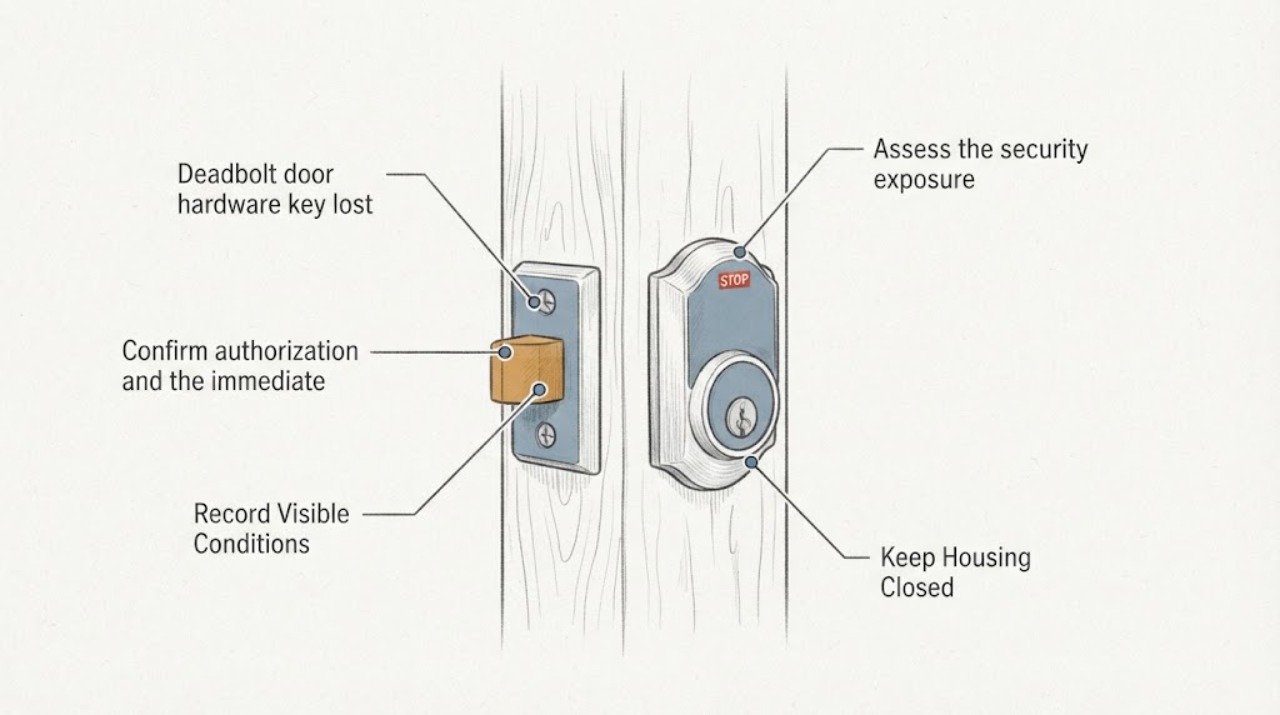
Work through in order
Diagnostic checks
Use only checks that match the exact appliance or system and its official guide.
-
Confirm authorization and the immediate access situation
From a safe location, confirm that you own, rent, manage, or are otherwise authorized to control the property, and note whether an authorized alternate entrance is available without touching the deadbolt.
Expected result: The property may be your residence, a managed or rented property, a shared building, or a location where ownership or permission is unclear; the door may be open, closed, or inaccessible.
Next step: If authorization is clear, preserve the alternate access and contact a qualified locksmith or the manufacturer's support route. If authorization is unclear, contact the owner or manager first.
Stop if: Stop all lock work if authorization cannot be established or if a person, child, animal, or medical need creates an emergency; use the appropriate emergency channel.
Why this matters
Why: The person who can approve lock work may be a property owner, landlord, building manager, or other authorized party. An inaccessible door requires a professional access plan, not an improvised method.
-
Record visible deadbolt identity without opening it
From the accessible side, photograph or write down the visible brand mark, model or product label, finish, keypad or cylinder style, and any information already present on the door hardware without removing covers or touching the cylinder internals.
Expected result: The lock may be a recognizable manufacturer's deadbolt, a keypad or electronic deadbolt with a physical key cylinder, an unmarked older lock, or part of a matching set.
Next step: Send the visible identity and clear photos to the qualified locksmith or manufacturer support channel and ask what information they need for an authorized rekey or replacement assessment.
Stop if: Do not remove the deadbolt, cylinder, trim, strike, screws, or batteries to find a hidden label.
Why this matters
Why: Identity and lock type help the professional determine whether a manufacturer-supported rekey path exists or whether replacement is more appropriate; similar-looking hardware is not proof of interchangeability.
-
Assess the security exposure from the missing key
Make a private record of where the key was last controlled and whether it may have been stolen, copied, attached to an address or identifying item, retained by a former occupant, or held by someone whose access should end.
Expected result: The key may be safely misplaced with no identifying information, unreturned by a former occupant or service provider, or potentially available to an unknown person.
Next step: Tell the locksmith or property owner the exposure category and identify any other locks that may share the key so they can decide whether to rekey or replace the affected hardware.
Stop if: Do not publish personal details, confront a suspected key holder, or continue using an exposed key as the security plan.
Why this matters
Why: A credible loss or unauthorized possession means the old key should no longer be treated as trusted, even if the door still locks. The scope may include other deadbolts that share the same key.
-
Observe the door and deadbolt condition only from an authorized side
If you are already inside with authorized access and the door is safe to handle normally, look at the strike area, door/frame alignment, visible bolt condition, and whether the door closes without binding; do not turn a locked cylinder or remove hardware.
Expected result: The door may appear aligned and undamaged, show a loose or damaged strike or trim, bind against the frame, or be unavailable for this observation.
Next step: Give the condition and door state to the locksmith and let them choose the safe, authorized service method.
Stop if: Do not force the bolt, pry the door, drill, remove the door, or test an inaccessible lock with improvised tools.
Why this matters
Why: A damaged or binding door may require door-hardware service in addition to key security work; a normal-looking door does not determine whether the lost key has compromised access.
-
Check whether the lock is part of a wider key system
Review existing records and visually compare other authorized exterior locks to determine whether the lost key was used for multiple doors, a garage, a common entrance, or a master-keyed system; do not remove any cylinders to compare them.
Expected result: The deadbolt may be standalone, keyed alike with other household locks, or part of a managed building or restricted key system.
Next step: Provide the list of potentially affected openings and the authorization contact to the locksmith or property manager before approving work.
Stop if: Stop if the system is a restricted, shared, or managed key system and wait for the responsible owner or manager's instructions.
Why this matters
Why: The professional may need to secure more than one opening or coordinate with the property manager; replacing only one visible lock may leave another opening exposed.
Use your observations
Decision map
Find the observation that best matches what you see, then follow the next safe action.
-
PATH 01Safety boundary
What you see
If the key may be stolen, copied, attached to identifying information, or held by an unauthorized person
Do this next
Treat the deadbolt as security-exposed and arrange an authorized locksmith assessment for rekeying or replacement; include any other openings that used the same key.
Why this path and its safety boundary
Safety stop: Do not rely on finding the key later or confront a suspected key holder.
-
PATH 02Safety boundary
What you see
If the key is merely misplaced and the property is secure with an alternate authorized entrance
Do this next
Keep the door and property secure, document the lock identity, and schedule a qualified locksmith or manufacturer-supported assessment rather than attempting to manipulate the cylinder.
Why this path and its safety boundary
Safety stop: Do not treat a temporary spare or borrowed key as a permanent security decision without authorization.
-
PATH 03Safety boundary
What you see
If the deadbolt is part of a keyed-alike, master-keyed, rental, or managed building system
Do this next
Contact the property owner or manager and give the locksmith the system context so the affected openings can be handled under the approved key plan.
Why this path and its safety boundary
Safety stop: Do not replace or rekey shared hardware without the responsible party's approval.
-
PATH 04Safety boundary
What you see
If the door is closed and no authorized alternate access is available
Do this next
Use a qualified locksmith or the property manager's authorized emergency access route and be ready to verify identity and authorization.
Why this path and its safety boundary
Safety stop: Do not attempt bypass, picking, drilling, prying, forced entry, or other destructive methods.
-
PATH 05Safety boundary
What you see
If the door, frame, strike, or deadbolt is visibly damaged or binds from the authorized side
Do this next
Tell the locksmith that door-hardware inspection is also needed; do not assume a new key or cylinder alone will correct the door condition.
Why this path and its safety boundary
Safety stop: Do not force the door or operate a damaged lock repeatedly.
Helpful context
Understand the symptom
Treat the missing key as a security decision
A key that is merely misplaced and a key that may be stolen create different security concerns. The right remedy also depends on whether the deadbolt is a keyed mechanical lock, a keypad or electronic model with a physical cylinder, part of a keyed-alike group, or controlled by a landlord, building manager, or other owner. The visible observations below help a professional choose between rekeying, replacement, or an authorized manufacturer route.
Preserve safe access while you arrange help
Use an already authorized alternate entrance or ask the property owner or manager for the approved access plan. Do not leave the door unsecured, share a borrowed key without verifying authorization, or attempt to defeat the deadbolt. If a person, child, or animal is in immediate danger, use emergency services rather than trying to work on the lock.
What a locksmith will need to know
Give the locksmith the property relationship, whether the key may be in someone else's hands, the door location, the visible brand or model, whether other doors share the key, and whether the door is currently open or closed. A clear account of these facts lets the professional plan an authorized rekey or replacement without relying on unsafe assumptions.
Only after diagnosis
Potential parts
- rekeyable deadbolt
Consider this only if the lock type and key system support rekeying and an authorized locksmith or manufacturer confirms the correct route after a key loss.
Match the exact lock brand, cylinder family, door preparation, and key system; a similar exterior style is not proof of fit or security compatibility. - deadbolt replacement
Consider replacement only if the cylinder cannot be appropriately rekeyed, the hardware is damaged, or the owner and locksmith choose replacement for the security situation.
Confirm door thickness, backset, handing, cylinder type, and authorized keying requirements with the model information before ordering.
When checks do not resolve it
Need a professional?
Contact a qualified locksmith or the lock manufacturer's authorized support route as soon as a deadbolt key is lost, especially if the key may be stolen, identifying information was attached, the door is inaccessible, or other locks share the key. A property owner or manager must approve work on managed or rented property.
Safety scope: Do not disassemble the lock or door, manipulate the cylinder, defeat the lock, damage the hardware, or attempt an improvised entry method.
Have this ready
- proof of ownership or authorization
- door state and any safe alternate access
- visible lock brand, model, and cylinder or keypad style
- whether the key may be stolen, copied, or unreturned
- other openings that may share the lost key
- visible door, frame, strike, or bolt condition
Common questions
FAQ
Should I rekey or replace a deadbolt after losing a key?
A qualified locksmith or authorized manufacturer route should decide after confirming the lock family, key exposure, door condition, and whether other openings share the key. Rekeying may be suitable for some locks; replacement may be chosen for damage, compatibility, or a broader security upgrade.
Can I make a new key from the deadbolt without the old key?
Do not disassemble or manipulate the lock to do this yourself. Give the visible lock identity and authorization information to a qualified locksmith or the manufacturer so they can use an approved route.
What if the lost key had my address on it?
Treat the lock as security-exposed and arrange prompt rekeying or replacement through an authorized locksmith or property manager. Include every opening that may use the same key.
What should I do if I am locked out?
Use an authorized alternate entrance if available or contact a qualified locksmith or property manager and be ready to verify authorization. Do not try to defeat, damage, or force the lock.
Read the exact guide
Official sources
- Schlage Advanced RekeySchlage · Use only to show that rekey options depend on the exact lock family and that a lost current key can require a builder or locksmith route; do not use its interactive instructions in this article.
- How To Avoid a ScamFederal Trade Commission · Use when choosing or verifying a locksmith contact; confirm the provider through a trusted official source and do not act under unexplained pressure.
- When you should rekey your exterior deadbolts and locksSchlage · Use for the security implication of lost or stolen keys and the choice between rekeying and replacing exterior deadbolts; it does not authorize bypass or self-entry methods.
Community feedback
Share a repair observation
Share a plain-text repair observation. Accepted observations are published automatically; this page may take a moment to update.