
On this page
Start here
Quick answer
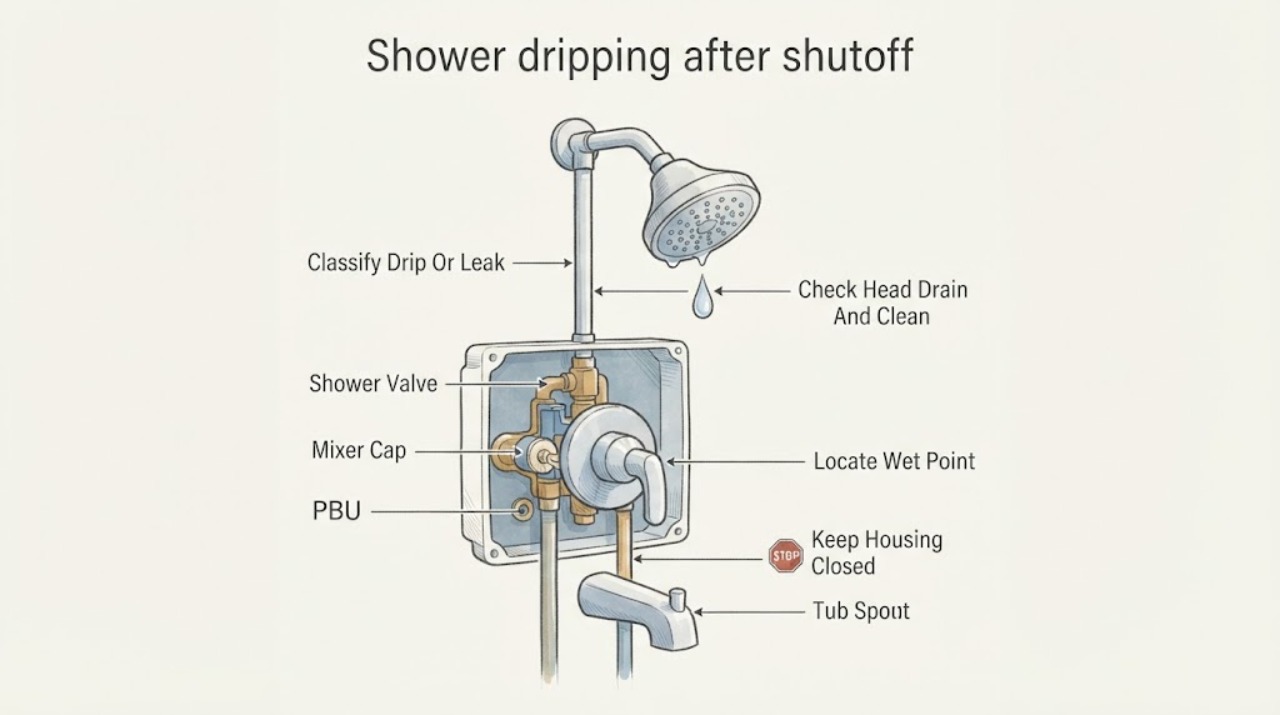
First distinguish a short drain-down from a continuing leak. Kohler says water retained in a showerhead may drip after a Rite-Temp valve is turned off, and changes in household water pressure can briefly add drips; a continuous flow or a drip that does not settle points to a different problem. With the control off, dry and observe the spray holes, showerhead connection, handle or trim, tub spout, and visible wall or ceiling. A showerhead that stops dripping when separated from the arm suggests retained head water, while a drip that continues can indicate an internal valve seal or tear. Clean only accessible showerhead spray holes or screen parts when the exact guide permits it. If the drip persists, Kohler's valve guidance points to model-specific internal service such as a mixer cap, pressure-balancing unit, or other cartridge-related parts. Do not guess a part or dismantle a pressurized valve; stop shower use and call a licensed plumber for hidden moisture, growing flow, a failed shutoff, hot-water risk, or any work beyond safe observation and model-supported surface cleaning.
Before you begin
Safety first
- Owner checks are limited to distinguishing retained head water from continuing flow, observing accessible locations, gently cleaning spray holes or a permitted screen, recording model and behavior, and using a known safe shutoff without force. A licensed plumber should handle valve disassembly, mixer-cap or pressure-balancing-unit diagnosis, concealed leaks, stuck or ineffective shutoffs, pressure or piping changes, hot-water risks, wall opening, and pressurized plumbing repair.
Work through in order
Diagnostic checks
Use only checks that match the exact appliance or system and its official guide.
-
Check 1
Turn the Kohler shower control fully off, dry the visible outlets, and observe the showerhead and tub spout without running another fixture. Note whether the water arrives as separated drops or as a continuous flow, and whether it stops on its own.
Expected result: Only a few separated drops occur and stop, drops continue repeatedly, or water flows without a pause.
Next step: Monitor a brief isolated drip once. For continuing drops or flow, identify the wet point and keep the shower out of service until the cause is evaluated.
Stop if: Stop immediately for a growing stream, flooding, a wet wall or ceiling, water near electrical equipment, or an inability to isolate water safely.
Why this matters
Why: Kohler treats separated drops as a drip and notes that retained showerhead water can drain briefly. Continuous flow or persistent drops are more consistent with a valve, internal seal, connection, diverter, or concealed leak.
-
Check 2
With the control off, dry and watch the spray holes, showerhead-to-arm joint, head body, handle or escutcheon, tub spout, and any visible wall or ceiling below. Do not remove trim or open the wall.
Expected result: Only the spray holes drip, the connection or seam wets, the handle or trim wets, the tub spout drips, or hidden moisture appears.
Next step: Use only the accessible head-care check for a clean spray-hole source. For handle, trim, tub-spout, or hidden moisture, limit water use and arrange model-specific plumbing diagnosis.
Stop if: Stop for water escaping into a wall or ceiling, loose or damaged trim, a moving valve, electrical proximity, or any uncontrolled leak.
Why this matters
Why: Spray-hole-only water can be retained head water or a valve path. A joint or seam points toward the head or seal. Handle, trim, and tub-spout symptoms point more toward valve or diverter service. Hidden moisture may indicate concealed damage.
-
Check 3
If water is limited to the showerhead and the exact Kohler care guide permits it, gently rub accessible spray holes with a finger or soft cloth and allow the head to drain. Do not remove the flow control or use abrasive cleaners; do not dismantle the in-wall valve.
Expected result: The head drains and stops, mineral residue is visible, the spray improves but the off-state drip remains, or the head body seam leaks.
Next step: Recheck once with the control off. If dripping persists, the seam remains wet, or the installed head's guide does not support the check, stop and arrange manufacturer or plumber service.
Stop if: Stop for a cracked head, damaged connection, chemical or abrasive exposure, hot-water splash, or any need to use force or remove an unspecified component.
Why this matters
Why: A clean head that stops dripping supports retained water or a surface-flow issue. Improved spray does not prove the valve is sealing. A body-seam leak is a head problem, not a reason to open the valve.
-
Check 4
If a tub spout and showerhead are installed, and the head connection is accessible without force, use the exact Kohler instructions to determine whether the drip stops when the head is separated from the arm; do not attempt this when the connection is seized, the wall or arm moves, or the leak is hidden.
Expected result: The drip stops with the head separated, continues from the arm, or the connection cannot be safely separated.
Next step: For retained head water, follow head-care guidance. For continued arm flow or an unsafe connection, keep the shower off and call a licensed plumber; do not force the joint.
Stop if: Stop for a stuck connection, movement at the wall, damaged threads, water behind the flange, or any need for heat, penetrating chemicals, or excessive torque.
Why this matters
Why: Stopping supports retained water in the head. Continuing from the arm points toward the valve or supply path. An unsafe connection leaves the source unresolved and risks damaging the arm or wall.
-
Check 5
Record the Kohler product or valve model from an already visible marking, paperwork, or the product record. Compare the handle count and symptom with Kohler's valve guidance and cartridge-size information; do not remove trim just to identify it.
Expected result: The exact model is known, only a broad valve family is known, or the model and cartridge size are unknown.
Next step: Give the model and wet point to Kohler support or a licensed plumber. Verify the exact model, valve family, cartridge size, and current instructions before any part is ordered or installed.
Stop if: Stop if identification requires dismantling the valve, the marking is missing, or a proposed replacement is based only on appearance.
Why this matters
Why: Kohler documents different valve families and cartridge sizes, and the correct internal service part depends on the installed product. A visually similar part is not evidence of compatibility.
-
Check 6
For a persistent drip, stop using the shower and, only if there is a known accessible shutoff that turns normally without force or hot-water exposure, close it. Record whether flow stops, then document timing, wet point, model, recurrence, and any wall or ceiling moisture.
Expected result: The flow stops, the shutoff does not fully stop it, the shutoff is inaccessible or stuck, or moisture continues behind the wall or below the shower.
Next step: Keep the shower out of service and call a licensed plumber. Provide the model, symptom record, photos of visible conditions, and whether the shutoff isolated the flow; do not remove valve parts or open the wall.
Stop if: Stop for a stuck shutoff, uncontrolled flow, hot-water burn risk, flooding, water near electrical equipment, or any sign of structural damage.
Why this matters
Why: A safe isolated supply can limit damage while service is arranged. An ineffective or unsafe shutoff leaves pressure and requires a plumber. Continuing hidden moisture suggests concealed repair rather than head cleaning.
Use your observations
Decision map
Find the observation that best matches what you see, then follow the next safe action.
-
PATH 01Next step
What you see
Only the showerhead spray holes produce separated drops after shutoff, the drops stop, and the handle, tub spout, wall, and ceiling stay dry.
Do this next
Monitor after normal use and follow the exact head guide for gentle draining or spray-hole care. Reassess if the drip becomes continuous, lasts unusually long, or recurs with another wet point.
-
PATH 02Next step
What you see
The showerhead continues to drip after residual water should have drained, and separating the accessible head from the arm does not stop water from the arm.
Do this next
Identify the Kohler valve model and arrange a qualified inspection. Do not guess a cartridge, remove a cap, or work on the valve under pressure.
-
PATH 03Next step
What you see
Water appears at the head-to-arm connection or escapes from the showerhead body seam, especially while the shower is running.
Do this next
Use only the exact Kohler head-care instructions for accessible cleaning and inspection. Do not over-tighten, apply improvised sealant, or open the wall; replace or service the head only after compatibility is confirmed.
-
PATH 04Next step
What you see
The handle, escutcheon, or tub spout drips or wets while the control is off, while the showerhead is dry.
Do this next
Stop repeated control cycling, record the model and handle type, and have a licensed plumber diagnose and select compatible parts.
-
PATH 05Next step
What you see
Water continues or appears at both the tub spout and showerhead after shutoff, or the timing changes with pressure, tubing, or another outlet, without visible trim or wall leakage.
Do this next
Do not alter piping, stops, pressure regulators, or diverter parts as a guess. Provide the valve model and symptom pattern to a licensed plumber for installation and pressure diagnosis.
-
PATH 06Next step
What you see
Water appears behind the trim, in a wall or ceiling below, the flow is increasing, or the supply shutoff is stuck, inaccessible, or ineffective.
Do this next
Stop shower use, isolate water only through a safe working shutoff, protect the area, and call a licensed plumber promptly. Do not open the wall or seal over the symptom.
Helpful context
Understand the symptom
A few residual drops are not the same as a continuous leak
Kohler defines a drip as separated individual drops and a leak as continuous flow. Its Rite-Temp guidance says retained water can drain from a showerhead for a short period after shutoff, and pressure changes can affect brief dripping. A showerhead that continues to drip, a steady stream, or water from the handle, tub spout, or wall should be treated as a diagnostic problem rather than dismissed as normal drain-down.
Find the wet point before blaming the valve
Dry the visible showerhead, head-to-arm connection, handle or escutcheon, and tub spout with a towel, then watch with the control off. If the showerhead is the only wet point, retained water or an internal valve path are possibilities. A connection or body seam suggests the showerhead or its seal. Handle, trim, tub-spout, or wall moisture requires valve, diverter, connection, or concealed-piping evaluation. Do not open a wall or remove valve trim merely to confirm the source.
Use model-supported showerhead care only
Kohler's showerhead guide allows gently rubbing accessible spray holes to dislodge mineral buildup and, for that guide's products, cleaning the screen washer while warning not to remove the flow control. A showerhead may also be tilted to drain retained water when its instructions allow it. These are surface-care checks, not a substitute for diagnosing a valve that continues to pass water when off. Follow the exact guide for the installed head and avoid abrasive cleaners, force, and improvised disassembly.
Kohler valve designs and parts are not interchangeable by appearance
Kohler's Rite-Temp page is specific to single-control valves and describes internal seal or tear issues, mixer-cap and pressure-balancing-unit service, and installation-related back pressure. Kohler also documents delayed flow when certain tubing arrangements cool after shutoff. These possibilities can look similar from the shower floor, so identify the valve and product model before choosing a cartridge, cap, pressure-balancing unit, seal, or trim part.
Keep pressurized and concealed work with a qualified professional
A persistent off-state drip can require opening the control and isolating hot and cold supplies. Do not remove a handle, mixer cap, pressure-balancing unit, cartridge, or valve body under pressure, and do not adjust stops or plumbing based on a generic video. A stuck or ineffective shutoff, hot-water exposure, water behind the wall, or damage below the shower makes the risk higher. Keep the shower out of service and call a licensed plumber when the safe surface checks do not identify a simple residual-drain explanation.
Safety boundary
Stop conditions
- Stop immediately for a wet wall or ceiling, rapidly increasing flow, flooding, water near electrical equipment, hot-water burn risk, or a failed supply shutoff; limit water use and obtain qualified help.
- Do not remove a Kohler handle, mixer cap, pressure-balancing unit, cartridge, or valve body under pressure. Do not alter stops, piping, pressure regulators, or diverters based on a generic diagnosis.
- Do not order or install a cartridge, cap, pressure-balancing unit, seal, screen, or trim part by appearance or by the Kohler brand alone. Confirm the exact model, valve family, cartridge size, and current installation instructions first.
- Do not force a stuck showerhead connection, use heat or abrasive chemicals, remove a flow control not covered by the guide, open a wall, or caulk over hidden moisture. Stop after safe observation and model-supported surface care; persistent or recurring dripping needs qualified diagnosis.
Only after diagnosis
Potential parts
- Kohler Rite-Temp mixer cap and pressure-balancing unit kit
Relevant only when a confirmed single-control Rite-Temp valve has persistent dripping after residual head water is ruled out and Kohler's model-specific guidance identifies this internal service.
Confirm the exact valve model, revision, installation, seals, and current Kohler instructions; do not open the valve under pressure or assume a kit fits another Kohler family. - Kohler shower valve cartridge
Relevant only when the installed valve family and internal leak diagnosis call for a cartridge rather than retained head water or an external connection repair.
Verify exact model, valve family, cartridge size, orientation, and installation guide. Kohler documents different common cartridge sizes; brand or appearance alone is insufficient. - showerhead screen washer or gasket
Relevant only when the leak is at an accessible head connection and inspection confirms a damaged or obstructed screen or seal under the exact care guide.
Match the exact showerhead, screen orientation, seal dimensions, and connection instructions; do not remove a flow control or over-tighten the arm. - Kohler showerhead
Relevant only when the head body seam or selector remains defective after permitted cleaning and Kohler or a plumber confirms replacement.
Confirm connection, flow specification, finish, model, and warranty details; replacing the head does not repair an in-wall valve leak. - Kohler valve seal or service pack
Relevant only when a qualified inspection identifies worn internal seals in the exact valve family and the manufacturer's instructions support that service.
Match the exact valve, seal arrangement, and current service instructions; do not substitute generic seals or conceal a behind-wall leak with trim sealant.
When checks do not resolve it
Need a professional?
Call a licensed plumber when the drip persists after residual water has drained, the handle, trim, tub spout, wall, or ceiling is wet, the leak recurs, the model or part compatibility is uncertain, the shutoff is ineffective, or any flooding, hot-water, structural, or electrical hazard is present.
Safety scope: Owner checks are limited to distinguishing retained head water from continuing flow, observing accessible locations, gently cleaning spray holes or a permitted screen, recording model and behavior, and using a known safe shutoff without force. A licensed plumber should handle valve disassembly, mixer-cap or pressure-balancing-unit diagnosis, concealed leaks, stuck or ineffective shutoffs, pressure or piping changes, hot-water risks, wall opening, and pressurized plumbing repair.
Have this ready
- Provide the Kohler model or visible product marking, valve handle count and family if known, exact wet point, drop-versus-stream behavior, duration after shutoff, whether the accessible head was cleaned or separated, recurrence, photos of visible conditions, any hidden moisture, and whether a safe shutoff stopped the flow. Do not remove trim or open the wall to collect information.
Common questions
FAQ
Is a Kohler showerhead dripping after shutoff always a bad valve?
No. Kohler says retained water can drain from a showerhead for a short period after shutoff. A continuous flow, persistent drops, or water from the handle, tub spout, or wall points toward a valve, connection, diverter, or concealed leak.
How can I tell a drip from a leak on a Kohler shower?
Kohler describes a drip as separated drops with space between them and a leak as continuous flow. Observe the dry outlet with the control off. A pattern that does not settle, becomes a stream, or appears elsewhere needs service.
Why does my Kohler shower keep dripping from the head when it is off?
It may be residual water, especially if the drops stop. If the drip continues, Kohler identifies possible internal seal or valve-component problems and recommends identifying the installed valve before selecting a repair.
Can I tilt my Kohler showerhead to stop dripping?
Some Kohler showerhead guides say to tilt the head to drain retained water after use. Follow the exact guide for your model, and do not treat this as a repair for a drip that continues from the arm, valve, handle, tub spout, or wall.
Can cleaning the Kohler showerhead fix the drip?
Gentle cleaning of permitted spray holes or a screen may address mineral buildup or head flow. It will not reliably repair a valve that passes water when off or a leaking head seam. Do not remove an unspecified flow-control part.
Should I replace the Kohler mixer cap or pressure-balancing unit myself?
Only a qualified person with the exact valve instructions and a reliable water shutoff should consider valve-internal work. Do not open a pressurized valve or guess the kit. Kohler's Rite-Temp guidance is specific to particular valve arrangements.
Why do the Kohler showerhead and tub spout both drip?
Kohler describes possible back pressure, outlet-pipe or tubing arrangements, valve components, and a permissible diverter-related drip in some setups. The pattern is not safely solved by changing pressure or piping as a guess; provide the model and have a plumber diagnose it.
What if the Kohler handle or tub spout leaks after shutoff?
That is not just retained water in the showerhead. It can indicate an internal valve, seal, stem, diverter, or trim issue. Stop repeated cycling, record the model and wet point, and arrange model-specific service.
How do I choose the correct Kohler shower cartridge?
Use the exact product or valve model and Kohler's current service information. Kohler documents more than one common cartridge size, so a part that looks similar or is marketed as a Kohler replacement is not enough to confirm compatibility.
When is a Kohler shower drip urgent?
Treat it as urgent when flow is increasing, water reaches a wall, ceiling, floor cavity, or electrical equipment, the supply shutoff fails, or hot water creates a burn risk. Stop using the shower, limit water safely, and call a licensed plumber.
Read the exact guide
Official sources
- Valves (Shower & Bath)Kohler · Kohler's official valve support index confirms separate troubleshooting paths for Rite-Temp dripping and delayed-flow or back-pressure symptoms, so the valve family and symptom pattern matter.
- Delayed Flow, Dripping or Back Pressure from Shower Head and/or Tub SpoutKohler · Kohler's valve guidance on tubing and outlet arrangements that can produce delayed flow or water from both the showerhead and tub spout after shutoff.
- Rite-Temp Valve Dripping from Showerhead or SpoutKohler · Kohler Assist guidance distinguishing drops from continuous leaks, residual showerhead water from continued valve flow, and model-specific valve or installation causes.
- Determine 1/2" or 3/4" Valve Cartridge SizeKohler · Kohler Assist page showing that common valve cartridge sizes differ and identification depends on the installed valve and retaining-pin details.
- Installation and Care GuideKohler · Official Kohler showerhead guide used for retained-water drainage, gentle spray-hole cleaning, screen-washer care, and the warning not to remove the flow control; apply only where the installed product's guide matches.
Community feedback
Share a repair observation
Share a plain-text repair observation. Accepted observations are published automatically; this page may take a moment to update.